Showing posts with label Space Opera. Show all posts

Thursday, 21 March 2024

A Tribute To Vernor Vinge

Even if you haven't read anything that Vernor Vinge wrote, you've likely read something that was inspired by his work. He was a titan in his field and his work spoke to fans around the globe.
This blog would likely not exist
without Vernor Vinge’s novel
A Deepness In The Sky.
(Photo by Olav Rokne)


When he died yesterday, his influence could be found in almost every corner of science fiction.

Vinge began writing science fiction when he was a teenager, penning the story “Bookworm Run!” while a senior in high school in 1962. It’s a story that appeared in print four years later, about the machine-human interface and the creation of a cyborg. Interestingly, it foreshadows much of Vinge’s career.

Cyborgs had, of course, been a science fiction staple for almost four decades by the time “Bookworm Run!” was written. Up to this point, cybernetic augmentation was depicted as either improving the physical abilities of the human, or challenging their self-identity (as in “No Woman Born” by CL Moore). In contrast, and as he would do often throughout his career, Vinge tried to imagine what it would be like for a human to think better.

“I had tried a straightforward extrapolation of technology, and found myself precipitated over an abyss,” he said about the story four decades after he’d written it. “It’s a problem writers face every time we consider the creation of intelligences greater than our own.”

In an era of punch-card readers and memory measured in dozens of bits, Vinge recognized the potential of computers in a way that most of his peers did not.

He earned his PhD in computer science at the University of California San Diego in 1971, studying conformal maps (functions that locally preserve angles, but not necessarily lengths), writing a thesis on Solutions to Extremal Problems in E^p Spaces. He began teaching computer science at San Diego State University later that year, which became the focus of his academic career.

Over the decades, Vinge became known for stories about enhanced cognition through consciousness uploading (“True Names”), machine-human cooperation (The Peace War), alternate-architecture group consciousness (Amdi in Fire Upon The Deep), virally-altered brain chemistry (Deepness In The Sky), and many more.

 In 1962 when Vinge started writing about computers,
the most powerful computer on Earth was the
Atlas 2 in Manchester UK. It had a 48-bit core memory.
(Image via Chilton Computers)
These ideas of altered and elevated consciousness dovetailed nicely with another of Vinge’s other major themes: the technological singularity, or the idea that more intelligent computers will drive the creation of even faster computers until progress advances so quickly it can no longer be understood.

“Singularity is the point at which our old models will have to be discarded, where a new reality will reign,” Vinge wrote. “This is a world whose outlines will become clearer, approaching modern humanity, until this new reality obscures surrounding reality, becoming commonplace.”

One of these forays into singularitarianism helped launch an entire subgenre of science fiction. First appearing in a Dell paperback alongside George R.R. Martin’s Nightflyers, the story True Names offered a blueprint for cyberpunk that would influence and inspire everything from blockbuster movies to role playing games and television series.

Perhaps just as prescient are passages like the scene at the end of A Deepness In The Sky, when Trixia Bonsol asserts the value of neurodiversity, and the right of individuals to have differing experiences of consciousness. Bonsol is one of a number of characters whose consciousnesses become chained by the villainous Emergents; her will subsumed by neurochemical conditioning such that her brain becomes a living computer. Because her brain has become “focused” on the task that she’s best at (translation), she is no longer neurotypical.

Trixia’s decision at the end of the novel to remain focused is quietly a revolutionary act that can be read as celebrating the value, independence, and agency of those on the autism spectrum.

Vinge is often praised for his wide-ranging imagination and for exploring weird, wonderful, and unique science fictional concepts. He should also be recognized for being ahead of his time on some political matters and his centering the better natures of humanity. He was critical of South Africa’s apartheid regime when many looked the other way. And he was never as reactionary as some right-wing fans wanted him to be.

Vinge accepted the Hugo for Best Novel in
Chicago in 2000 for Deepness In The Sky.
(Image via Midamericon)
“Every anarchical scheme has some set of assumptions for why people will cooperate (you can usually spot the assumption in the names: anarcho-communism, anarcho-capitalism…),” he once wrote. “There’s a fundamental problem all such plans must face: how to prevent the formation of power groups large enough to in fact be the government.”

Vinge’s last Hugo-winning novel Rainbows End is set next year. Published in 2006, the book correctly predicted Uber-like micro-transactions, and widely-available wireless broadband, and the ability for hackers to track everyone via the signals emitted by their devices. Sadly, the ubiquitous use of augmented reality goggles, driverless cars, and a cure for Alzheimer’s all remain on the horizon.

Despite his influence, Vinge was never going to be a household name outside of the genre. His writing was inescapably fannish, he was one of us, and he will be missed. 

Tuesday, 9 August 2022

The Breakfast Club in Space

There is a long-simmering tension in science fiction that could be reductively described as being between those who prefer books that are about things happening, and those who prefer books that are about people
Becky Chambers' fourth Wayfarers
novel continues her evolution away
from high-octane thrills.
(Image via Amazon)
experiencing emotions.

On the one extreme, we could describe the cold, sterile, action-packed Asimov tales of the 1940s. On the other extreme, we could examine some ponderous elegiac late-period Aldous Huxley works.

Few authors have pivoted between these two poles as thoroughly, or as successfully as Becky Chambers has over the past eight years since her (initially self-published) debut novel took the science fiction world by storm. Likewise, few authors have been as successful in showing the importance — and the value — of both strains of science fiction’s heritage.

Nowhere is this more evident than in her flagship works, the Best Series Hugo-winning Wayfarers novels. Fascinatingly, the most recent novel in this series The Galaxy, and the Ground Within could even be read as a textual mirror to the first book in the series Long Way To A Small, Angry Planet.

Both novels feature a diverse cast of middle-class characters from a variety of alien races, and both novels celebrate diversity, understanding, and compassion. But while Long Way To A Small, Angry Planet is an action-packed romp in which things never stop happening, this latest Hugo-finalist novel is far more meditative. They are similar in so many ways, but the later book could be interpreted as a foil to the first one’s action packed — and populist — approach to storytelling.

The set-up to Galaxy, and the Ground Within is fairly simple. Five characters with wildly different backgrounds are forced to spend time together after a technical failure traps them togetherfor several days. It’s The Breakfast Club in space, and as such the narrative is driven not by a series of events, but rather by how the characters relate to one another, and how they feel and grow. Althoughthere is a rescue plot at the very end of the novel, it feels somewhat tacked on.

Five people with wildly different personalities
and problems find commonalities and empathy.
(Image via Criterion)

Chambers’ Breakfast Club analogues are blue-collar Laru, immature Tupo, popular girl Pei Tem, mysterious Roveg, and good girl Speaker. Over the course of the novel, they deal with small survival issues pertaining to the life support system, but mostly they share their backstories and learn to get past their differences and prejudices.

It often seems that the vast majority of science fiction and fantasy deals with the fate of empires, the doom of worlds, epic galaxy-spanning wars of conquest, and special unique people born to greatness … and in doing so offers stories that are less relatable because they are not human scale. The fundamental relatability of Chambers' work is its greatest strength. 

Many of the folks who yearn for action adventure like Chambers’ earlier Wayfarers novels might not be drawn in by this book, and might in fact prefer some other Hugo finalists. In fact, those who aren’t drawn in by Chambers’ writing and excellent character building, might uncharitably dismiss The Galaxy, and the Ground Within as a book in which nothing happens. But that would be a mistake; this is a truly excellent example of emotionally grounded science fiction in which the narrative questions revolve around people experiencing emotions.

Monday, 8 August 2022

Hat on a Hat

One of the first things that an aspiring improv comedian will learn is this: Never put a hat on a hat.

Basically, what this means is that when you have a strong premise, it’s usually inadvisable to distract it by layering a different premise overtop of it. To put it another way, cognitive dissonance caused by disharmonious conceptual work will distract from strong material. Point is, if you have one hat … why do you need another hat on top of it?
This is an extremely well written
book filled with great ideas.
It’s unsurprising that Ryka’s other
works have been recognized
by the Lambda Literary Awards.
(Image via Goodreads)


Despite being an exceptionally well written novel filled with likable characters, and some very interesting ideas, Light From Uncommon Stars suffers from hat-on-a-hattedness. And this may prevent it from being at the top of our Hugo ballots. It’s a novel composed of at least two fundamentally separate narratives, and those stories might have been better served by being split into separate works.

The main story arc follows Katrina, a gifted but untrained violinist, whose talent blossoms after being spotted by Shizuka Satomi, a superstar violin teacher. Saddled with a surprisingly apt nickname ‘the Queen of Hell,’ Satomi needs to claim a human soul to free herself from a deal with the devil. Taking the young violinist as a student, Satomi offers a safe harbour from an adolescence marked by horrible abuse and neglect. Twinning musical and personal growth, Katrina eventually finds her feet at an open air concert, bringing the audience to tears with a classical piece (despite her passion for videogame music). The consummate entertainer, she adapts to meet her audience with a confidence that comes from self-actualization.

The anticipation builds as the reader is left wondering when, and how, Shizuka will be remunerated for her tutelage. Will she turn Katrina over to the demon Tremon, as traditional narrative would demand, or can a different future be negotiated? As a purely fantastical tale, Light From Uncommon Stars is well written and engaging, and gives us a main character that is easy to care about and root for. It’s strengthened further by deeply researched backstories about the emotional weight of violin production and ancestral gender roles that have disadvantaged women around the globe.

Recent documentary
Donut King provided
context that helped us
enjoy the book more.
(Image via IMDB)
On its own — with no aliens or spaceships — this would have been enough. But woven into this tale is another story about entrepreneurial aliens who have to learn the hard way that their food replicators are no match for an earthling palette. On its own, this is a satisfying science fiction story filled with alien tech toys: projectors that levitate their subjects, phones that scramble English into Vietnamese, AI that can substitute offspring, and weaponry that disintegrates humans and/or their memories. And this is all packed into a completely delightful narrative concept that could easily have sustained a whole novel. Instead, it left us wanting more. 

The novel could have stood on the rock solid foundation of a beautiful girl finding her place in the world, through the mastery of musical expression and the support of a found family.

While this profusion of distractions from the main story are in most cases entertaining, on their own, our group felt they could sometimes feel like clouds that blocked the light from the star.

We wanted more Katrina.


Friday, 11 March 2022

The Hugo For Best Star Trek: Hugo Cinema 1968

This blog post is the eleventh in a series examining past winners of the Best Dramatic Presentation Hugo Award. An introductory blog post is here.  


Star Trek’s dominance of the 1968 Hugo Award Best Dramatic Presentation shortlist is as much a reflection of the quality of the show’s first and second seasons (episodes from each were eligible), as it is evidence that it was an off-year for most science fiction on screen.

As noted by contemporaneous fan writers such as Ted White and Brian Aldiss, there were an extraordinary number of exceptionally terrible science fiction films in the theatres in the preceding year:
Star Trek faced weak competition
for the Hugo Award in 1968.
(Image via Vintage Movie Posters)

exploitation flicks like Voyage to the Planet of Prehistoric Women, broad comedies like Don Knotts’ The Reluctant Astronaut, and cheaply made filler like Journey To The Centre of Time. Most of the televised science fiction was sub-par, though Doctor Who’s Second Doctor had three of his best stories with “Tomb of the Cybermen,” “The Moonbase,” and “The Web of Fear.”

In terms of foreign-language cinema, there’s few stand outs. If it weren’t for Star Trek, would Best Dramatic Presentation have recognized something like Late August In The Hotel Ozone?

While some pundits decried the fact that the entire shortlist for the 1968 Dramatic Presentation Hugo was made up of Star Trek episodes, none could offer credible alternatives to Roddenberry’s show.

“Non-Star-Trek fanciers may be annoyed to see five Star Trek episodes and nothing else on the ballot, but I’m happy enough,” Juanita Coulson wrote in Yandro.

For the most part, it’s remarkable how well the shortlist holds up. It may all be Star Trek, but there is a remarkable diversity of science fiction stories that writers were able to tell within the confines of the show’s “wagon train to the stars” format.

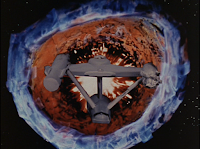
Reimagining Moby Dick by way of Fred Saberhagen’s Berzerker stories, Norman Spinrad’s episode
"Doomsday Machine" stands
the test of time as a solid
character study of obsession
and loss. 
(Image via StarTrek.com)

“Doomsday Machine” is a terrific adventure story that combines big science fiction ideas with memorable character moments. William Windom as Commodore Matt Decker is one of the all-time great guest appearances on Star Trek.

On the other end of the spectrum, “The Trouble With Tribbles” is a more lighthearted episode about an agricultural shipment, a grain-eating pest, and Cold War tensions. The dialogue in the episode is memorably sharp with quippy lines like “hauled away as garbage,” “a very little joke,” and “an ermine violin.” Some contemporaneous fans complained that the tone was too unserious, but with the benefit of hindsight, the episode holds up well.

To us, a more questionable inclusion was the Season 2 premiere “Amok Time,” a weird melodramatic episode about Spock’s return to his home planet of Vulcan. For those who haven’t seen it recently, it’s a buck-wild bit of ritual combat between Spock and Kirk as they are forced to fight over a woman. The “woman as a prize” theme should have been unacceptable in the 1960s, and certainly doesn’t hold up well today, the writing is mostly quite flat, and the depiction of Vulcans as a mystical culture that uses gongs excessively could be read as having some ugly coded subtext. This is one of the worst episodes for Kirk as a character; it’s unsettling to watch Kirk pressuring a subordinate to reveal personal info.

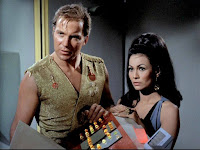
Although the ‘alternate universe’ episode has become a staple for most SFF TV shows, when Star Trek did
Kirk's visit to the darkest timeline
provided a template for all later
mirror universes on television.
(Image via StarTrek.com)

it with “Mirror Mirror,” the concept was still fresh. With the introduction of the concept to mass media television, they also hit a high water mark. The quality of Star Trek’s original cast shines through in this episode, as George Takei, Walter Koenig, and Leonard Nimoy all show why they would have been stars even if Trek had never made it to air. It must also be mentioned that guest star BarBara Luna is memorable as Lt. Marlena Moreau.

More has been written about the Hugo-winning episode, Harlan Ellison’s “City On The Edge of Forever,” than about probably any other single episode of televised science fiction. Given the weighty moral quandary (sacrificing love for the sake of history), and the solid character moments between the central trio of Spock, Kirk, and McCoy, the level of appreciation for the episode is understandable. What’s interesting is how quickly it was recognized as a classic, and immediately at the forefront of discussions of what should get the Hugo.

“City [on the Edge of Forever], which deservedly won the Hugo for best dramatic presentation, is probably the best drama, if not the best science fiction, ST has had to date, and I was happy to see it again” wrote Kay Anderson in her convention report.

What few complaints there were about a Star Trek-full category focused more on who had been left off the ballot; pundits such as Doug Lovenstem of the fanzine Arioch suggested that it was time for D.C. Fontana to win a Hugo Award (she would receive her only nomination 20 years later). Others noted the absence of “Devil in the Dark,” which is often regarded as one of Star Trek’s finest hours (and certainly better than “Amok Time”).

For our cinema club’s re-watch of these episodes, we’d all gone in expecting to agree with this consensus. But in the end, none of us were convinced that “City On The Edge of Forever” was the best episode; two of us preferred “Mirror Mirror,” one put “Doomsday Machine” at the top of their list, while another rated “Devil In The Dark” the most highly.

But at the 1968 Hugo Awards, two things were inescapable: Star Trek and Harlan Ellison. Five nominations to Star Trek, three to works penned by Ellison, and five to works that appeared in a publication edited by Ellison. In retrospect, this win seemed inevitable.

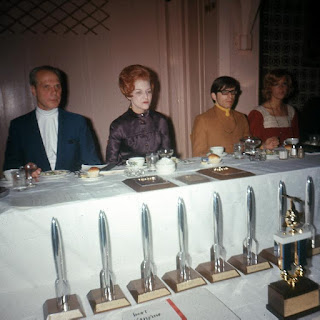
“The Hugos: Bjo doesn’t win. Dave Gerrold doesn’t win. Larry [Niven] doesn’t win. Harlan wins. There
The head table at the 1968 Hugo Awards banquet
Philip Jose Farmer, Betty Farmer, Harlan Ellison
(Image by Len & June Moffatt via Fanac.org)


is no justice in this world. I like Harlan, but there’s a limit to how many Hugos he should win,” Sandy Cohen wrote in Argus in October 1968. Ellison had ruffled his fair share of feathers throughout fandom, and it would eventually come to haunt him. But in 1968, Harlan Ellison was at the top of the SFF world, and probably his all-time most recognizable work took home the Best Dramatic Hugo.

The Best Dramatic Presentation shortlist in 1968 is a product of its time. It is likely that no SFF television show will ever have the impact that Star Trek did that year, and it is equally unlikely that there will be another year with as few viable contenders for the prize. (A clean sweep of nominations in the category has also been rendered impossible by rules changes).

In short: an odd year for the Hugos, but one where it’s difficult to argue too vehemently against the judgment of the fans.

Monday, 14 February 2022

Far From The Light Of Heaven - Review

One of Thompson’s great strengths as a writer is his ability to balance poetry and prose for a science
Far From The Light Of Heaven
balances modernity and tradition
within the science fiction genre.
(Image via Goodreads)

fiction audience, providing vividly visceral visuals that don’t slow down the narrative or distract from the characterizations. It’s a skill that’s on full display in Far From The Light Of Heaven, Thompson’s follow-up to the Wormwoood trilogy that earned him both a Clarke Award and a spot on the Hugo Award shortlist.

And what a follow up it is.

Set on an interstellar transport named The Ragtime, first mate Michelle “Shel” Campion awakens early from suspended animation to discover that thirty-odd passengers on the enormous colony ship have been killed and dismembered. Since the ship is at this point relatively close to their destination of Bloodroot, local detective Rasheed Fin is dispatched to investigate, and becomes embroiled in Shel’s attempts to keep the rest of her passengers alive despite The Ragtime’s rogue Artificial Intelligence captain’s attempts to thwart them.

Of course, a locked-room mystery on a spaceship is not a new set-up (notably implemented in Six Wakes by Mur Lafferty, which was a Hugo finalist in 2018), but the combination of Thompson’s agile pacing, worldbuilding rooted in Yoruba culture, and evocative prose make Far From The Light Of Heaven a standout. Weirdly improbable scenes such as the appearance of a wolf and flashbacks to a mining town are drawn out with convincingly detailed and precise language that manages to be both clear and evocative.
Mr. Thompson quit Twitter
earlier this year. 
(Image via The Guardian)


Thompson allows the tension to build slowly, and doesn’t play his hand too quickly, which lets the mystery provide both a compelling plot and a device with which to strategically introduce pieces of the setting to the reader. This includes themes of economic justice, leading us to believe that Thompson recognizes that imbalances of power exist across myriad cultures and that these imbalances metastasize in especially destructive ways in environments of unmitigated capitalism.

Far From The Light Of Heaven also provides some of Thompson’s best character work. As the two primary protagonists, Shel and Racheed’s disparate backgrounds and motivations lead to tensions and conflict that feel natural and believable.

Astute readers will, however, find some slight plot hiccups. An “experimental” section of the spacecraft is mentioned in passing at the beginning but only explored midway through the book even though it seems as if a place filled with dangerous life forms would be the first place any fatality investigation should start. Likewise, the fact that the richest man in all the cosmos is aboard would seem like an early lead, rather than a later one.

We might also note that the alien “Lambers” add very little to the overall narrative other than confusion about what they are. Whatever they are, and whatever their relationship to the colonists on Bloodroot, it doesn’t really affect the story.

But these are minor quibbles, Far From The Light Of Heaven is a superb book that deserves your attention.

Thursday, 30 December 2021

Best Dramatic Presentation Boldly Goes Forward (1967)

This blog post is the tenth in a series examining past winners of the Best Dramatic Presentation Hugo Award. An introductory blog post is here.  

With the benefit of hindsight, it seems only natural that Star Trek should win a Hugo Award in its first season.

The Hugo shortlist in 1967 included Fantastic Voyage,
Fahrenheit 451, The Menagerie, The Naked Time, &
The Corbomite Maneuver. (Image via IMDB)
At the time, however, this decision was not without controversy.

The Worldcon chair for 1967, Ted White, published a screed against the show calling its writers patronizing and ill-informed. Hugo-winning fan writer Alexei Panshin opined that Star Trek was filled with cliches and facile plots.

But for every voice criticizing the new show, there were several voicing their support. Big-name authors like Harlan Ellison and A.E. Van Vogt campaigned for the television series to win a Hugo, hoping that the recognition might buy it a second season. Writing in the fanzine Yandro, Juanita Coulson offered the definitive counterpoint: “The scorners of Star Trek do not seem to have an alternate dramatic piece of science fiction to offer; they usually do not like anything TV calls science fiction or fantasy.” 

It was by far the most talked about Best Dramatic Presentation ballot up to that point, with various pundits at turns praising Fahrenheit 451’s elegant direction, complaining about plot points in Fantastic Voyage, and analysing the merits of “The Corbomite Maneuver.” The quality of this debate, the resulting shortlist, and the final vote all look exceptional from the perspective of 2021; this was the year that the Hugo Award for Best Dramatic Presentation came into its own. 
In 1967, Gene Roddenberry was
one of the few Best Dramatic
Presentation winners to accept
the award in person.
(Photo by Jay Kay Klein


Considering the eligible works for this Hugo shortlist, one member of our cinema club (Paul) watched no fewer than 43 science fiction and fantasy movies that had hit cinemas in 1966, and concluded that Hugo voters could hardly have done better.

As we started watching movies and television shows from 1966, many of us had expected Fahrenheit 451, directed by François Truffaut to be the shortlist standout. However, we were surprised to find the movie had aged far more poorly than other works. Most readers will be familiar with the source material, which criticizes anti-intellectualism and post-literate culture, but this is an adaptation that does not live up to the provocative premise. The first half of the film moves at a pace that makes the Mendenhall Glacier look like quicksilver; and although the second half provides some good moments, it’s undermined by questionable choices around gender representation. That being said, Truffaut is a master of building individual shots, and some of the imagery continues to hit hard. Scenes which center the action on the television in Guy Montag’s apartment are visually arresting and prescient. The set design — both the use of existing architecture and the film’s own props — is iconic and lush. There are moments of brilliance in the movie; particularly a speech in which Captain Beatty cynically dismisses the value of books. In several other years, this might have been at the top of our ballots, but in 1967 it was outshone.

The most expensive science fiction movie to have been made up to that point, Fantastic Voyage, holds up somewhat better. Sparingly and effectively directed by Richard Fleischer, the movie follows a five-person submarine crew who are shrunk to microscopic size and injected into a scientist in order to perform life-saving brain surgery. Although far too many movies of the era over-explained their premise, Fleischer’s dialogue-free opening sequence is a masterclass in visual storytelling, showing the events that kick off the movie’s action.
A pleasure to burn perhaps, but not a pleasure to watch.
(Image via Pintrest)
It’s worth noting the quality of the visuals in Fantastic Voyage, which earned the movie two Academy Awards. Art Cruickshank’s visual effects pushed the limits of compositing technology at the time, while Jack Martin Smith and Dale Hennessy’s clean and functional design work made the secret military base setting seem real. The movie may have had a leg up on some of its competitors that year, since Isaac Asimov’s novelization of the movie had received mostly positive reviews. This might have been a very worthy Hugo winner, if it hadn’t been for the genre-defining presence of Star Trek.

From the day that Gene Roddenberry first showed “The Cage” and “Where No Man Has Gone Before” at the 1966 Worldcon in Cleveland, Star Trek had dominated discussions of science fiction. One unsigned complaint in the fanzine Algol notes “somewhat more than half of every fanzine I have seen this year was concerned with one subject and one subject alone: Star Trek.” Three episodes made the ballot in that first year: “The Menagerie,” “The Corbomite Maneuver,” and “The Naked Time.” 

“The Naked Time,” which aired first of the shortlisted episodes, is without a doubt one of the most well-remembered episodes of the original series, if for no other reason than the image of a shirtless Sulu wielding a fencing sword. The episode — which depicts a touch-transmitted disease that causes the protagonists to become disinhibited and act drunk — features some of the earliest moments of the series that show the range and depth of the characters. While “space makes people go mad” storylines were already a tired trope by the 1960s, the panache of the direction and the strong performances elevate the material. For at least one member of our viewing club, this would have been the top pick from the year.

In a slightly less-well-remembered episode, “The Corbomite Maneuver,”  the Enterprise crew is
We’d suggest that of the eligible episodes
(those that aired in 1966) both "The Conscience
of the King," and "Balance of Terror" might
also have made very solid inclusions on the ballot.
(Image via Youtube)  

confronted by an immense and implacable alien ship that seems intent on destroying them. At the risk of offering a heterodox opinion, the primary plot of the episode is less clever than its authors seemed to think, with Captain Kirk’s bluff reading as ham-handed. But despite this criticism, there’s enough in the episode to make it a worthy inclusion on the ballot. The theme of resolving conflict and building bridges between cultures is well handled. And this is one of the first opportunities to observe Kirk as a trusting and supportive captain.

“The Menagerie” is the only two-part episode of the original series of Star Trek. Making use of the original unaired pilot, it brings back the original captain Christopher Pike on a quest to return to the planet of Talos IV. Though it would be difficult to argue that it’s one of the best Trek episodes, it’s fine and provides backstories and insights about the show’s intentions. But fans had other reasons to support “The Menagerie” for the Hugo Award.

“We're agreed that we vote for “The Menagerie” and get the Hugo for Roddenberry personally, even though that wasn’t really the best episode,” Hugo-winning fanzine editor Buck Coulson wrote. “It's the only way to honor the man who made all the Star Trek episodes possible.”

Given how significant Roddenberry’s contributions to the genre would prove to be, it’s difficult to argue that Hugo voters got it wrong.

Friday, 9 July 2021

The End Of History & The Last Question

A novella that could be interpreted as a direct rebuttal to the work of Francis Fukuyama, Light Chaser
Light Chaser hits
shelves Aug. 24, 2021.
(Image via Goodreads)

is a deftly written space opera whose slender size belies the big ideas its authors are tackling.

Collaborations are tricky businesses, but Gareth Powell and Peter F. Hamilton’s work here shows that the results can produce a unique and engaging chemistry. Both of these authors are best known for tackling space opera, but Powell has usually provided more action-heavy fare while Hamilton has gone for vast sweeping epics. Light Chaser is an interesting balance of both of their strengths.

Set in a distant future where a human diaspora has populated millions of planets across the universe, the novella follows a near immortal traveler Amahle whose task is to document, collate, and share the memories and experiences of those living in these worlds. After working on this task for millennia, Amahle’s memory of her own experiences has faded, providing an interesting point of reflection on the role of the cultural archivist.

The worlds she visits are disparate but stable. Some could be described as high-tech civilizations, while others are immiserated medieval monarchies. What all these societies have in common, however, is that they are stable and unchanging. Humanity has hit a steady state; this is the ‘End of History.’

One of the nicely used tools for worldbuilding employed by the authors is Amahle’s collection of work experiences. By allowing her to vicariously live the memories of a few inhabitants of civilizations she visits, the reader is provided an ethnographic glimpse of the civilization instead of a summative infodump.

As her travels progress, Amahle starts to receive coded messages from a mysterious sender in her past… and starts piecing together the fact that her AI companion on these voyages may have ulterior motives. At moments, this may remind readers of the 2010 Hugo-winning movie Moon.
Capitalist eschatology
reached its apex in 1992.
(Image via Amazon)


Be forewarned: the ending that may be undermined by the narrative structure of the novella. For example, the book starts at the end of the plot and even five pages in, the reader already knows that the protagonist will sacrifice herself and her partner in order to kill an ancient and evil force. So it doesn’t come as much surprise when the reader learns that this ancient evil force is behind the stagnation of the human race, nor does it surprise when they start preparing to sacrifice themselves.

That being said, the novella is very welcome for its implicit criticism of complacent feel-good neoliberal end-of-history ideology that leaves major portions of the human race trapped as part of low-wage low-rights pools of exploitable labour. The metaphor was both incisive and perfectly woven into the story.

Light Chaser is an absolutely essential text for fans of either author, offering the punchy dialogue and sprightly pacing of Powell’s best work and the quirky-big-space-idea think pieces of Hamilton’s. It will likely find a place on several of our nominating ballots next year.

Saturday, 14 November 2020

The Vanished Birds soars

Rich with anthropological detail and criticism of market-driven ideologies, Simon Jimenez’ debut novel is a puzzle that rewards those with the patience to figure out how all the pieces fit together.
(image via Goodreads)


The novel’s sections appear at first to be distinct from each other. Readers begin by learning about a child growing up in an early agrarian society visited by space ships about every dozen years. Next they’re swept into the story of a merchant vessel from an advanced mercantile civilization reliant on exploiting planets like the one in the first chapter. Finally, the novel becomes an adventure about the rescue of a lost crew member.

Throughout the novel, flashbacks to a near contemporaneous earth are used to convey backstory through the eyes of Fumiko, an early architect of interstellar civilization who skips forward through time by going in and out of suspended animation.

Although various parts of the novel appealed to various book club members differently, there was a consensus that Jimenez’ writing is excellent. Some of us were drawn in by the first chapter while others were worried it was setting up a more wunderkind YA narrative. Using a subsistence farmer’s point of view in the first chapter served to create context for the subsequent stories.

There was even sharper disagreement about the flashbacks. Some club members felt it was essential exposition about the failure of modern capitalism and the colonization of space, while others described the flashbacks as extraneous.

The final section of the novel, in which the plot hits a fairly frenetic pace, left some readers scratching their heads. The change in tone from a contemplative — almost meditative — novel, to an action-adventure is somewhat jarring. 
(Image via Backpage)


Space opera is a subgenre that has all-too-often fallen into the trap of focusing on technology, rather than imagining alternative ways that humans can organize themselves. One of the most appealing aspects of The Vanished Birds is that Jimenez weaves social commentary and structural critiques into the cultural setting. He’s skillful enough not to slap readers in the face with this, but rather offers enough detail that those who scratch beneath the surface will be rewarded.

Jimenez seems deeply versed in the history of the genre; at times paying homage to Ursula K. le Guin, and at others referencing Alfred Bester. In fact, the book could be read as a direct response to Bester’s The Stars My Destination, as one of the main characters in The Vanished Birds can jaunt like the earlier novel’s protagonist Gully Foyle — and at a whim can travel across vast distances almost instantaneously. Jimenez’ seems to be suggesting that a citizen’s ability to leave would be the ultimate subversion of corporate power. 

The Vanished Birds is a puzzling novel, and one whose pieces occasionally fit together oddly. But it is also  a smart and thoughtful book that will deeply appeal to readers looking for cultural criticism in their outer-space adventures. 

Friday, 7 August 2020

Interview with Derek Künsken - Author of The House Of Styx

Ottawa-based science fiction author Derek Künsken has become a mainstay in
Cover of The House Of Styx
The House of Styx
is Derek Kunsken's
third (and best) novel.
(Image via Goodreads) 
the magazines Asimov’s Science Fiction and Analog Science Fiction. Armed with a master’s degree in molecular biology from McMaster University, and his experiences working in Canada’s diplomatic service, he writes politically deft space opera that explores the implications of genetic engineering. His third novel The House Of Styx was serialized this spring in Analog, with a complete edition coming out in a few weeks from Rebellion Publishing. In April, blog contributor Olav Rokne interviewed Künsken about the upcoming novel.  

House of Styx is your third novel, but it’s a prequel to the first two. Could you tell me a little bit about it and how it relates to your previous books and stories?

The House of Styx is basically a Godfather story set in the clouds of Venus.

It’s going to show in two books basically the genesis of the Venusian Congregate which in later stories and novels becomes an interstellar powerhouse.

You’re Canadian … you'll quite obviously notice that the Congregate in The House of Styx are Quebecois.

I had imagined what would happen if Quebec separated [from Canada] at some point and then wanted to be a space-faring nation. But by the time they got to space, the only place left unclaimed was Venus. What would you do with a society that has been focused for 250 years on trying not to be assimilated linguistically and culturally? And what would happen if they became powerful? How would their linguistic concerns play out in society?

That’s why in the book, we get French 8.1 and 8.3 and the Scarecrow speaks a 7.1 but it's impolitic for some outsiders to speak particular kinds of accents and stuff like that.

I so loved the idea of seeing my Quebecois family sort of reflected in the future history that I was writing and it’s interesting because a lot of future histories even written by non-American authors seem to reflect the future as a largely American-dominated culture. It’s that hegemony of American power that we see reflected.

What was the main theme that you wanted to tackle in The House of Styx?

I was flying to the Nebulas conference, I think it was in 2013. I had already created all of the biology in the clouds of Venus, but I didn't really have a story to tell with this. I had a sort of survival story, but something was missing. This was going on at the same time as some of the ‘reasonable accommodation’ debates were happening in Quebec — and I’m half-Quebecois myself.
The serialized version of House Of Styx was 
illustrated by Eldar Zakirov.
(Image via DeviantArt)


So I was following the news and basically it was appalling to see some of the discourse around “how should Arab people integrate into Quebec.” It quite obviously came from a place of intolerance. Then I realized that the caustic intolerance that I was observing in society was a perfect metaphor for the sort of acidic environment of the clouds of Venus. And so I wrote that story, but there was so much more to it that — as soon as I had sold it to Analog — I realized I had another novel or two in me dealing with those kinds of characters, that kind of political setting and that kind of metaphorical environment.

That’s interesting because I’d picked up on a theme of subverting colonialism in your work. It’s a colonialist system, but it’s a narrative of decolonization.

You’re correct.
The patron nations and the client nations came about in these stories because I was asking what would happen if the rich powers — these four major powers that basically get a lock on outer space resources — what would be left for a country that comes to space 100 years later?

That's concerning to me.

Once nations spend as much money to get into space as it takes, will they necessarily respect the common good? Or will it just be ‘I got here first, now I’m exploiting it?’

Does science fiction have a responsibility to imagine better possible futures and by doing so potentially engineer them?
Künsken takes inspiration from
politics in his home province.
(Image via NorthumberlandFM)


I don’t know if I would go so far as to say ‘responsibility,’ because in the end I’m trying to tell entertaining stories that will hopefully move people in some way. If there's a thousand readers or 10,000 readers and that’s it, you know sort of mission accomplished.

I don't see my role to necessarily look at things but one of the things science fiction does really well is cautionary tales. It’s not that I set out to write a cautionary tale, but some of my concerns come through, so things like the Puppets are an expression of my own anxieties.

One of the things I loved most about Quantum Garden and Quantum Magician was how you played with concerns around genetic engineering. I was wondering if you could expand on your thinking that led to the creation of the Puppets and Numen because they kind of creep me out.

So I want to start every conversation about The Quantum Magician with “I’m so sorry for the Puppets.”

There are some fundamentalist sects of Christianity where they tend to have multiple brides they tend to eject the younger males. I was reading about that at one point and I was surprised at how this could happen [today]. If that can happen on the Earth and if North Korea can happen on the Earth …

If our current systems can’t even deal with [Human Trafficking] on planet Earth, what would happen if you have an asteroid colony where 100 people take over and make everybody do what they want? What is it going to be like when the next nearest police or help for somebody is six light hours away?

I thought about what might happen if you took the most selfish and short-sighted people in the world and you gave them the power to genetically engineer their own children, what would they do?
If they want to make themselves perfect slaves that are half the size so that they will never be physically threatened and then build a system where pheremonally these people will love their masters … and there are people who are unethical enough and short-sighted enough to think that this would be a fine idea.

That’s where the Puppets came from.

A recurring theme in your work is the cruelty of creating these genetically engineered lines of humanity and the unintended consequences.

It is cruel.

The thing is you know let’s say you get a coder or a developer to write you a computer program. They have the specifications for what you need, and then they create a draft of the program, they run it and then they debug it and then they run it again and then they see is this what you wanted and then they’ll reprogram some things and then they’ll debug it again and there’s no ethical consequence to any of that process because there’s nothing in there that deserves ethical consideration.

When you’re dealing with human beings and you're dealing with germ-line changes — which means it’ll pass on to the children — the debugging process is literally the children are born and you hope they grow right. And if they don't, oh that's a bug in the code. So I mean there’s huge huge ethical problems with that process.

What’s next on your writing agenda?

Well, I’ve got an epic fantasy book that I’m editing right now. I would like to see if there’s any market for it. I also wrote a horror novel — a very short one so it probably needs a lot of beefing up. Some of what I did with the Puppets shows that I can probably do horror.

Thursday, 16 July 2020

Sleeping Next To An Elephant

It’s often said in Canada that living next to the United States is like sleeping with an elephant: you are
A Memory Called Empire
does not seem like a
first novel.
(Image via Amazon)
affected by every twitch and grunt. It’s a phrase that came to mind when reading Arkady Martine’s debut A Memory Called Empire, a sprawling and richly imagined novel about hegemony and loss of culture.

Set in the capital city of the vast Teixcalaanli interstellar empire, A Memory Called Empire follows Mahit Dzmare the new ambassador from the much smaller Lsel Stationer Republic as she investigates the murder of her predecessor and navigates a political crisis that could spell disaster for both nations.

Martine has delivered one of the most Asimovian science fiction novels we’ve read in recent memory, while making the narrative uniquely her own. There are clear parallels to Asimov’s Caves of Steel, as an outsider partners with a local to investigate a killing in a sprawling steel megacity. Much like in that classic robot novel, this provides the reader a powerful cultural vantage point. But the ways in which American exceptionalism is subverted in each novel is different, and reflects the time periods in which they were written; Asimov was concerned with what he saw as a growing rift within American society between the educated and the uneducated, while Martine seems to concern herself with the nature of how a culture exerts its dominance on another. While Martine’s staging of a dominant culture grappling with self-preservation in a wider social network pushes our use of the American metaphor, the use of a wider lense makes Memory more interesting.

Adding to the intellectual richness of this novel is the way in which the Teixcalaanli cultural and governance practices are emblematic of an empire in decline. Their obsession with rote memorization and a pedigreed form of high literature aligns with the obsessive conservative culture of, for example, the British Empire’s heyday. Their preoccupation with the preservation of their own culture at the expense of creative and technological innovation perhaps mirrors the Bakumatsu period in Japan (I.E. pre-Commodore Perry). The portrait of a civilization in which bureaucracy has bloomed past the point of usefulness is painfully relevant today. It’s a portrait that again evokes comparisons to Asimov, as one can find parallels to the crumbling Galactic Empire of Foundation.

Theodore Judson once observed that history is often the secret weapon of science fiction authors, and by that standard Arkady Martine is armed and dangerous.
Arkady Martine's academic background
in Byzantine history helps inform
her excellent debut novel.
(Image via MacMillan.com)


And this examination of hegemony is in fact one of the strongest elements of the novel; how the children on Lsel Station are exposed to so much Teixcalaanli poetry that they ignore their own cultural output, and how Mahit is at once both drawn to the dominant culture and uncomfortable with its allure. To be blunt about it, the Stationers are sleeping with an elephant.

Throughout the book, Martine makes these cultures feel distinct, and delves into their unique social mores. The writing is clear and engaging, and while the science fictional aspects of the book are never overwhelming in their detail, they are interesting and believable. Given the quality of the writing and plotting, it is hard to believe that this is a debut novel.

Despite the hype for A Memory Called Empire, none of us had read it prior to its inclusion on the Hugo Award ballot. We are very glad that it got nominated because it is very likely to end up at the top of some of our ballots.

Tuesday, 9 June 2020

The Last Emperox - Review

The Last Emperox is a disappointing final volume of an otherwise superb trilogy.
Image via Amazon.ca


Set in an interstellar empire connected by a network of conduits that allow faster-than-light travel, the Interdependency Trilogy centres around Emperox Grayland II. Shortly after her coronation, the Emperox learns that the network is about to collapse, leaving each imperial node cut off and isolated from each other.

The first two books dealt with the initial response to this discovery and the subsequent political machinations and attempted coups as various factions tried to turn the crisis to their advantage.

But as the third book opens, the underlying problem of an impending collapse of all interstellar trade remains unresolved. Grayland has five years before the worlds of her empire are split apart, and each system is left to fend for itself. It was made abundantly clear in the first two novels that there was no way to avoid this tragedy, and that each system would be unable to survive without their existing and symbiotic relationships with other worlds.

Resolving this point of tension in a satisfying and internally consistent way presents a major storytelling challenge. With 20 billion lives in the empire, the logistics of getting them all to the safety of a habitable planet (as opposed to orbital space stations) within five years would strain any story. Conversely, the prospect of ending a relatively light-hearted set of space adventure novels with the demise of 20 billion people would present major tonal challenges.

Unfortunately, Scalzi does not manage to resolve this conundrum. Instead of untangling the gordian knot created in the first two books, The Last Emperox offers readers another round of scheming nobility and coup attempts, with several of the most intriguing characters sidelined on personal quests and errands.

One of John Scalzi’s biggest strengths as a writer is his breezy, approachable prose that conveys meaning, personality, and emotion. For the first third of The Last Emperox, this remains true. But significant portions of the novel, particularly in the middle third, are told in the form of a rushed exposition of events.

The pace slows down suddenly during one character’s side-quest, but only to talk about the nature of the interstellar network. For the better part of a chapter, the author explains through metaphor and technobabble exactly why what was established as canonical fact about interstellar travel is no longer true.

Worse yet is the section in which we follow the plot as if it were a historical essay. Pages upon pages, paragraphs upon paragraphs without dialogue, character development, or human warmth. It feels like reading the text off a TV news anchor’s teleprompter. The writing comes across as rushed and lifeless.

During one of these expository sections, a major character is killed off so abruptly that some of us wondered whether it was a fake-out, and that it would be revealed later to be a ruse.

Most of all, the end of the novel is mostly a cop out. There’s plans to save the whole population of the Empire through a new property of the interstellar hyperspace network, though implementing this plan, and the possible demise of entire planets worth of people are left hanging. This cop-out ending seriously undermines the central climate change metaphor of the trilogy.

The first two novels of the Interdependency Trilogy are possibly the most enjoyable novels John Scalzi has ever written, in large part because of a diverse and interesting cast of characters. The first book introduced an interesting setting and a significant challenge. The second book explored some of the history and backdrop of this setting, while revealing new facets to the society. But the third adds very little.

Despite significant reservations about the third volume, we’d still recommend the series. The trilogy had the potential to be a definitive classic of science fiction, but is instead just OK.

Monday, 11 May 2020

Gideon The Ninth - review

Exuberant, quirky, and occasionally goofy, Tamsien Muir’s uneven debut novel is elevated by singular world building and an engaging primary narrator.

Introducing us to an ancient, decaying nine-world civilization, Gideon The Ninth follows the title character’s journey from her miserable, frozen and depopulated homeworld on the edge of the solar system to Canaan House, the central palace at the heart of the empire. Partnered with her hated childhood rival Harrow, Gideon represents her world in a series of trials.
Protagonist Gideon
Nonagesimus is an
extraordinary swordsman
who wears sunglasses.
(Image via Amazon.com)


The location is as integral to the novel as any of the characters: Canaan House is a massive, sprawling castle complex filled with antediluvian secret chambers, cyclopean tombs, labyrinthine passages, and crumbling architecture. It is a castle with a personality all its own, and may be one of the most well-developed characters in the novel. It reminded some of us of a YA Gormenghast.

The book is poised in that liminal zone between the fantastic and the science fictional. Details of how the world works are peppered organically through the story, without excessive elaboration about why, or how: magic (but only necromancy) is in common use, spaceships flit between distant worlds, the civilization is ruled by arcane and ancient noble houses, mirrored sunglasses are rare but obtainable. Nothing about the setting makes sense, and yet it all seems to work.

An interesting aspect of this world building is that although the magic is limited to various iterations of necromancy (raising the dead), it has been around long enough for civilization to have found every conceivable use for it. This is one of the most interestingly imagined magical systems in recent memory.

The prose may be somewhat rococo for the tastes of some readers, but it would be difficult to deny the skill that’s evident in the sentence structure, and the depth of descriptive detail. It has often been observed that the classic gothic horror novel is usually about a woman who moves to a house, where the otherworldly contents try to harm her. Both in terms of style and content, Gideon The Ninth falls into this tradition.

The book’s momentum is propelled by Gideon’s irreverent, quippy first-person narration, filled with bravado and ribald jokes. This type of cooler-than-cool, hipper-than-hip protagonist may be somewhat of a cliche in genre fiction, but Muir manages to make the trope feel fresh.

Through flashbacks and Gideon’s internal monologue, readers learn about her long problematic
Tamsyn Muir's debut novel
is filled to the brim with strange
and wondrous imagination.
(Image via Wikipedia)
relationship with Harrow, the heir to the throne of the House of the Ninth, and the person most responsible for hijacking Gideon’s life. Because they’re forced to ally with each other during the trials they face, they quickly grow closer, and eventually develop an intimate relationship.

This frenemy/codependency slowly becomes the heart of the novel, albeit an exceptionally problematic one. Gideon has very little agency in her decision-making. She’s essentially bound into servitude, frog-marched into her role as the Ninth House’s representative in the trials, and thrown into grave danger, with her freedom dangled as a potential reward. The power dynamics between Gideon and her oppressor are uncomfortable, as Harrow treats her with little respect. Some of us were uncomfortable with the abusive nature of this central relationship. 

Although a sequel is already available, even those of us who were enthusiastic in our appreciation of the novel wondered whether a follow-up is necessary. The book seems complete in and of itself, and further exploration of this bizarre and beautiful world may only serve to diminish the vast, unknowable mystery.

Despite these issues, Gideon The Ninth is a memorable, well-crafted, and worthy Hugo nominee that will end up fairly high on our ballots. We will be very interested to see what other strange and arcane worlds Tamsyn Muir will take us to next.

Tuesday, 18 February 2020

"The Light Of Impossible Stars" Shines Brightly

Compulsively readable, The Light Of Impossible Stars is the engaging capstone to Gareth Powell’s
Image via Amazon.com
delightful Embers Of War trilogy.

Following the events of Embers Of War and Fleet of Knives, this concluding novel finds the crew of the Trouble Dog and their allies fleeing from the ancient alien armada they unleashed over the previous two books.

Each sequel in the Embers Of War trilogy takes a hard 90 degree turn from the previous book, both thematically and narratively. The universe changes and lines of conflict are redrawn, providing characters with opportunities to explore loss, grief, and redemption.

The rapid-fire short chapter structure of these novels, along with the breezy first-person narration, continues to provide momentum. Although some point-of-view characters (Nod, Trouble Dog) stand out for their noticeably different voices, there are times when other narrators sound confusingly similar in approach.

More than the previous volumes, The Light Of Impossible Stars seems to oscillate between the military SF subgenre, and the xenoarchaeology subgenre. While the chapters dedicated to Trouble Dog’s crew are largely the former, the introduction of a new setting and a new protagonist, Cordelia Pa, gives Powell the chance to don an Indiana Jones fedora.

One of the most delightful aspects of the Embers Of War trilogy has been revelling in the quirky xenoarchaeology locations and artefacts: The Gallery, The Marble Armada, The Generation Ship “Restless Itch for Foreign Soil.” The chapters featuring Cordelia Pa delve deeper into these ancient aliens and big dumb objects in space, than either previous book does.

Set on a series of artificial metal worlds called “The Plates,” Pa’s adventures (and those of her
Gareth Powell has a reputation for
being one of the nicest people on Twitter.
(Image via Twitter)  
brother) provide welcome details of the now-long-extinct Hearther civilization, and a perspective on what life is like outside of the House of Redemption. It is evident that the author has put a lot of care and thought into the history of this universe. This care pays off in The Light Of Impossible Stars.

There are portions of the novel that seem extraneous to the overall plot; Trouble Dog’s detour to the Druff homeworld seemed irrelevant, and the few chapters dealing with Cordelia Pa’s brother Michael feel a little out-of-place. Thankfully, the short chapters and accessible prose keep the narrative pace up even during these odd detours.

One of the great joys of getting invested in a well-planned and thoughtfully crafted trilogy like this one is seeing the characters grow and evolve over time. Powell has the storytelling maturity and courage to guide readers through character actions with drawn-out consequences that resonate across multiple novels. Easy resolutions to character arcs are avoided, creating tension and moments of drama.

As a trilogy, Embers Of War deserves a place on Hugo ballot for Best Series. Works like this — ones that use the longer-form series arc to craft stories that wouldn’t hold up in in shorter-form works — are exactly the sort of work that should be honoured in that category.

Sunday, 9 June 2019

Space Opera — Review

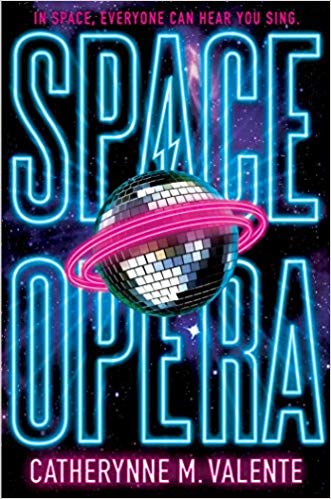
At our book club discussion of the Hugo-shortlisted novel Space Opera, there was a consensus that
Derivative and listless,
Space Opera failed to
meet expectations.
(Image via Amazon.com)
Catherine Valente is an author worthy of a best novel rocket ship on her mantle. We also agreed that Space Opera is not the work that should earn it for her.

Valente’s 2015 novel Radiance is criminally underrated. Thoughtfully tackling issues of patent hoarding and the resulting stifling of innovation, Radiance makes the case for the continued relevance of steampunk as a genre. The structural story-within-a-story techniques shows what Valente is capable of as an artist – this is a non-linear tale that could only really work as a prose novel.

Her 2011 novel Deathless is an engaging – and approachable – historical fantasy that weaves together fairy tales with the Russian revolution. It could be compared to something between Naomi Novik’s Uprooted and Susanna Clarke’s Jonathan Strange and Mr. Norrell.

And by contrast, Valente’s previous Hugo-shortlisted novel Palimpsest is an emotional tour-de-force about desire and possibilities. Deftly imagined – and artfully lyrical – Palimpsest is both a dreamlike and challenging book that readers will continue to get something out of on repeat readings.

Clearly, Valente writes first-rate books, in a wide range of styles and voices. There had not been a single one of her books that anyone in our book club had read and failed to enjoy… until Space Opera.
Catherine Valente is
capable of first-rate
novels, such as the
underrated gem
Radiance.
(Image via Amazon)


There are moments of entertainment in Space Opera’s numerous asides to metagalactic history, but the book is hampered by a surprisingly slow pace, thinly drawn characters, and a weak plot. Most troublesome for fans who wanted to love it, Space Opera is occasionally fun, but rarely funny.

While it’s obvious that not all comedy will appeal to all readers, those who study comedy contend that most successful jokes depend on a subversion of expectations. This is difficult to accomplish in science fiction in part because an author’s imagined strange new worlds are at their core an alienating experience for the reader; thus readers often have fewer expectations that can be successfully subverted.

Throughout Space Opera, every expectation is fulfilled, whether it’s the concluding clause of a sentence that reinforces the overarching point rather than subverting it, or the narrative arc of a character following a predictable cliched path.

In his classic work Hitchhiker’s Guide To The Galaxy, Douglas Adams managed a subversion of expectations repeatedly – often through deft linguistic legerdemain in which an end clause subverts the beginning of a sentence (I.E. “The ships hung in the sky in much the same way that bricks don’t.”), or by taking science fiction tropes to their logical but absurd extremes.

It is difficult not to compare Space Opera to Hitchhiker’s Guide. The latter work is not only the most famous science fiction comedy of all time, it’s set in a chaotic and diverse universe that is a clear antecedent to Valente’s book. This leads to similar joke setups, and similar punchlines.

And this becomes one of the major problems with the comedy in Space Opera; all sentences and actions live up exactly to expectations, especially if you’ve read any Douglas Adams.

As example, when Valente describes various animals that produce economically viable goods (such
If there's ever a movie adaptation
of Space Opera, we hope that the
role of Decibel Jones is played
by comedian Carlos Mencia.
(Image via ComedyZone.com
as a goat that “dispenses ice cream, brie, and buttercream frosting”) due to the random vagaries of evolution, it bears remarkable similarity to Adams’ section of the third Hitchhiker's book Life, The Universe And Everything in which we are introduced to the wild mattress creatures of Sqornshellous Zeta. When Valente treads the same territory as her predecessor, the comedic twist is lost, because you know where the joke is going.

In addition, Valente seems to use polysyndeton as a replacement for wit; “the glitter and the shine and the synth and the knowing”; “You are bizarre and disgusting and interesting and fixated on fetishes”; “Do you have enough empathy and yearning and desperation to connect to others outside yourself…” Sadly, this excessive use of the word ‘and’ just becomes tiresome.

It is uncomfortable for us to describe any book on the ballot as undeserving of the rocket, especially a book from an author for whom we have so much affection and respect. Unfortunately, none of the book club’s members plan to vote for Space Opera, and some couldn’t see placing this book above No Award.