Showing posts with label best series. Show all posts

Tuesday, 19 May 2026

The Bleak Prospect of Survival of the Richest

It’s unsurprising that Children of Time remains Adrian Tchaikovsky's best-known science fiction novel. It has sweeping ideas, a unique perspective on the future, and a well of empathy. It’s a Clarke Award-winning space opera about a dying earth, hyperevolved jumping spiders, and cross-species communication. It’s an impressive feat of worldbuilding -- and of exploring alternate cognitions.

Children of Strife, the fourth
of Adrian Tchaikovsky's
Children of Time books.
(Image via goodreads)
The novel has two strong follow ups: Children of Ruin in 2019 and Children of Memory in 2022. Subsequently, the series was honoured at the 81st World Science Fiction Convention with a Hugo Award for Best Series. Unfortunately, due to the numerous much-publicized issues with that year’s Hugo Awards, many in the SFF community — including Tchaikovsky himself — consider any award from that year to be tarnished.

The Hugo Award for Best Series cannot be awarded twice to the same series. Having won in 2023, Children of Time is not eligible in 2027, which is a shame because the recently-published Children of Strife makes the best case yet for why these novels deserve recognition as a series that is greater than the sum of its parts.,

Set over the course of millennia, the first book follows terraforming scientist Avrana Kern, the civilization of spiders that evolves on the world she’s working to create, and a band of refugee humans fleeing a collapsing Earth millennia after Kern’s project started.

Each of the sequels centres on a crew of Humans and Spiders visiting long-lost terraforming projects. With Children of Ruin, we were introduced to sentient octopuses, and Children of Memory brought us the delightful Gethy and Gothly, a pair of Ravens who share one cooperative consciousness.

What connects the books in this series isn’t tied to a shared set of characters — or some grand galactic plot arc — but rather an intellectual playfulness and positivity in imagining how a variety of sophonts might understand the world around them.

This latest book, however, mirrors the original Children of Time more closely than the other two; and in doing so offers a dark reflection on the ideas that Tchaikovsky was exploring. Children of Strife depicts a terraforming project led not by the government-funded Avrana Kern, but by her rival Gerey Hartmand — an Elon Musk-type figure who self-finances his own, self-selected experiments.

While Kern’s World evolves species who learn to cooperate, the arch-capitalist Hartmand and his four allies are focused on a reductive survival-of-the-fittest approach to their project, with a hierarchical governance model. To describe the world that Hartmand creates as “flawed” might be an understatement. When Earth collapses some millennia later, one of the ships of refugees is sent to Hartmand’s World.

Hartmand’s cadre of flunkies: Sui Dorcheson, Ken Pill, Redina Kott, and Milner, all seem to embody different aspects of real-world tech-bro disconnection from reality. The god-complex of Hartmand, the pharmaceutical haze of Pill, the nihilism of Kott. Over the course of the book, they each represent different ways in which reductive understandings of evolution can lead to terrible outcomes.
The pugilistic nature of the Mantis Shrimp
(aka Stomatopod) makes for an interesting
protagonist in Children of Strife.
(Image by Roy Caldwell via UC Berkley)


These corporatist terraformers embody a grim reflection of the idealistic experiment begun by Avrana Kern in Children of Time. Kern’s project sought to guide evolution toward intelligence, motivated by a flawed but sincere vision of uplifting life. The terraformers in Children of Strife, by contrast, pursue profit and control, reshaping worlds with little regard for ecological balance or emergent societies. Where Kern hoped to steward a new civilization, the corporatists reduce planets to personal playgrounds. There’s some unsubtle subtext about how our modern plutocrat class dreams of being worshiped as gods while people are sacrificed for their entertainment.

As with every previous book in the series, Tchaikovsky explores the ethology and cognition of a real-world species. For Children of Strife, this is Kato, an obstreperous space captain descended from stomatopods (sometimes referred to as “mantis shrimp”). As always, this is an interesting aspect of the book, although Kato is more difficult and more inhuman in perspective than many of the previous protagonists in the series.

Children of Time remains a modern classic of space opera; a best-selling book replete with engaging ideas that continue to resonate with audiences a decade after its publication. Children of Strife elevates the series by having something new to say about the failures of reductionist adaptationism as a view of evolution — and how that is reflected in failures of societies governed by capitalist competition and hierarchy.

It is now easier to see these books as a series, rather than one great book with enjoyable-enough sequels. If it were eligible for the Hugo for Best Series in 2027, we would vote for it. Children of Time books will forever live in a liminal space of having sort-of won the Hugo for Best Series, but never bear the words “Hugo-winning series” on their covers.

Children of Strife is the best — and most ambitious — sequel yet to Children of Time, in part because Tchaikovsky has the courage to subvert the optimism and hope underpinning the first novel.

Tuesday, 10 June 2025

A Bee-lief in the Common Good

“It is truly amazing how many flavours of dumb an apocalypse can spawn.” 
— Ada Risa (Bee Speaker.)

Bee Speaker — the third book in Adrian Tchaikovsky’s Dogs of War trilogy — is the capstone to an emotionally rich and intellectually satisfying hard science fiction series that deserves to be recognized with a nomination for the best series Hugo Award.

Bee Speaker's cover art
is by Pablo Hurtado
de Mendoza
(Image via Head of Zeus)
When the first Dogs of War novel was published in 2017, no North American publisher was willing to take it on. Children of Time had garnered Tchaikovsky some fans among science fiction readers, but he was still primarily seen as an author of multi-book epic fantasies.

Dogs of War was well received in the United Kingdom — earning a BSFA nod — but for years, it remained largely unknown in the United States and Canada.

That initial book introduced the audience to Rex, one of the first genetically-altered dogs bred and built as a loyal, obedient, and fearsome soldier. Along with his teammates — a hyperinteligent bear named Honey, a chamelon/lizard named Dragon, and a hive-mind swarm of Bees — Rex is dropped into the middle of a brutal war in near-future Mexico. If this were simply a war novel with a compelling protagonist, it would have still been a good piece of fiction … but Tchaikovsky shifts gears no fewer than four times through the story. With each pivot, the book becomes something more; a courtroom drama, a moral philosophy exercise, a political thriller. Tchaikovsky engages the reader with questions about moral culpability of those within a hierarchy, about the rights of animals, and more fundamentally, about what it means to be a person. It is a book that is complete unto itself, needed no sequel, and Tchaikovsky had no plans to write one.

Over the years, Dogs of War’s reputation grew by word of mouth. It resonated profoundly with some, and eventually found its readers. By 2021, it had earned a devoted following — and improbably, a sequel titled, Bear Head.

With Bear Head, Tchaikovsky took the story decades further into the future, centering the narrative around Rex’s teammate Honey. The sequel tackled the colonization of Mars by ruthless corporations using genetically modified humans to create a hierarchical civilization on the Red Planet. Like the previous book, Bear Head is about ways in which freedom can be subverted, but is more explicit in advancing an argument that if the rights of any sapient being are eroded then the rights of all sapient beings are at risk. Like the first book, it is complete unto itself and needed no sequel.

Which brings us to Bee Speaker, a novel that expands upon, refines, and also subverts thematic elements of the previous two novels in the trilogy. We may never have expected this sequel to exist, but are very glad it does.

Picking up centuries after the events of the previous book, Bee Speaker is set after a major technological collapse. On Earth — where much of the action takes place — the remnants of corporate feudalism have become warrior enclaves led by superannuated former billionaires and their descendant tribes, while subsistence farmers pay tribute from their meagre harvests, and a Bee-themed religion preserves what addled knowledge they can of the past. Mars — partially terraformed during the events of Book 2 and populated by genetically engineered humans, dogs, and other bioforms — fared slightly better than the Earth, having been forced by circumstances to maintain their technology for survival reasons.
Dogs of War has gained readership
over time, eventually being translated
into a variety of languages such as
French, Latvian, German, Catalan,
and of course Polish. 
(Image via Goodreads)


The book follows the exploits of modified human Ada, canine Wells, and lizard Irae — Martian engineers who are lured to Earth by a cryptic distress signal. Their expedition is the first contact that the two planets have had since the fall of Earthbound civilization and they stumble into unexpected situations and a clash of cultures, unintentionally upending local power structures.

The Martian characters operate under a misapprehension that the people of Earth will share their ideas about acting in the common good; while members of the feudal warrior culture make rash and impulsive decisions based on macho notions of honour. The book could be read as a parable about the impossibility of human progress, or as a comment on turning your back on the care and feeding of a working democracy.

While the previous books explored the pitfalls of hierarchies of high-technology and of corporate dominance, Bee Speaker posits that when democratic governance fails and technology crumbles, the worst sorts of low-tech hierarchies will reassert themselves. It also shows how even those who enjoy being at the top of the pyramid will eventually be brought low by the very hierarchies they believe in.

The cyclical nature of dark ages and renaissances will remind some readers of Walter Miller Jr.’s Canticle for Leibowicz, as will the role of religion in preserving knowledge. In Tchaikovsky’s book, however, the religion is based on the worship of Bees — the hyperinteligent hive mind who is the one character tying all three books together. One of our favourite characters in Bee Speaker is Cricket, a pious, easily influenced, and intellectually vulnerable young monk of the Apiary (the name for the church of Bees).

Uplifted animals have been a staple of science fiction for decades, but are often depicted either as just normal people, or as somehow … lesser. Informed by his passion for ethology (the study of animal behaviours), Tchaikovsky’s depiction of uplifted animals avoids these pitfalls; he seems to grok the canine soul, and offers us non-human characters who are not lesser, but inescapably other. We suspect that those who have had a dog in their life will appreciate this aspect of his speculative writing.

Adrian Tchaikovsky’s ability to create stories infused with abiding empathy for all creatures great and small has helped solidify his following. This trilogy puts these insights front-and-centre. Although they may not be his best-known novels, the Dogs of War books might be his strongest and most emotionally interesting.

Bee Speaker is not in any way a sequel we expected, but it is one we are very glad exists.

Sunday, 6 December 2020

Even Charles Stross' worst book is pretty good

If we select nominations for Best Series based on a representative title being released in 2020, The

Laundry Files may not make the grade. But if we are choosing nominations based on the strength of the entire series, then Charles Stross’s decades-long Laundry Files series is nearly a lock for our ballots.

This is not to say that Dead Lies Dreaming is a let-down. Rather, it’s an uneven book that doesn’t always showcase the strengths of the series, or Stross’ rich imagination.

Taking place in a London transformed by the rise of the dark and eldritch forces unleashed during the events of the previous few Laundry Files novels, Dead Lies Dreaming follows the exploits of a group of marginalized youths who support themselves through magic-based crime. Through various circumstances — and family connections — they become embroiled in a plot to travel back in time and secure a rare and dangerous tome of magic.

As always with Stross, there’s a fair degree of on-point criticism of capitalism’s excesses, much of which lands well. The sections in which he uses the point of view of the marginalized youths to examine the completely bizarre housing market in the United Kingdom, are perspicacious, witty, and sad.

One of the strongest scenes — and perhaps the most difficult to read because it hits so close to home — involves a visit to a long-term care facility. Stross writes the section with a keen eye for the real-world horrors of old age, dementia, and under-resourced nursing staff.
Those who have spent time at privatized seniors
care facilities will find Stross' insightful writing
about such places to be harrowing.
(Image via Chilliwack Progress


Where Dead Lies Dreaming falls down as a book is that it’s hard to get a handle on any of the characters as people. Several of them seem interesting at first — particularly police officer / thief taker Wendy Deere, and corporate power-broker Eve. Stross has introduced a large and diverse cast, but doesn’t develop many of them beyond sketch work.

Stross has made a clean break here from all the previous books in the series. The story barely even mentions any of the existing characters, does not tie into the overall story arc, and doesn’t even touch on the spycraft that had been the unifying theme for the series. This makes one wonder whether this book might have been better-served by being pared down, streamlined, and released as something wholly separate.

It has been almost a decade since Charles Stross penned a novel that was not a sequel to one of his previous books. Dead Lies Dreaming is still a sequel, but in some ways it is a welcome change in that it stands alone far more than most of his recent novels. Some might even find it a better entry point to the world of the Laundry Files than several of the previous books. But is this a world that is worth devoting many more books to? Only Stross can pull that off, and we think he could, but is he ready to move on? Dead Lies Dreaming leaves us hoping he might be.

Monday, 10 August 2020

Moving Forward on Looking Backwards

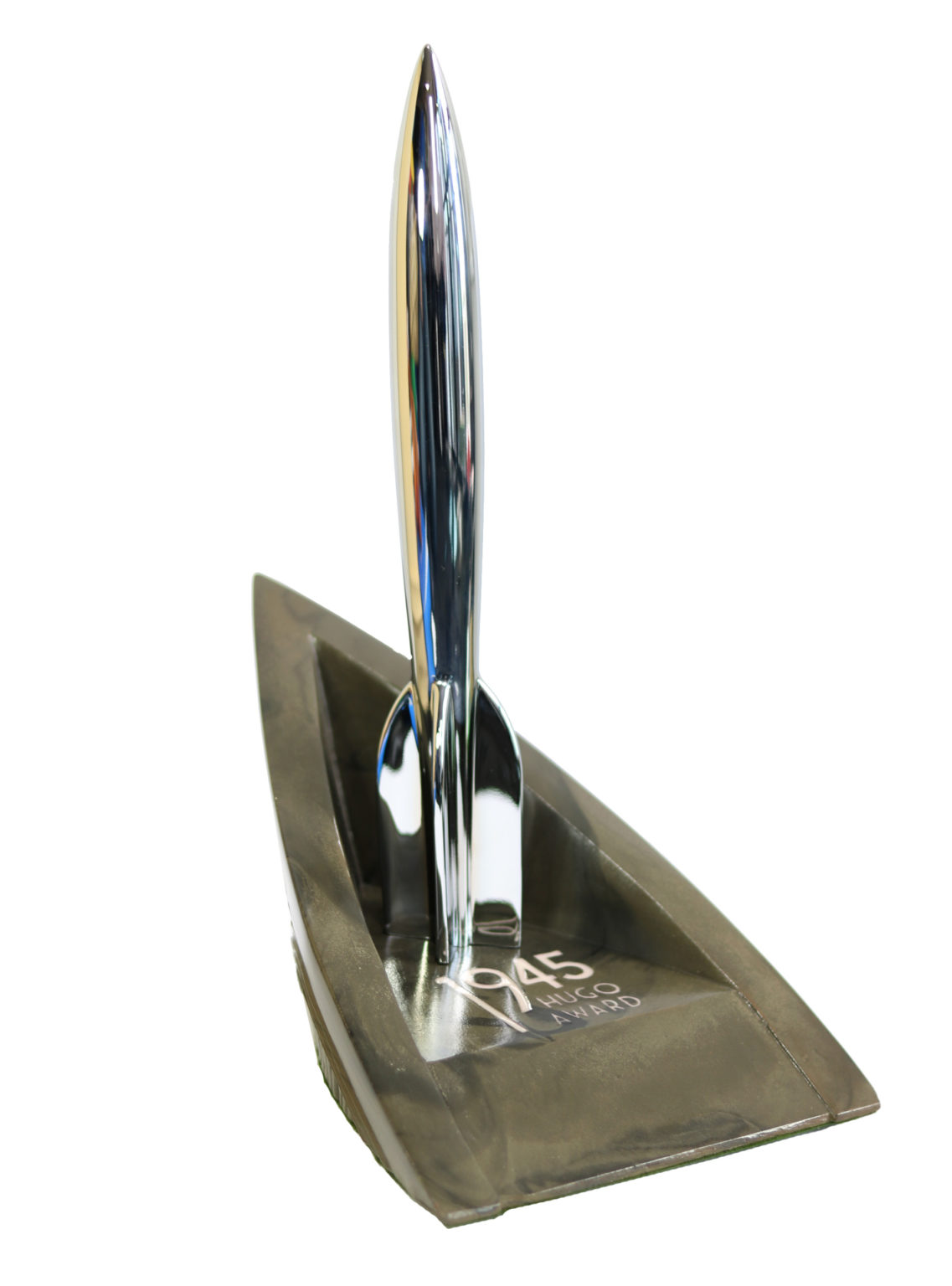
Among the controversies to emerge from this year’s Worldcon was the honouring of two disgraced
Say what you will about the
honourees, these are some of
the nicest-looking Hugo bases
ever designed. 
(Image via TheHugoAwards.org)
former titans of the genre, as both John W. Campbell Jr. and H.P. Lovecraft were selected to receive a Retro Hugo for the year 1945.

Their malignant racism is well documented, and does not need to be re-litigated here. Instead, we would like to take the regrettable outcome of these two awards as a case example of structural biases inherent in the Retro Hugo Awards.

The Retros Hugos sometimes stumble. It is worth asking whether they should continue, and if so what form they should take.

Retro History

The original proposal for the Retro Hugos came from long-time SFF fan Bruce Pelz during the lead-up to the 1996 Worldcon in Los Angeles. The Retros were initially intended to celebrate the 50th anniversary of the 1946 Worldcon which had also been held in Los Angeles. Pelz initially proposed that Retro Hugos would only be presented if a Worldcon was happening in the exact same place on a 50th or 100th anniversary.

The location requirement was dropped during debate because it was felt to be too restrictive. But it was still not anticipated that the Retro Hugos would become something that was done on a regular basis.

Here's what Pelz said in 1993 while introducing the idea of Retro Hugos: "I expect the idea to be pretty much a Funny-Once, and that other Worldcons will not want to try this. But with a 1946-1996 Opportunity, I would like to be able to try it at least once."

To date, Retro Hugos have been awarded on eight occasions. According to the WSFS constitution, they can only be awarded on the 50th, 75th or 100th anniversary of a year in which the Hugo Awards themselves did not occur.

Of the eight Retros, three were on the 50th anniversaries, and five have been on the 75th anniversaries.
Bruce Pelz speaking at Noreascon One. 
(Photo by Jay Klein via Calisphere.org
Looking at the lists of finalists, it seems evident that there is a difference between the awards at the 50-year mark (1946, 1951, 1954) and the awards presented at the 75-year mark. That additional 25 years of distance in the cultural memory is significant; it is not particularly unusual for a fan to attend two Worldcons 50 years apart, but it is almost unheard of for someone to attend conventions 75 years apart. The prospect of awards given out to works a full century after they were published — as might occur in 2040 — gives us trepidation.

Structural Biases

Because they are voted on primarily by people who were born decades after the original publication dates, the Retro Hugos are less likely to recognize work that has not been reprinted. This means that the average Retro Hugo voter inevitably experiences the works they’re voting on through a filter created by the intervening generations. 

Additionally, it is impossible for Retro Hugo voters to be unaware of what various writers might
Even if you can travel in time like the folk
from Journey Galactic, it's difficult to 
experience the stories in their original context.
(Image via Hugo Book Club Blog)
accomplish later in their careers. When Robert A. Heinlein’s debut novel Beyond This Horizon was on the Retro Hugo ballot, could any of us consider it without being aware of his long career and relevance to the field?

The effects of these systemic biases will naturally be most pronounced in the categories in which it is most challenging for the average Hugo voter to make an informed decision: the editing category, and the best series award.

The Invisible Editor

The value of talented editors can not be overstated. One only needs to look at the “Un-Edited” editions of Stranger In A Strange Land and The Stand to see that the professional editors who worked with Robert A. Heinlein and Stephen King made significant changes to these iconic novels. But other than these few examples where we can compare the texts, the value added by the editor is usually invisible to the reader. This presents a significant challenge to Hugo Award voters who take the task seriously.

With contemporaneous Hugos, we often rely on word of mouth and on reputation to make informed decisions, as well as a general awareness of what works those editors have had a hand in. But given the nature of the Retro Hugo Awards, the people who have worked with the editors nominated for the award aren’t around to inform the discussion. Thus, votes are cast based on little more than historical reputation.

The invisibility of editors’ work is a significant exacerbating factor to the reputational biases of the Retro Hugos. No matter how flawed a historical nominee may be, when voters don’t have the tools to judge the nominees work, name recognition becomes paramount.

Unintended Consequences

When the Retro Hugos were first conceived in the early 1990s, the Hugo for Best Series was not a consideration because that category did not exist. More recently, in all the WSFS business meeting debates surrounding the creation of a Hugo for Best Series, we cannot find one reference to how the new category would be handled in the Retro Hugos.

The Retro Hugo for Best Series therefore seems like an unintended consequence of multiple rule changes.

The amount of reading that Hugo voters need to do to make informed votes in the best series category is an issue that has been brought up repeatedly in discussions of this category. This reading burden is exacerbated when trying to make informed votes about long-out-of-print series.

If there’s a series on the Retro Hugo ballot that is still inspiring works in the new millennium, that series will have an obvious advantage, even if the works written 75 years ago were racist, misogynist, and mediocre.

A Silver Lining

The selection of H.P. Lovecraft and John W. Campbell Jr. as Retro Hugo recipients in 2020 has
On its original publication, Leigh Brackett's
Shadow Over Mars was in Starling Stories.
The fact that editor Oscar J. Friend
commissioned Virgil Finlay to illustrate the
story is an indication of the high regard
readers had for Leigh Brackett's writing.
(Image via claytonianjp.tumblr.com)
unfortunately overshadowed several ways in which the 1945 Retro Hugo awards have been successful.

The recognition of Leigh Brackett as a foundational figure in science fiction by awarding her the Best Novel award and Best Related Work award for 1945 will help ensure her work continues to be read. Recognizing the work of Margaret Brundage in the Best Professional Artist category is an excellent move by Hugo voters, and overdue. Significant credit for these successes should be paid to fan writer Cora Buhlert for her efforts over the past year to elevate the level of debate and dialogue surrounding the Retro Hugos.

Moving Forward on Looking Backward

There will be no Retro Hugos in 2021, given that the 1946 Retros were handed out at L.A. Con III in 1996. This is good because it gives the Worldcon community a chance to pause and reassess the value of continuing these retrospective awards.

The distorted perspective of voters who are living 75 years removed from the context of the matter being voted on means that some Hugo categories don’t work very well for the Retro Hugos. Is it time to abandon some categories in the Retro Hugos?

Additionally, when applied to works from a time before living memory, the Hugo nomination process seems to draw in works that have no business being celebrated: one can point to last year’s Retro Hugo-shortlisted movie Batman (1944). It’s a racist dumpster fire that deserves to be forgotten. Perhaps due to the nature of the award, different nomination rules for Retro Hugos should be considered?

Or perhaps the Retros can be salvaged through the work of bloggers like Buhlert, and by engaging a broader swath of Hugo voters in discussions about the less-savory aspects of fannish history.

For the Retro Hugos to be relevant and worthwhile awards, we as members of the World Science Fiction Society need to wrestle with why the awards need to exist. Is their intent to reproduce the racist tastes of the past or can they help focus a critical lens on the history of the genre and help us discover works that might have been overlooked?

There is a way to re-envision the Retro Hugos as progressive and constructive. We must look forward on looking backward, but that will take effort and commitment. If we aren’t willing to put in that effort, perhaps 2020 should be the last time Retro Hugos are presented. 

Tuesday, 9 June 2020

The Last Emperox - Review

The Last Emperox is a disappointing final volume of an otherwise superb trilogy.
Image via Amazon.ca


Set in an interstellar empire connected by a network of conduits that allow faster-than-light travel, the Interdependency Trilogy centres around Emperox Grayland II. Shortly after her coronation, the Emperox learns that the network is about to collapse, leaving each imperial node cut off and isolated from each other.

The first two books dealt with the initial response to this discovery and the subsequent political machinations and attempted coups as various factions tried to turn the crisis to their advantage.

But as the third book opens, the underlying problem of an impending collapse of all interstellar trade remains unresolved. Grayland has five years before the worlds of her empire are split apart, and each system is left to fend for itself. It was made abundantly clear in the first two novels that there was no way to avoid this tragedy, and that each system would be unable to survive without their existing and symbiotic relationships with other worlds.

Resolving this point of tension in a satisfying and internally consistent way presents a major storytelling challenge. With 20 billion lives in the empire, the logistics of getting them all to the safety of a habitable planet (as opposed to orbital space stations) within five years would strain any story. Conversely, the prospect of ending a relatively light-hearted set of space adventure novels with the demise of 20 billion people would present major tonal challenges.

Unfortunately, Scalzi does not manage to resolve this conundrum. Instead of untangling the gordian knot created in the first two books, The Last Emperox offers readers another round of scheming nobility and coup attempts, with several of the most intriguing characters sidelined on personal quests and errands.

One of John Scalzi’s biggest strengths as a writer is his breezy, approachable prose that conveys meaning, personality, and emotion. For the first third of The Last Emperox, this remains true. But significant portions of the novel, particularly in the middle third, are told in the form of a rushed exposition of events.

The pace slows down suddenly during one character’s side-quest, but only to talk about the nature of the interstellar network. For the better part of a chapter, the author explains through metaphor and technobabble exactly why what was established as canonical fact about interstellar travel is no longer true.

Worse yet is the section in which we follow the plot as if it were a historical essay. Pages upon pages, paragraphs upon paragraphs without dialogue, character development, or human warmth. It feels like reading the text off a TV news anchor’s teleprompter. The writing comes across as rushed and lifeless.

During one of these expository sections, a major character is killed off so abruptly that some of us wondered whether it was a fake-out, and that it would be revealed later to be a ruse.

Most of all, the end of the novel is mostly a cop out. There’s plans to save the whole population of the Empire through a new property of the interstellar hyperspace network, though implementing this plan, and the possible demise of entire planets worth of people are left hanging. This cop-out ending seriously undermines the central climate change metaphor of the trilogy.

The first two novels of the Interdependency Trilogy are possibly the most enjoyable novels John Scalzi has ever written, in large part because of a diverse and interesting cast of characters. The first book introduced an interesting setting and a significant challenge. The second book explored some of the history and backdrop of this setting, while revealing new facets to the society. But the third adds very little.

Despite significant reservations about the third volume, we’d still recommend the series. The trilogy had the potential to be a definitive classic of science fiction, but is instead just OK.

Tuesday, 18 February 2020

"The Light Of Impossible Stars" Shines Brightly

Compulsively readable, The Light Of Impossible Stars is the engaging capstone to Gareth Powell’s
Image via Amazon.com
delightful Embers Of War trilogy.

Following the events of Embers Of War and Fleet of Knives, this concluding novel finds the crew of the Trouble Dog and their allies fleeing from the ancient alien armada they unleashed over the previous two books.

Each sequel in the Embers Of War trilogy takes a hard 90 degree turn from the previous book, both thematically and narratively. The universe changes and lines of conflict are redrawn, providing characters with opportunities to explore loss, grief, and redemption.

The rapid-fire short chapter structure of these novels, along with the breezy first-person narration, continues to provide momentum. Although some point-of-view characters (Nod, Trouble Dog) stand out for their noticeably different voices, there are times when other narrators sound confusingly similar in approach.

More than the previous volumes, The Light Of Impossible Stars seems to oscillate between the military SF subgenre, and the xenoarchaeology subgenre. While the chapters dedicated to Trouble Dog’s crew are largely the former, the introduction of a new setting and a new protagonist, Cordelia Pa, gives Powell the chance to don an Indiana Jones fedora.

One of the most delightful aspects of the Embers Of War trilogy has been revelling in the quirky xenoarchaeology locations and artefacts: The Gallery, The Marble Armada, The Generation Ship “Restless Itch for Foreign Soil.” The chapters featuring Cordelia Pa delve deeper into these ancient aliens and big dumb objects in space, than either previous book does.

Set on a series of artificial metal worlds called “The Plates,” Pa’s adventures (and those of her
Gareth Powell has a reputation for
being one of the nicest people on Twitter.
(Image via Twitter)  
brother) provide welcome details of the now-long-extinct Hearther civilization, and a perspective on what life is like outside of the House of Redemption. It is evident that the author has put a lot of care and thought into the history of this universe. This care pays off in The Light Of Impossible Stars.

There are portions of the novel that seem extraneous to the overall plot; Trouble Dog’s detour to the Druff homeworld seemed irrelevant, and the few chapters dealing with Cordelia Pa’s brother Michael feel a little out-of-place. Thankfully, the short chapters and accessible prose keep the narrative pace up even during these odd detours.

One of the great joys of getting invested in a well-planned and thoughtfully crafted trilogy like this one is seeing the characters grow and evolve over time. Powell has the storytelling maturity and courage to guide readers through character actions with drawn-out consequences that resonate across multiple novels. Easy resolutions to character arcs are avoided, creating tension and moments of drama.

As a trilogy, Embers Of War deserves a place on Hugo ballot for Best Series. Works like this — ones that use the longer-form series arc to craft stories that wouldn’t hold up in in shorter-form works — are exactly the sort of work that should be honoured in that category.

Sunday, 20 October 2019

Cautiously Optimistic About The Best Series Category

We had our doubts about the creation of the Hugo Award for Best Series.

Does the category fill a need? Would the vote just be about name-recognition given how difficult it is to read all the shortlisted works? Might we just see the same set of series showing up on the ballot on alternating years?

But some of these doubts have been allayed by Becky Chambers’ series Wayfarers receiving the
Becky Chambers' win
shows that Best Series
serves a segment of SF
ignored by other Hugos.
(Image via Goodreads)
award in Dublin at Worldcon 77. It’s not just because we enjoyed the Wayfarers novels. This win gives us hope because it demonstrates that the Best Series Hugo can recognize works that weren’t well-served by the pre-existing four fiction categories (novel, novella, short story and novelette).

There are at least two reasons why we consider this to be a monumental win: none of the novels in the series had already been awarded a Hugo; and it recognizes a relatively new talent, as Becky Chambers is both the youngest person to have been shortlisted for Best Series and the youngest to win it by three decades.

These facts may seem like minor distinctions, given that the category has only been around for three years. But to us they are positive indicators that the category might be working as intended.

For the first two years of its existence, the Best Series Hugo Award was presented to a towering icon of science fiction — Lois McMaster Bujold. She has won the Best Novel Hugo more often than any other living author, and each of Bujold’s wins for Best Series involved a series that had previously won her a Hugo or two.

It would be hard to argue that Bujold’s work is not meritorious. But if the Best Series Hugo only ever went to series that include a Hugo-winning novel, it might call into question the need for a series award at all. Giving a Best Series Hugo to Best Novel winners seems a bit redundant.

Did the Vorkoskigan
saga need another
Hugo Award?
(Image via Amazon)
Although two of Becky Chambers’ Wayfarers novels appeared on the shortlist for Best Novel, the majority of the series on the ballot in each of the years the award has existed were composed of previously non-Hugo-shortlisted works (series such as The Centenal Cycle, Rivers Of London, and The Memoirs of Lady Trent.) This indicates strongly that the award is serving a segment of genre fiction that was not served by the existing categories.

It is interesting to note that to date only Seanan McGuire’s October Daye books have made a repeat appearance on the best series shortlist. With six finalists listed in each of three years, one repetitious nominee out of 18 gives us hope that we might continue to see a diverse range of series getting shortlisted. A lack of repeat appearances could indicate that the category is serving a diverse and engaged readership.

It is too early for anyone to pass judgment on whether or not the Best Series Hugo is a useful addition as a category.

But in the long term, we would be happy to be shown that we were wrong in our initial opposition to the creation of this category.