Showing posts with label Harlan Ellison. Show all posts

Friday, 29 December 2023

Death From Above (Hugo cinema 1979)

This blog post is the 22th in a series examining past winners of the Best Dramatic Presentation Hugo Award. An introductory blog post is here.

As the 1970s drew to a close, science fiction cinema was in transition. The Hugo for Best Dramatic Presentation in 1979 reflects this; socially conscious environmental parables of the waning decade were making way for a new era of popcorn cinema.
Star Wars producer Gary Kurtz presents the 1979
Hugo Award for Best Dramatic Presentation to
Superman star Christopher Reeve at Seacon.
(Image via Supermania78)


For the first time, there were two animated movies nominated in the same year (something that would not happen again until 2002): Watership Down and Ralph Bakshi’s Lord of the Rings. Hitchhikers Guide To The Galaxy became the first (and to date only) commercially broadcast radio show to earn a Hugo nod. This left Superman and Invasion of the Body Snatchers as the only live-action movies up for the award. From the start of organized fandom, fanzines had always provided reviews of movies, but in the late 1970s, more column inches were spent on cinema than ever before. Fans debated whether movies like The Wiz, The Cat From Outer Space, or Coma deserved recognition for the Hugo, and wisely decided that they did not.

In the wake of Star Wars, Hollywood had begun to recognize the commercial viability of big-budget science fiction. The floodgates were opening.

There had also been an uptick in televised science fiction. In Britain, Blake’s 7 was drawing in up to 10 million viewers an episode. In the United States, Glen A. Larson’s Battlestar Galactica became the most expensive television series ever made up to that point. Although it received mixed reviews from fandom, the original pilot Saga of a Star World holds up surprisingly well today. One of the show’s few defenders in fandom, Mike Glyer noted that “Battlestar Galactica has been panned in every review I've read — must be something wrong with me, I enjoyed it.”

In the days leading up to the Worldcon in Brighton, UK, the original radio production of The Hitchhikers’ Guide To The Galaxy seemed to have the edge. Indisputably fannish, and replete with genre references, it was an immediate hit in the United Kingdom. Despite the fact that the Douglas Adams’ comedy would not be broadcast in the United States until three years later, SFF fans all over the world were alerted to its existence by their British friends. It was broadcast on the BBC Worldwide shortwave service, and some North American fans were able to receive it via shortwave radio (and bootleg audio cassettes). File 770 took the unusual step of publishing the schedule of shortwave broadcasts for the show.
How many Hugo finalists have
inspired songs by Radiohead
and Perfect Circle?
(Image via Wikipedia)


Though it’s broadly recognized as a classic today, Richard Donner’s Superman did not seem destined to win the Hugo Award in 1979. When the movie first came out, critics were less than charitable in their assessment of the film. The New Yorker’s Pauline Kael excoriated it as smarmy and cynical with “a sour, scared undertone.” The New York Times’ review is even more dismissive, opining that, “It's as if somebody had constructed a building as tall as the World Trade Center in the color and shape of a carrot. Rabbits might admire it. They might even write learned critiques about it and find it both an inspiration and a reward, while the rest of us would see nothing but an alarmingly large, imitation carrot.”

Even within fandom, there was a sense that comic books weren’t ‘real science fiction,’ and consequently a comic book movie wasn’t a ‘real science fiction’ movie. In the fanzine SF Review, editor Richard E. Geis wrote that “We hated Superman cordially (and hated Invasion of the Body Snatchers not so cordially).”

Bakshi’s Lord of the Rings is arguably the weakest work on the shortlist. Some of the viewers in our group would have considered ranking it below no award if we were voting today. Although the first half of the movie hews closely to JRR Tolkein’s original novel, the second half rushes through major plot points without pause before ending abruptly. Praising the faithfulness of the adaptation, but excoriating the jumpy rotoscoping and off-putting visuals, fan Bill Warren dismissed Bakshi’s Lord of the Rings as “Middling Earth.”

More than in previous years, there was debate about the shortlist, and various works had their proponents. Harlan Ellison had endorsed Watership Down, writing that, “It is intelligent, elegant, true to the splendid book from which it was adapted, and as uplifting for adults as it will be for kids.” A reimagining of the Biblical story of Exodus told with rabbits, the movie had its world premiere at the 1978 Worldcon in Arizona. It may have received a boost by being seen by likely Hugo voters, and the enthusiastic lobbying of Ellison. The naturalism of the animal depictions resonate, and the painterly backdrops are striking, but there’s a tonal disconnect between the seriousness of the violence and juvenile elements like the wacky seagull sidekick Kehaar.
#NotMyAragorn
(Image via IMDB)


Though it initially received mixed reviews from mainstream critics, and only a modest success in its initial release, over time the 1978 remake of Invasion of the Bodysnatchers has gained critical acclaim. Some members of SFF fandom were ahead of the curve, with frequent reviewer Bill Warren describing it as the finest movie he’d seen that year, and suggesting that it was “more than just a remake of an old classic, it's a new classic in itself.” More than four decades after its release, the movie has aged well, with multiple possible interpretations. We ended up debating whether it was a warning about the threat of communism, a meditation on societal pressures to conform, or something else. It deserved its nomination, and would have been a worthy winner. It probably lost Hugo votes because author Jack Finney — upon whose book the movie is based — had shown some disdain for the fandom community.

In the final Hugo vote, the top two finalists were surprisingly close … each of which featured a protagonist who is the last survivor of a doomed planet and each of which had an influence on broader, mainstream culture: Superman and The Hitchhiker’s Guide To The Galaxy.

Hitchhiker’s Guide To the Galaxy is rightly regarded as a classic of science fiction comedy. Those in our cinema club who love it, do so unreservedly … but it was not to everyone’s taste. Understated and ironic, some consider it a masterpiece of timing and laconic charm, despite the dialogue feeling loose and unstructured. Following an everyday Englishman who survives the destruction of planet Earth, the series meanders between various science fiction tropes before the protagonist uncovers the galactic conspiracy behind his planet’s demolition. There’s a reason this radio show spawned four sequels, was adapted into a television series, a movie, a video game, and a novelization that sold more than 14 million copies.
The vote came down to two 
stories — each about a last
survivor of a doomed planet
who has to face off against
real estate developers.


The initial popularity of The Hitchhiker’s Guide To The Galaxy cannot be overstated. Within months of its first airing, fans had adapted it to a stage production, and Graham England was publishing a fanzine titled Don’t Panic, which was actively campaigning to get a Hugo Award for its author Douglas Adams. “I’m more astonished and delighted than I can say at the prospect of being put forward for a Hugo nomination — a fairly mind boggling prospect,” Adams wrote on February 14, 1979 about the campaign to have him recognized, and said he was trying to make the show available in the United States.

Despite the disdain critics had shown for it, Superman was the highest-grossing movie of the year and had connected to audiences. At the time, no movie based on a comic book superhero had been among the year’s top-20 grossing films (previous superhero movies such as the 1966 Batman were comparatively small-scale affairs). In many ways, this would be seen as the turning point in cinema history; the most dominant movies of today had their genesis in 1978, with almost every superhero movie in subsequent decades taking cues from Richard Donner’s interpretation of Superman.

When rewatching these movies with 40 years of hindsight, it’s clear that this was not only one of the more interesting Hugo shortlists, it was one of the best. After decades in which the Best Dramatic Presentation Hugo Award had been somewhat of an afterthought, science fiction cinema seemed to be coming into its own.


Monday, 3 April 2023

Edgelord Cinema Maximalism (Hugo Cinema 1976)

This blog post is the nineteenth in a series examining past winners of the Best Dramatic Presentation Hugo Award. An introductory blog post is here.  

Warning: Contains references to sexual violence depicted in the movies being reviewed. Also spoilers.

In the 1960s and 1970s, the new wave of science fiction transformed the genre. Writing styles became more varied. Surrealism and postmodernism were embraced. Authors began to explore previously taboo subjects like sexuality, drug use and abuse, and psychology.

Many of these genre-shaping stories were rightly celebrated for their insight, their boldness, and their inventiveness. But in some quarters, the pushing of boundaries became an end unto itself, and transgression became mistaken as insight.

Although the 1976 Hugo-winning incel manifesto A Boy And His Dog may not have been the nadir of this trend, it’s probably the most iconic example.

Members of our cinema club described
A Boy And His Dog as “a spasm
of puerile adolescent garbage” and
“The most reprehensible
thing I have watched.”
(Image via IMDB)
Set in a post-apocalyptic America decades after a nuclear war, A Boy And His Dog follows Vic (Don Johnson) a libidinous 18-year-old and his telepathic dog Blood as they search for food and women. The main plot of the movie covers Vic getting lured by a woman named Quilla June (Susanne Benton) into the clutches of a community living underneath the ruins of Topeka. After a failed revolution in the underground city, Vic and Quilla June fall in love and escape back to the surface.

The offensiveness of this movie and its misogyny cannot be overstated. The protagonist is a sexual predator who hunts women for sport. The animal sidekick cheers him on in his rapes. This all culminates in a “twist” ending in which Vic murders Quilla June and feeds her to the dog; driving home the fact that this movie treats women as little more than meat. At no point does this movie critique this repulsive stance; rather, it embraces it.

The novella upon which the movie is based provides a blueprint for all these problematic elements, but is slightly more critical in its treatment of Vic and of Blood. Director L.Q. Jones — who was trained on old-school westerns — provides mostly neutral or adoring depictions of Vic and Blood. The appalling end sequence is delivered with a smirk, and with a heroic framing as they ride off into the sunset.

Numerous contemporaneous critics flagged the reprehensible nature of the movie. Joanna Russ wrote a long-form critique, suggesting that “Sending a woman to see A Boy and His Dog is like sending a Jew to a movie that glorifies Dachau; you need not be feminist to loathe this film.” Writing in Yandro, Gary Anderson suggested that he was unlikely to vote for it in the Hugos.

A Boy And His Dog should not have been nominated for a Hugo Award and yet it won one. Anything else on the shortlist would have been a better choice. It is a black mark on the Hugos, and on Worldcon.

Although it received the fewest votes that year because of its limited distribution, The Capture might have been an interesting winner. A deeply fannish work, only shown at SFF conventions, it was a slideshow presentation (later self-published as a graphic novel) written by Robert Asprin and illustrated by Phil Foglio. It tells the story of a group of science fiction fans who are abducted by aliens. Filled with nerdy references, in-jokes about frequent Worldcon attendees, and deep-cut references about SFF, this isn’t a work that would appeal to everyone.
Illustration from The Capture by Phil Foglio. 
There is enduring value to fan history for this
work to be more accessible to readers.
(Image by Phil Foglio via Merrill Collection)

But it’s also quite charming. The art is terrific, and the writing is snappier than any of us had expected. The denouement — in which the fans are so annoying that the aliens decide to give up and send them back to Earth — is just … genre appropriate.

It’s not easy to find a copy of The Capture today. We were only able to access it because one of the members of our cinema club flew 2,700 kilometers to Toronto and visited the Merrill Collection. As far as we can ascertain there are only three libraries in North America that have a copy. There is also one copy available for purchase in New Jersey. Given that it is a work with enduring cultural and historical value to fandom, but which has little to no commercial value, we would urge Phil Foglio and the estate of Robert Asprin to allow the Fanac Fan History Project the permission to host an online copy of the booklet, and perhaps a recording of the original slide presentation.

One of the more interesting speculative trends in the history of Best Dramatic Presentations is how often Hugo voters seem to be able to notice an up-and-coming filmmaker before the rest of the world does. In 1976, they recognized the work of John Carpenter, long before he went on to direct any of his classic movies. Dark Star — which began as Carpenter’s student project while at the University of Southern California — is an odd, rambling movie.

After the end of the moon landings, it became 
possible to imagine outer space as ... boring.
(Image via IMDB)
Despite a microscopically low budget, a tiny cast, and some exceptionally silly special effects, there’s a lot to like in Dark Star. The story of a blue-collar crew of a star ship tasked with destroying rogue celestial objects, it's a comedic portrayal of the boredom of long-term space missions. The movie drifts aimlessly between one misadventure and the next; someone’s alien space pet becomes a threat. Later, they get caught up in a space storm. Some of these scenes work exceptionally well — particularly attempts to negotiate with a malfunctioning artificially intelligent bomb — though others fall flat. The movie almost has too many ideas (most of which would later be developed by the screenwriters into more commercially successful movies like Alien).

The highest-grossing science fiction movie of the year had been the ultraviolent commentary on sports culture Rollerball. Directed by Canadian cinema legend Norman Jewison (In the Heat of the Night, Fiddler on the Roof), the movie depicts a corporate-dominated dystopian future in which a bloody sport called Rollerball is used to distract the masses from larger societal inequities. At the beginning of the movie, the unquestioned greatest Rollerball player of all time Jonathan E. (James Caan), is pressured by his corporate overlords to retire after the upcoming championship, and begins to question the system that has enriched him.

All of this is a great premise for an action movie; and there’s a lot that works well in Rollerball. The set-piece sports scenes are first-rate, some of the performances are excellent, and the worldbuilding is interesting. But the suggestions of an anticapitalist message are never fully developed; viewers never learn why Jonathan is being asked to quit the sport, his relationship with his former wife Ella is never explained, and the final Rollerball match ends up feeling somewhat pointless.
The effect of concussions caused by Rollerball 
need to be studied, as too many Rollerball stars
seem to end up as Fox News talking heads.
(Image via Variety)


Of all the movies on the Hugo Shortlist in 1976, one stands out for its cultural impact and enduring appeal: Monty Python and the Holy Grail. Dialogue including gems like, “Strange women lying in ponds and distributing swords is no basis for a system of government” may be the greatest analysis of Arthurian legend ever written.

Comedies age more quickly than most other forms of cinema, but of the 1970s humorous works that received Hugo Award nominations, it’s Holy Grail that seems to have stood the test of time best. Some elements may have been sapped of their wit through endless repetition by fans, but much of it still hits its mark.

What’s sometimes overlooked is that this is also possibly the best-filmed and most lush production that the Monty Python crew ever put together. The animated segments offer us Terry Gilliam at his best, while with the live-action portions Terry Jones created provide artful shots that are edited together with panache. The result is a movie that visually reminded us of Andrei Tarkovsky’s Stalker, or John Boorman’s Zardoz.

It is interesting to note that Monty Python and the Holy Grail took second in the balloting, only being eliminated in the fourth-round. The major complaint that contemporaneous fans had about Holy Grail was that it was “barely SFF.”

At the ceremony, as was the norm, nobody from the team behind the Hugo-winning movie attended the ceremony. Shockingly, not even Harlan Ellison was there to accept the award. It was left to Ellison collaborator Edward Bryant to accept it on behalf of the production team. He noted, “There has been an ongoing controversy over the awards for dramatic achievement ... because so many times in the past, it seems the award has gone to frankly people who don’t appreciate the award.”

Viewing and writing almost five decades later, we’d suggest that perhaps it is better to give an award to someone who doesn’t appreciate it, than to celebrate something as reprehensible as A Boy And His Dog.

Friday, 11 March 2022

The Hugo For Best Star Trek: Hugo Cinema 1968

This blog post is the eleventh in a series examining past winners of the Best Dramatic Presentation Hugo Award. An introductory blog post is here.  


Star Trek’s dominance of the 1968 Hugo Award Best Dramatic Presentation shortlist is as much a reflection of the quality of the show’s first and second seasons (episodes from each were eligible), as it is evidence that it was an off-year for most science fiction on screen.

As noted by contemporaneous fan writers such as Ted White and Brian Aldiss, there were an extraordinary number of exceptionally terrible science fiction films in the theatres in the preceding year:
Star Trek faced weak competition
for the Hugo Award in 1968.
(Image via Vintage Movie Posters)

exploitation flicks like Voyage to the Planet of Prehistoric Women, broad comedies like Don Knotts’ The Reluctant Astronaut, and cheaply made filler like Journey To The Centre of Time. Most of the televised science fiction was sub-par, though Doctor Who’s Second Doctor had three of his best stories with “Tomb of the Cybermen,” “The Moonbase,” and “The Web of Fear.”

In terms of foreign-language cinema, there’s few stand outs. If it weren’t for Star Trek, would Best Dramatic Presentation have recognized something like Late August In The Hotel Ozone?

While some pundits decried the fact that the entire shortlist for the 1968 Dramatic Presentation Hugo was made up of Star Trek episodes, none could offer credible alternatives to Roddenberry’s show.

“Non-Star-Trek fanciers may be annoyed to see five Star Trek episodes and nothing else on the ballot, but I’m happy enough,” Juanita Coulson wrote in Yandro.

For the most part, it’s remarkable how well the shortlist holds up. It may all be Star Trek, but there is a remarkable diversity of science fiction stories that writers were able to tell within the confines of the show’s “wagon train to the stars” format.

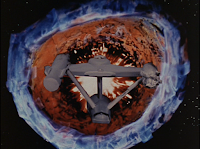
Reimagining Moby Dick by way of Fred Saberhagen’s Berzerker stories, Norman Spinrad’s episode
"Doomsday Machine" stands
the test of time as a solid
character study of obsession
and loss. 
(Image via StarTrek.com)

“Doomsday Machine” is a terrific adventure story that combines big science fiction ideas with memorable character moments. William Windom as Commodore Matt Decker is one of the all-time great guest appearances on Star Trek.

On the other end of the spectrum, “The Trouble With Tribbles” is a more lighthearted episode about an agricultural shipment, a grain-eating pest, and Cold War tensions. The dialogue in the episode is memorably sharp with quippy lines like “hauled away as garbage,” “a very little joke,” and “an ermine violin.” Some contemporaneous fans complained that the tone was too unserious, but with the benefit of hindsight, the episode holds up well.

To us, a more questionable inclusion was the Season 2 premiere “Amok Time,” a weird melodramatic episode about Spock’s return to his home planet of Vulcan. For those who haven’t seen it recently, it’s a buck-wild bit of ritual combat between Spock and Kirk as they are forced to fight over a woman. The “woman as a prize” theme should have been unacceptable in the 1960s, and certainly doesn’t hold up well today, the writing is mostly quite flat, and the depiction of Vulcans as a mystical culture that uses gongs excessively could be read as having some ugly coded subtext. This is one of the worst episodes for Kirk as a character; it’s unsettling to watch Kirk pressuring a subordinate to reveal personal info.

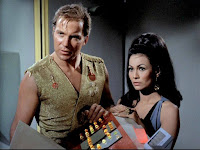
Although the ‘alternate universe’ episode has become a staple for most SFF TV shows, when Star Trek did
Kirk's visit to the darkest timeline
provided a template for all later
mirror universes on television.
(Image via StarTrek.com)

it with “Mirror Mirror,” the concept was still fresh. With the introduction of the concept to mass media television, they also hit a high water mark. The quality of Star Trek’s original cast shines through in this episode, as George Takei, Walter Koenig, and Leonard Nimoy all show why they would have been stars even if Trek had never made it to air. It must also be mentioned that guest star BarBara Luna is memorable as Lt. Marlena Moreau.

More has been written about the Hugo-winning episode, Harlan Ellison’s “City On The Edge of Forever,” than about probably any other single episode of televised science fiction. Given the weighty moral quandary (sacrificing love for the sake of history), and the solid character moments between the central trio of Spock, Kirk, and McCoy, the level of appreciation for the episode is understandable. What’s interesting is how quickly it was recognized as a classic, and immediately at the forefront of discussions of what should get the Hugo.

“City [on the Edge of Forever], which deservedly won the Hugo for best dramatic presentation, is probably the best drama, if not the best science fiction, ST has had to date, and I was happy to see it again” wrote Kay Anderson in her convention report.

What few complaints there were about a Star Trek-full category focused more on who had been left off the ballot; pundits such as Doug Lovenstem of the fanzine Arioch suggested that it was time for D.C. Fontana to win a Hugo Award (she would receive her only nomination 20 years later). Others noted the absence of “Devil in the Dark,” which is often regarded as one of Star Trek’s finest hours (and certainly better than “Amok Time”).

For our cinema club’s re-watch of these episodes, we’d all gone in expecting to agree with this consensus. But in the end, none of us were convinced that “City On The Edge of Forever” was the best episode; two of us preferred “Mirror Mirror,” one put “Doomsday Machine” at the top of their list, while another rated “Devil In The Dark” the most highly.

But at the 1968 Hugo Awards, two things were inescapable: Star Trek and Harlan Ellison. Five nominations to Star Trek, three to works penned by Ellison, and five to works that appeared in a publication edited by Ellison. In retrospect, this win seemed inevitable.

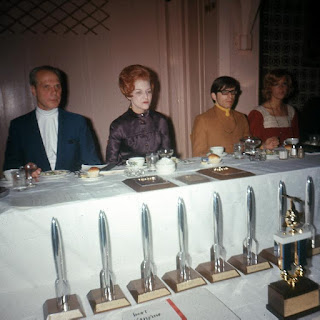
“The Hugos: Bjo doesn’t win. Dave Gerrold doesn’t win. Larry [Niven] doesn’t win. Harlan wins. There
The head table at the 1968 Hugo Awards banquet
Philip Jose Farmer, Betty Farmer, Harlan Ellison
(Image by Len & June Moffatt via Fanac.org)


is no justice in this world. I like Harlan, but there’s a limit to how many Hugos he should win,” Sandy Cohen wrote in Argus in October 1968. Ellison had ruffled his fair share of feathers throughout fandom, and it would eventually come to haunt him. But in 1968, Harlan Ellison was at the top of the SFF world, and probably his all-time most recognizable work took home the Best Dramatic Hugo.

The Best Dramatic Presentation shortlist in 1968 is a product of its time. It is likely that no SFF television show will ever have the impact that Star Trek did that year, and it is equally unlikely that there will be another year with as few viable contenders for the prize. (A clean sweep of nominations in the category has also been rendered impossible by rules changes).

In short: an odd year for the Hugos, but one where it’s difficult to argue too vehemently against the judgment of the fans.

Thursday, 30 December 2021

Best Dramatic Presentation Boldly Goes Forward (1967)

This blog post is the tenth in a series examining past winners of the Best Dramatic Presentation Hugo Award. An introductory blog post is here.  

With the benefit of hindsight, it seems only natural that Star Trek should win a Hugo Award in its first season.

The Hugo shortlist in 1967 included Fantastic Voyage,
Fahrenheit 451, The Menagerie, The Naked Time, &
The Corbomite Maneuver. (Image via IMDB)
At the time, however, this decision was not without controversy.

The Worldcon chair for 1967, Ted White, published a screed against the show calling its writers patronizing and ill-informed. Hugo-winning fan writer Alexei Panshin opined that Star Trek was filled with cliches and facile plots.

But for every voice criticizing the new show, there were several voicing their support. Big-name authors like Harlan Ellison and A.E. Van Vogt campaigned for the television series to win a Hugo, hoping that the recognition might buy it a second season. Writing in the fanzine Yandro, Juanita Coulson offered the definitive counterpoint: “The scorners of Star Trek do not seem to have an alternate dramatic piece of science fiction to offer; they usually do not like anything TV calls science fiction or fantasy.” 

It was by far the most talked about Best Dramatic Presentation ballot up to that point, with various pundits at turns praising Fahrenheit 451’s elegant direction, complaining about plot points in Fantastic Voyage, and analysing the merits of “The Corbomite Maneuver.” The quality of this debate, the resulting shortlist, and the final vote all look exceptional from the perspective of 2021; this was the year that the Hugo Award for Best Dramatic Presentation came into its own. 
In 1967, Gene Roddenberry was
one of the few Best Dramatic
Presentation winners to accept
the award in person.
(Photo by Jay Kay Klein


Considering the eligible works for this Hugo shortlist, one member of our cinema club (Paul) watched no fewer than 43 science fiction and fantasy movies that had hit cinemas in 1966, and concluded that Hugo voters could hardly have done better.

As we started watching movies and television shows from 1966, many of us had expected Fahrenheit 451, directed by François Truffaut to be the shortlist standout. However, we were surprised to find the movie had aged far more poorly than other works. Most readers will be familiar with the source material, which criticizes anti-intellectualism and post-literate culture, but this is an adaptation that does not live up to the provocative premise. The first half of the film moves at a pace that makes the Mendenhall Glacier look like quicksilver; and although the second half provides some good moments, it’s undermined by questionable choices around gender representation. That being said, Truffaut is a master of building individual shots, and some of the imagery continues to hit hard. Scenes which center the action on the television in Guy Montag’s apartment are visually arresting and prescient. The set design — both the use of existing architecture and the film’s own props — is iconic and lush. There are moments of brilliance in the movie; particularly a speech in which Captain Beatty cynically dismisses the value of books. In several other years, this might have been at the top of our ballots, but in 1967 it was outshone.

The most expensive science fiction movie to have been made up to that point, Fantastic Voyage, holds up somewhat better. Sparingly and effectively directed by Richard Fleischer, the movie follows a five-person submarine crew who are shrunk to microscopic size and injected into a scientist in order to perform life-saving brain surgery. Although far too many movies of the era over-explained their premise, Fleischer’s dialogue-free opening sequence is a masterclass in visual storytelling, showing the events that kick off the movie’s action.
A pleasure to burn perhaps, but not a pleasure to watch.
(Image via Pintrest)
It’s worth noting the quality of the visuals in Fantastic Voyage, which earned the movie two Academy Awards. Art Cruickshank’s visual effects pushed the limits of compositing technology at the time, while Jack Martin Smith and Dale Hennessy’s clean and functional design work made the secret military base setting seem real. The movie may have had a leg up on some of its competitors that year, since Isaac Asimov’s novelization of the movie had received mostly positive reviews. This might have been a very worthy Hugo winner, if it hadn’t been for the genre-defining presence of Star Trek.

From the day that Gene Roddenberry first showed “The Cage” and “Where No Man Has Gone Before” at the 1966 Worldcon in Cleveland, Star Trek had dominated discussions of science fiction. One unsigned complaint in the fanzine Algol notes “somewhat more than half of every fanzine I have seen this year was concerned with one subject and one subject alone: Star Trek.” Three episodes made the ballot in that first year: “The Menagerie,” “The Corbomite Maneuver,” and “The Naked Time.” 

“The Naked Time,” which aired first of the shortlisted episodes, is without a doubt one of the most well-remembered episodes of the original series, if for no other reason than the image of a shirtless Sulu wielding a fencing sword. The episode — which depicts a touch-transmitted disease that causes the protagonists to become disinhibited and act drunk — features some of the earliest moments of the series that show the range and depth of the characters. While “space makes people go mad” storylines were already a tired trope by the 1960s, the panache of the direction and the strong performances elevate the material. For at least one member of our viewing club, this would have been the top pick from the year.

In a slightly less-well-remembered episode, “The Corbomite Maneuver,”  the Enterprise crew is
We’d suggest that of the eligible episodes
(those that aired in 1966) both "The Conscience
of the King," and "Balance of Terror" might
also have made very solid inclusions on the ballot.
(Image via Youtube)  

confronted by an immense and implacable alien ship that seems intent on destroying them. At the risk of offering a heterodox opinion, the primary plot of the episode is less clever than its authors seemed to think, with Captain Kirk’s bluff reading as ham-handed. But despite this criticism, there’s enough in the episode to make it a worthy inclusion on the ballot. The theme of resolving conflict and building bridges between cultures is well handled. And this is one of the first opportunities to observe Kirk as a trusting and supportive captain.

“The Menagerie” is the only two-part episode of the original series of Star Trek. Making use of the original unaired pilot, it brings back the original captain Christopher Pike on a quest to return to the planet of Talos IV. Though it would be difficult to argue that it’s one of the best Trek episodes, it’s fine and provides backstories and insights about the show’s intentions. But fans had other reasons to support “The Menagerie” for the Hugo Award.

“We're agreed that we vote for “The Menagerie” and get the Hugo for Roddenberry personally, even though that wasn’t really the best episode,” Hugo-winning fanzine editor Buck Coulson wrote. “It's the only way to honor the man who made all the Star Trek episodes possible.”

Given how significant Roddenberry’s contributions to the genre would prove to be, it’s difficult to argue that Hugo voters got it wrong.

Wednesday, 8 September 2021

How I Learned to Stop Worrying and Love the Bombastic Ego

This blog post is the eighth in a series examining past winners of the Best Dramatic Presentation Hugo Award. An introductory blog post is here.  

On September 19, 1964, Harlan Ellison invited a group of fans over to watch an episode of television
Although Harlan Ellison was denied a Hugo nod
for his Outer Limits episode "Soldier," it remains
an influential classic. In retrospect, its omission
from the Hugo ballot seems questionable.
(Image via UltimateActionMovies.com

he had written: The Outer Limits season premiere “Soldier.” Although Ellison had written a handful of television episodes in the preceding two years, only one of those had been science fiction (an episode of Voyage to the Bottom of the Sea that he’d regretted).

Ellison told his Los Angeles-based fandom peers that “Soldier” was a milestone in his quickly growing fame, and that it would advance the reputation of science fiction on television. It was an episode of which he was proud, and one that he would spend much of the year promoting to Hugo voters as being worthy of recognition.

“The tension from a high-pitched show (and a higher-pitched host) was terrific. And at the end I felt I had spent a valuable hour even though I’m not yet a TV-watcher,” Ron Ellik wrote in his fanzine Starspinke.

Although Ellison would later have a large collection of Hugos, in 1964-65 he had yet to receive even a single nomination, and was hungry for the recognition.

In the January 1965 progress report of that year’s Worldcon (which was to be held in London) the convention’s organizing committee announced that they would present Hugos in the categories that had been recognized at the previous year’s convention. And as it so happened, Best Dramatic Presentation had been omitted in 1964, due to a lack of interest.

So there was to be no Best Dramatic Presentation Hugo Award that year, and “Soldier” would be denied the nomination that Ellison believed he was due.

The young Harlan Ellison 
already had a reputation for
bombast and temper. 
(Image via ElpasoPost.com)
Well-known for his level head and cool demeanor, Ellison responded to the omission of this category with good grace. He contacted a number of fans across the Western United States, suggesting that the Worldcon be stripped of their right to hold the Hugo Awards, with the possibility that the awards would instead be handed out at a North American convention. He went so far as to call Worldcon chair Ella Parker at 5 a.m. one morning in late January, and told her that Ben Jason would not be sending the Hugo trophies to the UK convention (though this was easy to disprove, as Jason had quit being the manufacturer of the trophies two years previously).

“When [Harlan] did finally phone-me, I lost no time informing him of his colossal blunder and, in no uncertain terms, advised him to write a letter of apology,” Jason wrote.

Though he backed down from that attempt, Ellison was adamant that there should be a Hugo for Best Dramatic Presentation in 1965, and encouraged other fans to write in nominations for the category … with the apparent belief that if the category was being considered that year, his Outer Limits episode would be a shoe-in.

But the 1965 Hugo Awards operated under a unique set of rules that have not been used since; as per the convention committee, the shortlist was created via “nomination by a panel of experts, selecting from suggestions offered by the membership at large.” In practice, this meant that no matter how many voters included “Soldier” on their nominating ballot, the Hugo Committee could omit it if they so chose.

In the final tally, this nominating committee chose to include only two names on the shortlist for the
At least one fan believed that
Disney classic Mary Poppins
deserved to be on the Hugo
ballot. We're inclined to agree.
(Image via EW.com)

Best Dramatic Presentation category in 1965; the only instance in any Hugo category of a shortlist that brief. As recorded in fanzines, it is clear that there were at least some nominating ballots submitted for “Soldier,” for Mary Poppins, and for The Last Man On Earth. But the Hugo Committee determined either that there weren’t sufficient nominations for these, or that the works listed weren’t appropriate for the Hugos.

It is a puzzling decision, particularly in light of one of the works they did include: The Seven Faces of Dr. Lao. Glacially directed by George Pal, and starring lilly-white Tony Randall as the racially stereotyped title character, it was agreed by most of our cinema club to be among the worst works ever shortlisted for a Hugo Award in any category. To compound the movie’s abhorrent racism, the dialogue spoon feeds the audience a series of simplistic moralist messages delivered with acting that is exceptionally exaggerated and broad. This is a movie that drips with condescension for its audience. The question of why The Seven Faces of Dr. Lao ended up on the Hugo shortlist remains baffling to us and leaves us wondering what Ellison’s emotional reaction might have been.

Best Dramatic Presentation was the last award handed out on the evening of August 29, 1965. “And we have a remaining category, for Best Drama. It goes to Dr. Strangelove,” presenter Robert Silverberg said. “We do not have Dr. Strangelove himself here to accept the award, but we do have Peter George who wrote the novel on which the movie was based.” 

The extent of George’s acceptance speech (as far as we are aware, the shortest Hugo acceptance speech on record) was: “Thank you very much. This is lovely.”
Dr. Strangelove author Peter George
accepts a Hugo Award in 1965.
Sadly, the author died of a self-inflicted
gunshot wound within the year. 
(Image via Fanac.org)

Dr. Strangelove is only marginally science fictional; the only element of the movie that is clearly speculative is the doomsday weapon, although there had long been a tradition of nuclear war fiction without any speculative technologies being considered for the Hugo — The Long Loud Silence by Wilson Tucker had been the runner-up for the very first Hugo Award in 1953. Still, for at least one of our bloggers this deficit of clearly science fictional elements in Dr. Strangelove was enough to bring into question whether it should have been recognized at all.

The shortlist from 1965 was probably too short, as there were numerous works that year whose omissions are puzzling. Matheson’s classic I Am Legend had been adapted as The Last Man On Earth, an effective and moody Hammer Horror movie starring Vincent Price. Later remade as The Omega Man, the original version hews more closely to the novel than later adaptations, and features a superb performance from Franca Bettoia who imbues her vampire character with enormous humanity. The intense loneliness conveyed in the movie is a more moving form of horror than any of the jump scares of Will Smith’s later I Am Legend.

We might also suggest that the Hugo shortlist might have done well to find room to honour The Earth Dies Screaming; a quirky low-budget British movie about an alien invasion. Despite its low budget, the film’s robots and zombies are often an effective storytelling device as the tension ratchets up. It’s difficult not to note the more economical pace of this low-budget movie, and how tightly edited it is, in comparison to the high-budget but soporific Seven Faces of Dr. Lao.

Overall, it is hard to question the decision of Hugo voters that year; Dr. Strangelove despite its paucity of obvious science fictional elements was the right work to recognize. The decisions of the nominating committee are less transparent (how did this committee work? What did they leave off and why?). Though some of us might have preferred to see Ellison’s “Soldier” receive the honour, as it was a far more science fictional story, his bad behaviour may have prevented him from snagging his first Hugo in 1965.