The most important year in the history of science fiction is 1973, because that’s when science fiction ended.
All fiction is political, and science fiction was the literature of technological triumphalism as a political idea. Like the Western pulps that it largely supplanted, it was primarily an American phenomenon from its inception as a defined genre in the late 1920s. And, like all literature, it was steeped in assumptions about societal and economic progress. The 1970s witnessed determinative changes in these assumptions, shifting the genre’s trajectory beyond recognition.
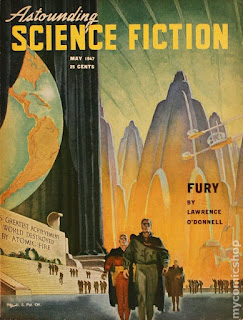 |
| (Image via MyComicShop.com) |
First, a bit of context. While individual stories that we would now class as science fiction existed prior to the 1920s, the genre became codified and defined through the early pulp era. This meant that genre traditions, tropes, and conventions were formed at a time when more new technologies were entering common use in the Western world than at any time before or since (automobiles, telecommunication, washing machines, etc.).
During the five decades of science fiction’s ascendancy as a defined genre, income inequality in the US was on the decline; between 1929 and 1941, the share of total GDP taken as income by the top one per cent of America’s richest people declined from about 20 per cent to 15 per cent. By 1952, that had declined to just eight per cent of the total GDP going to the top one per cent. Combined with the simultaneous doubling of per-worker productivity, this meant a radical improvement in the lives of working Americans.
Three parallel trends of technological, social, and economic progress made it a fecund era for imagining pollyannaish interplanetary monocultural futures clad in chrome and plastic. In just a 30-year span, Jack Williamson went from traveling by covered wagon to traveling by airplane, so one could understand why he might assume that in an additional 100 years people would be going to the stars.
And this is why the year 1973 is so important: it’s the year that shattered the fundamental assumptions that guided science fiction over the previous five decades. This happened in several important ways.
After Apollo 17 left the moon on December 17, 1972, vonbraunian dreams of a rocket-powered conquest of space began to look naïve. Though clearly technology continued to advance, this progress was less and less about raw power, and more about subtlety and efficiency. As the space race ended, the idea of a final frontier was relegated to increasingly fantastical fiction.
It was the same year in which inequality in the US began to increase after almost 50 years of decline. Since then, inequality has gone from eight per cent of income going to the top one per cent in 1973 to almost 30 per cent going to the top one per cent today.
Likewise, the unionization rate among American workers began its steep decline in 1973, from 26.7 per cent of workers belonging to a union to just 13 per cent in 2011.
In 1893, then 33-year-old historian Frederick Jackson Turner addressed the American Historical
Association and presented his theory on the closing of the American frontier: "The frontier has gone, and with its going has closed the first period of American history." Part of his thesis was that this closure had a profound impact on the national imagination of the United States, and it’s difficult to disagree with this assessment.
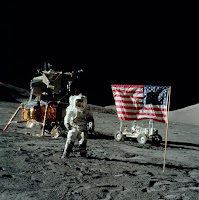 |
| They left, much as they had come: In peace, for all mankind. (Image via NASA.gov) |
Association and presented his theory on the closing of the American frontier: "The frontier has gone, and with its going has closed the first period of American history." Part of his thesis was that this closure had a profound impact on the national imagination of the United States, and it’s difficult to disagree with this assessment.
Likewise, it seems clear that the closing of the lunar frontier had a drastic impact on the imagination of the citizens of science fiction fandom.
When coupled with the fact that 1973 was a turning point in Western economies, the result is even more drastic.
When people imagine the future, they usually imagine one in which they have a part. So the exclusion of the working class from economic progress effectively limited the imaginations of many.
Many of these economic shifts have been attributed after the fact to the 1973 oil crash that marked the end of the era of cheap oil, and ushered in an era of greater control of prices by oil producers. It is possibly the most important economic shift that America has faced since the 1929 stock market crash.
It has often been observed that the secret weapon of science fiction authors is economics; in essence, that insights from economics are crucial to building believable fictional models of the future. So it should be no surprise that these shifts in long-term economic trends had an impact on the types of technologies that science fiction predicts.
Space adventure stories fundamentally shifted from being a near-future genre to being closer to fantasy. It became more and more difficult to suggest that futures depicted in works like A Fall Of Moondust, Farmer in the Sky, or The Caves Of Steel were based on any serious extrapolation of current trends. Also, declining economic fortunes became more of a focus of the genre. Although the term wouldn’t be coined for several more years, we could argue that cyberpunk’s birth was 1973 when John Brunner began writing The Shockwave Rider, and when James Tiptree Jr. published The Girl Who Was Plugged In.
The time it takes to write, edit, and publish a novel means that the distinction between pre- and post-1973 speculative fiction is fuzzy — but evident once you start looking for it.
We would argue that (without privileging one or the other) this shift from technological-triumphalist
new-frontiers speculative fiction to economic anxiety-driven social speculation is a significant enough change of focus that they are distinct genres. Science fiction as it had been understood ended, and something else took its place. We might argue that post-1973, the genre split into speculative fiction (cyberpunk, mundane SF, cli-fi) and science fantasy (space opera, time travel).
 |
| In this interpretation of history, Ursula K. Le Guin could be the progenitor of modern speculative fiction. (Image via NYTimes.com) |
new-frontiers speculative fiction to economic anxiety-driven social speculation is a significant enough change of focus that they are distinct genres. Science fiction as it had been understood ended, and something else took its place. We might argue that post-1973, the genre split into speculative fiction (cyberpunk, mundane SF, cli-fi) and science fantasy (space opera, time travel).
This new chapter in the history of speculative fiction has been increasingly diverse, less in thrall to destructive hegemonic ideas peddled by an influential early editor of a major magazine, and certainly less centered on the United States. As a result, the intellectual descendants of science fiction have been able to connect with the larger culture in ways that their predecessors were never able to. It is hard to imagine the ascendancy of pop cultural phenomenons like Star Wars and Guardians Of The Galaxy in a genre that was still tied to positivist (and occasionally objectivist) outlooks.
Arguably, the disruption of the COVID-19 pandemic is as significant an economic event as the Great Depression and the 1973 Energy Crisis. Perhaps it will be the event that moves speculative fiction into the next era.


