Showing posts with label Hugo Awards 2019. Show all posts

Wednesday, 10 July 2019

Trail of Lightning: Shockingly Good

Rebbeca Roanhorse’s debut novel Trail of Lightning might appear at first to be a run-of-the-mill
Rebecca Roanhorse at the 2018
Worldcon, where she won her first
Hugo Award.
(Photo by Olav Rokne)
urban fantasy, but it offers the astute reader a culturally-rich narrative.

Set against a multifaceted, frightening future where North America has been ravaged by man-made climate change, Trail of Lightning pits deadly, other-worldly monsters against people with superhuman powers.

Those familiar with Indigenous storytelling practices will be at home with Roanhorse’s writing style, in which metaphor and allegory are used prominently, and more-than-human relations (ie. relationships between humans, nature, animals, and spiritual beings) are common and understood (well, as much as any relationship can be understood).

While mainstream audiences may interpret these stories as myth or as speculative fiction, Indigenous storytelling traditions are more likely to recognize the philosophical and pedagogical nature of these narratives. At times, the stories shift from Aesop-like cautionary tales like that of the windigo, to stories that teach values like the story of Kunuuksaayuka. Roanhorse’s work expands on these traditions and exposes them to a new audience.

Like the Binti trilogy, the culturally-specific narrative anticipates that the audience can adjust, learn,
Trail Of Lightning blends Indigenous
narrative tradition with genre tropes.
(Image via Tor.com) 
and experience what is new to them. At times, etic readers may find this overwhelming, but The Six World series makes the effort worthwhile. Roanhorse doesn’t explain certain terms or phrasing in the first chapters because the protagonist and narrator, Maggie Hoskie, doesn’t need exposition. It’s the reality she lives in and knows. While it may be new to readers, it functions as an immersive experience.

The backdrop of apocalyptic climate change inspired discussion about its possible misuse as a fictive understanding of climate change itself (that is, as an argument against the science behind the evidence-based phenomenon). Others argued that the fantastical nature of the climate change seen in Trail of Lighting was used as a narrative tipping point. That is, the supernatural regains control after humans have mucked up the fifth world. Everyone seemed to agree that the setting made for an interesting element in that it constrained the protagonist from understanding the whole of the world.

With this idea of iterative ‘worlds’ that the planet experiences, it is hard not to compare the work to N.K. Jemisin’s much-lauded Broken Earth trilogy. Both works involve a world broken by Euro-settler hubris, both involve protagonists with superhuman gifts; and both are centred in cultural understandings. Likewise, one can see parallels between Trail of Lightning and American Gods, through its conflicts between the known world and the transcendent.

These comparisons, however, may place Trail of Lightning at a disadvantage, because as an introductory novel, it does not show the same writerly craft as these illustrious predecessors. In particular, some of the character development in the book shows some weakness and inconsistency — Maggie Hoskie’s simmering anger and grimness is a bit lacking in nuance. Given her self-reliance and independence, it’s disappointing to see her make mistakes because of a cliche romantic entanglement.

It is also interesting to compare Trail of Lightning to another 2018 Indigenous post-apocalyptic novel
Anishinaabe journalist Waubgeshig Rice
is another Indigenous writer whose SF
we would heartily recommend.
(Image via CBC.ca) 
Moon of the Crusted Snow by Anishinaabe writer and journalist Waubgeshig Rice, which was on several of our 2019 Hugo nominating ballots. This Canadian bestseller might have been overlooked by the broader science-fiction community, but Rice’s tale deserves more attention for his depiction of the collapse of society from the perspective of those who have marginalized for generations. It is an extraordinary science fiction novel. For those whose appetites for this type of narrative have been whet by Roanhorse’s book, we highly recommend this book.

Overall Trail of Lightning is an engaging read that brings an important and often marginalized viewpoint to a broader science fiction audience. Despite some of our criticisms of characterization, Roanhorse’s deft weaving of cultural knowledge, myth, metaphor and real-world challenges put this at or near the top of many of our ballots.

Sunday, 9 June 2019

Space Opera — Review

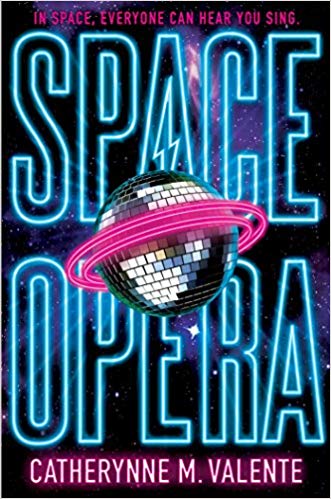
At our book club discussion of the Hugo-shortlisted novel Space Opera, there was a consensus that
Derivative and listless,
Space Opera failed to
meet expectations.
(Image via Amazon.com)
Catherine Valente is an author worthy of a best novel rocket ship on her mantle. We also agreed that Space Opera is not the work that should earn it for her.

Valente’s 2015 novel Radiance is criminally underrated. Thoughtfully tackling issues of patent hoarding and the resulting stifling of innovation, Radiance makes the case for the continued relevance of steampunk as a genre. The structural story-within-a-story techniques shows what Valente is capable of as an artist – this is a non-linear tale that could only really work as a prose novel.

Her 2011 novel Deathless is an engaging – and approachable – historical fantasy that weaves together fairy tales with the Russian revolution. It could be compared to something between Naomi Novik’s Uprooted and Susanna Clarke’s Jonathan Strange and Mr. Norrell.

And by contrast, Valente’s previous Hugo-shortlisted novel Palimpsest is an emotional tour-de-force about desire and possibilities. Deftly imagined – and artfully lyrical – Palimpsest is both a dreamlike and challenging book that readers will continue to get something out of on repeat readings.

Clearly, Valente writes first-rate books, in a wide range of styles and voices. There had not been a single one of her books that anyone in our book club had read and failed to enjoy… until Space Opera.
Catherine Valente is
capable of first-rate
novels, such as the
underrated gem
Radiance.
(Image via Amazon)


There are moments of entertainment in Space Opera’s numerous asides to metagalactic history, but the book is hampered by a surprisingly slow pace, thinly drawn characters, and a weak plot. Most troublesome for fans who wanted to love it, Space Opera is occasionally fun, but rarely funny.

While it’s obvious that not all comedy will appeal to all readers, those who study comedy contend that most successful jokes depend on a subversion of expectations. This is difficult to accomplish in science fiction in part because an author’s imagined strange new worlds are at their core an alienating experience for the reader; thus readers often have fewer expectations that can be successfully subverted.

Throughout Space Opera, every expectation is fulfilled, whether it’s the concluding clause of a sentence that reinforces the overarching point rather than subverting it, or the narrative arc of a character following a predictable cliched path.

In his classic work Hitchhiker’s Guide To The Galaxy, Douglas Adams managed a subversion of expectations repeatedly – often through deft linguistic legerdemain in which an end clause subverts the beginning of a sentence (I.E. “The ships hung in the sky in much the same way that bricks don’t.”), or by taking science fiction tropes to their logical but absurd extremes.

It is difficult not to compare Space Opera to Hitchhiker’s Guide. The latter work is not only the most famous science fiction comedy of all time, it’s set in a chaotic and diverse universe that is a clear antecedent to Valente’s book. This leads to similar joke setups, and similar punchlines.

And this becomes one of the major problems with the comedy in Space Opera; all sentences and actions live up exactly to expectations, especially if you’ve read any Douglas Adams.

As example, when Valente describes various animals that produce economically viable goods (such
If there's ever a movie adaptation
of Space Opera, we hope that the
role of Decibel Jones is played
by comedian Carlos Mencia.
(Image via ComedyZone.com) 
as a goat that “dispenses ice cream, brie, and buttercream frosting”) due to the random vagaries of evolution, it bears remarkable similarity to Adams’ section of the third Hitchhiker's book Life, The Universe And Everything in which we are introduced to the wild mattress creatures of Sqornshellous Zeta. When Valente treads the same territory as her predecessor, the comedic twist is lost, because you know where the joke is going.

In addition, Valente seems to use polysyndeton as a replacement for wit; “the glitter and the shine and the synth and the knowing”; “You are bizarre and disgusting and interesting and fixated on fetishes”; “Do you have enough empathy and yearning and desperation to connect to others outside yourself…” Sadly, this excessive use of the word ‘and’ just becomes tiresome.

It is uncomfortable for us to describe any book on the ballot as undeserving of the rocket, especially a book from an author for whom we have so much affection and respect. Unfortunately, none of the book club’s members plan to vote for Space Opera, and some couldn’t see placing this book above No Award.

Wednesday, 5 June 2019

Spinning Silver — Review

There is much to admire in Spinning Silver, and we can understand the evident passion that many
Image via Amazon.co.uk
readers have for Naomi Novik’s latest novel.

For one, Novik’s deconstruction, reimagining, and reconstruction of Rumpelstiltskin is both insightful and inventive. The systemic misrepresentation of non-majoritarian religious groups in folk tales – and the antisemitism of Rumpelstiltskin in particular – needs to be challenged. Novik provides an interesting approach, reframing these folk narratives with point-of-view characters who belong to marginalized groups.

Additionally, the animistic universe depicted in Spinning Silver provides an opportunity for an environmental metaphor that Novik weaves into the narrative carefully and subtly. Environmental issues (destruction of habitat) drive one of the major sources of conflict in the novel, and provide motivation for the primary antagonists.

Issues of race, gender, and environmental degradation are weighty subjects for a fairy tale, and could have made the book feel didactic. But Novik creates a narrative that feels natural and timely.

However, the book is not always fun to read. There is a ponderous, at times leaden, nature to the prose, which is often weighed down by excessive dependent clauses.

It will seem overwritten to some readers, like the author was less focused on readability than on crafting rococo sentences.

On the other hand, this excessive (posed) artfulness does have an upside. In some moments Novik hits the nail on the head with sublimely quotable sentence, like “Anger was a fire in a grate, and I'd never had any wood to burn. Until now, it seemed.” Some readers will find these gems worth the slog, while others are likely to grind their teeth at the paragraphs-upon-paragraphs of self indulgence.

Some of us felt that the three main narrators – Miryem, Wanda and Irina – all speak with a very similar, and at times condescending, voice. For example, the reader is often told how to feel, which can prevent the emotional engagement that comes from actually feeling emotional attachment to the characters.
Many of the assumptions in classic
fairy tales need to be challenged,
and there are few who do so as
thoughtfully as Naomi Novik.
(Image via NPR.org) 

The argument could be made that Miryem, the moneylender’s daughter who is involved with the supernatural Staryk, needs to drive a condescending narrative, given her haughty character and the well-earned distrust of her peers. However, when Wanda is narrating, this level of condescension feels weirdly out-of-place.

Other readers feel the three main narrators are distinct and engaging enough, but still agree that some of the tertiary narrators stand out as particularly unnecessary. Chapters told from the point of view of the vain and shallow lord are largely irrelevant and grating.

It should be noted that having a complex and not-always-likable protagonist in Miryem is something we appreciated. Compared with certain other slightly-twee female protagonists in other Hugo-finalist novels this year, Miryem stands out as a compelling and interesting character.

Overall, Novik has done so much so well in Spinning Silver that it will likely be close to the top of many of our Hugo ballots. Despite its flaws, we would not be disappointed to see it win the award, given the thoughtfulness and insight Novik displays in the narrative construction.

Saturday, 27 October 2018

An appreciation of Alasdair Stuart

Alasdair Stuart’s mild Manx accent might be one of the more recognizable voices in science fiction.
Alasdair Stuart and his Escape Artists
crew at the 2018 Hugo Awards
(Photo via Olav Rokne & Amanda Wakaruk) 
Any science fiction fan who listens to podcasts is likely familiar with his work as host of Pseudopod, as well as his frequent contributions to other podcasts in the Escape Artists network.

In addition to this high-profile work, Stuart’s contributions appear in a variety of venues including the Barnes and Noble’s website, Tor.com, SYFY.com, his personal blog, and many, many more. Stuart is prolific and varied in his output, and much of it could be classed as fan writing. 

Which is why it is surprising that Stuart has yet to appear on the Hugo Award ballot in the Best Fan Writer category. Last year, he was a scant 13 nominating votes shy of being a finalist. Several members of our book club have had him on our nominating ballots repeatedly over the past few years; hopefully this will be the year that finally sees him recognized by his peers.

In terms of simple quality of writing and argumentation, Stuart has long been one of the finer writers
Stuart may be a bigger fan of Doctor
Who
than we are. But his analysis
is always worth reading.
(Image via Variety.com)
engaging in critical examinations of science fiction, fantasy, and fan culture. This is not to say that we necessarily agree with Stuart’s analysis of every matter (particularly when it comes to his unflagging support of Doctor Who), but his arguments are always worth consideration.

But more than this, 2018 has so far been a particularly good year for Stuart’s oeuvre. He’s provided us with an examination of storytelling as a tool, he’s written an ode to Burt Reynolds work in science fiction, he offered an argument for hope, and he’s watched and reviewed all the Predator movies (so you don’t have to).

In one of our favourite pieces, he writes: “Stories teach us how to live in the world and how to make the world better for those who follow us and for ourselves. They are a memetic exoskeleton that has wrapped around humanity as long as we’ve been humanity. Stories teach us how to be us.”

Stuart also contributes to the science fiction community through guesting on innumerable podcasts and blogs. He has shown a willingness to help out small-time operations, and to signal-boost causes he feels are worthwhile.

Eligibility for the Fan Writer category explicitly excludes work that appears in professional publications. However, any person’s Fan Writing is going to be judged within the context of their overall output, and many professional and semi-professional writers have been honoured as fan writers. For example, it would be disingenuous to suggest that the people voting for Bob Tucker in 1970 were unaware of his professional work or his significant contributions to fandom.

In that spirit, it’s worth noting Alasdair Stuart’s broader works within fandom this year, such as his examination of Hugo finalist The Deep, by Clipping, his interview with Brooke Bolander on Barnes and Noble’s website, and his hosting of Pseudopod. 

To bolster the case that Stuart’s active fandom should be recognized, we ask Worldcon members to consider his rescuing of the Escape Artists network when they were going through troubled times in 2013, his strong presence on Twitter, and his contributions to innumerable conventions and panel discussions.

As the owner of — and part of the team that creates — the Escape Artists podcast network, Stuart had a hand in one of last year’s Best Semiprozine finalists. But that is a group nomination, and it doesn’t recognize Stuart individually as a writer or as a fan. 

Even if the award for Best Fan Writer has only existed since 1967, variations such as “Actifan,” “Reviewer” and “Fan Personality” filled a similar role in earlier years. In its current form as one of our most community-driven awards, Best Fan Writer might be the award that is at the heart of what the Hugo Awards represent. Fan writing is a community-building activity that has been important to the genre since before the Golden Age of science fiction.

By carrying on traditions that have existed since the dawn of fandom, Alasdair Stuart embodies exactly the type of fandom that the Best Fan Writer Hugo should celebrate.

Saturday, 20 October 2018

The Calculating Stars — Review

In The Calculating Stars, Mary Robinette Kowal offers an answer to one of alternate history’s most
The space race accelerates
in Mary Robinette Kowal's
new novels.
(Image via Amazon.com)
important questions: ‘What if Seveneves was fun to read?’

While we quite enjoyed Seveneves, many readers described it as a bit dry.

A comparison between the two books is apt. Seveneves and The Calculating Stars are books that explore many similar ideas, but they do so in very different ways that will appeal to different people.

Both works start with a celestial catastrophe that will eventually make the planet uninhabitable and feature a re-invigorated space program that finds ways for the human race to continue without the Earth. Both works have feminist themes and both offer perspectives about how science and politics conflict.

Although The Calculating Stars is an alternate history in which an asteroid impact jump-starts an international space program in the early 1950s, it hews to the conventions and structures of the classic science fiction space exploration novel. This story is less about how the historical dominoes fall after a point of divergence, and more about how people work together to solve problems.

These problems range from purely technical ones, such as survival over long periods in outer space, to larger social challenges such as combating institutional racism. It is evident that Kowal has done her research on these subjects, delving into historical accounts of racially marginalized workers in the early days of the US space program.

The book’s protagonist Elma York is a mathematical prodigy and pilot who fights an uphill battle to become one of the first women in space. She is a likable protagonist from a very Heinleinian model - smart, resourceful and self-effacing. Her anxiety and self-doubt may get a bit grating at times, but the author does use these character issues to make serious points about the stigmatization of mental illness.

One of the aspects of the book that is particularly strong is the supporting cast, from the primary
Mary Robinette Kowal is best known
for her Hugo-winning short story
Lady Astronaut of Mars, which has
been expanded into these new novels.
(Image via Goodreads.com)
antagonist, heroic astronaut Stetson Parker, to Elma’s husband Nathaniel. It was refreshing to see a well-developed healthy romantic relationship in fiction. It was equally refreshing that every antagonist in the book was more than a one-note caricature — Parker has redeeming qualities despite his attitude towards Elma.

Mary Robinette Kowal is a clear, concise and thoughtful writer who structures her novels efficiently. The approachable writing style, enjoyable characters and straightforward narrative — not to mention the 1950s-era technological triumphalism — make the book feel like something Heinlein might have written had he been just a little more woke. 

Science fiction and fantasy have seen far too many trilogies over the years where the middle volume is largely irrelevant. Thankfully, Kowal eschews this trend by telling a story in two volumes, concluding with the sequel The Fated Sky. The narrative leaps forward in time by several years, but the story does not suffer. In fact, one wonders how many series might have been improved by such storytelling discipline.

Both Calculating Stars and The Fated Sky were published in 2018, and they could be nominated for best novel in tandem with one another, much as Connie Willis’ Blackout and All Clear were in 2011. But to our minds, the first of Kowal’s books is the strongest, and could easily have stood on its own. From the opening pages, in which Elma and her husband face disaster, all the way through to its elegant conclusion, this is an engaging narrative.

There is a long tradition of Hugo-Award winning short works being expanded into longer works that are later shortlisted in the best novel category. It would not be surprising to see The Calculating Stars — which is a prequel to Kowal’s Hugo-winner Lady Astronaut of Mars — make it to the Hugo ballot. We would be very pleased to see it there.