Showing posts with label Norman Spinrad. Show all posts

Wednesday, 26 July 2023

太空纳粹死光光 (Space Nazis Must Die - Mandarin Translation)

希特勒的打手在科幻的世界里留下了巨大的阴影。

纳粹士兵的身影,浮现在《星战》的帝国军队、Doctor Who 中的“达立克” (Dalek), 《萤火虫》系列影视剧中的联盟,以及 Blake’s 7 剧集中的地球联邦突击队这些虚构产物中。
“我们会在(冲浪)
沙滩上与敌人战斗到底……”
(图片来自 IMDB.com )


展现纳粹外延的电影中往往有意选用特定的外在形式,包括雨果博斯式精工剪裁的军服,行军如条顿骑士般马靴叩地发出的脆响,以及阅兵场和耀眼的军旗等里芬施塔尔风格的电影视觉元素(指 Leni Riefenstahl, 执导德国纳粹宣传片《意志的胜利》)。这一类电影中还时常或明或暗地显示其虚构的兵士是受某种形式的种族主义意识形态驱使而作战,不过其具体细节往往让人如坠五里雾中。

不过我们要把话讲明:纳粹不是什么好东西。

纳粹分子不管出没何处,都应该人人喊打:无论是战场还是选票上、大街上,乃至幽暗深邃的星际空间。只有这样,在作品中为纳粹反派(及其纳粹思想)着墨才有其价值。

相反,如果仅仅是加以塑造,而不去揭示其心理动机的深层次来龙去脉,这样的作品是先天不足的。“纳粹”作为恶势力的外在符号,拿来随便一用再方便不过了,很容易用来逃避“恶的意义”这一课题。不错,帝国兵在《星战·帝国反击战》中害死了不少人,不过《釜山行》中的僵尸、《龙卷风》电影中的暴风,或者《异形》中的外星生物同样杀人如麻。《帝国反击战》中没有个体面孔的茫茫兵海,起到的作用无非是充当激光枪的靶子。在护目头盔和雪白亚克力防弹服之下,我们感受不到内在世界。

在作品中使用抽象化的纳粹,带给观众或读者的是一种用来建构世界背景和人物的速记符号。它传达的是一种让人麻痹的(伪)二元对立,让受众舒舒服服地理解纳粹 = 反派,从而其敌对方 = 好人。这就给文化消费者免去了自己思考善恶的负担。

科幻题材中,还是时不时出现若干对法西斯主义或法西斯分子更加尖锐、更有价值的塑造。保罗·范霍文执导的《星船伞兵》电影就变出了一台精彩的戏法。首先,片中借用政治宣传片技巧将地球联邦一步步塑造成一股正面的英雄力量,然后才渐渐让观众醒悟过来,发现自己已经被骗得为纳粹叫好。诺尔曼·斯宾拉德的《铁梦》所探索的,是英雄主义幻想叙事与法西斯主义的神话谱写为什么植根于相近的传说式历史观。此外,弗诺·文奇的《天渊》则探讨了人的自由如何被纳粹利用。

用纳粹作为代码的反派在科幻中数见不鲜,
从《星战》到伍迪·艾伦的无厘头电影 Sleeper
皆如是。然而,
这些电影是否做到了引发观众思考着类符号的真正含义呢?
(图片来自 Overture 杂志 )
不过,科幻中主流的纳粹意象,还仅仅停留在一袭戏服的层面。

考虑这样的事实:现实世界中有些摆明了身份、不以为耻反以为荣的纳粹主义者,同时也是《星战》铁粉。但我们要问的是,他们看不到自己和《星战》间的联系吗?《星战正传》三部曲试图激发的批判性思考如此有限,以至于我们完全可以想到这样的场景——有这么一种人,在选举当天荷枪实弹地游弋于投票站附近,专门恐吓来自少数族裔的选民;完事后回到家中,打开电视播放一部《星战正传》之《曙光乍现》,为银河抵抗军呐喊助威。同样,虽然“501部队”粉丝团乐于摇身一变打扮成邪恶政权的军人,但这些假扮的暴风兵绝大多数其实是良好公民,而非达斯·维德的忠实鹰犬或者帕尔帕廷大帝思想的好学生。我们无意将这两类人不恰当地等同起来,只是想指出,《星战》中对法西斯主义的刻画向来有多含糊、多贫乏,从而给观众留下的自由感悟空间只能局限于多么肤浅的层次。

这也就是为什么最近几部的《星战》作品令人耳目一新。Andor 剧集带领观众以多层次的视角深入帝国内部,探索专制制度对其参与者的诱惑。其中描绘的,有资产阶级从压迫中获利,享受虚妄的安全感;有中层干部膜拜秩序,抓紧机会向上爬;还有一些底层的劳动者,为了在屠夫刀俎下苟延残喘,不惜出卖同道中人。这么说可能会被当作是夸张了,但我们的感觉是,这部剧集所构建的,堪称是法西斯主义者的分类学——《奥杜邦学会常见纳粹观测入门》。
Andor 中出色地表现了将人视为工具的法西斯主义倾向,
以及监狱系统中的劳动剥削。
不过,还是有些粉丝不解其中意
(图片来自 [Polygon])。


Andor 展示了《星战》宇宙中的法西斯主义者不只千人一面。因此,帝国在这样的描写下更能让人信服,其帝制政体也更加令人不寒而栗。科幻界需要更多这样的作品。虚构的故事可以发生在很远很远的星系……然而,法西斯主义其实一直没有滚到离我们足够远的地方。

(注:原标题 Space Nazis Must Die, 取自B级片 Surf Nazis Must Die, 见配图。)

本杂志编撰团队感谢雨果奖提名,并借此机会挑选了2022年度若干得意之作翻译成中文,以飨参加本年度世界科幻大会的中国友人。译者:Zoë C. Ma [https://zoe-translat.es/]

Thursday, 10 November 2022

Space Nazis Must Die

Hitler’s goon squad casts a long shadow over science fiction.
 “We will fight them
on the beaches...”
(Image via IMDB.com)


It’s easy to see the outline of Nazi soldiers in the Impirial Military of Star Wars, Doctor Who’s Daleks, The Alliance in Firefly, or the Terran Federation shock troops in Blake’s 7.

Deliberate choices are made in films to offer the connotation of Nazi, often including immaculately tailored Hugo-Boss-style uniforms, Teutonic heel taps of the jackboots when marching, and Riefenstahllian visuals of parade grounds and iconic banners. Sometimes, there’s a suggestion that these fictional soldiers are motivated by some form of racist ideology, though the details of this are usually nebulous.

Let’s be clear here: Nazis are bad.

Nazis should be opposed wherever they exist: on the battlefield, at the ballot box, in the streets, and across the tenebrous depths of interstellar space. As such, depicting villains as Nazis — and therefore Nazism as villainous — has value.

But depiction without engaging with the premises of motivation is lacking. “Nazi” is such an easy signifier for evil, it often allows these narratives to avoid engaging with what evil actually means. Sure, Imperial Soldiers kill a lot of people in the Empire Strikes Back, but so do the zombies in Train to Busan, or the tornado in Twister, or the Xenomorphs in Alien. The faceless hordes provide little more than target practice for laser rays; there’s no interiority behind the mirrorshades and white perspex armour. 

Using the symbolic Nazi provides a type of worldbuilding and character shorthand for the viewer, or reader. It conveys a (false) dichotomy that provides comfort; a comfort in knowing that Nazi = bad and the other side = good. It gives the consumer a break from having to figure out bad from good for themselves.
Nazi-coded villains can be found in all kinds of SFF
from Star Wars to Planet of the Apes to Woody
Allen’s Sleeper. But do these movies invite the
viewer to consider what this iconography means?
(Image via Overture Magazine)


Science fiction’s depiction of fascism and of fascists is occasionally more pointed and valuable. Paul Verhoeven’s Starship Troopers plays a brilliant bit of sleight of hand, first building up the Terran Federation as a heroic force through propaganda techniques, then slowly revealing to the audience that they’ve been duped into cheering for Nazis. Norman Spinrad’s The Iron Dream explores how heroic fantasy narratives are rooted in similar assumptions to the mythologized history that underpin fascist mythmaking. And Vernor Vinge’s Deepness In The Sky explores new ways for human freedom to be subverted by Nazis.

But the predominant conception of Nazis in science fiction is little more than a costume.

Consider: there are overt and unrepentant real-world fascists who are die-hard Star Wars fans. But we wonder – do they see the linkage? The classic trilogy encourages such minimal critical engagement that it would be easy to imagine someone spending a day at a polling station with an assault rifle intimidating BIPOC voters and then go home and watch the Special Edition of A New Hope and cheer for the Rebellion. Likewise, it’s not uncommon to see left-wing pro-democracy activists involved in
The fascist tendency to view human beings as
tools, and the prison system as a source of 
expendable labour is depicted well in Andor.
Some fans didn’t get the message. 
(Image via Polygon)

the 501st Legion and dressing up as fascist Stormtroopers on a regular basis. This is not to play any false equivalence between these two groups; but rather to point out how vague and tenuous the depiction of fascism has traditionally been in Star Wars and how this leaves the viewer free to engage with its narratives at a superficial level.

And all of this is why the most recent iteration of Star Wars is so refreshing. Andor presents a multi-layered view at the Empire that explores the seductive power that authoritarian systems can have on their participants: the capitalist class that profits from oppression and is lulled by the illusion of security; the mid-level bureaucrats who fetishize order and see the opportunity for advancement; the ground-level workers who sell out their peers just to escape the butcher’s block for another day. At the risk of hyperbole, it sometimes feels as if the series is building a taxonomy of fascists; an Audubon Guide to the Nazis In Our Midst.

Andor suggests that there is no one type of fascist in the Star Wars universe, and in doing so makes the empire more believable, and the imperial system to be far scarier. The genre needs more of this. These may be stories that are often set in a galaxy far, far, away … but fascism is never as distant as it should be.

Friday, 11 March 2022

The Hugo For Best Star Trek: Hugo Cinema 1968

This blog post is the eleventh in a series examining past winners of the Best Dramatic Presentation Hugo Award. An introductory blog post is here.  


Star Trek’s dominance of the 1968 Hugo Award Best Dramatic Presentation shortlist is as much a reflection of the quality of the show’s first and second seasons (episodes from each were eligible), as it is evidence that it was an off-year for most science fiction on screen.

As noted by contemporaneous fan writers such as Ted White and Brian Aldiss, there were an extraordinary number of exceptionally terrible science fiction films in the theatres in the preceding year:
Star Trek faced weak competition
for the Hugo Award in 1968.
(Image via Vintage Movie Posters)

exploitation flicks like Voyage to the Planet of Prehistoric Women, broad comedies like Don Knotts’ The Reluctant Astronaut, and cheaply made filler like Journey To The Centre of Time. Most of the televised science fiction was sub-par, though Doctor Who’s Second Doctor had three of his best stories with “Tomb of the Cybermen,” “The Moonbase,” and “The Web of Fear.”

In terms of foreign-language cinema, there’s few stand outs. If it weren’t for Star Trek, would Best Dramatic Presentation have recognized something like Late August In The Hotel Ozone?

While some pundits decried the fact that the entire shortlist for the 1968 Dramatic Presentation Hugo was made up of Star Trek episodes, none could offer credible alternatives to Roddenberry’s show.

“Non-Star-Trek fanciers may be annoyed to see five Star Trek episodes and nothing else on the ballot, but I’m happy enough,” Juanita Coulson wrote in Yandro.

For the most part, it’s remarkable how well the shortlist holds up. It may all be Star Trek, but there is a remarkable diversity of science fiction stories that writers were able to tell within the confines of the show’s “wagon train to the stars” format.

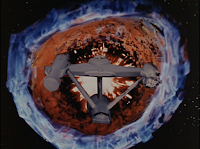
Reimagining Moby Dick by way of Fred Saberhagen’s Berzerker stories, Norman Spinrad’s episode
"Doomsday Machine" stands
the test of time as a solid
character study of obsession
and loss. 
(Image via StarTrek.com)

“Doomsday Machine” is a terrific adventure story that combines big science fiction ideas with memorable character moments. William Windom as Commodore Matt Decker is one of the all-time great guest appearances on Star Trek.

On the other end of the spectrum, “The Trouble With Tribbles” is a more lighthearted episode about an agricultural shipment, a grain-eating pest, and Cold War tensions. The dialogue in the episode is memorably sharp with quippy lines like “hauled away as garbage,” “a very little joke,” and “an ermine violin.” Some contemporaneous fans complained that the tone was too unserious, but with the benefit of hindsight, the episode holds up well.

To us, a more questionable inclusion was the Season 2 premiere “Amok Time,” a weird melodramatic episode about Spock’s return to his home planet of Vulcan. For those who haven’t seen it recently, it’s a buck-wild bit of ritual combat between Spock and Kirk as they are forced to fight over a woman. The “woman as a prize” theme should have been unacceptable in the 1960s, and certainly doesn’t hold up well today, the writing is mostly quite flat, and the depiction of Vulcans as a mystical culture that uses gongs excessively could be read as having some ugly coded subtext. This is one of the worst episodes for Kirk as a character; it’s unsettling to watch Kirk pressuring a subordinate to reveal personal info.

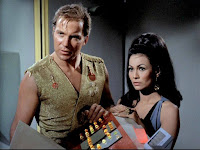
Although the ‘alternate universe’ episode has become a staple for most SFF TV shows, when Star Trek did
Kirk's visit to the darkest timeline
provided a template for all later
mirror universes on television.
(Image via StarTrek.com)

it with “Mirror Mirror,” the concept was still fresh. With the introduction of the concept to mass media television, they also hit a high water mark. The quality of Star Trek’s original cast shines through in this episode, as George Takei, Walter Koenig, and Leonard Nimoy all show why they would have been stars even if Trek had never made it to air. It must also be mentioned that guest star BarBara Luna is memorable as Lt. Marlena Moreau.

More has been written about the Hugo-winning episode, Harlan Ellison’s “City On The Edge of Forever,” than about probably any other single episode of televised science fiction. Given the weighty moral quandary (sacrificing love for the sake of history), and the solid character moments between the central trio of Spock, Kirk, and McCoy, the level of appreciation for the episode is understandable. What’s interesting is how quickly it was recognized as a classic, and immediately at the forefront of discussions of what should get the Hugo.

“City [on the Edge of Forever], which deservedly won the Hugo for best dramatic presentation, is probably the best drama, if not the best science fiction, ST has had to date, and I was happy to see it again” wrote Kay Anderson in her convention report.

What few complaints there were about a Star Trek-full category focused more on who had been left off the ballot; pundits such as Doug Lovenstem of the fanzine Arioch suggested that it was time for D.C. Fontana to win a Hugo Award (she would receive her only nomination 20 years later). Others noted the absence of “Devil in the Dark,” which is often regarded as one of Star Trek’s finest hours (and certainly better than “Amok Time”).

For our cinema club’s re-watch of these episodes, we’d all gone in expecting to agree with this consensus. But in the end, none of us were convinced that “City On The Edge of Forever” was the best episode; two of us preferred “Mirror Mirror,” one put “Doomsday Machine” at the top of their list, while another rated “Devil In The Dark” the most highly.

But at the 1968 Hugo Awards, two things were inescapable: Star Trek and Harlan Ellison. Five nominations to Star Trek, three to works penned by Ellison, and five to works that appeared in a publication edited by Ellison. In retrospect, this win seemed inevitable.

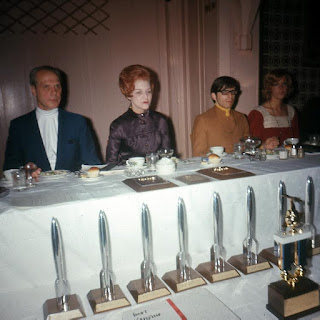
“The Hugos: Bjo doesn’t win. Dave Gerrold doesn’t win. Larry [Niven] doesn’t win. Harlan wins. There
The head table at the 1968 Hugo Awards banquet
Philip Jose Farmer, Betty Farmer, Harlan Ellison
(Image by Len & June Moffatt via Fanac.org)


is no justice in this world. I like Harlan, but there’s a limit to how many Hugos he should win,” Sandy Cohen wrote in Argus in October 1968. Ellison had ruffled his fair share of feathers throughout fandom, and it would eventually come to haunt him. But in 1968, Harlan Ellison was at the top of the SFF world, and probably his all-time most recognizable work took home the Best Dramatic Hugo.

The Best Dramatic Presentation shortlist in 1968 is a product of its time. It is likely that no SFF television show will ever have the impact that Star Trek did that year, and it is equally unlikely that there will be another year with as few viable contenders for the prize. (A clean sweep of nominations in the category has also been rendered impossible by rules changes).

In short: an odd year for the Hugos, but one where it’s difficult to argue too vehemently against the judgment of the fans.

Friday, 24 April 2020

The Edges Of A Genre

When Arthur C. Clarke observed that “any sufficiently advanced technology is indistinguishable from magic,” he highlighted a fundamental malaise of science fiction as a genre. This is a discomfort with which the fandom community continues to grapple.

There is a continuum between utterly mimetic and purely fantastical fiction; the difference between
(Image via Wikipedia)
Truman Capote’s In Cold Blood, and J.R.R. Tolkein’s Lord of the Rings is only a matter of degrees. The angst of science fiction is that it lies in a liminal area between that which reflects the real world and that which eschews reality.

There is clearly no “hard line” between what is science fiction and what is fantasy, a fact that Norman Spinrad inartfully grappled with in a now-notorious column in Asimov’s magazine last November.

Genre-based awards are, by definition, bound by an accepted understanding of the genre itself. For the science fiction community, and the Hugo Awards in particular, the existential anxiety of defining these boundaries continues to be both a strength and a weakness.

These days, the Hugo Award is an award for any form of speculative fiction, be it fantasy, science fiction, alternate history or other sub-genre work. In many ways, this inclusive, adaptive approach is a strength. But it does mean that none of the top-five most prestigious literary awards focus squarely on science fiction as a genre.

Fantasy has the World Fantasy Award (WFA), and horror has the Bram Stoker Award — neither of which recognize works of science fiction (beyond the occasional genre-blurring piece). The Arthur C. Clarke Award is more strict about genre delineations, but it is UK-based, and doesn’t have as high a profile as the WFA or the Locus Award. Both Hugos and Nebulas are about as likely to go to a work
Norman Spinrad may
have expressed himself
inelegantly recently.
(Image via Wordbasket)
of science fiction as they are a work of fantasy.

Those who criticize the Hugo Awards for recognizing fantasy works may in part be reacting to the absence of a “pure” science fiction award. However, it is possible for those who yearn for a more narrowly-defined award for science fiction to do so positively.

It’s worth digging into why the World Science Fiction Society (WSFS) at the World Science Fiction Convention gives an award formerly known as the “Science Fiction Achievement Awards,” but does not restrict the award to science fiction in the same way the World Fantasy Convention’s World Fantasy Award is restricted to works of fantasy (try saying that sentence ten times fast). Part of the explanation of this oddity may be found in the history of the Hugo Award.

In the 1953 Worldcon Progress Report #3, Will Jenkins writes:
  • “At the 11th World Science Fiction in Philadelphia on Labour Day weekend, a new tradition will be established, with the formal awarding of the First Annual Science Fiction Achievement Awards to those writers, editors, artists, and fans whom the members of the convention feel have distinguished themselves during the past year. This is the first time in the history of Science Fiction that such awards have been made to include all fields of Science Fiction endeavor.”
By the repetition of the phrase “science fiction” in describing the award and not once mentioning the word “fantasy,” it might be reasonable to assume that the original intent of the organizers was to focus on science fiction. Certainly in what we’ve read of the discussions of award voting that year, there’s no mention of now-classic works of fantasy that would have been eligible, such as C.S. Lewis’ The Voyage of the Dawn Treader. This seems to be an assumption that WSFS rules historian Ben Yalow disagrees with, as he writes on the official Hugo Awards website “The Hugo Award ... has always included works of fantasy.” Our disagreement with Yalow's assertion is more of a nitpick than a substantive argument against it.

We find it amusing to think that there might be proponents of Hugo Award Rules
Antonin Scalia was wrong
about the U.S. constitution …
much like the WSFS constitution,
it's a living document.
(Image via Wikipedia)
originalism; a WSFS equivalent of Antonin Scalia if you would. An examination of the evidence will tell you that the Hugos have accepted works of fantasy for more than six decades.

By the time they awarded the second Science Fiction Achievement Awards, the rules written by Nicholas L. Falasca include a note “While the award carries the connotation that only science fictional material will be considered, we hasten to add that fantasy and weird material can be included.” There’s explicit acknowledgment of fantasy, but the list of winners continues to show a strong bias towards what would generally be classed as science fiction (although the fanzine award that year was given to Fantasy Times).

By 1959, when the term “Hugo” began to be used in official documents to describe the awards, and the phrase “science fiction or fantasy” was used throughout the rules, clarifying that these awards include both.

The first 40 years of the Hugo Award winners show a strong bias towards works that would be classed by most readers as falling on the science fiction side of the SF-F spectrum. By our estimate, the first work of pure fantasy to win — or even be shortlisted for — a Hugo Award for fiction was in 1959 with the short story “That Hell-Bound Train” by Robert Bloch.

However in recent years, works that would likely be described as fantasy have become more common. This is particularly evident in the short story category where in 2019, the only finalist that falls on the science fiction end of the spectrum was Sarah Gailey’s interactive “STET.”

The World Fantasy Award — which was founded in 1975 as part of the World Fantasy Convention — doesn’t seem to have ever had any controversy about whether or not science fiction should be considered for the award. Looking over the list of shortlisted works, it would be difficult to argue that the World Fantasy Award recognizes science fiction. Although we have been unable to find an online version of the WFA rules, the nominees and winners appear to fit squarely within what most would describe as fantasy. The closest that we could find was the WFA judging panel announcements which mention that: “All forms of fantasy are eligible, e.g. high, epic, dark, contemporary, literary.”

The struggle to define the exact boundary between science fiction and fantasy does not mean that
Last year, the only short story on the
Hugo ballot that could be called
science fiction was Sarah Gailey's
"STET." If you haven't read it yet,
you should do so right now. It's great.
(Image via Goodreads)
there is no difference. Instead, it points to the fact that the edges of a genre aren’t necessarily hard edges, but rather points on a continuum. A work might be more science fictional or less science fictional, more fantastical or less fantastical. Those who suggest that one needs to “take a side” are woefully misguided... but those who suggest that there is no difference between science fiction and fantasy aren’t entirely correct either.

In his column, Spinrad took umbrage with the “evaporating” boundary between science fiction and fantasy. Some of his many critics have claimed that there is no difference between science fiction and fantasy, that any attempt to distinguish between them is futile.

In a well-reasoned response to Spinrad’s column, Alexandra Erin blogged at Uncanny magazine about the impossibility of creating a hard distinction between fantasy and science fiction. She highlighted numerous ways in which works that are generally considered to be science fiction are in fact fantastical, and several instances in which works generally regarded as fantasy are science fictional.

Within our book club, there are widely varying opinions and preferences about fantasy versus science fiction. Some of our book club members believe that a broad, more inclusive set of rules for the Hugos means that the cream rises to the top without putting it through a filter first. Others feel that the increasing prevalence of fantasy on the Hugo ballot makes the award more likely to be redundant, as there are other awards to recognize works of fantasy.

It can be said without privileging one over the other that there is a difference between science fiction and fantasy. Likewise, it’s completely fair for an individual reader to prefer science fiction or fantasy without casting aspersions on the other.

The Hugos have changed with time and with different contingents of Worldcon attendees. In the late 1960s, the definition of science fiction was radically changed as the demographic juggernaut of Baby Boomers began nominating and voting for works that addressed their concerns and tastes. We’re currently undergoing a similar demographic shift with the Hugos, as Millenials come into their Hugo-voting years and redefine the genre again.

Because Hugo nominees are not determined by a judging panel in the style of the WFA and Stoker,
"Oh no, millennials killed
science fiction!" is clearly
a ridiculous claim.
(Image via SassySpoon.com)
they are more affected by demographic shifts, and more prone to mutability of purpose. While this mutability is not necessarily a bad thing, it has left a gap in the ecosystem of genre awards, one that is keenly felt by fans who prefer a more technologically centred version of science fiction.

There is no easy way to address this gap. None of us want to impose more restrictive rules on the Hugo awards, since trying to parse the exact boundaries of the genre would be a fool’s errand. Creating a separate category within the Hugo architecture would likewise be unsatisfying, as there are frankly too many categories already, and more would dilute the importance of the awards.

For now, those who yearn for “pure” science fiction can make do with alternatives like the geographically restricted (not-universal) Arthur C. Clarke Award, sub-genre specific (but less prestigious) awards like the Prometheus Award, or recently created and troubled awards like the Dragon Awards. They can also lobby for the best examples of writing they love to win the Hugo. More people talking about great stories can only be a good thing.

These options may seem like cold comfort to some, but they are all better than — through churlish nostalgia — undermining an existing awards system that works well for a broader spectrum of genre fiction.

----

This is a blog post in part inspired by:
https://camestrosfelapton.wordpress.com/2019/11/07/fantasy-versus-science-fiction/
https://www.tor.com/2019/11/06/science-fiction-vs-fantasy-the-choice-is-clear/
https://classicsofsciencefiction.com/2019/11/06/does-science-fiction-have-a-purpose/
https://www.asimovs.com/current-issue/on-books/

Amy Goldschalger and Avon Eos did a creditable job of trying to define the differences between SF and fantasy: https://www.sfsite.com/columns/amy26.htm