Showing posts with label Derek Kunsken. Show all posts

Friday, 20 February 2026

The True North Strong And Speculative

In a year that saw concerted attacks on Canadian identity, it is particularly troubling to see that one of the country’s important literary institutions — On Spec Magazine — shut its doors and published its final issue.

The magazine’s impact cannot be overstated, but somehow, neither the magazine nor its editors have ever appeared on a Hugo Award shortlist. Given that its final issue was published in the autumn of 2025, this year will be the last that they will be eligible for most major SFF awards. As far as we can tell, the magazine has only appeared on the long-list once in 2025, placing eleventh.

There are many factors behind this omission; in recent years online-first magazines have dominated the Hugo shortlists while physically printed magazines have lagged. The magazine is less available outside of Canada, and at the last two Worldcons Canadians made up only about three per cent of Hugo voters. Despite these impediments to receiving a well-earned valedictory Hugo nod, we urge all our friends in the Worldcon community this year to consider nominating On Spec for the Best Semiprozine Hugo Award, and to consider nominating Diane Walton for Best Editor - Short Form.

Cory Doctorow, whose first story was published in the magazine put it succinctly: “More than any other publication, anthology or project, On Spec defined and refined Canadian sf. It was always on the leading edge, always editorially daring, and always brilliant. Losing On Spec is a huge blow to our field. It deserves recognition.”
Cory Doctorow's first published story was in 
the winter 1990 issue of On Spec.
(Image via On Spec)


On Spec
was founded in 1989, after a group of writers observed that there was no paying market in Canada for short-form speculative fiction. Some writers even complained that editors outside of the country would ask for their draft stories be made “less Canadian” before they could be accepted or published. It was a team that included Colin Bamsey, Jena Bamsey, Matt Bamsey, Tim Hammell, Ray Lirette, Marianne Nielsen, Paul Rogers, Hazel Sangster, Larry Scott, Phyllis Schuell, Diane Walton, Donna Weis and Lyle Weis, as well as an advisory board consisting of Douglas Barbour, Candas Jane Dorsey, J. Brian Clarke, Pauline Gedge and Monica Hughes.

From the outset, this founding group strived to create a magazine that reflected Canada’s multicultural identity and to include marginalized perspectives within speculative storytelling.

“For a lot of writers, Canadian or otherwise, publication in On Spec was an important signpost and the beginning of many Canadian and international careers,” editor and novelist Hayden Trenholm said about the magazine. “Recognizing it now would be a tribute to three decades of editorial accomplishment and to the hundreds of writers for whom On Spec meant: OMG, I really am a writer!”

For more than three decades, On Spec Magazine was the premier English-language publication for speculative fiction in Canada. Despite being a primarily Canadian publication, its influence on the genre has been felt across borders; it has helped launch the careers of notables such as Julie Czerneda, Cory Doctorow, Peter Watts, and Karl Schroeder; and it fostered a uniquely Canadian science fictional voice. Over the years, it has published works by almost every important science fiction writer in the country; everyone from Candas Jane Dorsey (Winter 1999 issue), Robert J. Sawyer (Summer 1993 issue), Derek Künsken (Autumn 2006 issue), Dave Duncan (Spring 1989 issue), Fiona Moore (Autumn 2016 issue), Michèle Laframboise (Spring 2022 issue), and WP Kinsella (Winter 1994 issue).
On Spec was founded at the convention ConText'89
Authors and editors who attended ConText'89.
Back row L-R: Charles de Lint, Kathryn Sinclair,
Dave Duncan, Lyle Weis, Robert Runté, J Brian Clarke,
Michael Skeet, HA Hargreaves, Doug Barbour,
Yves Meynard, Karl Schroeder, William Gibson, John Park.
Middle Row: Candas Jane Dorsey, Catherine Girczyc,
Marianne Nielsen, Judith Merril, Phyllis Gotlieb,
Nicole Luiken, Lexie Pakulak, Alice Major.
Front Row: Gerry Truscott, Diane Walton, Jena Snyder,
David Kirkpatrick, Sally McBride,
Leslie Gadallah, Eileen Kernaghan, Monica Hughes.


"On Spec was my before-and-after," said Derek Künsken. "Before On Spec sent me my very first acceptance, I felt like an aspiring writer. After that acceptance, I felt like I'd become something new. I didn't understand the impact and reach of On Spec until I saw my story reviewed online and requested for consideration by a year's best editor. On Spec helped me find other Canadian writers who are friends and colleagues and critiquers to this day."

But moreover, they published excellent works that may have not gotten the attention they deserved outside of Canada. We can still remember picking up the 1993 story Kissing Hitler by Erik Jon Spigel, a work whose commentary on the distortion and misremembering of history only seems more prescient today than when it was first published. Or Leah Bobet’s 2006 story Bliss, a brilliant little story about drug addiction that incisively lampoons middle-class fearmongering.

Almost as much as their publication history, the team from On Spec are known for the amount of community outreach that they’ve done. For most of their run, there wasn’t a science fiction convention in Western Canada without a presence from the staff of the magazine. They’d have tables in dealers’ halls, and their editors would conduct story reviews and writing workshops. They didn’t just publish science fiction and fantasy; they nurtured the community and young writers. The convention scene in Canada would have been much poorer without On Spec’s efforts.

For thirty-five years, On Spec has served as a cornerstone of Canadian speculative fiction and an internationally respected semiprozine. It’s high time that they got on the Hugo Award shortlist.

This is a year in which Canadian identity is under attack, and this is the last chance to do so. Please consider On Spec for your Hugo nominating ballot.

Thursday, 6 January 2022

Hugos Unlike Any Previous

The 2022 Hugo Awards seem likely to be unlike any previous Hugos, because the Hugo-nominating constituency will be unlike any previous.

As far as we are aware, there has yet to be a Worldcon in which the largest single contingent of the membership came from anywhere other than the United States. Likewise, as far as we can determine, there has yet to be a Hugo Awards at which the plurality of votes came from anywhere other than the United States.

Even when the Worldcon was in Dublin two years ago, members living in the U.S. were the group
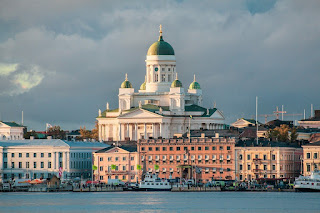
Even when the Worldcon was in far-off Helsinki,
there were more Americans than Fins in attendance.
(Photo by Tapio Haaja via Pixabay)

most represented in sales, with 2,750 of the 6,918 memberships (and 1,582 of the 4,190 in-person memberships) being purchased by U.S. residents. In Finland two years before that, 3,368 of the 8,748 memberships (and 1,141 of the 3,316 in-person memberships) were purchased by U.S. residents. At Japan’s 2007 Worldcon, 1,907 of the 4,010 memberships sold were purchased by U.S. residents. The complete and exact tally of how many people from each country bought memberships to Discon III is not available yet due to issues with the registration system, but similar patterns repeat in the demographic breakdown of every Worldcon for which we have found the statistics.

This dominance of American voters is reflected in the results of the Hugo Awards; almost 85 per cent of all Hugo-nominated fiction, and almost 85 per cent of all Hugo-winning fiction was written by U.S.-born authors (a statistic that’s even more revealing when one realizes that the calculation counts Isaac Asimov, Algis Budrys, and Manly Wade Wellman as not being U.S.-born.)

Editor and author Xueting
Christine Ni would be a
worthy inclusion on the Hugo
ballot. (Image via Amazon)

We predict that these statistics (which have remained fairly stable over recent decades) are about to change.

Rumours about a large number of supporting memberships being purchased in the days leading up to the 2023 Worldcon site selection vote were viral at Worldcon 2021. Turns out they were also accurate, with more than 2,400 Chinese residents purchasing supporting memberships for Discon III; approximately 1,600 of those memberships were purchased in the 10 days before the convention. The final vote tally was 2,006 votes for Chengdu to 807 for Winnipeg.
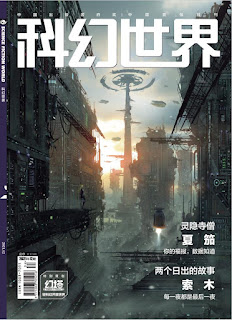
Science Fiction World prints more
than 200,000 copies every month.
(Image via CNBeta.com) 


We have trepidation about the Chinese government and its human rights record, but we also have respect for the fans and the bid committee behind the Chengdu Worldcon. As much as we would have preferred to see the 2023 Worldcon happen in Winnipeg, we are embarrassed to have seen the (sometimes racist) response we have seen towards the people working on the Chengdu Worldcon bid. Based on our attendance at related Worldcon 2021 sessions and conversations with members of both bids, the groups behind the 2023 bids seemed to be enthusiastic and professional, and backed by dedicated fans.

The Chengdu bid won this site selection vote through organizing, through outreach to convention runners, and through encouraging their local fans to purchase supporting memberships and to vote. As has often been pointed out by proponents of the Chendu bid, China is the country with the world’s largest number of science fiction fans. 

Based out of Chengdu, Science Fiction World (科幻世界) is the science fiction magazine with the largest circulation on Earth; comparable to the total of Analog, Asimov’s and the Magazine of Science Fiction & Fantasy combined. The 2,400 Discon III supporting memberships from China represent a fraction of a percent of the circulation of this one magazine.

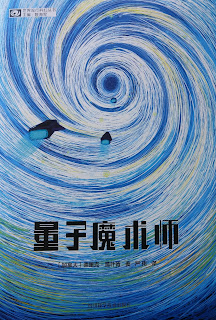
Canadian author Derek Künsken
does well in North America ...
but more than a million people
read his works in China.
(Cover of the Chinese edition
of Quantum Magician via the
publisher)

The vast majority of these memberships were bought by people who have never previously participated in voting on the Hugo Awards, as this will be their first Worldcon memberships. And excitingly, they will be eligible to nominate works for the Hugos in 2022. Given that there are usually little more than 1,000 nominating ballots cast in a given year, these supporting members of Discon III could have an enormous influence on what makes the ballot at the Chicago Worldcon. We encourage them to nominate. 

The third-highest grossing movie worldwide in 2021 was the Chinese-language time-travel movie Hi Mom. Han Song has won the Chinese Galaxy Award six times, but remains little-known among English-speaking readers. Xueting Christine Ni has been tirelessly working to promote Chinese science fiction for years, and could be recognized in one of the editor categories. And some authors underappreciated by Hugo voters (such as Derek Künsken) have found a broader audience with their works translated for Chinese-language magazines such as Non-Exist Magazine. We might also hope that these new Hugo voters will not neglect the fan categories.

There is a real possibility that the 2022 ballot could be the most surprising Hugo Awards shortlist in years — and the least U.S.-centric to date.

Friday, 7 August 2020

Interview with Derek Künsken - Author of The House Of Styx

Ottawa-based science fiction author Derek Künsken has become a mainstay in
Cover of The House Of Styx
The House of Styx
is Derek Kunsken's
third (and best) novel.
(Image via Goodreads) 
the magazines Asimov’s Science Fiction and Analog Science Fiction. Armed with a master’s degree in molecular biology from McMaster University, and his experiences working in Canada’s diplomatic service, he writes politically deft space opera that explores the implications of genetic engineering. His third novel The House Of Styx was serialized this spring in Analog, with a complete edition coming out in a few weeks from Rebellion Publishing. In April, blog contributor Olav Rokne interviewed Künsken about the upcoming novel.  

House of Styx is your third novel, but it’s a prequel to the first two. Could you tell me a little bit about it and how it relates to your previous books and stories?

The House of Styx is basically a Godfather story set in the clouds of Venus.

It’s going to show in two books basically the genesis of the Venusian Congregate which in later stories and novels becomes an interstellar powerhouse.

You’re Canadian … you'll quite obviously notice that the Congregate in The House of Styx are Quebecois.

I had imagined what would happen if Quebec separated [from Canada] at some point and then wanted to be a space-faring nation. But by the time they got to space, the only place left unclaimed was Venus. What would you do with a society that has been focused for 250 years on trying not to be assimilated linguistically and culturally? And what would happen if they became powerful? How would their linguistic concerns play out in society?

That’s why in the book, we get French 8.1 and 8.3 and the Scarecrow speaks a 7.1 but it's impolitic for some outsiders to speak particular kinds of accents and stuff like that.

I so loved the idea of seeing my Quebecois family sort of reflected in the future history that I was writing and it’s interesting because a lot of future histories even written by non-American authors seem to reflect the future as a largely American-dominated culture. It’s that hegemony of American power that we see reflected.

What was the main theme that you wanted to tackle in The House of Styx?

I was flying to the Nebulas conference, I think it was in 2013. I had already created all of the biology in the clouds of Venus, but I didn't really have a story to tell with this. I had a sort of survival story, but something was missing. This was going on at the same time as some of the ‘reasonable accommodation’ debates were happening in Quebec — and I’m half-Quebecois myself.
The serialized version of House Of Styx was 
illustrated by Eldar Zakirov.
(Image via DeviantArt)


So I was following the news and basically it was appalling to see some of the discourse around “how should Arab people integrate into Quebec.” It quite obviously came from a place of intolerance. Then I realized that the caustic intolerance that I was observing in society was a perfect metaphor for the sort of acidic environment of the clouds of Venus. And so I wrote that story, but there was so much more to it that — as soon as I had sold it to Analog — I realized I had another novel or two in me dealing with those kinds of characters, that kind of political setting and that kind of metaphorical environment.

That’s interesting because I’d picked up on a theme of subverting colonialism in your work. It’s a colonialist system, but it’s a narrative of decolonization.

You’re correct.
The patron nations and the client nations came about in these stories because I was asking what would happen if the rich powers — these four major powers that basically get a lock on outer space resources — what would be left for a country that comes to space 100 years later?

That's concerning to me.

Once nations spend as much money to get into space as it takes, will they necessarily respect the common good? Or will it just be ‘I got here first, now I’m exploiting it?’

Does science fiction have a responsibility to imagine better possible futures and by doing so potentially engineer them?
Künsken takes inspiration from
politics in his home province.
(Image via NorthumberlandFM)


I don’t know if I would go so far as to say ‘responsibility,’ because in the end I’m trying to tell entertaining stories that will hopefully move people in some way. If there's a thousand readers or 10,000 readers and that’s it, you know sort of mission accomplished.

I don't see my role to necessarily look at things but one of the things science fiction does really well is cautionary tales. It’s not that I set out to write a cautionary tale, but some of my concerns come through, so things like the Puppets are an expression of my own anxieties.

One of the things I loved most about Quantum Garden and Quantum Magician was how you played with concerns around genetic engineering. I was wondering if you could expand on your thinking that led to the creation of the Puppets and Numen because they kind of creep me out.

So I want to start every conversation about The Quantum Magician with “I’m so sorry for the Puppets.”

There are some fundamentalist sects of Christianity where they tend to have multiple brides they tend to eject the younger males. I was reading about that at one point and I was surprised at how this could happen [today]. If that can happen on the Earth and if North Korea can happen on the Earth …

If our current systems can’t even deal with [Human Trafficking] on planet Earth, what would happen if you have an asteroid colony where 100 people take over and make everybody do what they want? What is it going to be like when the next nearest police or help for somebody is six light hours away?

I thought about what might happen if you took the most selfish and short-sighted people in the world and you gave them the power to genetically engineer their own children, what would they do?
If they want to make themselves perfect slaves that are half the size so that they will never be physically threatened and then build a system where pheremonally these people will love their masters … and there are people who are unethical enough and short-sighted enough to think that this would be a fine idea.

That’s where the Puppets came from.

A recurring theme in your work is the cruelty of creating these genetically engineered lines of humanity and the unintended consequences.

It is cruel.

The thing is you know let’s say you get a coder or a developer to write you a computer program. They have the specifications for what you need, and then they create a draft of the program, they run it and then they debug it and then they run it again and then they see is this what you wanted and then they’ll reprogram some things and then they’ll debug it again and there’s no ethical consequence to any of that process because there’s nothing in there that deserves ethical consideration.

When you’re dealing with human beings and you're dealing with germ-line changes — which means it’ll pass on to the children — the debugging process is literally the children are born and you hope they grow right. And if they don't, oh that's a bug in the code. So I mean there’s huge huge ethical problems with that process.

What’s next on your writing agenda?

Well, I’ve got an epic fantasy book that I’m editing right now. I would like to see if there’s any market for it. I also wrote a horror novel — a very short one so it probably needs a lot of beefing up. Some of what I did with the Puppets shows that I can probably do horror.

Thursday, 23 August 2018

Künsken has a talent for imagining new unfreedoms

On one level, The Quantum Magician is a straightforward heist novel that might be compared to an
(Image via Goodreads)
Ocean’s Eight set in space.

But there’s far more going on under the hood of this well-engineered machine than that reductive description conveys. It is a novel about self-identity, about colonialism, about being handcuffed by our own instincts, and about the subversion of human freedom.

Derek Künsken’s debut introduces the reader to con-man protagonist Belisarius, who gathers up a rag-tag group of his former associates to pull a scheme worth billions.

These associates include his childhood love, his dying mentor, an outcast from the Puppet society, a zany demolitions expert, and an AI that thinks it’s the reincarnation of a Catholic saint. To be fair, some of these characters seem like they’re straight from central casting, but for the most part their relationships and dialogue are engaging and enjoyable.

Belisarius’ scheme, which involves helping a small fleet of warships successfully pass through a heavily fortified transport hub, is somewhat grandiose, but it provides Künsken some interesting chances to comment on colonialism and economic justice.

The planning, execution, twists and turns of the heist are interesting enough to make the book worth your time. But it’s the interplay between human and transhuman motivations that elevates The Quantum Magician.

Central to what makes the book so enjoyable is the character of Belisarius, the Homo Quantus.
It would be easy to imagine a
young Michael Cane as
Belisarius.
(Image via Mirror.Co.Uk) 


Genetically engineered as part of a project to create a human capable of understanding quantum mechanics, he is able to enter various trance-like states in which he redirects portions of his brain that are usually dedicated to social skills or motor functions.

He is, however, a reject from the genetic engineering project, incomplete and unable to fulfill his instinctive need to understand. To distract himself from his inabilities, he focuses his prodigious intellect on understanding human motivations and working as a con artist.

It is a difficult task for those of us who have standard-issue brains to write believably about the thought processes of those who are neuro-atypical, but Künsken pulls it off admirably. Some of the best portions of the book are those in which we get a window into how Belisarius’ brain is constantly churning with mathematics, a need to count items, and to grind away at even minor quandaries.

One of the other real highlights of the book are when Künsken uses the plot and the setting to take readers on a tour of a variety of ways that genetic engineering might lead humanity on a road to unfreedom: the engineering of people like Belisarius whose instinct for curiosity is so tweaked as to be inescapable; the creation of benthic monstrosities Homo Eridanus that cannot escape the task that they were designed to do; and finally, the citizens of the Free City of Puppets.

Two hundred years prior to the events of the novel, The Puppets were designed to be slaves. Genetic engineers boosted their ability to feel religious fervor, and coded them to worship a breed of master humans. By the time that The Quantum Magician takes place, the society of the Puppets has devolved into something strange and awful.

Although they aren’t front-and-centre, the particular form of unfreedom embodied by the Puppets is
Derek Künsken offers new ideas about
how freedom could be subverted.
(Image via DerekKunsken.com)  
affecting, viscerally repugnant, and creepy.

More than anything else, it’s the subplots about the Puppets that might place The Quantum Magician into a grand tradition of dystopic science fiction novels that warn about the subversion of human rights. The work I was reminded of most often when reading this book was Vernor Vinge’s A Deepness In The Sky, and the particular unfreedom embodied by Emergent focus.

Science fiction is often at its best when imagining new forms of tyranny. It is clear that Künsken has a talent for imagining oppressions. On the strength of that alone, The Quantum Magician is well worth picking up, and may end up on some of our nominating ballots.