Showing posts with label Yandro. Show all posts

Friday, 11 March 2022

The Hugo For Best Star Trek: Hugo Cinema 1968

This blog post is the eleventh in a series examining past winners of the Best Dramatic Presentation Hugo Award. An introductory blog post is here.  


Star Trek’s dominance of the 1968 Hugo Award Best Dramatic Presentation shortlist is as much a reflection of the quality of the show’s first and second seasons (episodes from each were eligible), as it is evidence that it was an off-year for most science fiction on screen.

As noted by contemporaneous fan writers such as Ted White and Brian Aldiss, there were an extraordinary number of exceptionally terrible science fiction films in the theatres in the preceding year:
Star Trek faced weak competition
for the Hugo Award in 1968.
(Image via Vintage Movie Posters)

exploitation flicks like Voyage to the Planet of Prehistoric Women, broad comedies like Don Knotts’ The Reluctant Astronaut, and cheaply made filler like Journey To The Centre of Time. Most of the televised science fiction was sub-par, though Doctor Who’s Second Doctor had three of his best stories with “Tomb of the Cybermen,” “The Moonbase,” and “The Web of Fear.”

In terms of foreign-language cinema, there’s few stand outs. If it weren’t for Star Trek, would Best Dramatic Presentation have recognized something like Late August In The Hotel Ozone?

While some pundits decried the fact that the entire shortlist for the 1968 Dramatic Presentation Hugo was made up of Star Trek episodes, none could offer credible alternatives to Roddenberry’s show.

“Non-Star-Trek fanciers may be annoyed to see five Star Trek episodes and nothing else on the ballot, but I’m happy enough,” Juanita Coulson wrote in Yandro.

For the most part, it’s remarkable how well the shortlist holds up. It may all be Star Trek, but there is a remarkable diversity of science fiction stories that writers were able to tell within the confines of the show’s “wagon train to the stars” format.

Reimagining Moby Dick by way of Fred Saberhagen’s Berzerker stories, Norman Spinrad’s episode
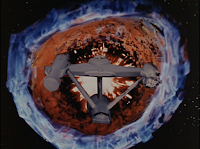
"Doomsday Machine" stands
the test of time as a solid
character study of obsession
and loss. 
(Image via StarTrek.com)

“Doomsday Machine” is a terrific adventure story that combines big science fiction ideas with memorable character moments. William Windom as Commodore Matt Decker is one of the all-time great guest appearances on Star Trek.

On the other end of the spectrum, “The Trouble With Tribbles” is a more lighthearted episode about an agricultural shipment, a grain-eating pest, and Cold War tensions. The dialogue in the episode is memorably sharp with quippy lines like “hauled away as garbage,” “a very little joke,” and “an ermine violin.” Some contemporaneous fans complained that the tone was too unserious, but with the benefit of hindsight, the episode holds up well.

To us, a more questionable inclusion was the Season 2 premiere “Amok Time,” a weird melodramatic episode about Spock’s return to his home planet of Vulcan. For those who haven’t seen it recently, it’s a buck-wild bit of ritual combat between Spock and Kirk as they are forced to fight over a woman. The “woman as a prize” theme should have been unacceptable in the 1960s, and certainly doesn’t hold up well today, the writing is mostly quite flat, and the depiction of Vulcans as a mystical culture that uses gongs excessively could be read as having some ugly coded subtext. This is one of the worst episodes for Kirk as a character; it’s unsettling to watch Kirk pressuring a subordinate to reveal personal info.

Although the ‘alternate universe’ episode has become a staple for most SFF TV shows, when Star Trek did
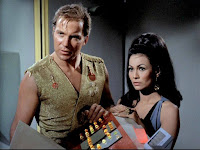
Kirk's visit to the darkest timeline
provided a template for all later
mirror universes on television.
(Image via StarTrek.com)

it with “Mirror Mirror,” the concept was still fresh. With the introduction of the concept to mass media television, they also hit a high water mark. The quality of Star Trek’s original cast shines through in this episode, as George Takei, Walter Koenig, and Leonard Nimoy all show why they would have been stars even if Trek had never made it to air. It must also be mentioned that guest star BarBara Luna is memorable as Lt. Marlena Moreau.

More has been written about the Hugo-winning episode, Harlan Ellison’s “City On The Edge of Forever,” than about probably any other single episode of televised science fiction. Given the weighty moral quandary (sacrificing love for the sake of history), and the solid character moments between the central trio of Spock, Kirk, and McCoy, the level of appreciation for the episode is understandable. What’s interesting is how quickly it was recognized as a classic, and immediately at the forefront of discussions of what should get the Hugo.

“City [on the Edge of Forever], which deservedly won the Hugo for best dramatic presentation, is probably the best drama, if not the best science fiction, ST has had to date, and I was happy to see it again” wrote Kay Anderson in her convention report.

What few complaints there were about a Star Trek-full category focused more on who had been left off the ballot; pundits such as Doug Lovenstem of the fanzine Arioch suggested that it was time for D.C. Fontana to win a Hugo Award (she would receive her only nomination 20 years later). Others noted the absence of “Devil in the Dark,” which is often regarded as one of Star Trek’s finest hours (and certainly better than “Amok Time”).

For our cinema club’s re-watch of these episodes, we’d all gone in expecting to agree with this consensus. But in the end, none of us were convinced that “City On The Edge of Forever” was the best episode; two of us preferred “Mirror Mirror,” one put “Doomsday Machine” at the top of their list, while another rated “Devil In The Dark” the most highly.

But at the 1968 Hugo Awards, two things were inescapable: Star Trek and Harlan Ellison. Five nominations to Star Trek, three to works penned by Ellison, and five to works that appeared in a publication edited by Ellison. In retrospect, this win seemed inevitable.

“The Hugos: Bjo doesn’t win. Dave Gerrold doesn’t win. Larry [Niven] doesn’t win. Harlan wins. There
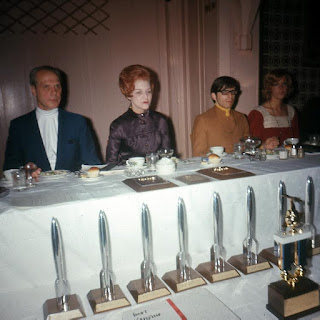
The head table at the 1968 Hugo Awards banquet
Philip Jose Farmer, Betty Farmer, Harlan Ellison
(Image by Len & June Moffatt via Fanac.org)


is no justice in this world. I like Harlan, but there’s a limit to how many Hugos he should win,” Sandy Cohen wrote in Argus in October 1968. Ellison had ruffled his fair share of feathers throughout fandom, and it would eventually come to haunt him. But in 1968, Harlan Ellison was at the top of the SFF world, and probably his all-time most recognizable work took home the Best Dramatic Hugo.

The Best Dramatic Presentation shortlist in 1968 is a product of its time. It is likely that no SFF television show will ever have the impact that Star Trek did that year, and it is equally unlikely that there will be another year with as few viable contenders for the prize. (A clean sweep of nominations in the category has also been rendered impossible by rules changes).

In short: an odd year for the Hugos, but one where it’s difficult to argue too vehemently against the judgment of the fans.

Thursday, 30 December 2021

Best Dramatic Presentation Boldly Goes Forward (1967)

This blog post is the tenth in a series examining past winners of the Best Dramatic Presentation Hugo Award. An introductory blog post is here.  

With the benefit of hindsight, it seems only natural that Star Trek should win a Hugo Award in its first season.

The Hugo shortlist in 1967 included Fantastic Voyage,
Fahrenheit 451, The Menagerie, The Naked Time, &
The Corbomite Maneuver. (Image via IMDB)
At the time, however, this decision was not without controversy.

The Worldcon chair for 1967, Ted White, published a screed against the show calling its writers patronizing and ill-informed. Hugo-winning fan writer Alexei Panshin opined that Star Trek was filled with cliches and facile plots.

But for every voice criticizing the new show, there were several voicing their support. Big-name authors like Harlan Ellison and A.E. Van Vogt campaigned for the television series to win a Hugo, hoping that the recognition might buy it a second season. Writing in the fanzine Yandro, Juanita Coulson offered the definitive counterpoint: “The scorners of Star Trek do not seem to have an alternate dramatic piece of science fiction to offer; they usually do not like anything TV calls science fiction or fantasy.” 

It was by far the most talked about Best Dramatic Presentation ballot up to that point, with various pundits at turns praising Fahrenheit 451’s elegant direction, complaining about plot points in Fantastic Voyage, and analysing the merits of “The Corbomite Maneuver.” The quality of this debate, the resulting shortlist, and the final vote all look exceptional from the perspective of 2021; this was the year that the Hugo Award for Best Dramatic Presentation came into its own. 
In 1967, Gene Roddenberry was
one of the few Best Dramatic
Presentation winners to accept
the award in person.
(Photo by Jay Kay Klein) 


Considering the eligible works for this Hugo shortlist, one member of our cinema club (Paul) watched no fewer than 43 science fiction and fantasy movies that had hit cinemas in 1966, and concluded that Hugo voters could hardly have done better.

As we started watching movies and television shows from 1966, many of us had expected Fahrenheit 451, directed by François Truffaut to be the shortlist standout. However, we were surprised to find the movie had aged far more poorly than other works. Most readers will be familiar with the source material, which criticizes anti-intellectualism and post-literate culture, but this is an adaptation that does not live up to the provocative premise. The first half of the film moves at a pace that makes the Mendenhall Glacier look like quicksilver; and although the second half provides some good moments, it’s undermined by questionable choices around gender representation. That being said, Truffaut is a master of building individual shots, and some of the imagery continues to hit hard. Scenes which center the action on the television in Guy Montag’s apartment are visually arresting and prescient. The set design — both the use of existing architecture and the film’s own props — is iconic and lush. There are moments of brilliance in the movie; particularly a speech in which Captain Beatty cynically dismisses the value of books. In several other years, this might have been at the top of our ballots, but in 1967 it was outshone.

The most expensive science fiction movie to have been made up to that point, Fantastic Voyage, holds up somewhat better. Sparingly and effectively directed by Richard Fleischer, the movie follows a five-person submarine crew who are shrunk to microscopic size and injected into a scientist in order to perform life-saving brain surgery. Although far too many movies of the era over-explained their premise, Fleischer’s dialogue-free opening sequence is a masterclass in visual storytelling, showing the events that kick off the movie’s action.
A pleasure to burn perhaps, but not a pleasure to watch.
(Image via Pintrest)
It’s worth noting the quality of the visuals in Fantastic Voyage, which earned the movie two Academy Awards. Art Cruickshank’s visual effects pushed the limits of compositing technology at the time, while Jack Martin Smith and Dale Hennessy’s clean and functional design work made the secret military base setting seem real. The movie may have had a leg up on some of its competitors that year, since Isaac Asimov’s novelization of the movie had received mostly positive reviews. This might have been a very worthy Hugo winner, if it hadn’t been for the genre-defining presence of Star Trek.

From the day that Gene Roddenberry first showed “The Cage” and “Where No Man Has Gone Before” at the 1966 Worldcon in Cleveland, Star Trek had dominated discussions of science fiction. One unsigned complaint in the fanzine Algol notes “somewhat more than half of every fanzine I have seen this year was concerned with one subject and one subject alone: Star Trek.” Three episodes made the ballot in that first year: “The Menagerie,” “The Corbomite Maneuver,” and “The Naked Time.” 

“The Naked Time,” which aired first of the shortlisted episodes, is without a doubt one of the most well-remembered episodes of the original series, if for no other reason than the image of a shirtless Sulu wielding a fencing sword. The episode — which depicts a touch-transmitted disease that causes the protagonists to become disinhibited and act drunk — features some of the earliest moments of the series that show the range and depth of the characters. While “space makes people go mad” storylines were already a tired trope by the 1960s, the panache of the direction and the strong performances elevate the material. For at least one member of our viewing club, this would have been the top pick from the year.

In a slightly less-well-remembered episode, “The Corbomite Maneuver,”  the Enterprise crew is
We’d suggest that of the eligible episodes
(those that aired in 1966) both "The Conscience
of the King," and "Balance of Terror" might
also have made very solid inclusions on the ballot.
(Image via Youtube)  

confronted by an immense and implacable alien ship that seems intent on destroying them. At the risk of offering a heterodox opinion, the primary plot of the episode is less clever than its authors seemed to think, with Captain Kirk’s bluff reading as ham-handed. But despite this criticism, there’s enough in the episode to make it a worthy inclusion on the ballot. The theme of resolving conflict and building bridges between cultures is well handled. And this is one of the first opportunities to observe Kirk as a trusting and supportive captain.

“The Menagerie” is the only two-part episode of the original series of Star Trek. Making use of the original unaired pilot, it brings back the original captain Christopher Pike on a quest to return to the planet of Talos IV. Though it would be difficult to argue that it’s one of the best Trek episodes, it’s fine and provides backstories and insights about the show’s intentions. But fans had other reasons to support “The Menagerie” for the Hugo Award.

“We're agreed that we vote for “The Menagerie” and get the Hugo for Roddenberry personally, even though that wasn’t really the best episode,” Hugo-winning fanzine editor Buck Coulson wrote. “It's the only way to honor the man who made all the Star Trek episodes possible.”

Given how significant Roddenberry’s contributions to the genre would prove to be, it’s difficult to argue that Hugo voters got it wrong.