Showing posts with label Best Dramatic Presentation. Show all posts

Sunday, 20 September 2026

Remakes, Retreads, Repeats (Hugo Cinema 1993)

This blog post is the thirty-sixth in a series examining past winners of the Best Dramatic Presentation Hugo Award. An introductory blog post is here.

The 51st World Science Fiction Convention had a more robust media presence than many of its predecessors had.

Special effects legend Stan Winston showed up to promote the upcoming adaptation of Interview With The Vampire. Rockne S. Obannon was on hand to show clips from his new series Seaquest DSV. There were presentations from that autumn’s hot new Superman TV show Lois and Clark. Publicists shared sizzle reels for several of that autumn’s SFF movies like The Shadow, Robocop 3, and Demolition Man.

Given the amount of money spent promoting their wares at the World Science Fiction Convention, it seemed like Hollywood was starting to take science fiction fandom seriously. But most of the films shown at the convention, and many of those on the shortlist in 1993 did not provide much evidence that they took science fiction itself very seriously.

An important exception to this was Babylon 5. The pilot had aired the previous February, and was already hotly discussed in fanzines. Series creator J. Michael Straczynski flew up to San Francisco in person to give fans a preview of the upcoming first season of the show. It garnered rave reviews from fans in attendance, many of whom felt that what was seen at Worldcon looked even better than what had
Alien 3 is pretty bad, but gave us one memorable
image. (Via IMDB)

previously aired. MT Void editor Mark Leeper enthusiastically wrote “I would trade any two episodes of Star Trek for one episode of Babylon 5.”

But Babylon 5 wouldn’t be on the ballot that year, and the shortlist offered a mostly forgettable set of movies that are re-treads of more artistically successful fare.

At a panel discussing the state of science fiction cinema at the Worldcon, attendees griped about the “poor calibre” of the Best Dramatic Presentation shortlist that year. In the end, two of the five finalists (Alien 3 and Batman Returns) were ranked below “no award” — something that had not happened in more than a decade.

Much (and deservedly) maligned, Alien 3 seems like an unusual inclusion on the Hugo Award ballot. “Alien 3 will alienate the hardcore fans of Alien and Aliens,” Hollywood Reporter reviewer Duane Byrge predicted with some accuracy. “It is perhaps the most sterile and mechanical science fiction film in history.” Assigned to first-time director David Fincher, the movie finds Ellen Ripley stranded on an all-male prison planet. Although that set-up might provide an interesting setting for further encounters with the titular xenomorphs, it ends up as mostly a shoddy production that looks and feels cheap. Brian Glover and Charles Dance provide significant charisma, but their contributions feel hollow given the fact that fan-favourite characters Bishop and Newt from the previous movie are killed offscreen before the movie begins.

Even the director of Alien 3 isn’t a fan of the film. "No one hated it more than me; to this day, no one hates it more than me," Fincher later wrote.

The sequel to Tim Burton’s genre-defnining first Batman movie, Batman Returns is one of the most idiosyncratic and strange mainstream superhero films. Mostly ignoring its own title character, the movie meanders between Catwoman (Michelle Pfeiffer) seeking revenge, the Penguin (Danny DeVito) running for mayor, Max Schreck (Christopher Walken) being a generically evil big businessman. It’s interesting to note that Burton deliberately abandoned the Oscar-winning sets from the first movie that had been
Batman Returns asks viewers to accept the idea that
a hideous charlatan with an unnatural skin tone and
improbable hair could be elected to executive office
 thanks to a campaign of lies and demagoguery.
Thankfully that could never happen
in the real-world. (Image via Batman.wiki)

designed by Anton Furst, choosing instead to hire Bo Welch with whom he’d worked on Beetlejuice and Edward Scissorhands. Welch’s more gothic and surreal sets in the sequel leave the world more unmoored from realistic worldbuilding, which we would suggest is reflected in the storytelling. Consequently Burton’s penchant for artifice and whimsy is at its height, and his ability to tell a story is at its nadir. The result is a somewhat perplexing mess of a movie filled with moments of genius that don’t add up to a coherent whole. It was, however, the highest grossing movie of the year, so it’s easy to understand why it’s on the Hugo ballot.

Despite being a bit of a hot mess, Francis Ford Coppola’s lush, overstuffed, rococo remake of Bram Stoker’s Dracula deserved its spot on the Hugo Award shortlist. “The film lifts from Klimt, Kupka and Beardsley for symbolist chic, Eisenstein and Kurosawa for the sabre-rattling historical prologue,” Jonathan Romney wrote in The New Statesman. “You can tell Coppola had fun.” It’s overly long, has too many characters, but is also visually compelling and features some first-rate performances. Notably, Winona Rider’s portrayal of Mina Harker gives the character more depth than most cinematic adaptations of Dracula.

The Disney Renaissance was in full swing when the musical animation interpration of Aladdin hit cinemas in November of 1992. The movie was the first the studio had released to feature non-European animated protagonists — though Aladdin was played by the very white Scott Weinger, while Jasmine was played by the even whiter Linda Larkin. The also pale-skinned Robin Williams, who was at the height of his fame, famously improvised his role as the genie of the lamp. By the time it was released, the film already had the first Disney song ever to top the Billboard Hot 100 (A Whole New World, sung by Peabo Bryson and Regina Belle). The classic fairy tale about a young man who is granted three wishes by a magic lamp is reinterpreted for a ’90s audience with a wise-cracking Djinn, some pretty kicking songs, and awkwardly
Dracula's demented and obsequious minion Renfield
has rarely been depicted as more vile and disgusting
than he was in Francis Ford Coppola's 1992 adaptation.
(Image via New York Daily News) 

stereotyped racial skin tones (all the protagonists have lighter skin than the villains or the guards…). Disney was a studio in transition, increasingly leaning on computer animation, but the line-drawing is not as smooth as some previous movies from the studio. Our viewing group was split on Aladdin, with most declaring it to be one of their all-time favourite animated movies, but others bristling at the tonal mismatch between Robin Williams’ manic performance and the more straight-laced tone chosen for the rest of the movie. Even those who loved it, however, suggested Aladdin doesn’t feel like a Hugo Award type of movie.

There are some notable omissions from the shortlist. Alexandr Petrov’s Dream of a Ridiculous Man (adapted from the short story by Fyodor Dostoevsky) is a visually inventive philosophical fantasy that might have warranted attention. Peter Mak Tai-Kit’s The Wicked City played on the liminal political status of Hong Kong in the 1990s, and did so with style (and a lot of neon lights). And Bill Kroyer’s eco-fable Fern Gully: The Last Rainforest holds up better than you’d expect.

But in 1992, the best screen speculative fiction was happening on television. After an uneven second season, Star Trek: The Next Generation was firing on all cylinders. It seems like just about every other week in 1992, there had been a stand-out episode of the iconic space exploration series: Hero Worship, Conundrum, The Outcast, Cause and Effect, I, Borg, and Chain of Command all come to mind.

Hugo voters nominated only one episode though: The Inner Light. In the episode, Captain Jean-Luc Picard (Patrick Stewart) has an encounter with an ancient alien space probe that forces him to experience the life of a member of a long-extinct species. It’s a stand-alone episode with a solid central arc, and offers the classically-trained Stewart an opportunity to flex his dramatic chops. From the perspective of those who do not have a significant investment in the characters or the series, it’s one of the most approachable episodes of the season, though the hard-core Next Generation fans in our group felt there were stronger stories from this season of television. Hugo administrators were surprised — and pleased — to discover that the episode’s director Peter Lauritsen flew out to San Francisco to accept the award at the Hugo ceremony.

Despite a weaker shortlist in 1992, the Hugo Award went to a deserving winner, especially if you count The Inner Light as representative of one of the greatest science fiction television series of all time. 

Saturday, 30 May 2026

A Year Of Solid Bangers (Hugo Cinema 1992)

This blog post is the thirty-fifth in a series examining past winners of the Best Dramatic Presentation Hugo Award. An introductory blog post is here.

It was the 50th World Science Fiction Convention, and to celebrate this milestone, the Hugo rocket was electroplated gold for the first and only time. In Hall A of the Orange County Convention Centre, air conditioning struggled to keep up with the muggy humidity outside.
A member of the production team
for Terminator 2 was on hand
in Orlando to accept the award.
Despite our best efforts, we have
not been able to identify him.
(Image via Fanac.org)


Overall, the 1992 Worldcon was an enormous success. The Hugo Awards, however, were a somewhat chaotic affair. The ceremony was marked by a slide presentation that omitted some (but not all) of the best artist finalists, some finalists who were remembered had their names mispronounced, and an entire category was almost forgotten altogether. Oh, and the fanzine Hugo was initially presented to the wrong finalist following a mix-up.

To quote Evelyn Leeper’s contemporaneous account, “What a fuck-up!”

None of the Hugo Award shenanigans, however, overshadow the fact that the Best Dramatic Presentation category had provided WSFS members with a list of solid bangers to choose from. It’s rare that we say this but the short list that year did a very good job of representing the breadth and scope of North American SFF cinema.

There isn’t even a real weak link on the shortlist.

The movie that came last in the final WSFS vote was the supernatural dark comedy The Addams Family, a visually lush adaptation of the 1960s television series of the same name … that was itself adapted from the one-panel comics of Charles Addams. The plot is slight, being primarily an excuse to string a series of quick jokes together. But thanks to the incredible charisma of Raul Julia, the sly charm of Angelica Houston, and an outstanding performance from a young Christina Ricci, it’s 99 minutes of breezy fun. Although Variety and The Hollywood Reporter were less than charitable in their assessment of the movie, Sight and Sound’s review suggested “The film works as a celebration of unconventional togetherness thanks mainly to a collection of casting coups.” While none of us would have voted for it to win the Hugo, we all felt it was worthy of being on the ballot.

Based on a comic book series by Dave Stevens and directed by Joe Johnson (who would later direct Captain America), The Rocketeer was a box-office disappointment in 1991 but developed a cult following in the years that followed. The film centres around aviation stunt man Cliff Secord (Billy Campbell), who discovers a prototype jetpack and then has to use it to fight off Nazis that have infiltrated Hollywood in the 1930s. It’s a stylish piece of work made with evident love for the source material. The old-school filmmaking and general-audiences sensibilities of the production only help accentuate the era-appropriateness of this love-letter to classic Hollywood movies — there’s even a reference to Rondo Hatton in the movie! Most of our viewing group enjoyed the movie and were happy to see it on the ballot. Although Timothy Dalton is endlessly entertaining as a villainous actor in league with the Nazis, much of the rest of the cast is fairly tepid, particularly leading man Billy Campbell. In a mixed review in the Los Angeles Times, Kenneth Turan mocked Campbell as the bland leading the bland, but allowed that ”this film is so dogged, so insistent, so relentlessly earnest in its one-dimensionality that no option but partial surrender to such charms as it has seems possible.”
Every Hugo-finalist movie had a
contemporaneous video game adaptation.
There was Belle’s Quest on the Sega Genesis,
The Rocketeer on the NES, The Addams Family
on the Game Boy, Star Trek 25th Anniversary
on the PC, and a half dozen Terminator 2
games on various consoles.


For at least two members of our cinema club, Star Trek VI: The Undiscovered Country remains the high-water mark for the entire cinematic franchise. It was the last movie featuring the entire original Star Trek cast, and they went out on a high note. Written and directed by Nicholas Meyer (who’d previously directed one of the other great Star Trek movies The Wrath of Khan) Undiscovered Country engaged with real-world politics and commented on the collapse of the Soviet Union by way of analogous events that transpired in the Klingon Empire. All seven original series cast members — William Shatner, Leonard Nimoy, Deforest Kelly, Walter Konig, George Takei, Nichelle Nichols, and James Doohan — are given solid character moments. Moreover, it’s one of the few Star Trek movies that doesn’t just posit that a utopian future is possible, but highlights the emotional labour involved in the soul searching and growth that humanity needs to work through in order to get there. Some of our crew wished it could have won a Hugo Award, but knew that in the context of what else was on the ballot in 1992, it just couldn’t.

Even the seemingly odd one out earned its place on the short list. The Disney renaissance was picking up speed in 1991, with their iconic production of Beauty and the Beast becoming the first animated movie to gross more than $100 million at the box office. Praised for its blend of traditional animation and computer graphics, it was also the first full-length animated contender for the Academy Award for Best Picture, and still holds the record for the most Oscar nominations for an animated movie. On top of all of this, the characters are engaging, the songs remain memorable, and the female protagonist has a little bit more agency than most other princess movies of this era. This film may be part of the princess-heteronormativity bootcamp, but it’s fairly innocuous in comparison with other films of this period.

It would be difficult to question the wisdom of Hugo voters in recognizing James Cameron’s Terminator 2. The movie sits comfortably high up on lists of the greatest science fiction movies of all time, given its cineplex-dominating, half-billion gross at the box office, given its multiple Academy Award wins, and given its groundbreaking digital effects. Moreover, on rewatching it, it’s surprising how modern the movie feels, even after more than three decades. More surprising in retrospect is that despite content that seems tame by the standards of 2026, organizations such as National Coalition Against Television Violence held pickets outside cinemas because they considered Terminator 2 too violent.
The design work and animation put
into the Beast character is impressive.
(Image via IMDB.com)


The plot is straightforward: there’s an evil robot (Robert Patrick) who’s trying to kill John Connor (Edward Furlong) and a good robot (Arnold Schwarzenegger) who’s trying to save him. Through 120 minutes, they fight and have chase scenes. But despite the simplicity of the plot, the writers don’t get lazy — none of the characters behave like idiots for the sake of increasing the tension. It’s taught, but internally consistent.

Although the digital effects for the liquid metal Terminator were the headline grabbers, a lot of low-tech old-school effects are used on the movie so seamlessly that they almost go without notice. Although he’s now mostly known as a director, James Cameron launched his career on the special effects side of the low-budget Roger Corman movie factory so he knew how to make a dollar stretch.

There are also a few works off the Hugo list that were distributed internationally and among independent cinema that merit discussion, such as Jean-Pierre Jeunet’s post-apocalyptic dark comedy Delicatessen, and the odd webstreamed movie Discovery of Television Among the Bees. But even these would have been unlikely to have made our shortlist in 1992.

James Cameron is one of the most Hugo-award-shortlisted directors, and Terminator 2 is arguably his masterpiece. In 1992, the Hugo Awards could not have done better on either the shortlist or the winner.

Thursday, 27 February 2025

The Ape Star


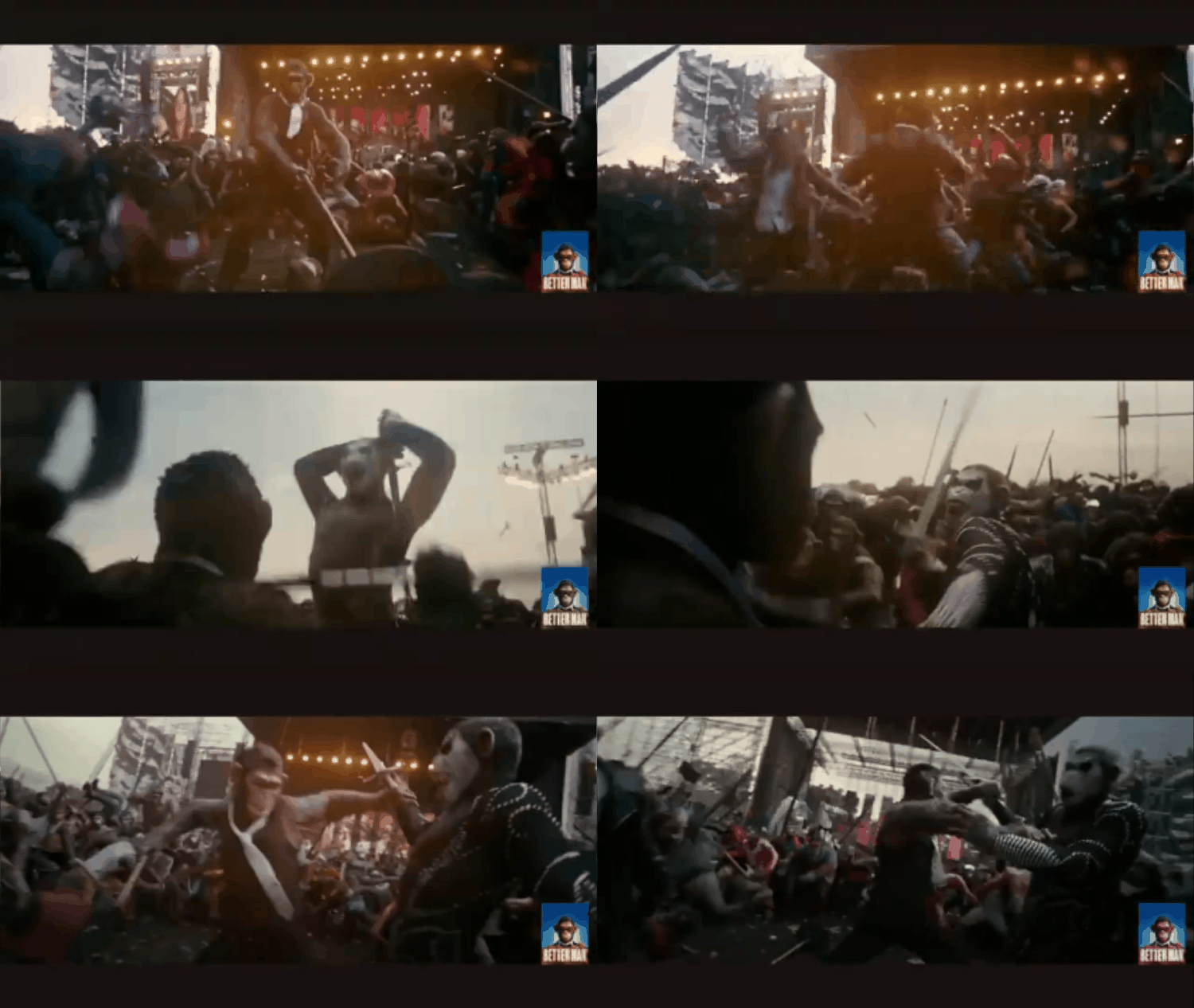
The climactic battle in Better Man is a frenzy
of ape-on-ape violence. This is clearly fantasy.
Image via YouTube.
In the climactic moment of Better Man, an anthropomorphic chimpanzee named Robbie Williams takes the stage at the Knebworth Festival in front of 125,000 fans to sing his pop anthem, “Let Me Entertain You.” Nearing the end of the song, he spots in the audience dozens — then hundreds — of younger and angrier chimpanzee versions of himself. Leaping into the crowd, he begins fighting them one-by-one, with each showdown getting bloodier and more outlandish.

With the leaping chimpanzees, the soaring camera work, and the colourful cinematography, it is as if the Battle of Isengard had been set on the Planet of the Apes and directed by Speed-Racer-era Wachowskis.

So let us be perfectly clear about this point: any movie featuring a battle royale between thousands of anthropomorphic apes is fantastical enough to be considered for a Hugo Award. Whether or not Better Man is a “pure” fantasy movie, it is at the very least a form of magical realism.

It’s also possibly the most audacious — and beautiful — science fiction or fantasy movie released in 2024.

Directed by Greatest Showman auteur Michael Gracey, the movie chronicles the rise of real-world, non-chimpanzee, UK superstar Robbie Williams, his feud with the boy band that launched his career, and his struggles with addiction. These are all the standard narrative beats of a Hollywood music biopic, but Better Man is elevated by the unusual approach to the subject (to whit the motion-capture ape), the panache with which the movie has been directed, and Williams’ sardonic voice.

The real-world non-chimpanzee Robbie Williams
is known for his self-serious dignity.
(Image via RobbieWilliams.com)
Unfortunately, the movie woefully underperformed at the box office — earning only $20 million on a budget that exceeded $110 million. Perhaps it struggled in cinemas because Americans have never really understood Robbie Williams, something explored in the recent Netflix documentary about his life … but not in this film. Americans like their bragaddocio unmitigated; every time Williams offers a bombastic line, he undermines it with a joke. His is a quintessentially British voice that did not appeal to enough people in the USA.

The film’s inability to reach a wider audience is a shame, because by wrapping its narrative in special effects and fantasy, the story becomes more universal. It makes no pretense of being an entirely true and factual depiction of Robbie Williams’ life. To quote Williams himself: “You don’t want the truth. Truth is boring.” This is a fantasy inspired by mostly inaccurate tabloid stories about a pop star. The viewer isn’t being offered the definitive biography of a person, but rather a fable about a dancing primate.

And this makes Better Man better cinema — and more interesting SFF. The movie is full of metaphor and surreal asides in which the chimpanzee Williams is constantly confronted by his personal demons in the guise of past versions of himself.

Williams has spoken about his cinematic simian alter-ego, explaining that he’s often described as “just a performing monkey,” that he’s “less evolved,” and that “fame makes monkeys of us all.” The effect was created by the special effects house Weta, the company that created Gollum in Lord of the Rings and Caesar in Planet of the Apes — they should get a lot of credit for making this central metaphor work, imbuing the animation with pathos while also maintaining its otherness.

One of the central relationships in the movie
is between chimpanzee Robbie and his
grandmother played by Alison Steadman.
(Image via Entertainment Weekly)
The cast is filled with scene-stealing turns by actors who are not yet household names. In the leading motion-capture performance, Jonno Davies manages to imbue the role with pathos and sincerity, while never downplaying the darker places to which the narrative takes him. Alison Steadman is simply superb as Betty Williams, Robbie’s grandmother. The movie’s most dislikeable character, Nigel Martin-Smith, is played with aplomb by Damon Herriman.

But the biggest star of the show is the cinematographer Erik Wilson, who offers infectiously joyful camera work during dance numbers that recall Golden Age movie musicals cranked up to 11 by modern technology. The “Rock DJ” scene in Oxford Circus is a stand-out.

Even describing just the fantastic elements of the movie fails to highlight just how bloody weird the film is. For one thing, Robbie Williams is much younger than you would expect for the subject of a valedictory movie like this; with the exception of movies about stars who died far too young (La Bamba was made when Ritchie Vallens would have been 46, Notorious was made when The Notorious B.I.G. would have been 35, The Doors was made when Jim Morrison would have been 48), the only example of a major Hollywood biopic about a living star as young as Robbie Williams is the Loretta Lynn biopic Coal Miner’s Daughter (Lynne was 48 in 1980 when the movie was released). Williams' most recent studio album is barely five years old, and topped the album charts in the UK, Australia, and Ireland. Moreover, the movie skips some of Robbie Williams’ biggest hits. Millennium, Something Stupid, Strong, and Kids are absent.

Speculative fiction — and the Hugo Awards — can and have embraced off-board picks in the past. Better Man was never marketed as fantasy, but it clearly fits any reasonable definition of genre cinema … and it is among the most bonkers, surreal, and beautiful movies of 2024. Seriously consider giving it a Hugo Award nomination.

Thursday, 25 April 2024

The Kaiju Extension Eligibility Society

Godzilla Minus One puts human-scale characters
in the foreground, while the kaiju casts a shadow
over their lives. (Image via IMDB.com)
This spring, almost 70 years after the original hit cinemas, Godzilla Minus One became the first movie in its franchise to win an Academy Award, for best visual effects. By our estimation, this marks the first time since 2006 that an Academy Award-winning SFF movie did not also earn a Hugo nod.

It’s a perplexing omission. Written and directed by Takashi Yamazki, Godzilla Minus One is a compelling and nuanced take on the kaiju cinema subgenre. Using the monster itself as a metaphor for militarism, for cultural trauma, and for guilt, the director has crafted a beautiful allegory about the power of community and rebuilding.

The protagonist, Koichi, is a former kamikaze pilot who is wracked with guilt over his decision to reject a pointless suicide mission at the end of the Second World War, and is haunted by memories of
The team behind Godzilla were
so enthusiastic at the Oscars,
how can you not cheer them on?
(Image via People.com)

an encounter with a massive lizard monster that nobody believes he saw. Trying to rebuild his life in the ruins of bombed-out Tokyo, he finds meaning in caring for Noriko, a woman who has also lost almost everything in the war, and Akiko, an orphaned baby.

Godzilla Minus One is a movie about human characters whose lives are upended by forces beyond their control. Their struggles to rebuild against the horror of their past are exacerbated by an impressively imagined monster. Godzilla's appearances are more genuinely frightening because we were so invested in the lives of the people.

Enhancing this first-rate script is a subtle and thoughtful approach with the special effects, and action scenes that emphasize the terror such a monster could evoke. The train carriage scene might be one of the greatest moments in kaiju history.

During an era in which the Hugo Awards seem to be beginning to embrace an international mandate of a “World” Science Fiction Convention, there had been hopes that Godzilla Minus One
Warner Brothers (the studio run by
everyone's favourite CEO David Zaslav)
 forced Godzilla Minus One out
of the cinemas early, thus
limiting its audience in America.
(Image via Warner Brothers)
might become the first live-action Japanese movie to earn a nomination for the award.

The fact that Godzilla Minus One does not appear on the Hugo Award Ballot likely has to do with the fact that it was released late in the year, hitting cinemas in the United States on November 29, 2023. Although it opened as a wide release, it did not have the marketing budget of a movie like Dune or Spider-Man. And although it was relatively successful in the box office, it was pulled from distribution early because executives at Warner Brothers didn’t want a Japanese kaiju movie competing with the American kaiju movie Godzilla x Kong: The New Empire which opened a few weeks after Godzilla Minus One.

These are circumstances relatively similar to those in 1981 that prompted the adoption of WSFS rules that enable the business meeting to extend the eligibility of a movie. If you’ve not read our blog post on the subject, here’s the relevant clause of the constitution:

3.4.3: In the event that a potential Hugo Award nominee receives extremely limited distribution in the year of its first publication or presentation, its eligibility may be extended for an additional year by a two-thirds (2/3) vote of the intervening Business Meeting of WSFS.

Given that Godzilla Minus One earned a respectable $56 million in North America, and was on more than 2,000 screens (compared to the English-language Godzilla x Kong, which made almost $500 million on 3,900 screens), it’s not exactly a clear-cut case that this movie was unavailable to Hugo nominators. Nevertheless, a compelling argument could be made that it was denied a fair shot at Hugo nod based on the studio shenanigans and the late-in-the-year release.

We’ll be putting forward an eligibility extension motion at this year’s business meeting. We hope you will support it, and consider it for the Hugo Award in 2025.


Friday, 29 December 2023

Death From Above (Hugo cinema 1979)

This blog post is the 22th in a series examining past winners of the Best Dramatic Presentation Hugo Award. An introductory blog post is here.

As the 1970s drew to a close, science fiction cinema was in transition. The Hugo for Best Dramatic Presentation in 1979 reflects this; socially conscious environmental parables of the waning decade were making way for a new era of popcorn cinema.
Star Wars producer Gary Kurtz presents the 1979
Hugo Award for Best Dramatic Presentation to
Superman star Christopher Reeve at Seacon.
(Image via Supermania78)


For the first time, there were two animated movies nominated in the same year (something that would not happen again until 2002): Watership Down and Ralph Bakshi’s Lord of the Rings. Hitchhikers Guide To The Galaxy became the first (and to date only) commercially broadcast radio show to earn a Hugo nod. This left Superman and Invasion of the Body Snatchers as the only live-action movies up for the award. From the start of organized fandom, fanzines had always provided reviews of movies, but in the late 1970s, more column inches were spent on cinema than ever before. Fans debated whether movies like The Wiz, The Cat From Outer Space, or Coma deserved recognition for the Hugo, and wisely decided that they did not.

In the wake of Star Wars, Hollywood had begun to recognize the commercial viability of big-budget science fiction. The floodgates were opening.

There had also been an uptick in televised science fiction. In Britain, Blake’s 7 was drawing in up to 10 million viewers an episode. In the United States, Glen A. Larson’s Battlestar Galactica became the most expensive television series ever made up to that point. Although it received mixed reviews from fandom, the original pilot Saga of a Star World holds up surprisingly well today. One of the show’s few defenders in fandom, Mike Glyer noted that “Battlestar Galactica has been panned in every review I've read — must be something wrong with me, I enjoyed it.”

In the days leading up to the Worldcon in Brighton, UK, the original radio production of The Hitchhikers’ Guide To The Galaxy seemed to have the edge. Indisputably fannish, and replete with genre references, it was an immediate hit in the United Kingdom. Despite the fact that the Douglas Adams’ comedy would not be broadcast in the United States until three years later, SFF fans all over the world were alerted to its existence by their British friends. It was broadcast on the BBC Worldwide shortwave service, and some North American fans were able to receive it via shortwave radio (and bootleg audio cassettes). File 770 took the unusual step of publishing the schedule of shortwave broadcasts for the show.
How many Hugo finalists have
inspired songs by Radiohead
and Perfect Circle?
(Image via Wikipedia)


Though it’s broadly recognized as a classic today, Richard Donner’s Superman did not seem destined to win the Hugo Award in 1979. When the movie first came out, critics were less than charitable in their assessment of the film. The New Yorker’s Pauline Kael excoriated it as smarmy and cynical with “a sour, scared undertone.” The New York Times’ review is even more dismissive, opining that, “It's as if somebody had constructed a building as tall as the World Trade Center in the color and shape of a carrot. Rabbits might admire it. They might even write learned critiques about it and find it both an inspiration and a reward, while the rest of us would see nothing but an alarmingly large, imitation carrot.”

Even within fandom, there was a sense that comic books weren’t ‘real science fiction,’ and consequently a comic book movie wasn’t a ‘real science fiction’ movie. In the fanzine SF Review, editor Richard E. Geis wrote that “We hated Superman cordially (and hated Invasion of the Body Snatchers not so cordially).”

Bakshi’s Lord of the Rings is arguably the weakest work on the shortlist. Some of the viewers in our group would have considered ranking it below no award if we were voting today. Although the first half of the movie hews closely to JRR Tolkein’s original novel, the second half rushes through major plot points without pause before ending abruptly. Praising the faithfulness of the adaptation, but excoriating the jumpy rotoscoping and off-putting visuals, fan Bill Warren dismissed Bakshi’s Lord of the Rings as “Middling Earth.”

More than in previous years, there was debate about the shortlist, and various works had their proponents. Harlan Ellison had endorsed Watership Down, writing that, “It is intelligent, elegant, true to the splendid book from which it was adapted, and as uplifting for adults as it will be for kids.” A reimagining of the Biblical story of Exodus told with rabbits, the movie had its world premiere at the 1978 Worldcon in Arizona. It may have received a boost by being seen by likely Hugo voters, and the enthusiastic lobbying of Ellison. The naturalism of the animal depictions resonate, and the painterly backdrops are striking, but there’s a tonal disconnect between the seriousness of the violence and juvenile elements like the wacky seagull sidekick Kehaar.
#NotMyAragorn
(Image via IMDB)


Though it initially received mixed reviews from mainstream critics, and only a modest success in its initial release, over time the 1978 remake of Invasion of the Bodysnatchers has gained critical acclaim. Some members of SFF fandom were ahead of the curve, with frequent reviewer Bill Warren describing it as the finest movie he’d seen that year, and suggesting that it was “more than just a remake of an old classic, it's a new classic in itself.” More than four decades after its release, the movie has aged well, with multiple possible interpretations. We ended up debating whether it was a warning about the threat of communism, a meditation on societal pressures to conform, or something else. It deserved its nomination, and would have been a worthy winner. It probably lost Hugo votes because author Jack Finney — upon whose book the movie is based — had shown some disdain for the fandom community.

In the final Hugo vote, the top two finalists were surprisingly close … each of which featured a protagonist who is the last survivor of a doomed planet and each of which had an influence on broader, mainstream culture: Superman and The Hitchhiker’s Guide To The Galaxy.

Hitchhiker’s Guide To the Galaxy is rightly regarded as a classic of science fiction comedy. Those in our cinema club who love it, do so unreservedly … but it was not to everyone’s taste. Understated and ironic, some consider it a masterpiece of timing and laconic charm, despite the dialogue feeling loose and unstructured. Following an everyday Englishman who survives the destruction of planet Earth, the series meanders between various science fiction tropes before the protagonist uncovers the galactic conspiracy behind his planet’s demolition. There’s a reason this radio show spawned four sequels, was adapted into a television series, a movie, a video game, and a novelization that sold more than 14 million copies.
The vote came down to two 
stories — each about a last
survivor of a doomed planet
who has to face off against
real estate developers.


The initial popularity of The Hitchhiker’s Guide To The Galaxy cannot be overstated. Within months of its first airing, fans had adapted it to a stage production, and Graham England was publishing a fanzine titled Don’t Panic, which was actively campaigning to get a Hugo Award for its author Douglas Adams. “I’m more astonished and delighted than I can say at the prospect of being put forward for a Hugo nomination — a fairly mind boggling prospect,” Adams wrote on February 14, 1979 about the campaign to have him recognized, and said he was trying to make the show available in the United States.

Despite the disdain critics had shown for it, Superman was the highest-grossing movie of the year and had connected to audiences. At the time, no movie based on a comic book superhero had been among the year’s top-20 grossing films (previous superhero movies such as the 1966 Batman were comparatively small-scale affairs). In many ways, this would be seen as the turning point in cinema history; the most dominant movies of today had their genesis in 1978, with almost every superhero movie in subsequent decades taking cues from Richard Donner’s interpretation of Superman.

When rewatching these movies with 40 years of hindsight, it’s clear that this was not only one of the more interesting Hugo shortlists, it was one of the best. After decades in which the Best Dramatic Presentation Hugo Award had been somewhat of an afterthought, science fiction cinema seemed to be coming into its own.


Thursday, 9 November 2023

Indie Cinema And The Hugo Of Doom

At the 2023 WSFS Business Meeting, a constitutional amendment was passed that would (if ratified at the 2024 Business Meeting) add two new categories to the already long list of Hugo Awards: Best Independent Short Film and Best Independent Feature Film.
Independent Cinema is awesome, but ill-defined.
(Photo by Daniel Penfield via Wikipedia) 


The beauty and diversity of global cinema and of independent film is something that should be more celebrated at the Hugo Awards. But despite our love of independent SFF cinema, we are firmly opposed to the creation of a secondary award for a specific type of movie.

Here’s the motion that succeeded by a vote of seven to five:

3.3.X: Best Independent Short Film Award. Awarded to science fiction or fantasy productions presented in the short film format (under 45 minutes) for the first time in the previous calendar year. The films should not be funded by a major studio or distribution label/platform/streamer. Films can be funded by national film/arts grants like the BFI or TeleCanada. The award should not include broadcast or streaming television series episodes.

3.3.X+1: Best Independent Feature Film Award. Awarded to science fiction or fantasy productions presented in the long film format (over 61 minutes) for the first time in the previous calendar year. The films should not be funded by a major studio or distribution label/platform/streamer. Films can be funded by national film/arts grants like the BFI or TeleCanada.

“Although we already have a [Hugo] award for films, those films are usually mainstream. They’re already commercially very successful,” Xia Tong, one of the two fans who proposed the new categories, said. “There are a lot of art movies and Indian films that are quite popular among our fandom. They need more encouragement.”

These are sentiments with which we largely agree. What we don’t agree with is the idea that Indie films need a separate award to be recognized for their value by Worldcon members … and the idea that allowing the existing categories to remain the domain of mainstream films will help.
In the independent movie Prospect, Pedro Pascal
plays a grizzled loner hanging out with a kid,
a role completely unlike any other he's taken.
(Image via Wikipedia)  


In recent years, sub-par corporate works such as The Hobbit: An Unexpected Journey and Avengers Endgame have received Hugo nods ahead of significantly better independent and foreign movies such as Robot & Frank and Prospect. That does point to problems with the category. But the solution is advocacy. People who care about independent cinema should be working to encourage Hugo voters to check out a wider variety of films, and then giving them the time to watch those movies by WSFS extension of eligibility under rule 3.4.3.

Over the past four years, we have filed extension of eligibility motions (allowing a longer time for Hugo voters to consider nominating) on lower-budget SFF movies like After Yang, Strawberry Mansion, Neptune Frost, Mad God, Nine Days, Beyond The Infinite Two Minutes, Psycho Goreman, The Color Out Of Space, and Prospect. We are passionate about celebrating and promoting independent SFF movies. However, we do not think that the best way to recognize that is with the creation of new Hugo Award categories, seemingly based on how much money a film makes.

There are a number of problems with the idea of a Hugo Award for independent cinema. The first and most significant to us is that creating these categories positions independent cinema as something other than “real” movies. Hiving off independent cinema into its own special category creates a ghettoized award that is inherently lesser than mainstream studio movies. As an analogy, nobody markets Billie Eilish’s When We Fall Asleep, Where Do We Go? as the winner of the Grammy for Best Pop Vocal Album … because it also won the Grammy for Best Album of the Year. The category with a more restrictive set of eligibility criteria is going to be seen as less prestigious.

The definition of what counts as "independent" is
quite nebulous — and could even include 
music videos such as Skibidi.
(Image via YouTube)
On a practical level, it is difficult to parse out which works might be eligible for these awards. As an example, this year’s Hugo-winning movie Everything Everywhere All At Once has been categorized as an independent film (and was honoured by the Independent Spirit Awards). Although Everything Everywhere All At Once was not funded by one of the Big Five Studios (Universal Pictures, Paramount Pictures, Warner Bros. Pictures, Walt Disney Studios, and Sony Pictures), the production was funded by IAC, a firm with $10 billion in holdings. Likewise, the 2009 Hugo-winning movie Moon can be categorized as an independent film (winning the BIFA award for Best British Independent Film), but the production was funded by Stage 6 Films, which is wholly owned by Sony Pictures. In addition, a reasonable argument could have been made that Iron Man might have been classed as “independent,” since Marvel Studios self-financed the movie and was at that time not part of Disney. Parsing out the differences between “Independent” and “Studio” films would be a significant challenge for Hugo administrators.

This also raises the question of whether a single work should be eligible for two separate Hugo Awards. In the past, the awards have operated on a premise that recognizing a single work with two separate trophies would be akin to gilding a lily. It seems likely that if these awards had existed in 2023, Everything Everywhere All At Once would have been honoured with both the Best Dramatic Presentation Long Form Hugo, as well as the Best Independent Feature Film Award. (Unlike with the Best Series Hugo which was introduced in 2017 and can bend this principle, the creation of the Independent Cinema Hugos would break the principle fully.)

As of 2024, there will be no fewer than 18 permanent categories at the Hugo Awards. The ever-expanding slate of categories is creating an increasing burden on the event, its volunteers, and the voting membership. This is not the main reason to oppose these new categories, but it should be a significant consideration.

The wording for these awards as it stands would exclude any movies that are between 46 and 60 minutes in length; the short movie award caps out at 45 minutes, and the long form is not available for anything shorter than 61 minutes. This is a nitpick rather than a substantive criticism, but it does seem ill-considered.

2023 Hugo Winner Everything
Everywhere All At Once
also
won the Independent Spirit
Award for Independent Cinema.
(Image Via Wikipedia)
Several attendees of the business meeting spoke in favour of these new categories, including Louis Savy who has done excellent work to promote independent SFF movies as the organizer of the Sci-Fi London Film Festival. On Facebook, organizers of other science fiction film festivals have indicated an intention to attend the next Worldcon to vote for this motion. The question, however, is if new Hugo Awards should be created to meet the needs of a small group of professionals, or in the interests of the Worldcon membership.

This blog has a history of championing independent and smaller-budget SFF films. We would suggest that many of the small-budget SFF movies are more ambitious, daring, provocative, and thoughtful than the endless cavalcade of costumed CGI-generated crimefighter movies that are churned out by large studios. As we have previously argued, the role of the Hugos as they were initially envisioned in 1953 was “to make the great works of science fiction better known to the world,” and by this measure the Best Dramatic Presentation category does not serve its purpose by routinely honouring the big-budget blockbusters of which the world is already well aware. The solution is not to create new categories, but to make more use of WSFS rule 3.4.3, which can help platform independent gems. And, to perhaps build awareness and interest in films from regions not regularly represented on the nominating ballot.

Conversely, it’s worth noting that Worldcon has always been more of a literary convention than a media convention. Consequently, the Hugos are voted on by people with a deeper knowledge of literature than of the independent film festival circuit. In that light, it might also be time for us to consider whether or not the Best Dramatic Presentation categories should continue at all, though that’s a conversation for another time.

Awards that recognize works based on a democratic vote depend on an informed electorate. But independent cinema is accessible to a smaller audience than mainstream blockbusters, and it is consequently difficult for nominators to be aware of the field. An award for independent science fiction cinema is warranted, but it is likely that a juried award would be better suited to do justice to this art form.

The WSFS Business Meeting in Glasgow should reject these proposed categories. Not every type of work needs to have a category at the Hugo Awards.


Saturday, 22 July 2023

The Golden Age Of Wes Anderson Is Twelve

Asteroid City may be Anderson’s first unambiguously genre movie, but for many science fiction fans, it feels like he’s always been one of us.

Wes Anderson's aesthetics have often harkened
back to the post-war era — the waning end of
science fiction's "Golden Age."
(Image via IMDB.com)
Between the heightened reality of his cinematic style and his worldbuilding sets (gormengastian hotels and benthic exploration), his movies have always been on the edge of SFF. In addition, it’s easy to believe that Ender Wiggin, young Anakin, and Wesley Crusher would find a peer group among the socially awkward child prodigies who are mainstays in Anderson’s films.

On the surface, Asteroid City offers what fans have come to expect from Anderson; symmetrical framing, deliberate pastel colour palette, deadpan dialogue delivery, and dysfunctional family dynamics at a time of transition. It will no doubt be loved by many, hated by some, and possibly ignored by most Worldcon nominators.

As with his earlier films — such as The Royal Tenenbaums, The Grand Budapest Hotel, and Moonrise Kingdom — this latest offering provides a complex blend of quirky characters, played by a cult-like cast of actors (plus Tom Hanks and Margot Robbie) delivering whimsical and pretentious dialogue for a fraction of their regular incomes.

The setting for the story is the annual Asteroid Day stargazing event, which includes the Junior Stargazer convention. Here, five privileged, intellectually gifted teens receive awards for their space-related inventions. These relatively benign inventions become crucial to the success of the story’s plot arc, when an alien visit forces a quarantine that raises tensions.

And it’s the film’s child actors that move the narrative and, some might argue, steal the show.

It’s through the teenage characters that we see the strongest ties to science fiction, (although Tilda Swinton as the socially awkward, workaholic astrophysicist Dr. Hickenlooper also gives that thread a serious pull, with her lifelong commitment to “figuring out the math.”)
In a star-studded cast, Ethan Josh Lee,
Grace Edwards,  Zoe Bernard,
and Aristou Meehan still stand out.
(Image via IMDB.com)


Framed on top of and interspersed throughout the main narrative of the film is a meta-analysis that neurotically overlays the existential angst of the playwright, played by a long-time Anderson favourite Edward Norton. This secondary narrative mirrors the motivations of the Junior Stargazers, and provides reflection on the very human need to speculate about the future and always strive to do better. To do your best and, unfortunately but perhaps most importantly, to steadfastly refuse to accept that it’s ok to stop and feel joy if you’ve achieved something that’s merely good enough. In order to drive this point home, an acting class in the secondary layer of narrative literally chants this mantra at the audience: “You can’t wake up if you don’t fall asleep.”

To be clear, this isn’t a film for everyone. But we do see this same indefatigable quest for aspirational advancement everywhere in science fiction. The energy and motivation to seek something better is a prerequisite for most standard science fiction tropes. And, unsurprisingly, this drive is mirrored again, through the alien. The non-speaking character is a duty-bound bureacrat that travels from beyond our star system to steal, inventory, and return an asteroid. The part is played by Jeff Goldbloom, who is later shown smoking a cigarette backstage in the secondary narrative, muttering defensively about his role.

Famed fanzine editor Peter Graham once famously quipped that “the Golden Age of Science Fiction is 12,” and we might suggest that Wes Anderson shows an understanding of what that means at its core. Asteroid City depicts the childlike sense of wonder that is at the heart of science fiction fandom with respect and affection that could be read as a love letter to the genre.

It may be the best genre movie of 2023.

Thursday, 8 June 2023

I've Got A Bad Feeling About This (Hugo Cinema 1977)

This blog post is the 20th in a series examining past winners of the Best Dramatic Presentation Hugo Award. An introductory blog post is here.

Imagine the producers of these four movies being
told that ‘no award’ got a standing ovation,”
award presenter Robert Silverberg noted wryly.
(Image from the 1971 Hugos by Jay Kay Klein)
The decision to reject all the nominees in a Hugo Award category should never be taken lightly. And the snubbing of every movie on the 1977 shortlist seems — in retrospect — to be one of the more egregious examples of dismissing members’ suggestions.

It’s a shortlist that’s difficult to argue with: Logan’s Run, Futureworld, The Man Who Fell To Earth, and Carrie are all notable movies that have held up relatively well.

But that shortlist suffered from bad timing, having been announced on April 15, 1977 … just 40 days before the release of possibly the biggest science fiction movie in history. To say that these four movies were overshadowed by Star Wars would be an understatement.

That year’s Hugo Awards presenter Robert Silverberg (appearing on stage with a Wookie) warned the audience that “Best Dramatic Presentation … no, no, it is not Star Wars. Star Wars is not eligible this year.”

And when he announced that there would be no award for Best Dramatic Presentation, the crowd cheered — possibly the loudest cheers of the whole evening.

Star Wars was revolutionary. It transformed the pop cultural landscape, and one can understand how it eclipsed all other science fiction cinema. In retrospect, however, all the finalists are interesting and worth watching — at least from the perspective of the history of genre cinema — and it seems a shame that they were snubbed.

In some ways, the nomination of Futureworld seems like the end of an era in Hugo cinema. Through the 1970s, a certain class of B-grade movies that didn’t require massive special effects budgets and often over-explained their very serious science fiction premises to the audience made frequent appearances on the ballot. The Immortal, Questor Tapes, and The People (among others) share similar pacing, similar lighting, and similar stodginess. Futureworld fits into this mold fairly closely, though some of the big ideas are relatively compelling. The premise is fundamentally sound; and it’s interesting to explore the idea that the androids from the first movie are being used to replace high-profile politicians and subvert democracy. It’s essentially an anticapitalist riff on The Pod People, though most of the ideas in the original Futureworld were explored with more nuance on the recent HBO remake.
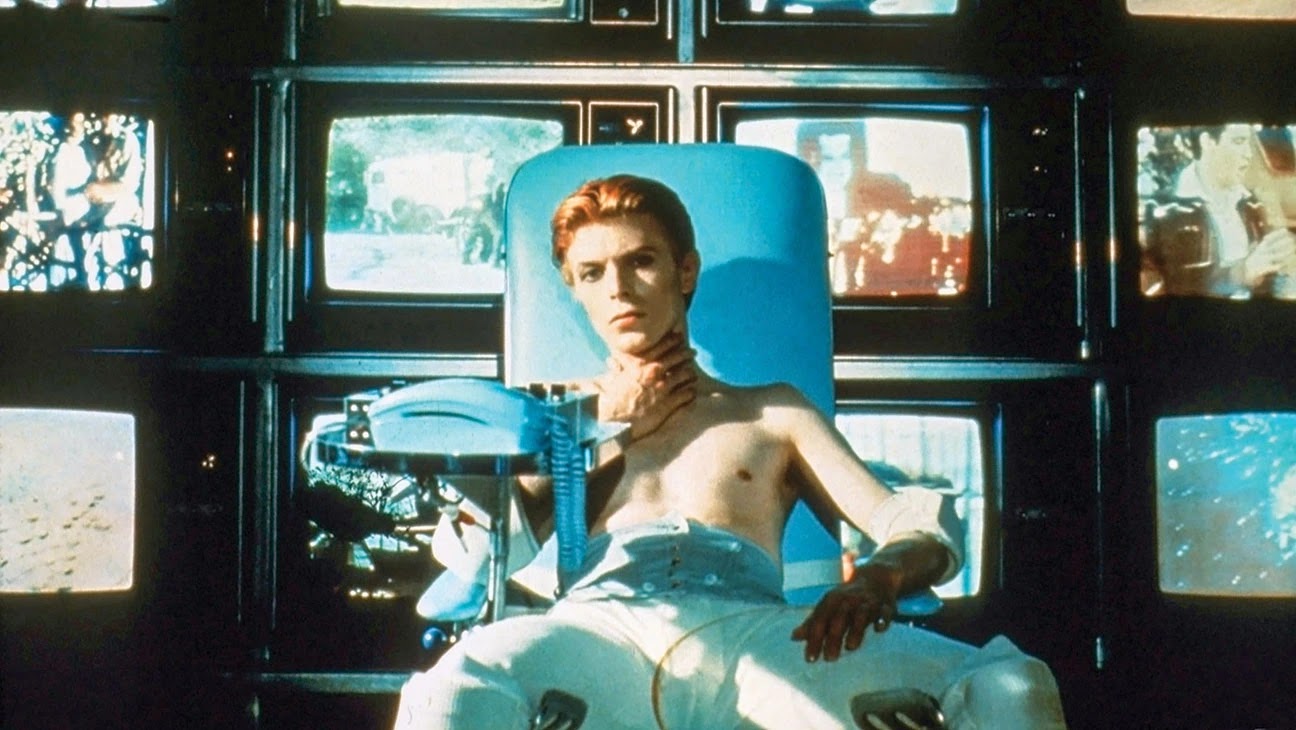
Although the movie has some shaky moments,
David Bowie is iconic as Thomas Jerome Newton.
(Image via Hollywood Reporter)

At almost the opposite end of the cinematic spectrum is The Man Who Fell To Earth, a ponderous, perplexing, and unsettling piece of arthouse cinema directed by Nicholas Roeg. The movie features David Bowie as the alien Thomas Jerome Newton on a mission to bring water back to his home planet. Armed with a vast archive of scientific knowledge, he starts businesses and investments, building a ship to take himself back to his home planet. Over the course of decades, he becomes seduced by the carnal pleasures available to him on Earth, and loses his way. Based on a novel by Walter Tevis (Queen’s Gambit, Mockingbird, The Hustler), the movie feels incomplete; like more effort was put into visuals than plotting, without much consideration for what the story adds up to.

Though it ended up on the Hugo ballot, there was a significant and vociferous faction of fandom that loathed Logan’s Run. Contemporaneous fanzine reviews described it as “ludicrous,” “hackneyed,” and “insulting.” But with the benefit of four decades of hindsight, we’d suggest it holds up admirably well. Adapted from a novel by William F. Nolan and George Clayton Johnson, the movie explores a society in which citizens are given a maximum lifespan, and are culled the day they turn 30. It’s a broadly ephebiphobic commentary on contemporaneous youth culture; and is reflected in various ways in generations of young-adult dystopias such as The Maze Runner and Divergent. The filmmaking is ambitious, lush, and looks great. One of the striking things about Logan’s Run is just how sex-positive the movie is; this hedonistic society puts consent at the forefront, and accepts homosexuality without judgment. For the era, it’s exceptionally progressive on these fronts.

There are portions of Carrie where every frame
of the movie is riveting and spectacular.
(Image via ABC News) 
Of all the finalists, Brian de Palma’s Carrie probably stands out as the best piece of filmmaking. That said, it’s more uneven a movie than most of us had remembered; de Palma’s attempts to mimic earlier horror directors such as Hitchcock are a little overdone. But when he leans in to his own music-video style the movie soars. There are numerous moments that are etched indelibly into pop culture: Sissy Spacek at the Prom being the most iconic. In some ways, it’s essentially a movie about personal autonomy; Carrie is cowed by an overbearing and extremely religious mother, constrained by bullies, and trapped by her school. In fact, until the last scene, nobody ever asks Carrie what she wants. Even the most well-meaning characters try to act in her best interest behind her back — without consulting her. We'd also note that Sissy Spacek's performance is unbelievable; the movie would not hold up nearly as well without her. 

The Hugo Award should have gone to Carrie or to Logan’s Run. The Worldcon snubbed some great filmmaking that may not have been as momentous and era-defining as Star Wars, but still deserved respect, as did the efforts of those who nominated.

Note: Our series of blog posts about Hugo-shortlisted movies will be on hiatus for the next several months while one of our key contributors recovers from surgery.

Monday, 3 April 2023

Edgelord Cinema Maximalism (Hugo Cinema 1976)

This blog post is the nineteenth in a series examining past winners of the Best Dramatic Presentation Hugo Award. An introductory blog post is here.  

Warning: Contains references to sexual violence depicted in the movies being reviewed. Also spoilers.

In the 1960s and 1970s, the new wave of science fiction transformed the genre. Writing styles became more varied. Surrealism and postmodernism were embraced. Authors began to explore previously taboo subjects like sexuality, drug use and abuse, and psychology.

Many of these genre-shaping stories were rightly celebrated for their insight, their boldness, and their inventiveness. But in some quarters, the pushing of boundaries became an end unto itself, and transgression became mistaken as insight.

Although the 1976 Hugo-winning incel manifesto A Boy And His Dog may not have been the nadir of this trend, it’s probably the most iconic example.

Members of our cinema club described
A Boy And His Dog as “a spasm
of puerile adolescent garbage” and
“The most reprehensible
thing I have watched.”
(Image via IMDB)
Set in a post-apocalyptic America decades after a nuclear war, A Boy And His Dog follows Vic (Don Johnson) a libidinous 18-year-old and his telepathic dog Blood as they search for food and women. The main plot of the movie covers Vic getting lured by a woman named Quilla June (Susanne Benton) into the clutches of a community living underneath the ruins of Topeka. After a failed revolution in the underground city, Vic and Quilla June fall in love and escape back to the surface.

The offensiveness of this movie and its misogyny cannot be overstated. The protagonist is a sexual predator who hunts women for sport. The animal sidekick cheers him on in his rapes. This all culminates in a “twist” ending in which Vic murders Quilla June and feeds her to the dog; driving home the fact that this movie treats women as little more than meat. At no point does this movie critique this repulsive stance; rather, it embraces it.

The novella upon which the movie is based provides a blueprint for all these problematic elements, but is slightly more critical in its treatment of Vic and of Blood. Director L.Q. Jones — who was trained on old-school westerns — provides mostly neutral or adoring depictions of Vic and Blood. The appalling end sequence is delivered with a smirk, and with a heroic framing as they ride off into the sunset.

Numerous contemporaneous critics flagged the reprehensible nature of the movie. Joanna Russ wrote a long-form critique, suggesting that “Sending a woman to see A Boy and His Dog is like sending a Jew to a movie that glorifies Dachau; you need not be feminist to loathe this film.” Writing in Yandro, Gary Anderson suggested that he was unlikely to vote for it in the Hugos.

A Boy And His Dog should not have been nominated for a Hugo Award and yet it won one. Anything else on the shortlist would have been a better choice. It is a black mark on the Hugos, and on Worldcon.

Although it received the fewest votes that year because of its limited distribution, The Capture might have been an interesting winner. A deeply fannish work, only shown at SFF conventions, it was a slideshow presentation (later self-published as a graphic novel) written by Robert Asprin and illustrated by Phil Foglio. It tells the story of a group of science fiction fans who are abducted by aliens. Filled with nerdy references, in-jokes about frequent Worldcon attendees, and deep-cut references about SFF, this isn’t a work that would appeal to everyone.
Illustration from The Capture by Phil Foglio. 
There is enduring value to fan history for this
work to be more accessible to readers.
(Image by Phil Foglio via Merrill Collection)

But it’s also quite charming. The art is terrific, and the writing is snappier than any of us had expected. The denouement — in which the fans are so annoying that the aliens decide to give up and send them back to Earth — is just … genre appropriate.

It’s not easy to find a copy of The Capture today. We were only able to access it because one of the members of our cinema club flew 2,700 kilometers to Toronto and visited the Merrill Collection. As far as we can ascertain there are only three libraries in North America that have a copy. There is also one copy available for purchase in New Jersey. Given that it is a work with enduring cultural and historical value to fandom, but which has little to no commercial value, we would urge Phil Foglio and the estate of Robert Asprin to allow the Fanac Fan History Project the permission to host an online copy of the booklet, and perhaps a recording of the original slide presentation.

One of the more interesting speculative trends in the history of Best Dramatic Presentations is how often Hugo voters seem to be able to notice an up-and-coming filmmaker before the rest of the world does. In 1976, they recognized the work of John Carpenter, long before he went on to direct any of his classic movies. Dark Star — which began as Carpenter’s student project while at the University of Southern California — is an odd, rambling movie.

After the end of the moon landings, it became 
possible to imagine outer space as ... boring.
(Image via IMDB)
Despite a microscopically low budget, a tiny cast, and some exceptionally silly special effects, there’s a lot to like in Dark Star. The story of a blue-collar crew of a star ship tasked with destroying rogue celestial objects, it's a comedic portrayal of the boredom of long-term space missions. The movie drifts aimlessly between one misadventure and the next; someone’s alien space pet becomes a threat. Later, they get caught up in a space storm. Some of these scenes work exceptionally well — particularly attempts to negotiate with a malfunctioning artificially intelligent bomb — though others fall flat. The movie almost has too many ideas (most of which would later be developed by the screenwriters into more commercially successful movies like Alien).

The highest-grossing science fiction movie of the year had been the ultraviolent commentary on sports culture Rollerball. Directed by Canadian cinema legend Norman Jewison (In the Heat of the Night, Fiddler on the Roof), the movie depicts a corporate-dominated dystopian future in which a bloody sport called Rollerball is used to distract the masses from larger societal inequities. At the beginning of the movie, the unquestioned greatest Rollerball player of all time Jonathan E. (James Caan), is pressured by his corporate overlords to retire after the upcoming championship, and begins to question the system that has enriched him.

All of this is a great premise for an action movie; and there’s a lot that works well in Rollerball. The set-piece sports scenes are first-rate, some of the performances are excellent, and the worldbuilding is interesting. But the suggestions of an anticapitalist message are never fully developed; viewers never learn why Jonathan is being asked to quit the sport, his relationship with his former wife Ella is never explained, and the final Rollerball match ends up feeling somewhat pointless.
The effect of concussions caused by Rollerball 
need to be studied, as too many Rollerball stars
seem to end up as Fox News talking heads.
(Image via Variety)


Of all the movies on the Hugo Shortlist in 1976, one stands out for its cultural impact and enduring appeal: Monty Python and the Holy Grail. Dialogue including gems like, “Strange women lying in ponds and distributing swords is no basis for a system of government” may be the greatest analysis of Arthurian legend ever written.

Comedies age more quickly than most other forms of cinema, but of the 1970s humorous works that received Hugo Award nominations, it’s Holy Grail that seems to have stood the test of time best. Some elements may have been sapped of their wit through endless repetition by fans, but much of it still hits its mark.

What’s sometimes overlooked is that this is also possibly the best-filmed and most lush production that the Monty Python crew ever put together. The animated segments offer us Terry Gilliam at his best, while with the live-action portions Terry Jones created provide artful shots that are edited together with panache. The result is a movie that visually reminded us of Andrei Tarkovsky’s Stalker, or John Boorman’s Zardoz.

It is interesting to note that Monty Python and the Holy Grail took second in the balloting, only being eliminated in the fourth-round. The major complaint that contemporaneous fans had about Holy Grail was that it was “barely SFF.”

At the ceremony, as was the norm, nobody from the team behind the Hugo-winning movie attended the ceremony. Shockingly, not even Harlan Ellison was there to accept the award. It was left to Ellison collaborator Edward Bryant to accept it on behalf of the production team. He noted, “There has been an ongoing controversy over the awards for dramatic achievement ... because so many times in the past, it seems the award has gone to frankly people who don’t appreciate the award.”

Viewing and writing almost five decades later, we’d suggest that perhaps it is better to give an award to someone who doesn’t appreciate it, than to celebrate something as reprehensible as A Boy And His Dog.

Friday, 23 September 2022

Clash of the Cinema Titans (1972)

This blog post is the fiftteenth in a series examining past winners of the Best Dramatic Presentation Hugo Award. An introductory blog post is here.

The early 1970s saw a flourishing of SFF cinema. In 1971 alone, Jim McBride’s X-rated Glen and Randa scandalized audiences with post-apocalyptic sex scenes, and garnered critical love along the way. Boris Sagal threw Charleton Heston to the vampires in the blockbuster The Omega Man. And Josef Pinkava offered audiences a whimsical tale of children with a magical computer in The Wishing Machine. But these films were up against long odds to make the Hugo shortlist. 

The shortlist in 1972 may have provided the most star-studded Best Dramatic Presentation ballot the awards have ever seen. 

The movies on that shortlist were directed by a cavalcade of what are now household names for many: George Lucas, Steven Spielberg, Robert Wise, and Stanley Kubrick. Between these four people, there’s a total of 46 Academy Award nominations and $23 billion in box office receipts.
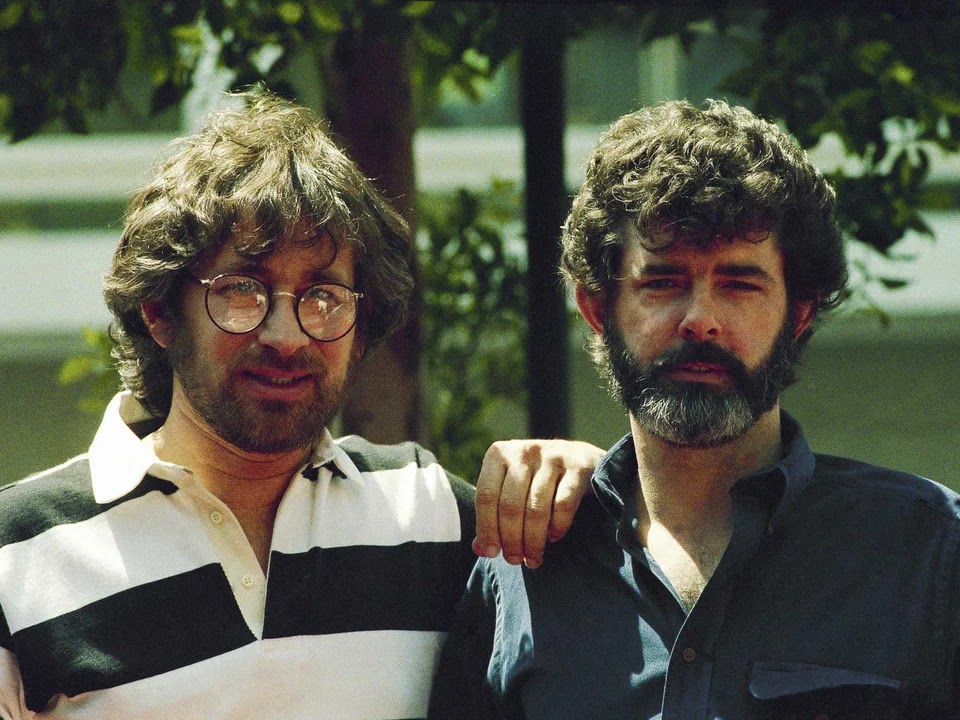
George Lucas and Steven Spielberg in the 1970s.
Long before they were beloved by millions of 
moviegoers, science fiction fandom embraced
the works of Steven Spielberg and George Lucas.
The Hugos gave each of them their first award nods
for feature films.
(Image via Reddit)

Each of these directors moved the art of moviemaking forwards and made extraordinary contributions to science fiction cinema … but to be blunt, none of them produced their best work in 1971.

Despite the Hugo ceremony taking place near the Los Angeles airport, none of the finalists made an appearance at the awards. In fact, none of them even bothered to send someone to pick up the award, with local fan Bill Warren acting as the acceptor.

Four movies made the ballot — and a second Firesign Theatre album. Only Bozos On This Bus loosely continues the story started in the previous year’s comedy album, which may make it the first instance in which a work and its sequel were both shortlisted for a Hugo. It probably would have been near the bottom of most of our ballots though. 

More interestingly, an little-remembered television movie L.A. 2017 did make the ballot.

Just 24 years old at the time, Steven Spielberg was taking short-term television gigs while trying to break into feature film work. He’d had a rocky start with poorly-received work on Rod Sterling’s Night Gallery and on Marcus Welby, M.D., when he had the opportunity to direct a one-off science fiction TV movie for an anthology show about journalists in Los Angeles. The result, L.A. 2017, is a surprising inclusion on the Hugo ballot.

Shot for a paltry $375,000, and with a script by Philip Wylie (author of When Worlds Collide and
Poster for City of Stars
The real Los Angeles of 2017 turned out to be far
more dystopian than even Steven Spielberg had
imagined in his first feature-length movie L.A. 2017.
(Image via IndieWire)
Gladiator), L.A. 2017 is an uneven work at best. The parable about a fascist future United States living underground to hide from pollution is heavy handed, most of the acting is hammy, and the ending is an appalling cop out. But having watched a number of other television movies of the time during our voyage through Hugo history, we were struck at how much livelier the directing was. It’s clear that Spielberg was head and shoulders above most of his peers directing television in the early 1970s, conveying more through effective framing and camera movement.

Although not well remembered, L.A. 2017 is of significant historical value as it opened doors for the young Spielberg. It’s also interesting to note that this nomination means that the Hugo Awards can boast of being the first major award to have shortlisted Stephen Spielberg.

Just two years older than Spielberg, George Lucas was somewhat more established in Hollywood. Fresh off filming the disastrous Altamont Music Festival for the Maysles brothers’ documentary Gimme Shelter, Lucas was given his first chance to direct a feature film through a partnership with more-established filmmaker Francis Ford Coppola.

Intended to launch a new studio, THX-1138 was shot on a modest budget of slightly under $1 million — by comparison Marooned, which was released little more than a year earlier, had cost ten times that amount. Lucas does an extraordinary amount on that small budget, creating a world that is evocative, cold, and sterile to tell a story about rebellion and a search for emotional connection.

Although this may be one of George Lucas’ most visually compelling movies, the plot (which is essentially an unacknowledged adaptation of Brave New World) is mostly unengaging. The coldness of the setting leaks into the dialogue, leaving little for an audience to engage with.
Shockingly, the guy who would go on to write 
screenplays for The Radioland Murders and
Strange Magic wrote some clunky dialogue
in the movie THX-1138.
(Image via Lucasfilm)


Interestingly, the Hugo nomination for THX-1138 was also George Lucas’ first major award nomination for a feature film (a short version of the film had received a nod at the Oberhausen Short Film Festival in 1968.)

In 1972, Robert Wise was a Hollywood icon at the height of his career. He’d won Oscars for Best Director and Best Picture twice (1961 West Side Story, 1965 Sound of Music). After Universal had won the bidding war over Michael Crichton’s breakout novel The Andromeda Strain, Wise was brought onboard to bring a sense of respectability to a script that might otherwise have been seen as another cookie-cutter disaster movie. Andromeda Strain covers a four-day period after a pathogen arrives from space, and concerns itself with the scientific team attempting to contain the disease.

While it may not deliver high-octane thrills, or incisive social commentary, it’s one of the best depictions of science or scientists that science fiction cinema had seen up to this point. Notably, it's refreshing to see the inclusion of central protagonist Dr. Ruth Leavitt, a caustic, competent, and down-to-earth scientist. Her character — and the lack of objectification — makes Andromeda Strain one of the least sexist SFF movies up to this point.

That depiction stands in stark contrast to the over-the-top misogyny of A Clockwork Orange, Stanley Kubrick’s stylish, beguiling, and deeply unpleasant Hugo winner. Set in a near-future England that has slid into fascism, the movie follows a young man named Alex, his friend group, and their experiences with the police and prisons.
Alex in Clockwork Orange screaming as he's forced to watch awful movies.
Documentary footage of our cinema club reacting
to 1960 Hugo-finalist Men Into Space.
(Image via FilmLoverss)


Based on a novel by Anthony Burgess, the movie seems to suggest that the sexual revolution will only provide ways for men to aggressively dominate women’s bodies. Debates have raged over the past five decades over whether Clockwork Orange is a commentary on misogyny, or simply misogynistic in and of itself.

Though Kubrik won his third Hugo Award as a director (a feat only equalled by three other directors), it’s difficult to suggest that the voters got this one right. Clockwork Orange is certainly a classic of cinema, and the actual filmmaking, editing, and camera work are all meticulous. But it’s barely science fictional, and many (including about half our cinema club) find it offensive.

It’s not made by as famous a director, but perhaps the more meat-and-potatoes populist option of The Omega Man might have been a more suitable choice to honour with a Hugo in 1972?