Wednesday, 16 March 2022

Open Discussion — What's worth considering for the ballot in 2023?

 The following list will be updated over the next few months as we read, watch, and listen to Hugo-eligible works for 2023. These are not necessarily what we plan to nominate, but rather works that at least one member of the Edmonton Hugo Book Club has enjoyed and believes to be worth consideration. We appreciate any additional suggestions in the comments.

Updated on January 29, 2023 

Items marked with a “*” are ones for which there was significant disagreement within the book club. 

Novel
Goliath — Tochi Onyebuchi*
A Half-Built Garden — Ruthanna Emrys
Babel — R.F. Kuang
City of Last Chances — Adrian Tchaikovsky

Novella
Ogres — Adrian Tchaikovsky
These Prisoning Hills — Christopher Rowe
High Times in the Low Parliament — Kelly Robson
Unto the Godless What Little Remains — Mário Coelho

Novelette
Mender of Sparrows — Ray Nayler
We Built This City — Marie Vibbert 

Short Story
Seen Small Through Glass — Premee Mohamed
All That Burns Unseen — Premee Mohamed
It Takes A Village — Priya Chand
This Side Of The Rock — Yvette Lisa Ndlovu
Two Spacesuits — Leonard Richardson
The Almond Pirates — Annalee Newitz
Destiny Delayed — Oghenechovwe Donald Ekpeki

Best Editor Long Form
David Thomas Moore

Best Related Work 
African SFF Database — Wole Talabi and the African Speculative Fiction Society
American Masters: Elsa Sjunneson — Directed by Michael Pressman
The Zack Snyder Video — Patrick H. Willems

Lodestar
Akata Woman — Nnedi Okorafor
Thousand Steps into Night — Tracy Chee

Best Series
Chorus of Dragons — Jenn Lyons
Beneath The Rising Trilogy — Premee Mohamed
Laundry Files — Charles Stross
Children of Time Series — Adrian Tchaikovsky
The Founders Trilogy — Robert Jackson Bennett

Graphic Story
Radio Apocalypse — Written by Ram V, art by Anand RK
Decorum — written by Jonathan Hickman, art by Mike Huddleston
Frontiersman — Written by Patrick Kindlon
What's The Furthest Place From Here — written by Matthew Rosenberg, art by Tyler Boss
Supergirl: Woman of Tomorrow — written by Tom King art by Bilquis Evely

Semiprozine

Professional Artist
Lauren Saint-Onge
Will Staehle

Fan Artist
Richard Man
Lorelei Esther

Fan Writer
Chris M. Barkley
Alex Brown
Alasdair Stuart
Paul Weimer

Dramatic Presentation (Short Form) 
Severance S01E07 — "Defiant Jazz"
The Peacemaker S01E08 — "It's Cow Or Never"
Upload S02E07 — "Download"
Andor S01E10 — "One Way Out
The Lazarus Project S01E01 — "Episode 1"

Dramatic Presentation (Long Form) 
Everything Everywhere All at Once — Directed by Daniel Kwan & Daniel Scheinert
Neptune Frost — Saul Williams & Anisia Uzeyman
The Northman — Robert Eggers
Slash/Back — Nyla Innuksuk
Prey — Dan Trachtenberg
Nope — Jordan Peele

Fanzine

Astounding
Richard Swan (qualifying work The Justice of Kings
Ai Jiang
Nia Davenport
Isabel J. Kim

Sunday, 13 March 2022

Crab Your Enthusiasm

Evolutionary biologists have long studied a phenomenon known as “carcinisation.” It’s a term used to describe the process by which a variety of non-crab creatures facing similar environmental pressures evolve to become more crab-like.

We would suggest that something similar happens as long-running science fiction franchises evolve over time. 

Although individual episodes of television are not exactly randomly-varying-replicators, the non-random survival of such stories within the collective imagination can lead to similar outcomes to those of convergent evolution. Major television, movie, and comic book universes all feed on the attention spans and wallets of the SFF-consuming public, and are thus adapting to one shared ecological niche. It’s easier, and safer for large media conglomerates to produce the least-objectionable programming than it is to produce something unique.

Nature abhors a vacuum, and
also anything that isn’t a crab.
(Image CC BY 4.0 by J. Antonio Baeza)
The late Jerry Pournelle once observed that “In any bureaucracy, the people devoted to the benefit of the bureaucracy itself always get in control and those dedicated to the goals that the bureaucracy is supposed to accomplish have less and less influence, and sometimes are eliminated entirely.” Fundamentally, we have to recognize that the creation of these long-running media franchises is a product of bureaucratic commerce first, and of art second. Those in charge of these media machines are dedicated to the survival of the corporation — and thus the franchise — first and foremost, and telling a compelling story is a tertiary objective at best.

So what does the carcinisation of mass-media science fiction look like? A franchise initially premised on historical time travel eventually adds antagonistic warrior aliens, while a franchise initially premised on aliens and space travel eventually ends up being about fixing the past. For example, over the past few decades Star Trek and Doctor Who have significantly converged. There might still be slight differences between the modern incarnations of the two shows; akin to the differences between king crabs and porcelain crabs … but they are not as dissimilar as their ancestors were.

Due to the ever-rotating nature of media franchise authorship, diverging creative visions essentially produce a near-random but finite variation of plot elements. When a narrative runs long enough, most of the stories that easily fit within the base premise get told. If there hasn’t been time travel yet in your science fiction or fantasy franchise, after about a decade one of the writers will likely feel the need to add it. If there hasn’t been an evil Lovecraftian god, that’s an easy hour of television to sell. Over time, the plot elements that are popular with audiences become encoded as tropes in the franchise, and eventually are seen as “integral” to an understanding of the series’ canon.

Let’s look at the case example of “your friendly neighbourhood” Spider-Man, a multi-media narrative
Does it seem odd than a story
about a school for teenage misfits
with psychic powers eventually
becomes space opera?
(Image via Marvel.com)

media franchise that began with a fairly simple premise: Peter Parker is a teenager with the abilities of a spider and uses those abilities to fight crime. Early stories stayed relatively close to this premise. Over the years, this fairly street-level and human-scale story became increasingly bombastic and less grounded: he battled his own clone (1973), was transported to a distant planet and bonded with an alien (1984), made a deal with the literal devil (2007), and fought a demented interstellar god of death with the fate of the universe on the line (2017). The “friendly neighbourhood” to which his tagline refers at some point became the entire cosmos of every universe across space and time. To someone approaching the character from a perspective not steeped in the history of the character, these stories would likely seem increasingly disconnected from the original premise.

To one degree or another, the same scope bloat has affected just about every mass-media franchise from Star Wars to Superman. Sadly, it leads to less diverse storytelling; it would take few changes to turn any of the most recent three Spider-Man movies into episodes of Doctor Who.

It could be suggested that the carcinisation of mass-media science fiction and fantasy has accelerated as
In the media landscape, just as in nature,
that which persists does so by
putting its survival first and
foremost, whether the result
is a butterfly or a botfly.
(Image via Karsten Heinrich)

the anglosphere media markets have consolidated; there used to be much more distinction between Canadian television and British television, but the internet has helped blur those lines. Thanks to increasingly interconnected communications networks, there is more of an intellectual monoculture across the English-speaking world than ever before. Rather than distinct media ecosystems, they have converged. This can be paralleled to an ecological niche that is declining in biodiversity; and in such situations the population of specific species can explode.

This is a phenomenon that we, as a community of science fiction enthusiasts, should be concerned about. I mean, how many crabs do we need? And what are they driving out of the habitat?

Friday, 11 March 2022

The Hugo For Best Star Trek: Hugo Cinema 1968

This blog post is the eleventh in a series examining past winners of the Best Dramatic Presentation Hugo Award. An introductory blog post is here.  


Star Trek’s dominance of the 1968 Hugo Award Best Dramatic Presentation shortlist is as much a reflection of the quality of the show’s first and second seasons (episodes from each were eligible), as it is evidence that it was an off-year for most science fiction on screen.

As noted by contemporaneous fan writers such as Ted White and Brian Aldiss, there were an extraordinary number of exceptionally terrible science fiction films in the theatres in the preceding year:
Star Trek faced weak competition
for the Hugo Award in 1968.
(Image via Vintage Movie Posters)

exploitation flicks like Voyage to the Planet of Prehistoric Women, broad comedies like Don Knotts’ The Reluctant Astronaut, and cheaply made filler like Journey To The Centre of Time. Most of the televised science fiction was sub-par, though Doctor Who’s Second Doctor had three of his best stories with “Tomb of the Cybermen,” “The Moonbase,” and “The Web of Fear.”

In terms of foreign-language cinema, there’s few stand outs. If it weren’t for Star Trek, would Best Dramatic Presentation have recognized something like Late August In The Hotel Ozone?

While some pundits decried the fact that the entire shortlist for the 1968 Dramatic Presentation Hugo was made up of Star Trek episodes, none could offer credible alternatives to Roddenberry’s show.

“Non-Star-Trek fanciers may be annoyed to see five Star Trek episodes and nothing else on the ballot, but I’m happy enough,” Juanita Coulson wrote in Yandro.

For the most part, it’s remarkable how well the shortlist holds up. It may all be Star Trek, but there is a remarkable diversity of science fiction stories that writers were able to tell within the confines of the show’s “wagon train to the stars” format.

Reimagining Moby Dick by way of Fred Saberhagen’s Berzerker stories, Norman Spinrad’s episode
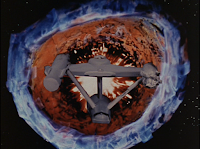
"Doomsday Machine" stands
the test of time as a solid
character study of obsession
and loss. 
(Image via StarTrek.com)

“Doomsday Machine” is a terrific adventure story that combines big science fiction ideas with memorable character moments. William Windom as Commodore Matt Decker is one of the all-time great guest appearances on Star Trek.

On the other end of the spectrum, “The Trouble With Tribbles” is a more lighthearted episode about an agricultural shipment, a grain-eating pest, and Cold War tensions. The dialogue in the episode is memorably sharp with quippy lines like “hauled away as garbage,” “a very little joke,” and “an ermine violin.” Some contemporaneous fans complained that the tone was too unserious, but with the benefit of hindsight, the episode holds up well.

To us, a more questionable inclusion was the Season 2 premiere “Amok Time,” a weird melodramatic episode about Spock’s return to his home planet of Vulcan. For those who haven’t seen it recently, it’s a buck-wild bit of ritual combat between Spock and Kirk as they are forced to fight over a woman. The “woman as a prize” theme should have been unacceptable in the 1960s, and certainly doesn’t hold up well today, the writing is mostly quite flat, and the depiction of Vulcans as a mystical culture that uses gongs excessively could be read as having some ugly coded subtext. This is one of the worst episodes for Kirk as a character; it’s unsettling to watch Kirk pressuring a subordinate to reveal personal info.

Although the ‘alternate universe’ episode has become a staple for most SFF TV shows, when Star Trek did
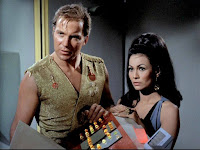
Kirk's visit to the darkest timeline
provided a template for all later
mirror universes on television.
(Image via StarTrek.com)

it with “Mirror Mirror,” the concept was still fresh. With the introduction of the concept to mass media television, they also hit a high water mark. The quality of Star Trek’s original cast shines through in this episode, as George Takei, Walter Koenig, and Leonard Nimoy all show why they would have been stars even if Trek had never made it to air. It must also be mentioned that guest star BarBara Luna is memorable as Lt. Marlena Moreau.

More has been written about the Hugo-winning episode, Harlan Ellison’s “City On The Edge of Forever,” than about probably any other single episode of televised science fiction. Given the weighty moral quandary (sacrificing love for the sake of history), and the solid character moments between the central trio of Spock, Kirk, and McCoy, the level of appreciation for the episode is understandable. What’s interesting is how quickly it was recognized as a classic, and immediately at the forefront of discussions of what should get the Hugo.

“City [on the Edge of Forever], which deservedly won the Hugo for best dramatic presentation, is probably the best drama, if not the best science fiction, ST has had to date, and I was happy to see it again” wrote Kay Anderson in her convention report.

What few complaints there were about a Star Trek-full category focused more on who had been left off the ballot; pundits such as Doug Lovenstem of the fanzine Arioch suggested that it was time for D.C. Fontana to win a Hugo Award (she would receive her only nomination 20 years later). Others noted the absence of “Devil in the Dark,” which is often regarded as one of Star Trek’s finest hours (and certainly better than “Amok Time”).

For our cinema club’s re-watch of these episodes, we’d all gone in expecting to agree with this consensus. But in the end, none of us were convinced that “City On The Edge of Forever” was the best episode; two of us preferred “Mirror Mirror,” one put “Doomsday Machine” at the top of their list, while another rated “Devil In The Dark” the most highly.

But at the 1968 Hugo Awards, two things were inescapable: Star Trek and Harlan Ellison. Five nominations to Star Trek, three to works penned by Ellison, and five to works that appeared in a publication edited by Ellison. In retrospect, this win seemed inevitable.

“The Hugos: Bjo doesn’t win. Dave Gerrold doesn’t win. Larry [Niven] doesn’t win. Harlan wins. There
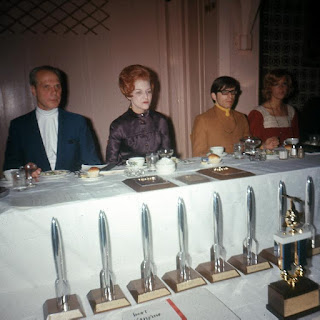
The head table at the 1968 Hugo Awards banquet
Philip Jose Farmer, Betty Farmer, Harlan Ellison
(Image by Len & June Moffatt via Fanac.org)


is no justice in this world. I like Harlan, but there’s a limit to how many Hugos he should win,” Sandy Cohen wrote in Argus in October 1968. Ellison had ruffled his fair share of feathers throughout fandom, and it would eventually come to haunt him. But in 1968, Harlan Ellison was at the top of the SFF world, and probably his all-time most recognizable work took home the Best Dramatic Hugo.

The Best Dramatic Presentation shortlist in 1968 is a product of its time. It is likely that no SFF television show will ever have the impact that Star Trek did that year, and it is equally unlikely that there will be another year with as few viable contenders for the prize. (A clean sweep of nominations in the category has also been rendered impossible by rules changes).

In short: an odd year for the Hugos, but one where it’s difficult to argue too vehemently against the judgment of the fans.

Monday, 28 February 2022

So Glad We Asked: an appreciation of Chris M. Barkley

Activist fan Chris M. Barkley
at the 2015 Hugo Awards
(Photo by Olav Rokne)
For more than 45 years, Chris M. Barkley has been quietly contributing to science fiction fandom in the best ways possible: Volunteering on the front lines of Worldcons, adding thoughtfully to the dialogue, and making spaces safer and more welcoming for fans.

Probably best known for his entertaining and personable columns that appear on File 770, Barclay has also written for Locus, Amazing Stories, the SFWA Blog, fanzines such as Argentus and Journey Planet, and numerous convention publications. It’s for this last category of fan writing that we feel Barkley has earned serious consideration for a Hugo Award, and in particular why we would urge you to include his name on your nominating ballots.

One key reason why 2021 has been such an impressive year for Barkley is his long-form work “Fantasy & Science Fiction Media Relations – Press Room Guide” published in August 2021. It’s a resource that should be distributed as widely as possible, to as many convention runners as possible. This thorough and detailed guide to the ups and downs, opportunities and pitfalls of media relations will help future conventions and convention-goers succeed. It’s a resource to use during both preparation and when facing a crisis.

As someone who has headed up the media office at five Worldcons (and staffed 14 others), Barkley has a depth of experience to draw on. It should be noted that this guide is roughly the length of a short novelette, and probably on its own has a word count equivalent to some fan writer finalists’ entire annual output.

Bolstering the case for nominating Barkley are this year’s crop of his “So Glad You (Didn’t) Ask” columns. Having sometimes described himself as an “activist fan,” it should be no surprise that Barkley can often be found agitating for tweaks to the rules that he suggests would make conventions more equitable and inclusive. Case in point, “So Glad You (Didn’t) Ask” number 57, which lays out five proposals on how to ensure the survival of fandom.

Barkley has volunteered in 
the press office of 19 Worldcons,
most recently taking on the role
of head of the press office in 2016
when a previous volunteer was
suddenly unable to do so.
(Image via Fanac.org)

Over the years, Barkley has affected real change through his work. He’s often commended for helping to split Best Dramatic Presentation into short form and long form, and for leading the charge to split Best Editor into short form and long form (though with typical modesty, he always offers credit to others). He worked tirelessly to create a Hugo for best Young Adult novel and was an important voice in helping create a Best Graphic Story Award, and co-sponsored the creation of Best Fancast. It could be argued that few people have ever had as much of an impact on the Hugo Award categories.

In retrospect, Barkley has shown a remarkable amount of foresight. He warned in 2004 (a full decade before it happened) that there was the possibility that a slate of politically motivated malcontents might attempt to disrupt the Hugos. This was followed by his urging in 2013 that “The only way traditions like the Worldcon and Hugos will have any future is if the people who are interested and feel frozen out of the process continue to provide civil and constructive criticism and stay involved in fandom … What we need is MORE dissent, MORE thinking outside the box and MORE diversity in fandom, not less.”

The first time the editors of this blog encountered Chris M. Barkley, we were volunteering as photographers for the 2015 Hugo Awards ceremony. For years after, we assumed that he had received a Hugo Award nomination for his blogging, and this seemed like a reasonable assumption to make: his work is consistently good, he writes about fannish activities, and he’s well known in the community.

It was to our great surprise when we learned that he has never been on the Hugo Award ballot as a fan writer. It’s time to rectify that oversight, and 2022 should be his year.

Monday, 14 February 2022

Far From The Light Of Heaven - Review

One of Thompson’s great strengths as a writer is his ability to balance poetry and prose for a science
Far From The Light Of Heaven
balances modernity and tradition
within the science fiction genre.
(Image via Goodreads)

fiction audience, providing vividly visceral visuals that don’t slow down the narrative or distract from the characterizations. It’s a skill that’s on full display in Far From The Light Of Heaven, Thompson’s follow-up to the Wormwoood trilogy that earned him both a Clarke Award and a spot on the Hugo Award shortlist.

And what a follow up it is.

Set on an interstellar transport named The Ragtime, first mate Michelle “Shel” Campion awakens early from suspended animation to discover that thirty-odd passengers on the enormous colony ship have been killed and dismembered. Since the ship is at this point relatively close to their destination of Bloodroot, local detective Rasheed Fin is dispatched to investigate, and becomes embroiled in Shel’s attempts to keep the rest of her passengers alive despite The Ragtime’s rogue Artificial Intelligence captain’s attempts to thwart them.

Of course, a locked-room mystery on a spaceship is not a new set-up (notably implemented in Six Wakes by Mur Lafferty, which was a Hugo finalist in 2018), but the combination of Thompson’s agile pacing, worldbuilding rooted in Yoruba culture, and evocative prose make Far From The Light Of Heaven a standout. Weirdly improbable scenes such as the appearance of a wolf and flashbacks to a mining town are drawn out with convincingly detailed and precise language that manages to be both clear and evocative.
Mr. Thompson quit Twitter
earlier this year. 
(Image via The Guardian)


Thompson allows the tension to build slowly, and doesn’t play his hand too quickly, which lets the mystery provide both a compelling plot and a device with which to strategically introduce pieces of the setting to the reader. This includes themes of economic justice, leading us to believe that Thompson recognizes that imbalances of power exist across myriad cultures and that these imbalances metastasize in especially destructive ways in environments of unmitigated capitalism.

Far From The Light Of Heaven also provides some of Thompson’s best character work. As the two primary protagonists, Shel and Racheed’s disparate backgrounds and motivations lead to tensions and conflict that feel natural and believable.

Astute readers will, however, find some slight plot hiccups. An “experimental” section of the spacecraft is mentioned in passing at the beginning but only explored midway through the book even though it seems as if a place filled with dangerous life forms would be the first place any fatality investigation should start. Likewise, the fact that the richest man in all the cosmos is aboard would seem like an early lead, rather than a later one.

We might also note that the alien “Lambers” add very little to the overall narrative other than confusion about what they are. Whatever they are, and whatever their relationship to the colonists on Bloodroot, it doesn’t really affect the story.

But these are minor quibbles, Far From The Light Of Heaven is a superb book that deserves your attention.

Sunday, 6 February 2022

Subtweetpunk, shadecore, and other subgenres

There is power in the act of naming. 

Labels are part of how people communicate and make sense of the world. This can bring us together, but until new terms have meaning for a larger group, they can also isolate. There
The word is "Midichlorians"… and this
organization you're joining is totally not a cult!
(Image via Lucasfilm) 
’s a reason that numerous cults have their own dictionaries filled with loaded terms such as ‘Thetans,’ ‘Jness,’ ‘HODL,’ or ‘Meeks.’

At times, science fiction likewise seems to be a genre in love with inventing its own dictionaries; and not just as part of world building in books like Lord of the Rings and The Fifth Season. While terms like ‘SMOF,’ ‘mundanes,’ or ‘gafiate,’ can be useful shorthand in fan discussions, their prevalence can compound or create obfuscation for those not steeped in the genre and its convention culture. Often terms are created to describe new subgenres, whether or not the new term has any real meaning to it.

It makes sense that those trying to make sense of science fiction and fantastical discourse (for good or ill) will coin new terms for trends, tropes, and ideas they are grappling with. But creating categories within a genre can be an attempt to exert control and can easily succumb to gatekeeping.

The effects of creating increasingly arcane terminology for subgenres are at least twofold: those who don't understand the new terms are excluded from being able to fully participate in the discussion and the creation of the term divides works into those worthy of inclusion, and those that are unworthy. Stories that are deemed to conform to a nebulous criteria (or are written by an author considered to be a part of the in-group) can be declared to be part of the select subgenre, while those that do not meet their standards (or are written by an author considered to be a part of the out-group) can sometimes be declared to be part of a lesser or derided subgenre.

As an aside, it does seem worth noting that which works are selected or rejected to be considered part of subgenres often show biases based on the gender, age, class, and cultural backgrounds of those creating the categories.

Media theorist Marshall McLuhan once noted, “All words, in every language, are metaphors.” And the
Marshall McLuhan
(Image via MediaCentre) 

connotations of these metaphors are particularly evident in many of the invented words of fandom. Take for example “Hopepunk,” the term coined by Alexandra Rowland as she called for uplifting stories that helped inspire people to believe in the future. This portmanteau combines an aspirational ideal of hope with the positive anti-authoritarian connotation of the punk music scene. By doing so, the very word “hopepunk” suggests that those in power benefit from the hopelessness of the masses, and that in fact the most rebellious thing people can do is dream of a better tomorrow.

Thus, naming something sometimes allows the term to define it, and to some degree can help shape how the public learns about it, thinks about it, and even searches for it. But naming also legitimizes a concept, and formalizes it in ways that are often unexpected. Calling music “shoegaze” was originally intended as an insult to guitarists who liked using distortion pedals while they played; it became a badge of honour. Fred Hoyle was trying to dismiss the concept of an explosive start to the universe when he dismissed it as a “Big Bang”; now it’s the common term for how many people believe existence came to be.
Nothing appeals to
the kids like references
to an obscure 75-year-old
Canadian SF author!
(Image via wikipedia)


Usually, naming something connects best with audiences when there is a clear and concise definition of what it is. “Cyberpunk” for example is one of the most enduring subgenres in part because the extent of literature in this category is relatively easy to identify. Likewise, “Urban Fantasy” existed and had tropes and conventions long before anyone tried to put a name to it.

Successful subgenre names are ones that help people find books they might enjoy, but are rarely used to define something as good or bad. They’re descriptors, rather than pejoratives. In short, the thing being described existed before the terminology. 

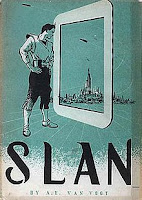
As fans, we should be careful about the language we choose to describe the genre, the subgenre, and ourselves. The idea that ‘Fans are Slans,’ as example created a linguistic wall around fandom that in some ways persists today. At their worst, these empty ill-defined terms become semantic stop-signs that are a language of non-discourse. They can be the thought-ending cliche of cultural discussions, unquestionable for fear of offending those who accept the term unquestioningly. And they can define and alienate us all from relevance.

Wednesday, 2 February 2022

Please give the German android gigolo movie a Hugo nod

It’ll be an uphill battle to get I’m Your Man the Hugo nod it deserves.
(Image via TIFF)


Of the five Hugo Award-shortlisted movies directed by women, only The Matrix (directed by Lilly and Lana Wachowski) was an original screenplay rather than an adaptation. The other four — Wonder Woman, Birds of Prey, Old Guard and Captain Marvel — are all comic book adaptations.

Of the five Hugo-shortlisted movies that were not in English, only Invention For Destruction (1958) and Last Year at Marienbad (1961) earned less than $5-million in North American cinemas. The three foreign-language movies to have been shortlisted this century were all mainstream hits: Pan’s Labrynth ($60 million domestic box office in 2006), Spirited Away ($10 million domestic box office in 2002), and Crouching Tiger, Hidden Dragon ($126 million domestic box office in 2000).

So it seems fair to say that a German-language sci-fi romance that earned less than $300,000 in North American cinemas and was written and directed by a woman is unlikely to be noticed by Hugo Award nominators. But this is a shame, because I’m Your Man is a quiet, thoughtful, compassionate, and nuanced movie directed and scripted by Maria Schrader based on a short story by Emma Braslavsky. And it is exactly what the award should be recognizing. 

Set in a near-future Hamburg, I’m Your Man follows Dr. Alma Felser (Maren Eggert), an anthropology
Maren Eggert and Dan Stevens
don't exactly have chemistry,
they have something far more
… calculated than that.
(Image via NationalPost)

professor who has begrudgingly agreed to conduct an assessment of Tom (Dan Stevens), a prototype of an android designed to be a romantic partner. Fesler, a divorcee who has put her career first, is dubious of the android’s value and participates in the assessment as a favour to the head of a university department with which she is affiliated.

Despite an initial clinical detachment, Dr. Felser begins to be enticed by the android’s meticulous focus on being the ideal romantic partner. But she can’t fully buy into the experience because she knows that every perfect moment is the product of research, psychology, and algorithms. Simultaneously, she’s challenged emotionally by her ex-husband and his new girlfriend’s decision to have a baby together. This is all, of course, standard plot tension for a romance film.

What’s refreshing, for both AI and romance films, is that I’m Your Man feels like a deeply personal
Director Maria Schrader might
be familiar to SFF fans as 
Quissima Dhatt in the BBC
adaptation of The City & The City.
(Image via Radio Times)

movie, comfortable both with its own awkwardness, and with tackling the difficulties of relationships and the contradictory desires of humans. This is not a movie that follows standard Hollywood narrative patterns, or focus-grouped easy satisfaction conclusions, but rather tells a story that one person wanted to tell. And it’s stronger for that. Writer-director Maria Schrader is probably best-known in North America for directing the Netflix drama Unorthodox, for which she won an Emmy, though she also had a supporting role in the BBC TV series adapted from China Miéville’s Hugo-winning novel The City and the City.

As a dialogue and interaction-focused science fiction movie that is quite at odds with the dynamics of most American cinema, I’m Your Man might not have worked if it weren’t for the superb performances of the two leads.

Dan Stevens, who is probably most famous to SFF fans for playing David Haller in the superhero TV show Legion or for playing Alexander Lemtov in last year’s Hugo finalist Eurovision, alternates disconcertingly between charm and a lack of affect in possibly his finest performance to date. Evident in this performance are insights into what humanoid robots might actually be like, and this is part of what makes I’m Your Man so good as a work of science fiction. It’s a movie that grapples with the consequences of fulfilling humanity’s emotional needs through simulacra and artifice. It’s a movie that understands the seductive and dangerous allure of lying to ourselves.

But the real stand-out of the movie is Maren Eggert, who fully embodies the complexities and passion of an academic. Viewers who have worked at an institution of higher learning will recognize small details and nuances in her depiction of Dr. Alma Felser; the excitement of new knowledge, and the heartbreak at seeing someone else publish the idea first. Those who have struggled to find a romantic relationship that fits with a self-imposed, demanding career will likewise find a lot to appreciate in Eggert’s performance.

I’m Your Man is possibly the finest robot story brought to the screen since Fondly Farenheit was adapted as Murder And The Android in 1959. It deserves your attention, and no matter how unlikely a contender it might be, I’m Your Man deserves to make Hugo history as the first foreign-language movie directed by a woman to make the shortlist.