Labels are part of how people communicate and make sense of the world. This can bring us together, but until new terms have meaning for a larger group, they can also isolate. There
’s a reason that numerous cults have their own dictionaries filled with loaded terms such as ‘Thetans,’ ‘Jness,’ ‘HODL,’ or ‘Meeks.’
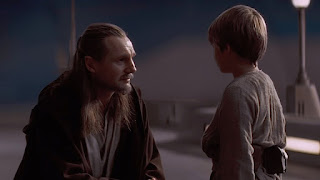 |
| The word is "Midichlorians"… and this organization you're joining is totally not a cult! (Image via Lucasfilm) |
At times, science fiction likewise seems to be a genre in love with inventing its own dictionaries; and not just as part of world building in books like Lord of the Rings and The Fifth Season. While terms like ‘SMOF,’ ‘mundanes,’ or ‘gafiate,’ can be useful shorthand in fan discussions, their prevalence can compound or create obfuscation for those not steeped in the genre and its convention culture. Often terms are created to describe new subgenres, whether or not the new term has any real meaning to it.
It makes sense that those trying to make sense of science fiction and fantastical discourse (for good or ill) will coin new terms for trends, tropes, and ideas they are grappling with. But creating categories within a genre can be an attempt to exert control and can easily succumb to gatekeeping.
The effects of creating increasingly arcane terminology for subgenres are at least twofold: those who don't understand the new terms are excluded from being able to fully participate in the discussion and the creation of the term divides works into those worthy of inclusion, and those that are unworthy. Stories that are deemed to conform to a nebulous criteria (or are written by an author considered to be a part of the in-group) can be declared to be part of the select subgenre, while those that do not meet their standards (or are written by an author considered to be a part of the out-group) can sometimes be declared to be part of a lesser or derided subgenre.
As an aside, it does seem worth noting that which works are selected or rejected to be considered part of subgenres often show biases based on the gender, age, class, and cultural backgrounds of those creating the categories.
Media theorist Marshall McLuhan once noted, “All words, in every language, are metaphors.” And the
connotations of these metaphors are particularly evident in many of the invented words of fandom. Take for example “Hopepunk,” the term coined by Alexandra Rowland as she called for uplifting stories that helped inspire people to believe in the future. This portmanteau combines an aspirational ideal of hope with the positive anti-authoritarian connotation of the punk music scene. By doing so, the very word “hopepunk” suggests that those in power benefit from the hopelessness of the masses, and that in fact the most rebellious thing people can do is dream of a better tomorrow.
Thus, naming something sometimes allows the term to define it, and to some degree can help shape how the public learns about it, thinks about it, and even searches for it. But naming also legitimizes a concept, and formalizes it in ways that are often unexpected. Calling music “shoegaze” was originally intended as an insult to guitarists who liked using distortion pedals while they played; it became a badge of honour. Fred Hoyle was trying to dismiss the concept of an explosive start to the universe when he dismissed it as a “Big Bang”; now it’s the common term for how many people believe existence came to be.
Usually, naming something connects best with audiences when there is a clear and concise definition of what it is. “Cyberpunk” for example is one of the most enduring subgenres in part because the extent of literature in this category is relatively easy to identify. Likewise, “Urban Fantasy” existed and had tropes and conventions long before anyone tried to put a name to it.
Successful subgenre names are ones that help people find books they might enjoy, but are rarely used to define something as good or bad. They’re descriptors, rather than pejoratives. In short, the thing being described existed before the terminology.
As fans, we should be careful about the language we choose to describe the genre, the subgenre, and ourselves. The idea that ‘Fans are Slans,’ as example created a linguistic wall around fandom that in some ways persists today. At their worst, these empty ill-defined terms become semantic stop-signs that are a language of non-discourse. They can be the thought-ending cliche of cultural discussions, unquestionable for fear of offending those who accept the term unquestioningly. And they can define and alienate us all from relevance.
It makes sense that those trying to make sense of science fiction and fantastical discourse (for good or ill) will coin new terms for trends, tropes, and ideas they are grappling with. But creating categories within a genre can be an attempt to exert control and can easily succumb to gatekeeping.
The effects of creating increasingly arcane terminology for subgenres are at least twofold: those who don't understand the new terms are excluded from being able to fully participate in the discussion and the creation of the term divides works into those worthy of inclusion, and those that are unworthy. Stories that are deemed to conform to a nebulous criteria (or are written by an author considered to be a part of the in-group) can be declared to be part of the select subgenre, while those that do not meet their standards (or are written by an author considered to be a part of the out-group) can sometimes be declared to be part of a lesser or derided subgenre.
As an aside, it does seem worth noting that which works are selected or rejected to be considered part of subgenres often show biases based on the gender, age, class, and cultural backgrounds of those creating the categories.
Media theorist Marshall McLuhan once noted, “All words, in every language, are metaphors.” And the
 |
| Marshall McLuhan (Image via MediaCentre) |
connotations of these metaphors are particularly evident in many of the invented words of fandom. Take for example “Hopepunk,” the term coined by Alexandra Rowland as she called for uplifting stories that helped inspire people to believe in the future. This portmanteau combines an aspirational ideal of hope with the positive anti-authoritarian connotation of the punk music scene. By doing so, the very word “hopepunk” suggests that those in power benefit from the hopelessness of the masses, and that in fact the most rebellious thing people can do is dream of a better tomorrow.
Thus, naming something sometimes allows the term to define it, and to some degree can help shape how the public learns about it, thinks about it, and even searches for it. But naming also legitimizes a concept, and formalizes it in ways that are often unexpected. Calling music “shoegaze” was originally intended as an insult to guitarists who liked using distortion pedals while they played; it became a badge of honour. Fred Hoyle was trying to dismiss the concept of an explosive start to the universe when he dismissed it as a “Big Bang”; now it’s the common term for how many people believe existence came to be.
 |
| Nothing appeals to the kids like references to an obscure 75-year-old Canadian SF author! (Image via wikipedia) |
Usually, naming something connects best with audiences when there is a clear and concise definition of what it is. “Cyberpunk” for example is one of the most enduring subgenres in part because the extent of literature in this category is relatively easy to identify. Likewise, “Urban Fantasy” existed and had tropes and conventions long before anyone tried to put a name to it.
Successful subgenre names are ones that help people find books they might enjoy, but are rarely used to define something as good or bad. They’re descriptors, rather than pejoratives. In short, the thing being described existed before the terminology.
As fans, we should be careful about the language we choose to describe the genre, the subgenre, and ourselves. The idea that ‘Fans are Slans,’ as example created a linguistic wall around fandom that in some ways persists today. At their worst, these empty ill-defined terms become semantic stop-signs that are a language of non-discourse. They can be the thought-ending cliche of cultural discussions, unquestionable for fear of offending those who accept the term unquestioningly. And they can define and alienate us all from relevance.


