Showing posts with label hopepunk. Show all posts

Friday, 9 October 2026

Polycrisis Pollyanna

E.J. Swift's Clarke Award-winning
novel connects policy decisions with
societal change and progress.
(Image via Goodreads)
Although the word “Pollyanna” is now a pejorative term for someone who is excessively optimistic and passive in the face of calamity, the protagonist of Eleanor Porter’s eponymous 1913 novel displayed an optimism that was neither passive nor uncritical. The Pollyanna for whom the term is named is a character whose optimism spurs her to action in the face of adversity, leading her to improve the lives of those around her.

Released a year ago today, the solarpunk novel When There Are Wolves Again by E.J. Swift could be described as a 21st Century Polyanna — specifically what the original novel offered rather than the negative connotation that “Polyanna” acquired over the past century.

Set in the United Kingdom and chronicling the intertwined lives of two women living through turbulent decades between 2020 and 2070, When There Are Wolves Again is a portrait of optimism in the face of climate and political adversity. In E.J. Swift’s telling, the years ahead are filled with more pandemics, conflicts, and climate-change-driven catastrophes. Despite the polycrisis facing this future United Kingdom, the protagonists of the book find ways to advocate for change and to make a difference — arriving to that place from different places within society; urban and rural, privileged and working class..

There’s a pleasing cadence to the book’s chapters, which alternate between the perspective of young activist Lucy Gillard and documentary filmmaker Hester Moore. Years go by between chapters, giving the book the feel of a future history. Although the two protagonists rarely interact directly, their shared advocacy for conservationism brings them together in interesting ways.

Climate change and its attendant health issues are themes in the book, however the degradation of ecosystems through extinction and extirpation is a more central focus — with Swift making the subject more viscerally affecting by connecting it with the human experience. In particular, the young Lucy’s relationship with her grandmother is strengthened by their shared interest in local bird habitats, which makes for some lovely character development.
The lives and habitats of British birds (like this
common Chaffinch) play a significant role in
When There Are Wolves Again.
(Image by Steve Walker CC BY-ND 2.0 via Flickr)


Interestingly, reactionary forces who cling to older — more ecologically destructive — ways of living and interacting with the natural world are handled with a level of empathy. Even though we never see the story from the perspective of these political foes, the book does not shy away from exploring their narrative arcs. Hester faces tumult because she has family on the opposite side of major protests. Lucy finds an uneasy peace with a violent antagonist. The resolution of these tensions are explored, though we might suggest that Swift has more faith in human nature than some of her readers.

When There Are Wolves Again’s optimism is not based on the assumption that everything will work out. Swift’s future is too messy for that kind of reassurance. The novel finds hope in agency. This is a story about belief that even when individuals cannot fix the world, they can still alter the circumstances immediately around them. Swift’s protagonists do not deny the existence of suffering, but like Pollyanna they refuse to accept suffering as a reason for inaction and sidestep the learned helplessness they see around them.
Pollyanna was a novel whose central
message — and character — resonated
deeply with 1920s audiences who were
faced with a pandemic, global conflicts,
and an exceptionally racist U.S. president.
Obviously, this is not something that
would resonate with modern readers.
(Image via Goodreads)


It is worth noting that the real-world climate catastrophe inexorably barrelling towards us is one that affects global populations differently, with the worst impacts hitting the Global South first and more severely. When There Are Wolves Again offers a slightly parochial, British, and privileged perspective on this crisis. That might be to the book’s detriment, but it is also speaking to those in a position of power to change the future.

There is a longstanding link between science fiction and politics. Every policy decision made in every legislature is based on the same kind of imagining — “what if the world were different in this specific way?” — that underpins speculative fiction. What makes When There Are Wolves Again such an effective work of science fiction is that it connects specific speculative policy decisions with the effects of those policies.The rewilding of the British Midlands is depicted over the course of decades, from proposal to protest, and from concept to consequence. As with real-world policy changes, there are winners and losers in the story.

In this time of polycrisis, perhaps there’s a place for active, engaged, and empathetic Pollyannaishness. Hopefully stories like When There Are Wolves Again can prompt the kind of optimism that fuels change for the better.

Sunday, 6 February 2022

Subtweetpunk, shadecore, and other subgenres

There is power in the act of naming. 

Labels are part of how people communicate and make sense of the world. This can bring us together, but until new terms have meaning for a larger group, they can also isolate. There
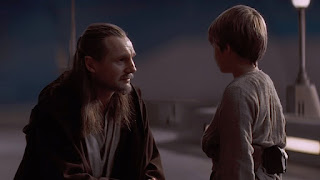
The word is "Midichlorians"… and this
organization you're joining is totally not a cult!
(Image via Lucasfilm) 
’s a reason that numerous cults have their own dictionaries filled with loaded terms such as ‘Thetans,’ ‘Jness,’ ‘HODL,’ or ‘Meeks.’

At times, science fiction likewise seems to be a genre in love with inventing its own dictionaries; and not just as part of world building in books like Lord of the Rings and The Fifth Season. While terms like ‘SMOF,’ ‘mundanes,’ or ‘gafiate,’ can be useful shorthand in fan discussions, their prevalence can compound or create obfuscation for those not steeped in the genre and its convention culture. Often terms are created to describe new subgenres, whether or not the new term has any real meaning to it.

It makes sense that those trying to make sense of science fiction and fantastical discourse (for good or ill) will coin new terms for trends, tropes, and ideas they are grappling with. But creating categories within a genre can be an attempt to exert control and can easily succumb to gatekeeping.

The effects of creating increasingly arcane terminology for subgenres are at least twofold: those who don't understand the new terms are excluded from being able to fully participate in the discussion and the creation of the term divides works into those worthy of inclusion, and those that are unworthy. Stories that are deemed to conform to a nebulous criteria (or are written by an author considered to be a part of the in-group) can be declared to be part of the select subgenre, while those that do not meet their standards (or are written by an author considered to be a part of the out-group) can sometimes be declared to be part of a lesser or derided subgenre.

As an aside, it does seem worth noting that which works are selected or rejected to be considered part of subgenres often show biases based on the gender, age, class, and cultural backgrounds of those creating the categories.

Media theorist Marshall McLuhan once noted, “All words, in every language, are metaphors.” And the
Marshall McLuhan
(Image via MediaCentre) 

connotations of these metaphors are particularly evident in many of the invented words of fandom. Take for example “Hopepunk,” the term coined by Alexandra Rowland as she called for uplifting stories that helped inspire people to believe in the future. This portmanteau combines an aspirational ideal of hope with the positive anti-authoritarian connotation of the punk music scene. By doing so, the very word “hopepunk” suggests that those in power benefit from the hopelessness of the masses, and that in fact the most rebellious thing people can do is dream of a better tomorrow.

Thus, naming something sometimes allows the term to define it, and to some degree can help shape how the public learns about it, thinks about it, and even searches for it. But naming also legitimizes a concept, and formalizes it in ways that are often unexpected. Calling music “shoegaze” was originally intended as an insult to guitarists who liked using distortion pedals while they played; it became a badge of honour. Fred Hoyle was trying to dismiss the concept of an explosive start to the universe when he dismissed it as a “Big Bang”; now it’s the common term for how many people believe existence came to be.
Nothing appeals to
the kids like references
to an obscure 75-year-old
Canadian SF author!
(Image via wikipedia)


Usually, naming something connects best with audiences when there is a clear and concise definition of what it is. “Cyberpunk” for example is one of the most enduring subgenres in part because the extent of literature in this category is relatively easy to identify. Likewise, “Urban Fantasy” existed and had tropes and conventions long before anyone tried to put a name to it.

Successful subgenre names are ones that help people find books they might enjoy, but are rarely used to define something as good or bad. They’re descriptors, rather than pejoratives. In short, the thing being described existed before the terminology. 

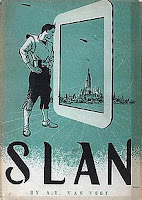
As fans, we should be careful about the language we choose to describe the genre, the subgenre, and ourselves. The idea that ‘Fans are Slans,’ as example created a linguistic wall around fandom that in some ways persists today. At their worst, these empty ill-defined terms become semantic stop-signs that are a language of non-discourse. They can be the thought-ending cliche of cultural discussions, unquestionable for fear of offending those who accept the term unquestioningly. And they can define and alienate us all from relevance.