Saturday, 20 August 2022

Possibly The Worst Year In Sci-Fi Cinema

This blog post is the fourteenth in a series examining past winners of the Best Dramatic Presentation Hugo Award. An introductory blog post is here.

The 1971 Best Dramatic Presentation Hugo ballot was filled to the brim with mediocrity. Despite having the benefit of hindsight and an internet to help us learn about films eligible in that year, our cinema club couldn’t have produced a better list of nominees.

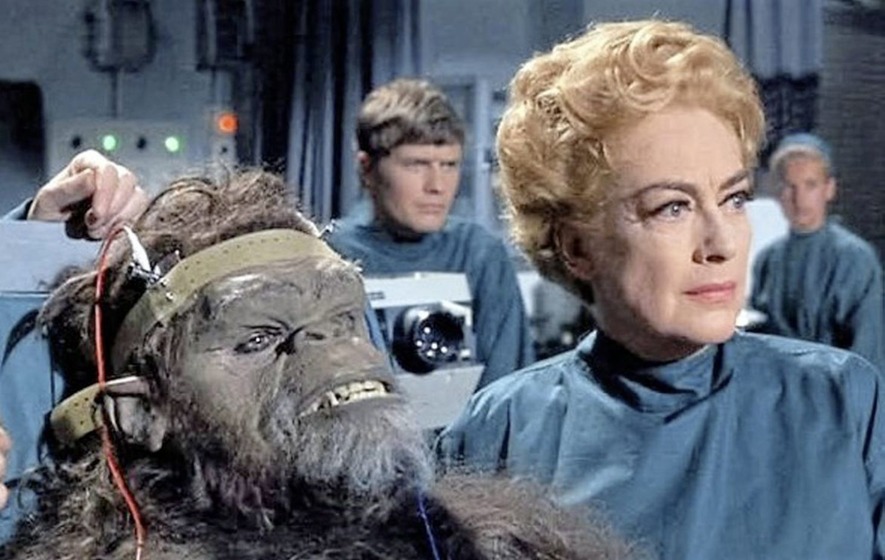
Despite Joan Crawford's performance, Trog is not
up to the standards we might look for in a Hugo finalist.
(Image via IMDB)
We scoured the internet for other options. Doomwatch was influential, but an absolute bore. Skullduggery was a hit, but beyond risible. David Cronenberg’s first movie Crimes of the Future shows promise, but is still the unfinished vision of a young creator. Fans had slim pickings when nominating that year — which may in part explain some of the more … unorthodox choices they made.

It was the first year that audio recordings made it on the ballot, and as much as we are fans of being format agnostic, we wish that the distinction of being the first comedy album to get a Hugo nod had gone to a more worthy entry than Don't Crush That Dwarf, Hand Me the Pliers.

Expressing a sentiment that was common at the time, John Baxter wrote: “Written SF is usually radical in politics and philosophy; SF cinema, like the comic strips, endorses the political and moral climate of its day.” While we’d suggest that Baxter was a little too generous towards prose SF, having watched and listened to the 1971 shortlist, it’s clear that there’s some merit in his indictment of screen offerings.

The shortlist was an eclectic one in some ways. It had one theatrically released American movie (Colossus: The Forbin Project), one television movie (Hauser’s Memory), one British movie (No Blade of Grass) one spoken-word comedy album (Don't Crush That Dwarf, Hand Me the Pliers) and one prog rock concept album (Blows Against the Empire).

While this relative diversity of formats could be praised for a willingness to consider various forms of storytelling, to our eyes it looks like Hugo voters were scraping the bottom of the barrel. Writing in Science Fiction Review, Fred Patten suggested that the entire shortlist “is not worthy of consideration.”

Paul Kantner's Blows Against the Empire has
a relatively simple premise that hasn't aged well.
(Image via Futurama)
Blows Against the Empire, recorded by Paul Kantner and some of his Jefferson Airplane bandmates, loosely tells the story of a bunch of San Francisco hippies who steal a starship to go off into space and create a new, better civilization on another planet. The story also seems to focus on a baby that Paul Kanter was having with Grace Slick. To be perfectly blunt, the storytelling offers the height of self-indulgent self-aggrandizement that reflects the worst artistic impulses of the Altamont generation. The majority of the songs contribute nothing to the narrative, and although music may appeal to some listeners, as a piece of science fiction it is dreadful.

Ever so slightly less perplexing a choice for a finalist is Don't Crush That Dwarf, Hand Me the Pliers, the third album from Los Angeles comedy troupe Firesign Theater. Although it seems fairly scattershot at the beginning, it slowly becomes clear that the album is telling the life story of a single character named George Leroy Tirebiter, through flashbacks and television. The comedic style has aged poorly, and we wonder how it ever could have been appreciated. The degree to which the work counts as science fiction or fantasy was also perplexing.

Hauser’s Memory, a made-for-television adaptation of Curt Siodmak’s novel of the same name, is a competent if boring spy adventure in which scientist Hillel Mondoro (played by NCIS-regular David McCallum) injects himself with evil brain juice in an attempt to recover secrets that are vital to national security. As the cerebral spinal fluid infects his mind with the memories of a Nazi scientist, Mondoro is compelled to commit a series of crimes, and finally dies. It’s slow-moving, uses excessive crossfades to depict the disorientation of the protagonist, and treads many similar plot points of the author’s previous and much superior novel, Donovan’s Brain.
Sharp-eyed Canadian political
buffs may recognize that the role
of Joseph Slaughter in Hauser's
Memory
is played by the younger
brother of Deputy Prime Minister
Erik Nielsen. 
(Image via IMDB)

Viewers of the era were somewhat more generous, with Hank Davis writing in Yandro that Hauser’s Memory was “The next best thing I have seen this year.” Of course, this assessment needs to be taken in context.

Tying into the nascent environmental movement, No Blade of Grass updated the John Cristopher novel The Death of Grass to make it clear that the demise of all plants from the Gramineae family is caused in part by pollution. There are some interesting scenes that foreshadow later post apocalyptic films like Mad Max, and the bleak premise is followed through to a logical conclusion. It’s an uneven effort that has some high points — such as the sadly realistic depiction of an incompetent British government sacrificing millions of people — but it is bogged down by brutal misogyny and clumsy foreshadowing.

Given the distasteful treatment of women in the movie, it’s hard to recommend No Blade of Grass to a modern (or truth be told any) audience.

The most redeemable work on the Hugo Best Dramatic Presentation ballot in 1971 was certainly Colossus: The Forbin Project. From opening scenes exploring a mountain-sized computer, the movie draws in the viewer to a world that becomes quickly dominated by an artificial intelligence designed to bring peace. It’s a great concept that’s mostly followed through on. Eric Braeden is excellent in the lead role of Dr. Charles Forbin, though the supporting cast is mostly merely filling space.

Contemporaneous reviewers generally agreed with this assessment. Richard E. Geis, writing in Science Fiction Review, named Colossus as the only noteworthy science fiction film of the year. Kay Anderson was somewhat more effusive with her praise, writing in Yandro “For my money, The Forbin Project is better than 2001 … Reviews around here are calling it a masterpiece, and I’ll drink to that.”

The pickings were slim, but in some places you could see the seeds of better things to come, though it might take years — even decades — for these themes to flourish. No Blade of Grass was not in the same league as the environmental parables that would be released later in the decade, but with the benefit of hindsight we can see how it was a stepping stone in the evolution of SFF cinema. Likewise, the concept of a science fiction rock opera concept album may be old hat now, but in 1971, Blows Against The Empire was doing something new. These films — and albums — may be mediocre, but they were pushing the medium forward.

By this point, the Hugos had attempted to recognize works of stage and screen on a dozen occasions, and for a third time in that span Worldcon attendees decided not to present a trophy. Not for the first time, the audience laughed and cheered in approval at the announcement of no award. Thankfully, we can find no record of any representatives of any of the five finalists being in attendance for the ceremony, so they were spared this indignity.

Several members of our cinema club may have ended up voting for no award (though others dislike no award on a matter of principle). Either way the consensus was clear: this was a terrible year for science fiction told by screen or sound.

Tuesday, 9 August 2022

The Breakfast Club in Space

There is a long-simmering tension in science fiction that could be reductively described as being between those who prefer books that are about things happening, and those who prefer books that are about people
Becky Chambers' fourth Wayfarers
novel continues her evolution away
from high-octane thrills.
(Image via Amazon)
experiencing emotions.

On the one extreme, we could describe the cold, sterile, action-packed Asimov tales of the 1940s. On the other extreme, we could examine some ponderous elegiac late-period Aldous Huxley works.

Few authors have pivoted between these two poles as thoroughly, or as successfully as Becky Chambers has over the past eight years since her (initially self-published) debut novel took the science fiction world by storm. Likewise, few authors have been as successful in showing the importance — and the value — of both strains of science fiction’s heritage.

Nowhere is this more evident than in her flagship works, the Best Series Hugo-winning Wayfarers novels. Fascinatingly, the most recent novel in this series The Galaxy, and the Ground Within could even be read as a textual mirror to the first book in the series Long Way To A Small, Angry Planet.

Both novels feature a diverse cast of middle-class characters from a variety of alien races, and both novels celebrate diversity, understanding, and compassion. But while Long Way To A Small, Angry Planet is an action-packed romp in which things never stop happening, this latest Hugo-finalist novel is far more meditative. They are similar in so many ways, but the later book could be interpreted as a foil to the first one’s action packed — and populist — approach to storytelling.

The set-up to Galaxy, and the Ground Within is fairly simple. Five characters with wildly different backgrounds are forced to spend time together after a technical failure traps them togetherfor several days. It’s The Breakfast Club in space, and as such the narrative is driven not by a series of events, but rather by how the characters relate to one another, and how they feel and grow. Althoughthere is a rescue plot at the very end of the novel, it feels somewhat tacked on.

Five people with wildly different personalities
and problems find commonalities and empathy.
(Image via Criterion)

Chambers’ Breakfast Club analogues are blue-collar Laru, immature Tupo, popular girl Pei Tem, mysterious Roveg, and good girl Speaker. Over the course of the novel, they deal with small survival issues pertaining to the life support system, but mostly they share their backstories and learn to get past their differences and prejudices.

It often seems that the vast majority of science fiction and fantasy deals with the fate of empires, the doom of worlds, epic galaxy-spanning wars of conquest, and special unique people born to greatness … and in doing so offers stories that are less relatable because they are not human scale. The fundamental relatability of Chambers' work is its greatest strength. 

Many of the folks who yearn for action adventure like Chambers’ earlier Wayfarers novels might not be drawn in by this book, and might in fact prefer some other Hugo finalists. In fact, those who aren’t drawn in by Chambers’ writing and excellent character building, might uncharitably dismiss The Galaxy, and the Ground Within as a book in which nothing happens. But that would be a mistake; this is a truly excellent example of emotionally grounded science fiction in which the narrative questions revolve around people experiencing emotions.

Monday, 8 August 2022

Hat on a Hat

One of the first things that an aspiring improv comedian will learn is this: Never put a hat on a hat.

Basically, what this means is that when you have a strong premise, it’s usually inadvisable to distract it by layering a different premise overtop of it. To put it another way, cognitive dissonance caused by disharmonious conceptual work will distract from strong material. Point is, if you have one hat … why do you need another hat on top of it?
This is an extremely well written
book filled with great ideas.
It’s unsurprising that Ryka’s other
works have been recognized
by the Lambda Literary Awards.
(Image via Goodreads)


Despite being an exceptionally well written novel filled with likable characters, and some very interesting ideas, Light From Uncommon Stars suffers from hat-on-a-hattedness. And this may prevent it from being at the top of our Hugo ballots. It’s a novel composed of at least two fundamentally separate narratives, and those stories might have been better served by being split into separate works.

The main story arc follows Katrina, a gifted but untrained violinist, whose talent blossoms after being spotted by Shizuka Satomi, a superstar violin teacher. Saddled with a surprisingly apt nickname ‘the Queen of Hell,’ Satomi needs to claim a human soul to free herself from a deal with the devil. Taking the young violinist as a student, Satomi offers a safe harbour from an adolescence marked by horrible abuse and neglect. Twinning musical and personal growth, Katrina eventually finds her feet at an open air concert, bringing the audience to tears with a classical piece (despite her passion for videogame music). The consummate entertainer, she adapts to meet her audience with a confidence that comes from self-actualization.

The anticipation builds as the reader is left wondering when, and how, Shizuka will be remunerated for her tutelage. Will she turn Katrina over to the demon Tremon, as traditional narrative would demand, or can a different future be negotiated? As a purely fantastical tale, Light From Uncommon Stars is well written and engaging, and gives us a main character that is easy to care about and root for. It’s strengthened further by deeply researched backstories about the emotional weight of violin production and ancestral gender roles that have disadvantaged women around the globe.

Recent documentary
Donut King provided
context that helped us
enjoy the book more.
(Image via IMDB)
On its own — with no aliens or spaceships — this would have been enough. But woven into this tale is another story about entrepreneurial aliens who have to learn the hard way that their food replicators are no match for an earthling palette. On its own, this is a satisfying science fiction story filled with alien tech toys: projectors that levitate their subjects, phones that scramble English into Vietnamese, AI that can substitute offspring, and weaponry that disintegrates humans and/or their memories. And this is all packed into a completely delightful narrative concept that could easily have sustained a whole novel. Instead, it left us wanting more. 

The novel could have stood on the rock solid foundation of a beautiful girl finding her place in the world, through the mastery of musical expression and the support of a found family.

While this profusion of distractions from the main story are in most cases entertaining, on their own, our group felt they could sometimes feel like clouds that blocked the light from the star.

We wanted more Katrina.


Monday, 27 June 2022

Clark's inDjinnious worldbuilding

With his first novel, Master of Djinn, P. Djèlí Clark returns to the alternate magical Egypt that he previously explored in works such as his Hugo-finalist novella The Haunting of Tram Car 015.
The UK edition of Master of Djinn sports
a cover that is as epic as the contents. 
The designer Matthew Burne deserves kudos.
(Image via Little Brown Book Group)


Set decades after magic was returned to the world by 19th-Century wizard al-Jahiz, these stories follow detectives who are tasked with solving supernatural mysteries.

This time, protagonist Fatma el-Sha’arawi is tasked with solving the murder of an important foreign dignitary, Lord Worthington, and the possible return of al-Jahiz himself.

What elevates the work is Clark’s use of the premise for confident explorations of colonialism, racism, and sexism. One member of our book club flippantly described Master of Djinn as being “from an alternate history where The Dresden Files bothers to say something interesting.”

Alternate history often doesn’t have a deep enough toolbox with which to examine and challenge historical power structures. Colonialism, patriarchy, and structural racism are so ingrained in the cause-and-effect patterns of real-world history that it’s difficult to find plausible allohistorical points of divergence in which these forces are subverted. In short, it would take magic of the sort that enriches Master of Djinn to tackle these entrenched forces and their myriad complexities.

The fantastical elements of Clark’s Egypt are imbued with a deep sense of history. While this book isn’t precisely an alternate history (as many purists of that genre will argue that any story that involves magic cannot be alternate history), Master of Djinn’s worldbuilding is complex enough for the reader to feel that there is a real past and a real future to this society.

In fact, this living, breathing history might be the most engaging character in the book. It’s a world full of sky trams, clockwork angels, and jazz clubs. Clark has skillfully woven worldbuilding details into the narrative that made it seem effortless and natural. It helped, of course, to have a character smitten with history and dedicated to sharing that knowledge.

An interesting parallel could be drawn between Master of Djinn and Rockne S. O’Bannon’s Hugo-shortlisted dramatic presentation Alien Nation. These are stories that deal with police investigating mysteries in a society that is adapting to the arrival of alien beings. In both cases, there are strong elements of social criticism and the use of non-humans as a metaphor for cultural barriers.
P. Djèlí Clark — also known as Dr. Dexter Gabriel
— holds a PhD in history and teaches at the University
of Connecticut. This education is evident in the 
richly layered history that he crafts in Master of Djinn.
(Photo by Peter Morenus via UConn Magazine)


While the central mystery of the book, and most of the characters, are mostly enjoyable they are also largely unremarkable. For some readers, the relentless description of the flawlessness, stylishness, and incredible competence of the protagonist became tiresome. Likewise, Fatma’s much-trumpeted skill as a detective is undermined by how selectively observant she was, and how much of the plot depended on her missing obvious clues. Those who are seeking an engaging mystery may be disappointed, for the reasons above and also because this is not a page-turner typical of that genre.

It did seem odd that the novel was peppered with so many references to the previous stories set in the same world. Those who had not read the preceding works were left feeling that there was something missing.

But for many in the book club, these quibbles are overshadowed by the engaging motivations of those who committed the crime, the well-thought out tensions in the world’s international politics, and the skillful interrogation of power dynamics. Digressions into a possible alliance between the Kaiser and Ottoman Empire, and speculation about what Lord Worthington may have been up to before his demise are all quite interesting.

A Master of Djinn is a strong Hugo finalist that may be near the top of some of our ballots.

Friday, 17 June 2022

One Giant Leap Backwards For Science Fiction On Screen

This blog post is the thirteenth in a series examining past winners of the Best Dramatic Presentation Hugo Award. An introductory blog post is here.  

“The dramatic Hugo is the least satisfactory category under today's reality.” - Harry Warner, Jr., 1970

“I didn’t see anything worth giving it to.” - Buck Coulson on Best Dramatic Presentation 1970

To say that the fictional works on the shortlist for the Best Dramatic Presentation Hugo in 1970 was a step backwards would be an understatement.

On first glance, the shortlist seems like an aberration, comprising such unloved and unmemorable works as Marooned, The Bedsitting Room, Illustrated Man, and The Immortal. Watching these movies, we wondered what Hugo voters could have been thinking in nominating them. 
Hugo finalist dramatic presentation Marooned has
the unique distinction of being the only Academy
Award winner to be lampooned on MST3K.
(Image via IMDB)


But the more we looked at cinema from that year, the more we realized that Hugo voters had done as good a job as possible in selecting the shortlist, considering that the eligible films for those Hugos (movies released in 1969) included such celebrated works as Journey to the Far Side of the Sun, Moon Zero Two, Night of the Bloody Apes and The Curious Dr. Humpp.

Reality had overtaken screen SFF. The decision to honour news footage rather than fiction (a decision we had initially questioned) seems rather brilliant in the context of the rest of the shortlist and the state of science fiction cinema. 

The nomination process wasn’t helped by a moral panic among a recalcitrant conservative faction of fandom. With the site selection vote having given the 1970 Worldcon to Heidelberg, West Germany, there were fears that the Hugos would be taken away from the English-speaking West, that the United States might never have another Worldcon, and that the Best Novel shortlist would be comprised of nothing but Perry Rhodan books. Members of the 1969 WSFS business meeting passed several motions trying to prevent this speculative calamity, including provisions that put restrictions on the language that the Hugo finalist could be published in (spoiler: English only).

Thankfully, fandom has moved beyond this type of knee-jerk panic. There’s no object lesson to be learned from what happened in 1970, and none of these events are at all relevant to anything going on in Worldcon fandom in 2023.

This change meant that in 1970, the Japanese action movie Latitude Zero and the Italian-French comedy Hibernatus were ineligible. Although neither movie is a classic, either one would have been a more interesting finalist than most of the works on the shortlist.

Of the films that did make the shortlist, the most serious is the high-budget Marooned, a Martin Caidin-penned tale of three American astronauts dealing with technical problems during a NASA mission. Although the movie has high-wattage star power featuring (among others) Gregory Peck and Gene Hackman, it is astonishingly dull and monotonous.

There are a few redeeming moments in Marooned; the heroic role of Russian cosmonauts and the international cooperation depicted is certainly refreshing for the era. And there is an excellent taut sequence in which one of the astronauts is asked to sacrifice himself to save oxygen for the rest of the crew. But overall, it is an astonishingly dreary movie to endure.

It’s interesting that Marooned and 2001: A Space Odyssey were filmed on comparable budgets at approximately the same time. Although it won an Academy Award for special effects, Marooned seems cheap and shoddy by comparison to Kubrik’s masterpiece.

The Illustrated Man, based on Bradbury’s collection of stories, is mediocre in more perplexing ways. Much like the collection it’s based on, the movie uses a man’s tattoos as a narrative framework to tell various stories, including Bradbury’s “The Veldt,” “The Long Rain,” and “The Last Night of the World.”

While any of these stories could have been adapted into serviceable episodes of The Twilight Zone, they don’t work well when combined into one overarching narrative. Compounding this tonal mismatch is leaden dialogue and hammy acting.

The most controversial of the shortlist for us turned out to be The Bedsitting Room, a frankly bizarre post-apocalyptic comedy set in the ruins of London in the wake of a nuclear war. Based on a stage play by Goon Show legend Spike Milligan, the movie rambles between the 20 or so survivors of the atomic fires as they go about their daily lives and come into incredibly petty conflicts and surreal misadventures.

The Bedsitting Room is elevated by an exceedingly strong cast including Dudley Moore, Rita Tushingham, Peter Cook, and Marty Feldman (in his film debut).
In the bright cold air, you seemed as innocent
and fair as Rita Tushingham in 1969.
(Image via IMDB)

Very little in the movie makes sense, whether it’s an elderly woman spontaneously turning into a piece of furniture, an aquatic bishop swimming up from a lake to perform a forced marriage, or the cast being listed in the credits by order of height. While those of us with strong cultural ties to the United Kingdom found some of these moments funny, overall it was a difficult movie to appreciate.

The nearly forgotten and short-lived television series The Immortal may have been the strongest fictional work on the ballot in 1970.

The show is a story about Ben Richards, a race car driver whose genetics render him impervious to disease and likely to live an extended lifespan. The show puts him in conflict with a billionaire who wants to kidnap him and harvest his blood. Much like Richard Kimble, The Incredible Hulk, or Johnny Bago, the series follows the protagonist as he flees across the country.

The Immortal — which didn’t even last a full season — wasn’t great. They took a decent novel by James E. Gunn, sanded the rough edges off it and made it safe and generic television. However, the fact that most of our cinema club would have put it on the top of our ballots is an indictment of the quality of screen SFF that year.

Produced by Universal's famous "factory" model
of television storytelling, the Immortal is remarkably
similar to many of the studio's shows. 
(Image via ComfortTV)
In light of the year’s fiction in this category, the selection of news footage from Apollo XI as the winner for Best Dramatic Presentation looks rather inspired. Certainly the special effects were extraordinarily realistic (given that they were real), viewers were emotionally engaged by the memorable characters such as Buzz Aldrin, and Neil Armstrong, and the work did provide some of the most quotable dialogue in dramatic presentation history (who could ever forget lines like “One Giant Leap For Mankind”?).

The news footage is interesting, but needed an editor to tighten it down to a shorter run time and to provide context. Rather than going back and watching the original news footage, we would recommend watching the spectacular IMAX documentary Apollo 11. The event and the documentation holds up remarkably well 53 years later.

There was at least one major omission from the Hugo Awards ballot: Destroy All Monsters. The ninth, and arguably most bonkers, of Ishirō Honda’s Godzilla movies brings together kaiju from all previous entries in the series. This is the Avengers: Endgame of the GCU (Godzilla Cinematic Universe.) It is likely that among our viewing group, this would have been the top pick amongst actual movies and TV shows that year. Likewise, it's possible that one of the late episodes of Star Trek such as "All Our Yesterdays" might have warranted an inclusion … though even this might be a stretch. 

After several years in which Hugo nominators had an embarrassment of riches to choose from, the well had gone suddenly dry, and there was little top tier science fiction on screen.

It still feels weird to honour real history in a category that has otherwise been exclusively dedicated to fiction, but if not for Apollo XI, this might have been the first year that we suggested a No Award result. 

Thursday, 2 June 2022

The Tsars Like Dust

For a genre that has an unparalleled canvas on which to sketch alternative systems, science fiction all too often falls back on the oldest, simplest, stupidest, and most regressive form of government: Monarchy.

To celebrate the 70th anniversary
of Her Majesty Queen Elizabeth II's
ascent to the throne, the authors
and editors of this blog would like to
respectfully suggest that all monarchies
(even vestigial ones like the House of
Windsor) should be abolished.
(Image via IMDB.com)
It’s easy to think of examples: Princess Ardala, The Gray Prince, King T'Chaka, Emperox Grayland, Emperor Six Direction, Princess Dejah Thoris, Emperor Balem Abrasax, Princess Irulan, Queen Yllana, Princess Astra, Emperor Zarkon, Princess Koriand'r, and Emperor Cleon II to name just a handful. Unfortunately, many of these examples do not engage critically with the idea of monarchy, nor attempt to grapple with the societal consequences of this form of government, nor question the underlying elitist philosophy it represents. Readers should therefore approach such stories with skepticism.

Given that there are few places that are still governed by monarchs of anything other than a vestigial variety, it might seem reasonable that few authors choose to engage critically with the consequences of the monarchies they depict. Americans under the age of 244 and British people with no recollection of what things were like before Peterloo don’t have any direct experience with just how truly awful it would be to live in a polity governed by Emperoxes. (Even if there's a good ruler like Greyland once in a while, they end up being hamstrung by the weight of tradition.) 

Authors seeking to more accurately depict what a space empire might look like should probably look to the few modern-day examples of absolute monarchy that still exist, places like the Sultanate of Oman, the Kingdom of Eswatini, and the Kim Family Protectorate of North Korea. To put it bluntly, in the real world there is a strong correlation between the authority of monarchs, and a lack of human rights, and this is rarely depicted in science fiction.

There are obvious reasons why writing about monarchs might be enticing: It’s an easy signifier of a character’s relevance and agency. The moment that someone mentions Princess Leah, the audience knows that this is a character who is important.

Likewise, from a storytelling perspective it’s easier to explain policy decisions as the result of one person’s choice, rather than the deliberative process often necessary for other forms of government to act.

It should also be noted that as the longest surviving human institution, persisting for more than 10,000 years, it seems likely that some form of monarchy will unfortunately continue well into the future.

But all too often, the genre has engaged uncritically with this repressive and regressive form of governance. For example, even when talking about what might replace a flawed and failing empire in the early Foundation novels, Asimov didn’t suggest a form of governance more complex or nuanced than monarchy.

Alderaan is depicted as idyllic
and a near utopian monarchy,
while in the real world kings
and human rights are incompatible.
(Image via StarWars.com)
In the Honorverse novels by David Weber, Elizabeth III, Queen and Empress of Manticore is inevitably always on the right side of every issue — and her decisive leadership is a stark contrast to the incompetent and bumbling democratic governments in the series. Although Lois McMaster Bujold at least concedes that there have been terrible emperors in the past, Gregor Vorbarra is basically decent. By failing to challenge the myth of the benevolent despot, these works reinforce it.

Perhaps the colonization of the stars is more likely under the violent and rapacious system of monarchy. Often empires don’t survive if they aren’t expanding. So a democratic system might be happy (or forced) to focus on increasing (or achieving) the wellbeing of citizens instead of venturing to the stars. Like the corporate pseudo-monarchs of capitalism, a traditional monarchy might also feel compelled to reach for ever more. But then fiction's various versions of the Organas should be portrayed as violent and greedy instead of as compassionate rulers.

The Star Wars franchise has rarely made any pretense of being interested in deeper cultural criticism, but the increasingly incoherent and inchoate depiction of governance systems is worth noting. It’s almost impossible to parse out how any of their government works; there’s a senate, an emperor, elected princesses, and a trade federation that wields some sort of authority. What is made clear however, is that the problem isn’t with the institution of the monarchy: the problem is that the emperor is evil. Ergo: the problem is that the wrong people are in power, rather than a need for greater systemic reform.

Despite otherwise nuanced and
high-brow storytelling, Leprechaun
In Space
fell back on the tired
trope of having an interstellar monarch.
(Image via IMDB)
All monarchy is based on a presumption that there is an inherent superiority to those within a specific lineage, and as such it is underpinned by the same philosophy that informs institutional racism. This is reinforced in the latest Star Wars trilogy; Rey is a force adept only because she is a direct descendant of Emperor Palpatine. Her worth and power results from her lineage. It should therefore be no surprise that many science fiction writers who belong to marginalized and racialized backgrounds have tended to depict monarchies with a healthier degree of suspicion than the mostly white writers of the Campbellian era of SFF.

It is interesting to note that despite being on opposite poles of the political spectrum, of the big-name Campbell-era authors, Robert Heinlein and Frederick Pohl were possibly the most skeptical of monarchy as a concept. Pohl’s few depictions of monarchy are irreverent, while Heinlein depicts monarchy as either alien or abhorrent, while offering protagonists who champion democratic systems of various sorts.

There however is something to be said for fiction that directly engages with the idea of monarchy, and does so in order to interrogate what that system of government actually means for those who participate in it. An excellent example of this would be Charles Stross’ Merchant Princes series, which somewhat unflinchingly depicts some of the consequences and externalities of having a privileged and chosen bloodline.

Monarchy is a brutal, awful system of government that has largely been abandoned in most prosperous progressive nations. At current count, the world has only seven absolute monarchies left, as well as a smattering of nations that have vestigial monarchs. It seems odd, therefore, that for significant portions of a genre that looks to the future this dreadful system seems to be the default.

When imagining futures for society, we would urge fandom to take an approach of healthy skepticism towards monarchies. 

Wednesday, 18 May 2022

All My Apes … Gone!

This blog post is supplemental to a series of blog posts examining past winners of the Best Dramatic Presentation Hugo Award. An introductory blog post is here.
For a $2.3-billion grossing science fiction franchise that has spawned nine movies, a popular toy line, a saturday morning cartoon, a prime-time drama, and some of the most enduring Simpsons gagsPlanet of the Apes has had shockingly little recognition at the biggest awards in the genre.
Though later movies would ape its style, the
original movie's cinematography stood out.
(Image via American Cinematographer)

To date, no entry in the entire franchise has been shortlisted for a single Hugo Award or Nebula Award. This seems odd since these awards have rarely shown reluctance to reward high-grossing dramatic presentations, and some of the Apes movies are genuinely quite excellent.

Pierre Boule’s novel, originally published in French in 1963 and translated into English by Xan Fielding later that same year, probably remains the high point of the Apes franchise. Enriched by a terrific narrative framing, it’s an almost poetic allegory about the horrors of how humans treat animals. Given that the author was already an Academy Award winner (for Bridge Over The River Kwai), and the fact that it received positive reviews in the press, it seems odd in retrospect that the book was overlooked by Hugo voters in 1964. We can only speculate that within fandom circles, it carried the stench of “mundane literature.”

The first movie — which was one of the top-grossing movies of 1968 — likewise seems a surprising omission from the Hugo Awards shortlist. It was nominated for two Academy Awards, on top of a special Oscar for makeup (which was not yet a category). It was a cultural phenomenon, moments of which continue to resonate in pop culture. Looking at it in retrospect, some of the pandering and broad comedy (“Don’t Trust Anyone Over 30,” for example), comes across as condescending for today’s audience. But the 1969 Hugo shortlist has one or two weaker entries (I.E. Yellow Submarine), so it’s worth asking why the movie was ignored.
As Camus has said, an ape begins by demanding
justice, and ends by wanting to wear a crown.
(Image via USA Today)

Sequels of diminishing quality (with the possible exception of Beneath the Planet of the Apes) are also easy to dismiss as Hugo contenders, as are both of the execrable television shows. But their existence and popularity in their day points to the enduring appeal of the original works in the series. It also points to how malleable and powerful a metaphor the Apes franchise is built around: a world dominated by Apes can be used as a tool to criticize animal testing, to examine the fatalism of Cold War military policy, to interrogate class struggles, and to comment on youth culture.

Although Tim Burton’s remake was a compellingly weird flop, recent movies directed by Rupert Wyatt and Matt Reeves (of The Batman fame) have been among the most thoughtful and nuanced action blockbusters of the past decade, and featured what may be Hugo-favourite Andy Serkis’ finest performances of all time. Despite their critical and commercial success, however, not one of them has earned a coveted spot on the Hugo or Bradbury Award ballots.

It’s interesting to speculate about why this might be. Does the failure of some early works in the franchise cast a long enough shadow to dismiss consideration for subsequent releases? Do Hugo voters get into the habit of sticking with one franchise over another when preparing their nominating ballots? Despite the franchise’s success and turn towards serious dramatic fare, do the jokes about the campiness of the original frame even the later works as unserious? Whatever the reason, it seems notable.

Few media franchises have, over the course of almost six decades, seen as much variability in quality as Planet of the Apes (sometimes varying wildly within the same film). Despite its success in the broader culture, this franchise seems to be unloved within fandom. Perhaps it’s worth reevaluating our relationship with it.