Showing posts with label Planet of the Apes. Show all posts

Thursday, 27 February 2025

The Ape Star


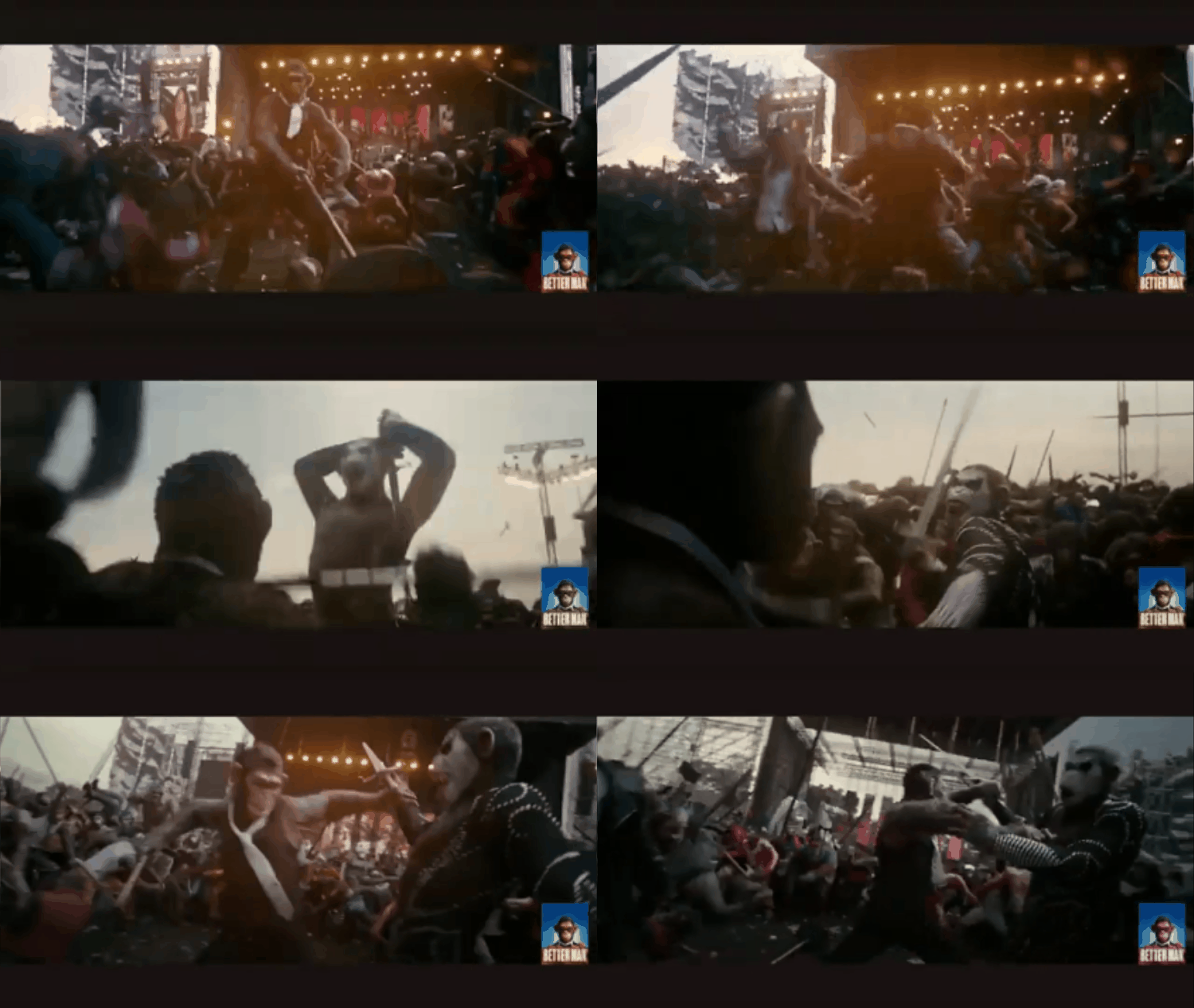
The climactic battle in Better Man is a frenzy
of ape-on-ape violence. This is clearly fantasy.
Image via YouTube.
In the climactic moment of Better Man, an anthropomorphic chimpanzee named Robbie Williams takes the stage at the Knebworth Festival in front of 125,000 fans to sing his pop anthem, “Let Me Entertain You.” Nearing the end of the song, he spots in the audience dozens — then hundreds — of younger and angrier chimpanzee versions of himself. Leaping into the crowd, he begins fighting them one-by-one, with each showdown getting bloodier and more outlandish.

With the leaping chimpanzees, the soaring camera work, and the colourful cinematography, it is as if the Battle of Isengard had been set on the Planet of the Apes and directed by Speed-Racer-era Wachowskis.

So let us be perfectly clear about this point: any movie featuring a battle royale between thousands of anthropomorphic apes is fantastical enough to be considered for a Hugo Award. Whether or not Better Man is a “pure” fantasy movie, it is at the very least a form of magical realism.

It’s also possibly the most audacious — and beautiful — science fiction or fantasy movie released in 2024.

Directed by Greatest Showman auteur Michael Gracey, the movie chronicles the rise of real-world, non-chimpanzee, UK superstar Robbie Williams, his feud with the boy band that launched his career, and his struggles with addiction. These are all the standard narrative beats of a Hollywood music biopic, but Better Man is elevated by the unusual approach to the subject (to whit the motion-capture ape), the panache with which the movie has been directed, and Williams’ sardonic voice.

The real-world non-chimpanzee Robbie Williams
is known for his self-serious dignity.
(Image via RobbieWilliams.com)
Unfortunately, the movie woefully underperformed at the box office — earning only $20 million on a budget that exceeded $110 million. Perhaps it struggled in cinemas because Americans have never really understood Robbie Williams, something explored in the recent Netflix documentary about his life … but not in this film. Americans like their bragaddocio unmitigated; every time Williams offers a bombastic line, he undermines it with a joke. His is a quintessentially British voice that did not appeal to enough people in the USA.

The film’s inability to reach a wider audience is a shame, because by wrapping its narrative in special effects and fantasy, the story becomes more universal. It makes no pretense of being an entirely true and factual depiction of Robbie Williams’ life. To quote Williams himself: “You don’t want the truth. Truth is boring.” This is a fantasy inspired by mostly inaccurate tabloid stories about a pop star. The viewer isn’t being offered the definitive biography of a person, but rather a fable about a dancing primate.

And this makes Better Man better cinema — and more interesting SFF. The movie is full of metaphor and surreal asides in which the chimpanzee Williams is constantly confronted by his personal demons in the guise of past versions of himself.

Williams has spoken about his cinematic simian alter-ego, explaining that he’s often described as “just a performing monkey,” that he’s “less evolved,” and that “fame makes monkeys of us all.” The effect was created by the special effects house Weta, the company that created Gollum in Lord of the Rings and Caesar in Planet of the Apes — they should get a lot of credit for making this central metaphor work, imbuing the animation with pathos while also maintaining its otherness.

One of the central relationships in the movie
is between chimpanzee Robbie and his
grandmother played by Alison Steadman.
(Image via Entertainment Weekly)
The cast is filled with scene-stealing turns by actors who are not yet household names. In the leading motion-capture performance, Jonno Davies manages to imbue the role with pathos and sincerity, while never downplaying the darker places to which the narrative takes him. Alison Steadman is simply superb as Betty Williams, Robbie’s grandmother. The movie’s most dislikeable character, Nigel Martin-Smith, is played with aplomb by Damon Herriman.

But the biggest star of the show is the cinematographer Erik Wilson, who offers infectiously joyful camera work during dance numbers that recall Golden Age movie musicals cranked up to 11 by modern technology. The “Rock DJ” scene in Oxford Circus is a stand-out.

Even describing just the fantastic elements of the movie fails to highlight just how bloody weird the film is. For one thing, Robbie Williams is much younger than you would expect for the subject of a valedictory movie like this; with the exception of movies about stars who died far too young (La Bamba was made when Ritchie Vallens would have been 46, Notorious was made when The Notorious B.I.G. would have been 35, The Doors was made when Jim Morrison would have been 48), the only example of a major Hollywood biopic about a living star as young as Robbie Williams is the Loretta Lynn biopic Coal Miner’s Daughter (Lynne was 48 in 1980 when the movie was released). Williams' most recent studio album is barely five years old, and topped the album charts in the UK, Australia, and Ireland. Moreover, the movie skips some of Robbie Williams’ biggest hits. Millennium, Something Stupid, Strong, and Kids are absent.

Speculative fiction — and the Hugo Awards — can and have embraced off-board picks in the past. Better Man was never marketed as fantasy, but it clearly fits any reasonable definition of genre cinema … and it is among the most bonkers, surreal, and beautiful movies of 2024. Seriously consider giving it a Hugo Award nomination.

Thursday, 25 May 2023

The Word For "World" Isn't America

In China they honour works of science fiction with the Galaxy Award, the Atorox Award is presented annually to the best Finnish work of SFF, Australia’s Ditmar Award recently celebrated 50 years of recognizing Aussie sci-fi, Japan has the Seiun Award, Canada the Aurora, New Zealand the Sir Julius Vogel Award, Netherlands the Paul Harland Prize, in Croatia they present the SFera Award … we could go on.

The Ditmar Award is almost
as old as the Nebula, and
recently recognized 
J.S. Breukelaar's "The Bridge."
(Image via BlackGate)
These national awards support science fiction fandom by platforming works that express the local concerns and national character of their host nations. Although neither Julie E. Czerneda, Candas Jane Dorsey, or Karl Schroeder have been honoured by the Hugo Awards, they’re truly great authors and we’re glad that the Aurora Award has recognized them. Their creative works speak to and for Canadians.

So why is there no national award recognizing the best science fiction published by authors from the United States?

It could be argued that this is a reflection of American exceptionalism or imperialism.

The Hugo Award — when it was established in 1953 — may have billed itself as celebrating the world’s greatest science fiction, but that was for a limited definition of “world.” This was a “world” that extended no further north than Toronto, no further east than London, and no further south or west than Los Angeles. American cultural hegemony was baked into the DNA of the award.

An American national SFF award was not seen as necessary, because the Hugos existed.

To date 84.2 per cent of all winners, and 84.5 per cent of the authors represented in the prose categories (short story, novelette, novella, novel and series) were born in the United States. If anything, these statistics understate the level of American dominance, given that the non-American 15 per cent includes figures like Isaac Asimov (born in Russia), Algis Budrys (born in Germany) and Ursula Vernon (born in Japan). If the goal of the Hugo Awards is to represent the best science fiction in the world, then we cannot limit ourselves to works by American authors.

It can be argued that American dominance might have eased slightly in recent years. But even over the most recent three awards ceremonies, 76 per cent of Hugo finalists in the prose categories were still Americans.

Despite a slightly increasing global reach of Worldcon over the past 20 years, clearly, the award’s early focus on America and on American SFF remains.

And this now feels like a disservice to the genre as a whole. The list of iconic SFF writers who did not primarily write in English, and who consequently never got even a whif of Hugo recognition is long. Among others, we’d mention Japan’s Kobo Abe, France’s Pierre Boule, Brazil’s Jerônymo Monteiro, France’s Bernard Werber.

Elia Barceló is among the best-known Spanish
authors and has published best-selling works of SFF.
But the Hugo Awards have yet to recognize her work.
(Image via Zendalibros.com)
The lack of an award for Best American Science Fiction means that the Hugo is the primary award that American science fiction fans and authors pay attention to, lobby for, and consequently dominate. Thus, the award for the best science fiction on Earth is usually awarded to American authors, and consequently reinforces the perception that American science fiction is the beginning and end of the genre.

Put another way, the lack of an American SFF award ends up disprivileging non-American authors.

But it’s a sword that can cut both ways.

This year, with Worldcon being held in China for the first time, there have been more nominating ballots than ever before received from science fiction fans whose first language is not English. There is consequently a real chance that the Hugo Award ballot may primarily celebrate Chinese-language works.

If this comes to pass, and if deserving works of American science fiction are denied recognition as a consequence, we should not blame the Chinese fans who engaged with the Hugos. The fault belongs with all of us in North American fandom for trying to have our award be global, but still wanting to be the only ones who can win it.

Regardless of what the shortlist looks like in 2023, the Hugos would be improved by the existence of a national science fiction award in the United States.

As much as Worldcon likes to think of itself as a “World” event, it seems pretty clear that for the first seven decades that it existed, the Hugo Award has steadfastly resisted the global reach of fandom.

If the Hugo Award is to be a truly “World” award, American fandom may need to relinquish it … by establishing an American award for American fiction.

Wednesday, 18 May 2022

All My Apes … Gone!

This blog post is supplemental to a series of blog posts examining past winners of the Best Dramatic Presentation Hugo Award. An introductory blog post is here.

For a $2.3-billion grossing science fiction franchise that has spawned nine movies, a popular toy line, a saturday morning cartoon, a prime-time drama, and some of the most enduring Simpsons gagsPlanet of the Apes has had shockingly little recognition at the biggest awards in the genre.
Though later movies would ape its style, the
original movie's cinematography stood out.
(Image via American Cinematographer)

To date, no entry in the entire franchise has been shortlisted for a single Hugo Award or Nebula Award. This seems odd since these awards have rarely shown reluctance to reward high-grossing dramatic presentations, and some of the Apes movies are genuinely quite excellent.

Pierre Boule’s novel, originally published in French in 1963 and translated into English by Xan Fielding later that same year, probably remains the high point of the Apes franchise. Enriched by a terrific narrative framing, it’s an almost poetic allegory about the horrors of how humans treat animals. Given that the author was already an Academy Award winner (for Bridge Over The River Kwai), and the fact that it received positive reviews in the press, it seems odd in retrospect that the book was overlooked by Hugo voters in 1964. We can only speculate that within fandom circles, it carried the stench of “mundane literature.”

The first movie — which was one of the top-grossing movies of 1968 — likewise seems a surprising omission from the Hugo Awards shortlist. It was nominated for two Academy Awards, on top of a special Oscar for makeup (which was not yet a category). It was a cultural phenomenon, moments of which continue to resonate in pop culture. Looking at it in retrospect, some of the pandering and broad comedy (“Don’t Trust Anyone Over 30,” for example), comes across as condescending for today’s audience. But the 1969 Hugo shortlist has one or two weaker entries (I.E. Yellow Submarine), so it’s worth asking why the movie was ignored.
As Camus has said, an ape begins by demanding
justice, and ends by wanting to wear a crown.
(Image via USA Today)

Sequels of diminishing quality (with the possible exception of Beneath the Planet of the Apes) are also easy to dismiss as Hugo contenders, as are both of the execrable television shows. But their existence and popularity in their day points to the enduring appeal of the original works in the series. It also points to how malleable and powerful a metaphor the Apes franchise is built around: a world dominated by Apes can be used as a tool to criticize animal testing, to examine the fatalism of Cold War military policy, to interrogate class struggles, and to comment on youth culture.

Although Tim Burton’s remake was a compellingly weird flop, recent movies directed by Rupert Wyatt and Matt Reeves (of The Batman fame) have been among the most thoughtful and nuanced action blockbusters of the past decade, and featured what may be Hugo-favourite Andy Serkis’ finest performances of all time. Despite their critical and commercial success, however, not one of them has earned a coveted spot on the Hugo or Bradbury Award ballots.

It’s interesting to speculate about why this might be. Does the failure of some early works in the franchise cast a long enough shadow to dismiss consideration for subsequent releases? Do Hugo voters get into the habit of sticking with one franchise over another when preparing their nominating ballots? Despite the franchise’s success and turn towards serious dramatic fare, do the jokes about the campiness of the original frame even the later works as unserious? Whatever the reason, it seems notable.

Few media franchises have, over the course of almost six decades, seen as much variability in quality as Planet of the Apes (sometimes varying wildly within the same film). Despite its success in the broader culture, this franchise seems to be unloved within fandom. Perhaps it’s worth reevaluating our relationship with it.

Monolithic! (The Hugo cinema of 1969)

This blog post is the twelfth in a series examining past winners of the Best Dramatic Presentation Hugo Award. An introductory blog post is here.

Content Warning: This article contains references to sexual violence, both that which is depicted in these movies, and perpetrated by the director of one of those movies.

Spoiler Warning: This article contains plot details of 50-year-old movies.


2001: A Space Odyssey was the first science fiction movie to be shortlisted for the Academy Award for screenwriting. It was a crossover success drawing rave reviews from the mainstream press, with audiences lining up to see it. On its release, it was the first science fiction film in more than a decade to be one of the top-grossing movies of the year. The American Film Institute places it 22nd on their list of the greatest movies ever made.

To non-fans, the fact that 2001 won the Hugo Award
in 1969 might seem like gilding the lily.
(Image via Harvard Crimson)
But still, winning a Hugo Award seemed far from certain.

The movie had been highly anticipated within fandom, but reactions immediately after it was released in April 1968 were extremely harsh. Reviewing an advance screening of the movie for Science Fiction Times, Walter R. Cole opined “2001 probably will be considered for a Hugo nomination in 1969, but unfortunately it is a big disappointment and should not win.” Lester del Rey was filled with invective for the movie. And although he would later change his tune, Isaac Asimov initially panned Space Odyssey.

Despite this initial vitriol, the movie slowly found champions among fandom. One of the most prominent voices in debates over Best Dramatic Presentation Hugos Juanita Coulson, declared that no science fiction movie had ever filled her with such awe. The fanzine Double Bill proclaimed it to be the best science fiction movie ever made. Even reactionary fan Ted White reluctantly went to see 2001: A Space Odyssey having told Samuel R. Delaney that he fully expected and intended to loathe it, but came out of the theatre a convert: “There is little in this movie which will be new to SF fans; in precis it reads like a 1931 SF story: a moralistic travelog that ends upon an almost sermon-like moral” White wrote in Shangri-L’affaires “But it is effective … I was impressed. In spite of myself.”

Certainly, the movie divided our viewing group as few films ever had.

Given the polarity of opinions about A Space Odyssey, it was bound to be a contentious winner, and arguments continued about it for years. Notably a faction of younger fans were all-in for The Prisoner, while another faction was peeved that Star Trek had been left off the ballot altogether.

There are numerous intriguing omissions from the ballot that year. Planet of the Apes, which was a cultural phenomenon and kicked off one of the most successful science fiction film franchises of all time, was nowhere on the ballot

Possibly the most egregious omission in hindsight is Night of the Living Dead, George A. Romero’s seminal and provocative classic. Though it has spawned numerous imitators, sequels, parodies, remakes, and rip-offs, this raw and visceral original has yet to be equaled. It’s tightly edited and enjoys a narrative momentum that distinguishes it from its contemporaries in SFF. The characters are quickly introduced, and they are thrown into a pressure cooker. The multipolar tensions in the group illuminate issues of race and class in ways that continue to resonate more than 50 years later. For at least one member of our cinema club, this movie deserved the Hugo Award most of all.
The movie that has possibly withstood the test of time
best of all is the low-budget Night of the Living Dead.
(Image via FilmComment)

Almost as notable an oversight is that after two years of Star Trek’s dominance, the show was shut out from the Hugo shortlist. Despite a common perception in 1969 that the show had jumped the shark, Star Trek had several worthy episodes that would have been eligible. These include The Enterprise Incident (air date September 27, 1968), The Immunity Syndrome (air date January 19, 1968), The Ultimate Computer (air date March 8, 1968), and The Tholian Web (air date November 15, 1968). Given the dominance of Trek the previous years, we were not too disappointed to see it off the ballot, though it is a shame that the late great Dorothy Fontana had to wait another 20 years to receive a Hugo Award.

The ballot as it stood hewed more to mainstream culture than to the fannish, which was unusual for that era of Hugo Awards. Between the five nominees, two of them were among the top-grossing movies of the year, another featured the most popular pop band in history, and another was an actor-focused drama and mainstream critical darling. Three of the shortlisted movies received trophies at that year’s Academy Awards: Ruth Gordon winning for Best Supporting Actress in Rosemary’s Baby; Charly getting best actor for Cliff Robertson; and 2001: A Space Odyssey being recognized for the best special effects.

Although Yellow Submarine is a visually compelling movie that’s livened by classic and enduring songs, it seemed to us the weakest of the nominated works. Despite the truly spectacular images, a thread-bare nonsensical plot, and the wittering banalities fobbed off as dialogue render long stretches of the movie almost unbearable. In retrospect, we would argue, this did not deserve consideration for a Hugo Award: it’s great as a sequence of music videos, but poor as fantasy or science fiction.

The Prisoner, which comes from the same “cool Britannia” moment of pop culture as Yellow Submarine, fares a lot better in the light of history. The concluding episode “Fall Out”, which made it onto the Hugo ballot, sums up the themes of the series nicely, and provides an emotional resolution to the question of whether or not Number Two can escape. Interestingly, both Yellow Submarine and The Prisoner: Fall Out use the song “All You Need Is Love” in their soundtracks. It’s used with sincerity in the Beatles movie, but with a twist of irony in The Prisoner. We would suggest that it is more effective in the latter.
Was Barbarella a good movie? Definitely not.
But it was visually compelling, and the focus
on female pleasure stands in sharp contrast to 
the violent and deeply troubling scenes in Charly.


Charly
is the first remake to have been shortlisted for the Hugo Award, having been previously on the ballot as the TV movie The Two Worlds of Charlie Gordon in 1961, shortlisted as a novel, and having already won a Hugo as a short story Flowers For Algernon. In light of modern understandings of disabilities, this movie comes across as dated and condescending towards persons with Down’s Syndrome. And the scene in which the protagonist Charly Gordon tries to force himself on his teacher Alice is extremely problematic, especially in light of how this act of violence is framed as forgivable, and an expression of love. If we’d had our druthers, this movie would not have been a Hugo finalist.

It is impossible to talk about Rosemary’s Baby without addressing the later conduct of its director. Roman Polanski has admitted in court to unlawful sexual intercourse with a minor, and as such, his inclusion on this shortlist is a stain on the Hugo Awards. In fact, it is difficult to judge this movie without considering Polanski’s crimes, particularly given that the feminist themes in Rosemary’s Baby stand in stark contrast to the director’s personal life. While there is a scene in which sexual assault is depicted in this movie, it is framed much differently than in Charly. By showing the event from a female perspective, Rosemary’s Baby does not imply the act is anything other than horrific.

The whole movie can be read as a parable about how the patriarchy forces women into specific roles, and punishes those who confront conformity; and the horror of the final scene is that Rosemary ultimately gives in. This presents a significant question about how much a viewer should separate the art from the artist, or how much of a movie belongs to the director, rather than to the original novelist, or actors like Mia Farrow who gave an extraordinary performance, and accentuated the works feminist themes. In some ways, Rosemary's Baby might be more poignant these days than in 1969, and the fact that a predator created it makes it even more unsettling. It is a remarkably excellent movie on many levels and might have topped some of our ballots, though in light of his crimes, most of us would choose not to honour Polanski.

Revisiting 2001: A Space Odyssey in the context of contemporaneous screen science fiction highlights
As had become tradition, nobody
involved in the making of the
Best Dramatic Presentation winner
was on-hand to accept the award.
Well-known fan David Kyle
accepted the award on behalf
of the production.
(Photo by Jay Kay Klein
via Calisphere)

just how remarkable a movie it was. However, it remains just as polarizing. Some of the group could not get past how slow and ponderous it was, but all acknowledged the cinematography and immersive special effects were unlike anything that had been made to date. The special effects would not be equaled for almost a decade. Even such minor elements as the helmets on the spacesuits look light-years more believable than those from Marooned — a movie made a year later on an equivalent budget. The scope of the movie was huge but was made relatable through the slice-of-life-in-space scenes. Some go as far as to call it a masterpiece. Love it or loathe it, we could not deny its impact, both on science fiction and how mainstream audiences perceived the genre.

Screen science fiction and fantasy’s best and worst were on display at the 1969 Hugo Award for Best Dramatic Presentation, and often within the same shortlisted work. Even more than previous years, the Hugo shortlist feels like a time capsule that both reflects a world that no longer exists and reminds us that, when it comes to gender-based violence, we’ve still got a ways to go.