Monday, 24 October 2022

Interview with Premee Mohamed, author of the Beneath The Rising trilogy

Scientist and author Premee Mohamed photographing
photos of insects in a riparian area of Alberta, Canada.
Her work often reflects environmental impacts and
concerns.
(Image via the author)
Premee Mohamed is an Indo-Caribbean scientist and speculative fiction author based in Edmonton, Alberta. Over the past year, her work has appeared on the ballots for the World Fantasy Award, the British Fantasy Award, and Hugo Awards, as well as earning her a Nebula and an Aurora for best Novella. This spring, she published the capstone to the horror adventure trilogy that started with her debut novel Beneath the Rising. Mohamed spoke with blog contributor Olav Rokne in September.

UHBC Blog: Just earlier today, while prepping for this interview, I read “All That Burns Unseen.” I actually emailed my wife and told her “You have to read this story!”

Every time that we get fire seasons — like the one in the story — I feel like the world is ending. So that story felt very real.

Premee Mohamed: I'm glad … but I'm also horrified, because it feels really really real to me too.

The story came from just this idea of like the year-long fire season with no water left to fight it. And that's barely sci-fi. That's soon. That's going to be happening real, real soon.

UHBC Blog: Do you have any family up north? Because that aspect of the story was particularly true to life.

Premee Mohamed: Not me personally. But for the story, I did uh pick the brains of a friend of mine who works for the air monitoring division [of Alberta Environment and Parks] and he was sent up with very little notice to the Fort Mac fires. And I asked him “Visually what do you remember? What were some things that stood out to you?”

UHBC Blog: So yeah, I was actually planning to bring up the fact that climate change seems like a
In 2022, Premee Mohamed won
the Nebula for best novella, and
the Aurora for best novella ... 
though oddly with different books
earning the awards.
(Image via Goodreads)

recurring theme for you. It informs What Can We Offer You Tonight, Annual Migration of Clouds, and of course that excellent short story. Do you think it's possible to write near-future fiction and not include some time of climate change elements?

Premee Mohamed: Well, anything's possible in fiction.

But suppose I wanted to write a murder mystery set in London in a fancy house in the middle of the city in 1942. In theory, I could write the entire book just about the murder mystery and these friends would have to solve it.

But in practice, if I didn't mention World War II at any point or the Blitz or the bombs or people that they knew that had died in the war … it would feel very weird and I feel like the book would be kind of missing something enormous about the reality of London in 1942.

So I don't think it's possible to write a future on Earth in fiction where we either aren't facing the catastrophic effects of mass climate change, or we have figured out a way to mitigate it.

I'm looking at my Twitter feed and there's disasters happening all over the world that are directly attributable to climate change. All I can picture is a future where eventually those disasters join up temporally and spatially … and everything is bad for everybody pretty much all of the time.

UHBC Blog: I always read the first two Beneath The Rising books as a bit of a climate change metaphor,

Premee Mohamed: I think what I was thinking of was not specifically um climate change per se, but certainly eschatology — end of the world scenarios.

Nuclear was actually what was informing the first one: this world-ending technology that once it started wouldn't stop.

But I don't think that climate change is actually that different from the idea of this nuclear disaster. 

It's something that most of us can't directly affect ... and the people that can affect it, the people who hold all the power seem unable to respond effectively.
The third book in the Beneath The Rising trilogy
hit shelves in April. 
(Image via SciFiNow)

UHBC Blog: One of the aspects that really drew me into those books was what I perceived as a parasitic friendship between Joanna and Nick. Was any aspect of that drawn from real life?

Premee Mohamed: I was quite young when I started writing that first book; I was Nick's age. So my friends were kind of my entire sphere of influence.

I had just realized that some of my friends' families had a lot more money than mine. I didn't really think about it, it wasn't something that one really noticed. Just, you know, their house was nicer, he always had the latest newest gadgets. I was 18 at this point, and it had been years of me noticing this, but not really noticing. And it kind of sank in like, “Oh man, this explains so much about like the last like seven or eight years of my life.” Things that I did not notice.

So Nick is very cognizant that Johnny is a multi-millionaire, or maybe a billionaire. Aware that she owns companies, she's got influence, she's in the media, she's a celebrity.

And at the start Nick's like “I'm extremely ordinary isn't it a miracle that we're friends.” But then you start to see that the person who has the most Johnny is taking the most and the person who has the least — Nick — is giving the most and it's so uneven. When he realizes that, of course he shatters the friendship.

That being said, it wasn't so much that I drew from myself and my friends when crafting the relationship between Johnny and Nick. Their relationship is more of a microcosm of the overarching story as a whole.

The reason disasters keep happening to them is because the old friendship and trust that they shared has been broken.

When their friendship is close and tight, they're able to work together and they can actually accomplish positive things. But when they don't trust each other, the plot falls apart and disasters start happening.

I wasn't really doing that consciously so much in the first book, but definitely in the second and the third.

UHBC Blog: So … you mentioned that you started writing the book when you were 18 or so. So that would have been around 1999 or 2000. And it seems to me that's right around the time that the resurgence of Lovecraftian fiction was starting, so you were kind of ahead of the curve.

Premee Mohamed: I actually hadn't read any Lovecraft when I started writing the book.

And in the earliest drafts of the book, it was a pretty straightforward good guys against like … the actual devil, and demons. But as I started writing, it seemed like the devil as a villain had kind of been done. I didn't feel like I could put a fresh spin on it.

I was like “why am I putting Satan in this?” “Is this 12 years of Catholic School speaking?”

Around that time, I started reading Robert E. Howard, and in the back of the book someone had written an essay about a bunch of other similar authors

It was like Lovecraft and Arthur Machen and Lord Dunsany and a couple of other names. So I went and looked up Lovecraft collected works in the library and I was like “oh this is some terrible writing and a really good sandbox! Look at all these weird ancient gods and these cults and the possessions and this extremely weird haunted house with tentacles in the basements!”

UHBC Blog: What is it about the current moment that makes these metaphors about secrets that man was not meant to know relevant again?

Premee Mohamed: I suppose part of it must be that with the advent of the internet we don't think there's anything we can't know. There shouldn't be any information that is beyond us because it's somewhere online.

Having just adopted a cat, I think I'm seeing this attitude right now. His attitude is: “Whatever it is you are doing, I have the right — nay, the duty! — to come see what it is.”

I think it's this attitude of entitlement to information is part of it and the idea that there is information out there that someone has that no one else has that we could have.

That's pretty alluring I think and part of it I think must also be the cosmic side of things: This idea that the villain doesn't even notice us unless we somehow attract its attention. The villains are just villainously doing whatever it is they do and humans are so insignificant that all they can think of to do when they encounter us is enslave us or exterminate us or use us as part of their horrible life cycle.

And it all defies understanding and it's supposed to be incomprehensible which in the books that really bugs Johnny. She's a scientist, she wants to understand, and believes she should be able to control magic because to her magic is basically an elementary particle like a photon. If we can understand and measure and control photons why can't she do the same to magical particles?

UHBC Blog: It strikes me that this is somewhat related to a dichotomy in your career. I mean you're a person with two science degrees working in a field that is all about uh metrics and and and facts and and yet a lot of your fiction is entwined with that branch of weird sff in which science cannot save us.

Premee Mohamed: I really enjoy the tension actually.

I like the idea of people encountering things that should be scientifically explicable in some way that just aren't.

For example in And What Can We Offer You Tonight the reason Winfield comes back to life is never given. I don't think there's a point in explaining it, and I don't want somebody to strap her down to a table and vivisect her. I don't know why she did and that's not the point of the story.

If I want to write a story where scientific understanding is the point of the story then I do. For instance my story that's coming out in Life Beyond Us, which is an anthology in association with the European Space Agency. My story is called “The Far Side of the Door,” and it does involve a medical mystery that has to be solved using science.
Among her numerous upcoming works is a short
story in the anthology "Life Beyond Us."
(Image via Kickstarter)

But sometimes I don't want to explain it, and it's actually more satisfying to me not to. You know in These Lifeless Things, readers might ask “How do the statues come to life?” “How come that's never explained when the scientists come to the city 50 years later?”

I'm like: “Because I don't want you to know.” “Because I don't want the reader to have some questions answered.” I want them to ask and I want them to not know at the end deliberately, because it's more fun.

UHBC Blog: Well and speaking of These Lifeless Things, you've had a very successful year in terms of novellas. What appeals to you with the novella as a format?

Premee Mohamed: I really love the length. In the next couple of years I'm gonna have three more out.

So one with tor.com and then two are the sequels to The Annual Migration of Clouds.

I've been really trying to put my finger on it, because I just did the Edmonton Expo, and somebody was asking about novellas.

I think what appeals to me about a novella is similar to what appeals to me about a short story is how ruthless you have to be with what part of the character's lives you choose to focus on. What time period you want the story to cover and what events can be allowed to happen in it to kind of illustrate what you want people to go through and how much you have to trust the reader.

In a novel, if I need to explain why this entire city has only subsisted on sardines for the last 50 years, I have room to do that. In a short story I may have a couple of sentences.

The novella is the perfect you know length between I want to explore one idea or one premise with one overarching plot structure and at most one subplot and a limited number of characters.

So when the reader is reading, they are laser focused on this single string of events that is happening and on these few characters' experience of this story. There's no room for tangents, there's no room for digressions.

So it ends up just a really great interesting length to write in terms of both the freedoms and the limitations that it gives you.

Friday, 14 October 2022

A Unanimous Gold Mine Of Subtext

If you’ve ever wondered what it would be like if Sun Ra and Samuel R. Delany had tried to make The Matrix, the answer is something like Neptune Frost.
Burudian rapper Kaya Free (AKA Bertrand
Ninteretse
) gives a compelling nuanced performance
as Matalusa in Neptune Frost. 
(Image via the Facebook Page of Saul Williams) 


A collaboration between alternative hip-hop artist and provocateur Saul Williams and Rwandan artist and playwright Anisia Uzeyman, Neptune Frost is structured in alternating segments between a story following a coltan miner named Matalusa whose brother is killed while mining coltan in an open pit mine, and an intersex runaway named Neptune who flees from an attempted sexual assault. Neither of them fits into the systems at play in the communities they call home, and through this, the viewer is challenged to find parallels between the oppression of gender conformity and the oppression of standard capitalist employment relationships.

The ability of each of these narrative threads to engender empathy hangs on superb performances in these two roles; Matalusa as played by Kaya Free and Neptune who is played alternatingly by Cherylel Isheja and Elvis Ngabo.

Finding each other when they join a revolutionary anti-capitalist hackers collective, Matalusa and Neptune discover that their relationship warps the fabric of reality and may provide the key to freeing society from the grip of a rapacious mining company and an authoritarian regime.

But a simple plot summary does not begin to convey what makes the movie so unusual and compelling. The central characters’ journeys through this imagined future Rwanda and Burundi shimmers between differing states of existence; musical understandings of the world and cinematic explorations. It’s … a lot to work through.

Additionally, given that it’s a multilingual movie whose dialogue is in parts spoken in Kirundi, Swahili, Kinyarwanda, French, and English, and given that some of the subtext depends on puns in the various languages, it is the sort of cinema that takes some generosity, imagination, and effort to parse.

Although the movie can be opaque and obtuse at times, what is clear is the criticism of capitalism, of colonialism, and of exploitation. This is a movie about an anarchist, anticolonial rejection of heterodox narrative conventions.

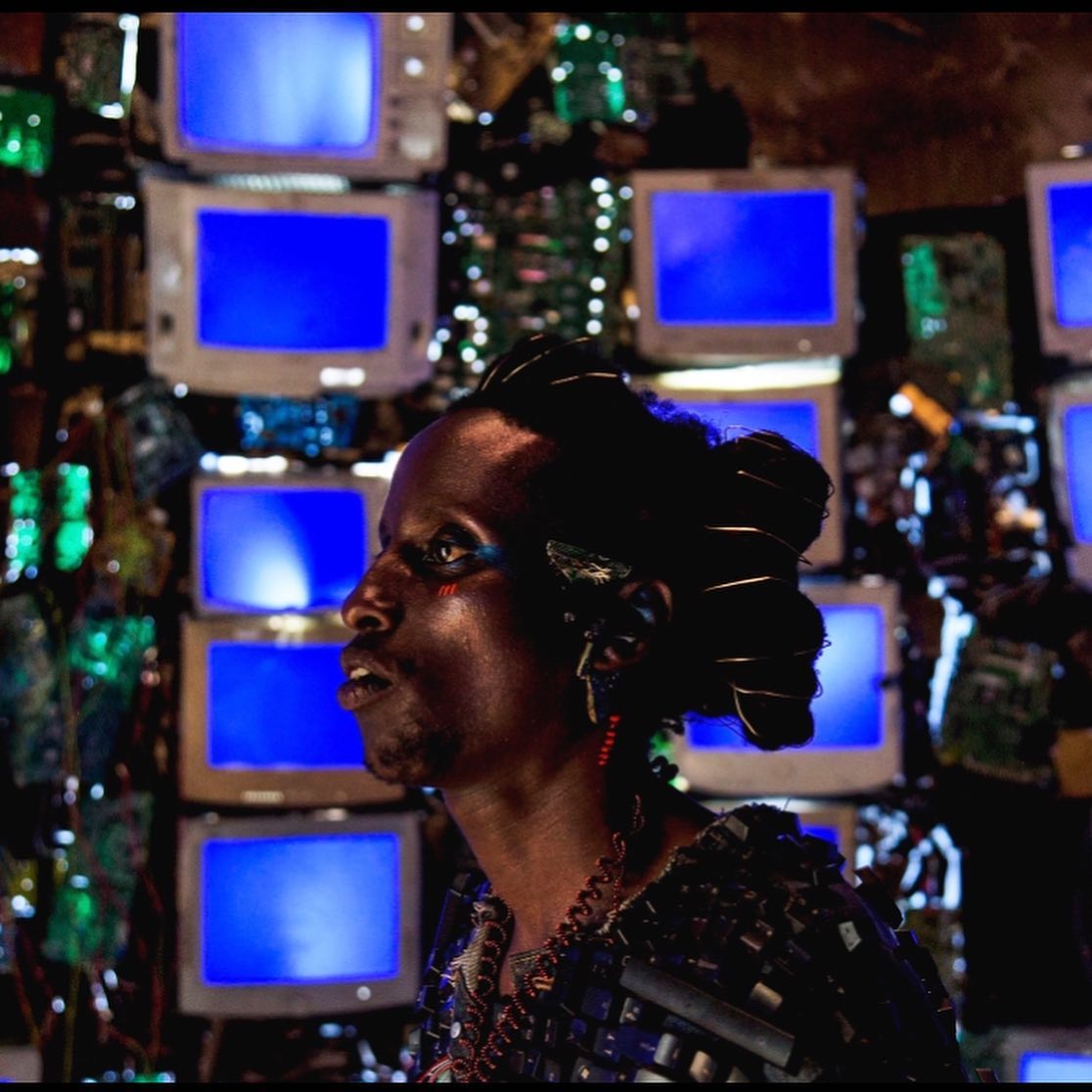
This carries through to the exuberant and kaleidoscopic visuals that are elevated by found-item and repurposed set construction. This world is built of broken, discarded, and recycled computers and technology, evoking a punk aesthetic; handmade yet high tech.
Creators Saul Williams and 
Anisia Uzeyman. 
(Image via Facebook)


Although it opened at the Cannes Film Festival in 2021, it’s eligibility for the Hugo Awards was extended at the 2022 WSFS business meeting, so it can be nominated for a Hugo Award for Best Dramatic Presentation in 2023. And it deserves your attention. 

Although the Hugo Award for Best Dramatic Presentation has a long history of celebrating works that are already successful, several nominations in other categories show that Hugo voters are interested in works that represent cultural perspectives other than North American.

In an era when mainstream science fiction movies have embraced safe and comforting fare, experiencing cinema that dares to offer non-traditional narrative structures is refreshing.

Currently available for purchase on various streaming services (YouTube, Apple+, GooglePlay), this challenging, multilayered, perplexing, beautiful beat poem of a movie is probably the most interesting piece of science fiction cinema to have arrived from Africa since the 2009 release of Wanuri Kahiu’s Pumzi.

To quote Neptune Frost itself: this is a Unanimous Gold Mine.

Wednesday, 5 October 2022

Interview with Oghenechovwe Donald Ekpeki, editor of Bridging Worlds

Oghenechovwe Donald Ekpeki is an African speculative fiction writer, editor, and publisher based in
Oghenechovwe Donald Ekpeki at the 
2021 Worldcon in Washington, DC.
(portrait by Richard Man)

Nigeria. Among his numerous honours, he has won the Nebula award and is a multiple Hugo Awards finalist. This spring, he published Bridging Worlds, a non-fiction anthology with 18 essays, interviews, and reflections from Black writers examining the challenges of creating art during a pandemic. Ekpeki, who recently returned from Worldcon, chatted with blog contributor Olav Rokne in September.

How did Bridging Worlds come about? When did you first have the idea to put this together?

While in the middle of a project, the thing that always comes to mind is, what next? And that’s how it was. I was in the middle of editing the Dominion anthology when the idea for Bridging Worlds came to me. The experiences were immense and intense. Working with Zelda Knight, and so many other writers to compile, collate, their works, crowdfund for and produce the book. And while I was at it I thought if people only knew what we went through, how this felt. And I thought why shouldn’t they? And I knew each of the creators had a story to tell, the story of the story, the reality of the fiction they wrote. It was the middle of the pandemic year. They already told me those stories. Why they couldn’t send in their stories on time, or this or that which happened. And I thought, there’s the next project. Why don’t we tell these stories? And that’s how the Bridging Worlds anthology was born. Out of an intense need to not just tell our stories, the stories that we dream up, but the stories of ourselves. Of how we tell our stories. Black, African stories in the middle of a deadly pandemic.

What was your mission in getting this together?

The Black, and African experience is one that’s often minimized and overlooked. It usually takes more effort in a world that marginalizes us. And the world often doesn’t see or understand the effort it takes to create Black excellence or even just Black art, or anything African. The pandemic was no different. It marginalized us just as much as anything else. We died more, suffered more, we lost more. And in the midst of this, we created. Putting this together was so we could document some of that effort and those experiences. So the world could see, have a visible source to go to for those experiences. And the very publication process of this was part of that story.

I note that it’s available for free online; was this an attempt to get the word out more widely? Was there a specific audience you wanted to reach with this?

Ahhh. Every creative loves to be paid. No less marginalized ones during a deadly pandemic, the likes of which its deadly effects hadn’t been seen since the world wars. And with the work that went into collating, gathering and putting out the book, it’s definitely not by choice that it’s free. Black and African creators especially at a time like this, being the demographic hardest hit by the pandemic strongly deserved to get paid. And they were. From the contributing authors of essays, interviews, whatever they contributed, to the copy editors. The book however was made free after the depredations of nearly every force out there that sought to prevent the book from seeing the light of day. 

Both personal and institutional, there were many hindrances. From Amazon to Smashwords to Draft2digital seizing the proceeds from the sale and throwing the book out of their platforms, shutting down our accounts, to review bombing on Amazon and Goodreads, to death threats and online harassment. The only recourse was to make it free altogether. So it wasn’t to get the word out more widely, but to enable it to be born at all into the world, and see the light of day. In the end we had to do a crowdfunding drive to even pay the authors after our funds were illegally detained. As at the time of my writing this, up to 500 dollars of mine is still being held illegally by Smashwords/Draft2digital for no other reason than as they themselves admitted, that I’m Nigerian. You can read about the Amazon and Draft2digital issues there.

Meanwhile the book was made for anyone with an interest in the source and process of Black and African speculative fiction creation, in one of the most gruelling times we have faced in these modern times.

It strikes me that your previous anthology Dominion was extremely successful. It seems to me like it would be tempting to take the easy route and follow that up with something very similar. One of the things that impresses me about Bridging Worlds is that you’ve taken a risk. Could you speak to that risk? To the fact that you’re tackling new ground here?

I consider myself a literary explorer. I want to enjoy and experience things across the entire gamut of the literary, starting with the speculative. That is why I am engaged in a wide range of activities like writing and editing, long and short fiction, non-fiction, slush reading, publishing, conrunning, organizing awards, presses, etc. Even in my fiction, you’ll notice this. O2 Arena my Nebula-winning story is mundane sci-fi as Geoff Ryman coined, where my Nommo-winning “Witching Hour” is fantasyish. “Mother’s Love, Father’s Place” is a historical fantasy and “Destiny Delayed” in Asimov’s and Galaxy’s Edge published this year is a genre blender. My latest story “The Magazine of Horror”, yet unpublished is epistolary, written as a series of letters between magazine editors and a submitter. 
Non-fiction anthology Bridging Worlds
includes 18 essays and reflections
on creativity in a pandemic.
(Image via ODEkpeki.com)

My editing is the same. After Dominion, an original fiction anthology, I undertook to do the first-ever Year’s Best African Speculative Fiction anthology, a Hugo, Locus, WFA & BFA finalist. It was a reprint anthology. And next was Bridging Worlds, an original non-fiction anthology, then I edited several collections with Interstellar Flight Press before returning to editing original fiction with Sheree Renée Thomas and Zelda Knight again in Africa Risen. I believe in exploring, charting and discovering new courses, to challenge myself to growth as you cannot find without risk. Rather than stagnating on the capitalist, hollywoodish attitude of being safe and dying on the altar of ‘never change a winning formula.’ The truest wins, are yet undiscovered and continued progress and the ongoing growth of the genre hinges on going outside our comfort zones to find what’s different, new, needed.

When you set out on this project, did you have a list of authors you wanted to speak to in mind? Was there anyone who you were particularly pleased said “yes” to participating in the anthology?

Well some of the contributors to Dominion who I interacted with already, then players I was aware of their immense work in and contribution to the Black and African speculative fiction space. Mazi Nwonwu of Omenana, Sheree Renée Thomas for her work across the genre editing and community building, esp as the first Black editor of The Magazine of Fantasy & Science Fiction. Zelda herself, my co-editor for Dominion who had been editing several mags and presses for half a decade before we worked together. Chimedum Ohaegbu of Uncanny, Shingai Njeri Kagunda and Lisa Yvette Ndlovu of Voodoonauts, Milton Davis who has done extensive work in the indie sphere, Eugen Bacon, Wole Talabi and Geoff Ryman amongst others. Virtually everybody on the project was truly special in their own way and had contributed immensely to the project.

One of the things I took away from reading this was Wole Talabi’s observation that the rise of hybrid and virtual conventions was breaking down some of the barriers that authors outside of the USA had in terms of promoting their work. To what extent do you think this is true?

I think it’s true to a very large extent. I talk about this myself. It created a bridge to the sff world that had formerly been unavailable. Many people underplay the effects of cons to the development of an sff creative. But it plays a huge role indeed as I talk about on my Twitter thread here. Ironically, with you.

Could you speak a bit to the distinctions between SFF from Africa and that from the Black diaspora? And why is it important to platform both?

Africa means different things to so many of us. And all forms of it and us are valid. So I always try to create that balance of voices and equal representation of Africa in all my projects. From Dominion to the Year’s Best, to Bridging Worlds, to Africa Risen. Africa as we say is not a monolith. The difference is in the flavours of our identity. And it can manifest in so many ways. But ultimately I consider us all part of a whole. And I believe in building bridges that connect and highlight those differences while celebrating them. That’s a major part of what my work is about.

In your interview with Chimedum Ohaegbu, you ask “What are your thoughts on the current state of Black and African speculative fiction on the continent and in the diaspora?” I’d like to direct the same question to you?

I believe that African speculative fiction is strong. Stronger than it’s ever been and rising faster everyday. There is a lot of work to be done. A lot of gaps to be covered. A lot of firsts are still happening everyday. Recently, Nalo won the Sturgeon award, the first Black person to do so. I and Sheree Renée Thomas who edited Nalo’s Sturgeon winning work in The Magazine of Fantasy & Science Fiction will be the first Black finalists for the Hugo award, best editor short form category. I’ll be the first African-born Black writer to win the Nebula award and be a Hugo finalist. And so on and so forth. A lot more boons and deals could and should happen, to open for African writers in the continent and diaspora. And I am hopeful that as these firsts begin, more will follow until the floodgates are entirely thrown open.

One of the things I particularly liked about Bridging Worlds was how the essays were ordered and how the experience of reading it is structured. Nikhil Singh’s essay starts off the book with an absolutely gut-wrenching look at the stories of people who are among the most marginalized global citizens; a deeply felt piece of writing. Then we get some personal stories about how writers worked to stay creative, and then interviews and thoughts on people helping each other. The whole thing ending with Nicole Givens Kurtz’ metaphor laden piece about surviving and her final parting words “I am here. I am alive. Treading water.” Could you share some thoughts about how you selected the pieces in the book, and how the experience was structured?

It was more a selection of the people than the pieces. Having worked with a lot of writers in the field, I hand-picked those I identified had stories that the larger industry needed to hear. And so they crafted the stories that later appeared in the anthology after their selection. I also worked closely with them and a copy editor to ensure they were at the right place, that we were all satisfied with. Perhaps there’ll be another volume of the book, with an open call for essays as well this time.

What makes you proudest about Bridging Worlds? What choice that you made brings you the most joy?

For me, it’s the formulation of the idea, firstly. That’s where everything begins; as an idea, as a dream. Without that, nothing can happen. But if you can first dream it, then everything is possible after. A book like this, on this topic and form needed to exist. That and being able to follow through with the idea till it came to fruition, despite all the obstacles we faced with bringing it to conception. I’ve afterall had a number of good ideas. But not all of them were opportuned to see the light of day. Some died in the tunnels to being. I am exceedingly proud of the fact that this one could be carried to term.

The past two years have seen your works reprinted, published in one of the largest-circulation SFF magazines, and recognized by the two most-established SFF awards. What’s next for you? What are your next goals as an author and editor? (Am I out-of-line to be hoping that a novel is on the way?)

A novel isn’t on the way. It’s already here. I am done with the first draft of my novel, and already working on a graphic novel and some other works. I am also putting together a collection and some other special projects still in the works, that I hope will alter for the better, how we see and receive genre and Black/African speculative fiction forms. So collections, anthologies, novels, novellas, short fiction, everything is in the works. And also more non-fiction.

In your most recent few stories, you seem to be increasingly playing with the malaise of capitalism run amok. Why is this such fertile ground for storytelling? How much of “Destiny Delayed” should we read as poetic realism, and how much should we see as fable?

Well I’d say they are both actually. My stories are both rooted in the imaginary and real. And I believe that one of the biggest problems of the world today is greed. Not lack of but deliberately inefficient allocation or what is hoarding of resources. I believe mastering the malaise that is toxic capitalism will solve so many of the world’s problems and allow us to focus on solving problems that make humanity better instead of just what gives individuals more and takes takes away from all humanity. And I show the harm in toxic capitalism, hoping that the ugliness of what I show the world can make it turn away from its ugly path. You could say I’m hoping to change the world, make a better reality with my fiction.

Over the past three years, there’s been a clear evolution in your writing towards more formal narrative structures. What are your personal goals for your work as a storyteller?

At heart, my goal has been to tell stories, in all forms. Short fiction, long fiction, short non fiction, long fiction, writing, editing, panels, etc. I’m certain phases my work has moved through certain forms. But the goal remains the same, to tell stories that delight and instruct. That contribute to humanity effectively. And for that I’m willing to take my work through all the iterations of the art of the literary that have been discovered and not.

Thanks for taking the time to answer these questions. I’d really like to see this book get on the Hugo ballot next year.

We can hope. And nominate. Thank you as well for doing this.

Friday, 23 September 2022

Clash of the Cinema Titans (1972)

This blog post is the fiftteenth in a series examining past winners of the Best Dramatic Presentation Hugo Award. An introductory blog post is here.

The early 1970s saw a flourishing of SFF cinema. In 1971 alone, Jim McBride’s X-rated Glen and Randa scandalized audiences with post-apocalyptic sex scenes, and garnered critical love along the way. Boris Sagal threw Charleton Heston to the vampires in the blockbuster The Omega Man. And Josef Pinkava offered audiences a whimsical tale of children with a magical computer in The Wishing Machine. But these films were up against long odds to make the Hugo shortlist. 

The shortlist in 1972 may have provided the most star-studded Best Dramatic Presentation ballot the awards have ever seen. 

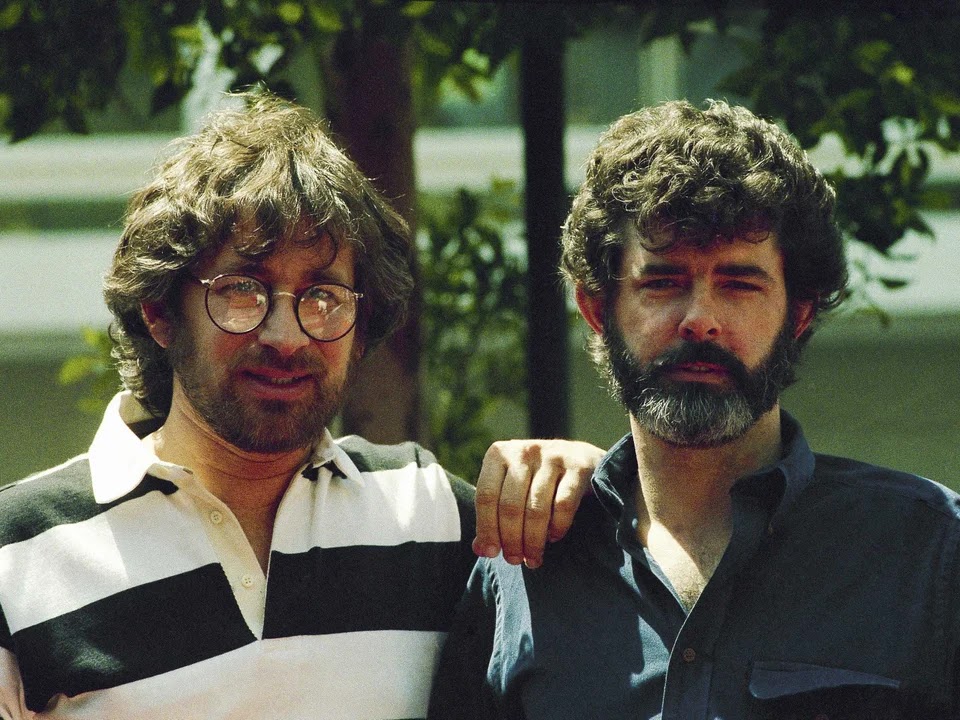
The movies on that shortlist were directed by a cavalcade of what are now household names for many: George Lucas, Steven Spielberg, Robert Wise, and Stanley Kubrick. Between these four people, there’s a total of 46 Academy Award nominations and $23 billion in box office receipts.
George Lucas and Steven Spielberg in the 1970s.
Long before they were beloved by millions of 
moviegoers, science fiction fandom embraced
the works of Steven Spielberg and George Lucas.
The Hugos gave each of them their first award nods
for feature films.
(Image via Reddit)

Each of these directors moved the art of moviemaking forwards and made extraordinary contributions to science fiction cinema … but to be blunt, none of them produced their best work in 1971.

Despite the Hugo ceremony taking place near the Los Angeles airport, none of the finalists made an appearance at the awards. In fact, none of them even bothered to send someone to pick up the award, with local fan Bill Warren acting as the acceptor.

Four movies made the ballot — and a second Firesign Theatre album. Only Bozos On This Bus loosely continues the story started in the previous year’s comedy album, which may make it the first instance in which a work and its sequel were both shortlisted for a Hugo. It probably would have been near the bottom of most of our ballots though. 

More interestingly, an little-remembered television movie L.A. 2017 did make the ballot.

Just 24 years old at the time, Steven Spielberg was taking short-term television gigs while trying to break into feature film work. He’d had a rocky start with poorly-received work on Rod Sterling’s Night Gallery and on Marcus Welby, M.D., when he had the opportunity to direct a one-off science fiction TV movie for an anthology show about journalists in Los Angeles. The result, L.A. 2017, is a surprising inclusion on the Hugo ballot.

Shot for a paltry $375,000, and with a script by Philip Wylie (author of When Worlds Collide and
Poster for City of Stars
The real Los Angeles of 2017 turned out to be far
more dystopian than even Steven Spielberg had
imagined in his first feature-length movie L.A. 2017.
(Image via IndieWire)
Gladiator), L.A. 2017 is an uneven work at best. The parable about a fascist future United States living underground to hide from pollution is heavy handed, most of the acting is hammy, and the ending is an appalling cop out. But having watched a number of other television movies of the time during our voyage through Hugo history, we were struck at how much livelier the directing was. It’s clear that Spielberg was head and shoulders above most of his peers directing television in the early 1970s, conveying more through effective framing and camera movement.

Although not well remembered, L.A. 2017 is of significant historical value as it opened doors for the young Spielberg. It’s also interesting to note that this nomination means that the Hugo Awards can boast of being the first major award to have shortlisted Stephen Spielberg.

Just two years older than Spielberg, George Lucas was somewhat more established in Hollywood. Fresh off filming the disastrous Altamont Music Festival for the Maysles brothers’ documentary Gimme Shelter, Lucas was given his first chance to direct a feature film through a partnership with more-established filmmaker Francis Ford Coppola.

Intended to launch a new studio, THX-1138 was shot on a modest budget of slightly under $1 million — by comparison Marooned, which was released little more than a year earlier, had cost ten times that amount. Lucas does an extraordinary amount on that small budget, creating a world that is evocative, cold, and sterile to tell a story about rebellion and a search for emotional connection.

Although this may be one of George Lucas’ most visually compelling movies, the plot (which is essentially an unacknowledged adaptation of Brave New World) is mostly unengaging. The coldness of the setting leaks into the dialogue, leaving little for an audience to engage with.
Shockingly, the guy who would go on to write 
screenplays for The Radioland Murders and
Strange Magic wrote some clunky dialogue
in the movie THX-1138.
(Image via Lucasfilm)


Interestingly, the Hugo nomination for THX-1138 was also George Lucas’ first major award nomination for a feature film (a short version of the film had received a nod at the Oberhausen Short Film Festival in 1968.)

In 1972, Robert Wise was a Hollywood icon at the height of his career. He’d won Oscars for Best Director and Best Picture twice (1961 West Side Story, 1965 Sound of Music). After Universal had won the bidding war over Michael Crichton’s breakout novel The Andromeda Strain, Wise was brought onboard to bring a sense of respectability to a script that might otherwise have been seen as another cookie-cutter disaster movie. Andromeda Strain covers a four-day period after a pathogen arrives from space, and concerns itself with the scientific team attempting to contain the disease.

While it may not deliver high-octane thrills, or incisive social commentary, it’s one of the best depictions of science or scientists that science fiction cinema had seen up to this point. Notably, it's refreshing to see the inclusion of central protagonist Dr. Ruth Leavitt, a caustic, competent, and down-to-earth scientist. Her character — and the lack of objectification — makes Andromeda Strain one of the least sexist SFF movies up to this point.

That depiction stands in stark contrast to the over-the-top misogyny of A Clockwork Orange, Stanley Kubrick’s stylish, beguiling, and deeply unpleasant Hugo winner. Set in a near-future England that has slid into fascism, the movie follows a young man named Alex, his friend group, and their experiences with the police and prisons.
Alex in Clockwork Orange screaming as he's forced to watch awful movies.
Documentary footage of our cinema club reacting
to 1960 Hugo-finalist Men Into Space.
(Image via FilmLoverss)


Based on a novel by Anthony Burgess, the movie seems to suggest that the sexual revolution will only provide ways for men to aggressively dominate women’s bodies. Debates have raged over the past five decades over whether Clockwork Orange is a commentary on misogyny, or simply misogynistic in and of itself.

Though Kubrik won his third Hugo Award as a director (a feat only equalled by three other directors), it’s difficult to suggest that the voters got this one right. Clockwork Orange is certainly a classic of cinema, and the actual filmmaking, editing, and camera work are all meticulous. But it’s barely science fictional, and many (including about half our cinema club) find it offensive.

It’s not made by as famous a director, but perhaps the more meat-and-potatoes populist option of The Omega Man might have been a more suitable choice to honour with a Hugo in 1972?

Thursday, 15 September 2022

The Gordian Knot of Fan Vs. Pro

Wilson Tucker was a superb author whose prose almost earned him the very first Hugo Award for Best Novel in 1953. His Long Loud Silence — one of the most unflinching and depressing looks at the future of war — came in second to Alfred Bester’s Demolished Man.
Should Tucker have recused
himself from consideration
when he was shortlisted
for the Hugo for best Fan Writer
in 1970? We would suggest not.
(Image via File 770)


But his accomplishments as a professional writer were often overshadowed by his contributions to fandom. He coined the term “Space Opera,” and helped develop the fanzine culture that continues to enrich the genre. He was Fan Guest of Honour at two Worldcons: 1948 in Toronto and 1967 in New York.

In a very real way, Tucker is the case example of a dilemma that has bedeviled those arguing about Hugo Awards rules: the question of fan versus pro, and, specifically, what works should qualify for fan Hugos. Given his output as an author, Wilson Tucker was a pro. Given his contributions to fandom, Wilson Tucker was a fan. But should these roles be viewed as complementary or binary for the purpose of community recognition? And should there be clear guidelines about who counts as a “fan”?

These questions have reared their head in the wake of Worldcon 2022 at which three out of the four fan Hugos were presented to industry professionals. We want to stress that, in our opinion, all of these finalists and Hugo winners are worthy of recognition — in particular we were glad to see Lee Moyer win a long-overdue first Hugo Award. Questions of what a “fan” work is shouldn’t distract from the quality of these projects.

But it is still worth talking about why questions about “Fan Vs. Pro” arise, and hopefully forestall any hasty and ill-considered changes to the WSFS constitution.

This debate has a long history. While it’s clear that “Fan” and “Pro” are not antonyms, there’s reason to suggest that “fan” might be interpreted as being synonymous with “amateur” or “non-professional.”

The category now called “Fanzine” is the second-longest running Hugo category, having been awarded on no fewer than 75 occasions (only Novel has been recognized more often). But for the first quarter century the award existed, it was called the Hugo for best Amateur Magazine, and the distinction was explicit that this was a non-professional award.

From the very beginning, there were questions about what counted as amateur (or “fan” work), and what counted as professional. The first recorded constitution of the World Science Fiction Society from 1963 sets out the fanzine category as a “generally available non-professional magazine devoted to science fiction, fantasy or related subject.” That constitution’s primary author George Scithers noted in a 1964 edition of Yandro that non-professional was not defined, but added “I think the terms are well-enough understood to be clear.”

All the existing fan categories were hived off from Amateur Publication / Fanzine. First with fan writer and fan artist recognizing those who contributed to fanzines, then with fancast as a new medium of fanzine. They all derive from the same tradition of amateur publications.

Just three years after the Scithers constitution was introduced, Jack Gaughan showed just how unclear the existing language could be, winning both the fan artist and professional artist Hugo Awards in a single evening. There was an outcry over this — why have two separate categories if the same body of work could win both? A clause was quickly added to the constitution to prevent this from happening again, but the language did not seek to clarify what was Fan and what was Pro, rather stating that “Anyone whose name appears on the final ballot for a given year under the professional artist category will not be eligible for the fan artist award for that year.”
In the unlikely event that this blog ever generated more
than $500 a month in revenue via crowdfunding, we would
recuse ourselves from the fan categories. To be clear,
we do not plan to profit from our fan writing, and instead
of ever having a Patreon we would encourage you
to support Trans Lifeline, Planned Parenthood,
the EFF, Wikipedia, or the ACLU.
(Image licensed via Shutterstock.)

Over the years, this question has resurfaced fairly regularly. Questions were raised over John Scalzi winning best fan writer in the same year that his novel The Last Colony was on the ballot. Two years later there was some slight grumbling about Fred Pohl — at that time one of only 25 authors to have won three professional prose Hugos — winning for best fan writer.

So in this context, a well-intentioned but problematic proposal (“An Aristotelian Solution to Fan vs Pro”) brought forward to this year’s business meeting provided an attempt to parse out this question. The Hugo Awards Study Committee suggested that language be added to the constitution laying out strict guidelines about the commercial purposes or uses of artistic works and fan writing. Though this proposal was soundly defeated at the 2022 WSFS business meeting, the subsequent Hugo Awards ceremony featured three of the four “fan” categories going to creators who are full-time professionals within the field. In some cases, the fanworks in question were also commercially successful.

The Hugo Study Committee suggested commercial activity as a means to determine what constitutes professional works, and thus which creators are non-professional. For example, it would be difficult to call an online publication “amateur” if it has a Patreon page that collects upwards of $1,000 per month. But there are more problematic scenarios. What about fan artists who sell a handful of print-on-demand T-Shirts based on their works? They might make enough from these sales to buy a Starbucks coffee every other week… should that prevent them from being recognized in a fan Hugo category?

Attempts to set a bright-line test to determine category correctness are doomed. Should there be a rule to parse out which creators can call themselves “Fans,” it would inevitably fail. No creator who works for both payment and fandom does so in isolation of the other.

To further complicate this question, authorship is a profession which operates in a reputation economy in which an individual author’s future earnings are contingent on the public awareness and appreciation of that person’s works. As such, any publishing activity or communication to the public by an author whose living depends on sales can be seen as promotional activity, and therefore could be interpreted as “professional,” even if they never earn a dime directly from that output. When examining the question under this lens, the work may be fannish, or it may be professional, and the only difference is motivation. Let us say very clearly here that it should never be the job of anyone in fandom to police or attempt to interpret the motivation of creators. 
Alexei Panshin recused himself from the fan
categories after winning best fan writer. Lady
Business recused themselves after winning best
fanzine. It's a courageous decision to make.
(Photo by Jay Klein via Calisphere)

There is no easy solution to this dilemma, no set of rules that will ever be able to parse out what should be considered as fannish activity from that which is not. When it comes to what should count as fan works, we should avoid the temptation to take the same approach that United States Supreme Court Justice Potter Stewart took on obscenity: “I know it when I see it.”

As America has seen with the selective enforcement of obscenity tests, any determination based on a gut feeling will be overly influenced by the unconscious prejudices of those in power. For example if the Hugo Admins or a motivated block of voters took it upon themselves to selectively determine what was appropriate to be a “fan” work in any given year, it’s likely that such decisions would disprivilege the already marginalized — not through ill intent, but due to subconscious factors.

So where does this leave us?

Perhaps the best solution is not to change the rules at all, but rather to foster existing cultural norms that encourage us all to ask ourselves whether or not we are appropriate for the categories we are shortlisted in.

These categories have sometimes recognized pros for their fannish endeavours, but have continued to mostly recognize non-professional amateurs who have contributed to fandom. As long as nobody Langfords a category, the fan Hugos will be just fine.

Saturday, 20 August 2022

Possibly The Worst Year In Sci-Fi Cinema

This blog post is the fourteenth in a series examining past winners of the Best Dramatic Presentation Hugo Award. An introductory blog post is here.

The 1971 Best Dramatic Presentation Hugo ballot was filled to the brim with mediocrity. Despite having the benefit of hindsight and an internet to help us learn about films eligible in that year, our cinema club couldn’t have produced a better list of nominees.

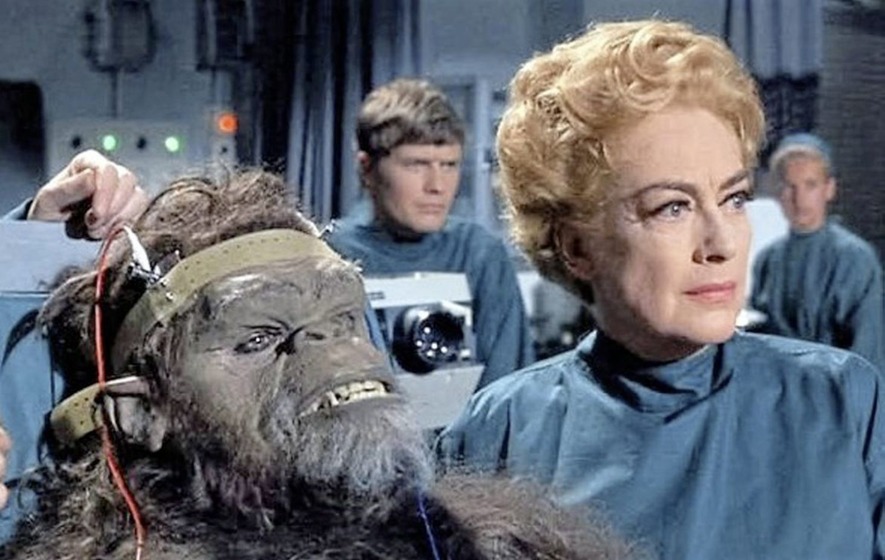
Despite Joan Crawford's performance, Trog is not
up to the standards we might look for in a Hugo finalist.
(Image via IMDB)
We scoured the internet for other options. Doomwatch was influential, but an absolute bore. Skullduggery was a hit, but beyond risible. David Cronenberg’s first movie Crimes of the Future shows promise, but is still the unfinished vision of a young creator. Fans had slim pickings when nominating that year — which may in part explain some of the more … unorthodox choices they made.

It was the first year that audio recordings made it on the ballot, and as much as we are fans of being format agnostic, we wish that the distinction of being the first comedy album to get a Hugo nod had gone to a more worthy entry than Don't Crush That Dwarf, Hand Me the Pliers.

Expressing a sentiment that was common at the time, John Baxter wrote: “Written SF is usually radical in politics and philosophy; SF cinema, like the comic strips, endorses the political and moral climate of its day.” While we’d suggest that Baxter was a little too generous towards prose SF, having watched and listened to the 1971 shortlist, it’s clear that there’s some merit in his indictment of screen offerings.

The shortlist was an eclectic one in some ways. It had one theatrically released American movie (Colossus: The Forbin Project), one television movie (Hauser’s Memory), one British movie (No Blade of Grass) one spoken-word comedy album (Don't Crush That Dwarf, Hand Me the Pliers) and one prog rock concept album (Blows Against the Empire).

While this relative diversity of formats could be praised for a willingness to consider various forms of storytelling, to our eyes it looks like Hugo voters were scraping the bottom of the barrel. Writing in Science Fiction Review, Fred Patten suggested that the entire shortlist “is not worthy of consideration.”

Paul Kantner's Blows Against the Empire has
a relatively simple premise that hasn't aged well.
(Image via Futurama)
Blows Against the Empire, recorded by Paul Kantner and some of his Jefferson Airplane bandmates, loosely tells the story of a bunch of San Francisco hippies who steal a starship to go off into space and create a new, better civilization on another planet. The story also seems to focus on a baby that Paul Kanter was having with Grace Slick. To be perfectly blunt, the storytelling offers the height of self-indulgent self-aggrandizement that reflects the worst artistic impulses of the Altamont generation. The majority of the songs contribute nothing to the narrative, and although music may appeal to some listeners, as a piece of science fiction it is dreadful.

Ever so slightly less perplexing a choice for a finalist is Don't Crush That Dwarf, Hand Me the Pliers, the third album from Los Angeles comedy troupe Firesign Theater. Although it seems fairly scattershot at the beginning, it slowly becomes clear that the album is telling the life story of a single character named George Leroy Tirebiter, through flashbacks and television. The comedic style has aged poorly, and we wonder how it ever could have been appreciated. The degree to which the work counts as science fiction or fantasy was also perplexing.

Hauser’s Memory, a made-for-television adaptation of Curt Siodmak’s novel of the same name, is a competent if boring spy adventure in which scientist Hillel Mondoro (played by NCIS-regular David McCallum) injects himself with evil brain juice in an attempt to recover secrets that are vital to national security. As the cerebral spinal fluid infects his mind with the memories of a Nazi scientist, Mondoro is compelled to commit a series of crimes, and finally dies. It’s slow-moving, uses excessive crossfades to depict the disorientation of the protagonist, and treads many similar plot points of the author’s previous and much superior novel, Donovan’s Brain.
Sharp-eyed Canadian political
buffs may recognize that the role
of Joseph Slaughter in Hauser's
Memory
is played by the younger
brother of Deputy Prime Minister
Erik Nielsen. 
(Image via IMDB)

Viewers of the era were somewhat more generous, with Hank Davis writing in Yandro that Hauser’s Memory was “The next best thing I have seen this year.” Of course, this assessment needs to be taken in context.

Tying into the nascent environmental movement, No Blade of Grass updated the John Cristopher novel The Death of Grass to make it clear that the demise of all plants from the Gramineae family is caused in part by pollution. There are some interesting scenes that foreshadow later post apocalyptic films like Mad Max, and the bleak premise is followed through to a logical conclusion. It’s an uneven effort that has some high points — such as the sadly realistic depiction of an incompetent British government sacrificing millions of people — but it is bogged down by brutal misogyny and clumsy foreshadowing.

Given the distasteful treatment of women in the movie, it’s hard to recommend No Blade of Grass to a modern (or truth be told any) audience.

The most redeemable work on the Hugo Best Dramatic Presentation ballot in 1971 was certainly Colossus: The Forbin Project. From opening scenes exploring a mountain-sized computer, the movie draws in the viewer to a world that becomes quickly dominated by an artificial intelligence designed to bring peace. It’s a great concept that’s mostly followed through on. Eric Braeden is excellent in the lead role of Dr. Charles Forbin, though the supporting cast is mostly merely filling space.

Contemporaneous reviewers generally agreed with this assessment. Richard E. Geis, writing in Science Fiction Review, named Colossus as the only noteworthy science fiction film of the year. Kay Anderson was somewhat more effusive with her praise, writing in Yandro “For my money, The Forbin Project is better than 2001 … Reviews around here are calling it a masterpiece, and I’ll drink to that.”

The pickings were slim, but in some places you could see the seeds of better things to come, though it might take years — even decades — for these themes to flourish. No Blade of Grass was not in the same league as the environmental parables that would be released later in the decade, but with the benefit of hindsight we can see how it was a stepping stone in the evolution of SFF cinema. Likewise, the concept of a science fiction rock opera concept album may be old hat now, but in 1971, Blows Against The Empire was doing something new. These films — and albums — may be mediocre, but they were pushing the medium forward.

By this point, the Hugos had attempted to recognize works of stage and screen on a dozen occasions, and for a third time in that span Worldcon attendees decided not to present a trophy. Not for the first time, the audience laughed and cheered in approval at the announcement of no award. Thankfully, we can find no record of any representatives of any of the five finalists being in attendance for the ceremony, so they were spared this indignity.

Several members of our cinema club may have ended up voting for no award (though others dislike no award on a matter of principle). Either way the consensus was clear: this was a terrible year for science fiction told by screen or sound.

Tuesday, 9 August 2022

The Breakfast Club in Space

There is a long-simmering tension in science fiction that could be reductively described as being between those who prefer books that are about things happening, and those who prefer books that are about people
Becky Chambers' fourth Wayfarers
novel continues her evolution away
from high-octane thrills.
(Image via Amazon)
experiencing emotions.

On the one extreme, we could describe the cold, sterile, action-packed Asimov tales of the 1940s. On the other extreme, we could examine some ponderous elegiac late-period Aldous Huxley works.

Few authors have pivoted between these two poles as thoroughly, or as successfully as Becky Chambers has over the past eight years since her (initially self-published) debut novel took the science fiction world by storm. Likewise, few authors have been as successful in showing the importance — and the value — of both strains of science fiction’s heritage.

Nowhere is this more evident than in her flagship works, the Best Series Hugo-winning Wayfarers novels. Fascinatingly, the most recent novel in this series The Galaxy, and the Ground Within could even be read as a textual mirror to the first book in the series Long Way To A Small, Angry Planet.

Both novels feature a diverse cast of middle-class characters from a variety of alien races, and both novels celebrate diversity, understanding, and compassion. But while Long Way To A Small, Angry Planet is an action-packed romp in which things never stop happening, this latest Hugo-finalist novel is far more meditative. They are similar in so many ways, but the later book could be interpreted as a foil to the first one’s action packed — and populist — approach to storytelling.

The set-up to Galaxy, and the Ground Within is fairly simple. Five characters with wildly different backgrounds are forced to spend time together after a technical failure traps them togetherfor several days. It’s The Breakfast Club in space, and as such the narrative is driven not by a series of events, but rather by how the characters relate to one another, and how they feel and grow. Althoughthere is a rescue plot at the very end of the novel, it feels somewhat tacked on.

Five people with wildly different personalities
and problems find commonalities and empathy.
(Image via Criterion)

Chambers’ Breakfast Club analogues are blue-collar Laru, immature Tupo, popular girl Pei Tem, mysterious Roveg, and good girl Speaker. Over the course of the novel, they deal with small survival issues pertaining to the life support system, but mostly they share their backstories and learn to get past their differences and prejudices.

It often seems that the vast majority of science fiction and fantasy deals with the fate of empires, the doom of worlds, epic galaxy-spanning wars of conquest, and special unique people born to greatness … and in doing so offers stories that are less relatable because they are not human scale. The fundamental relatability of Chambers' work is its greatest strength. 

Many of the folks who yearn for action adventure like Chambers’ earlier Wayfarers novels might not be drawn in by this book, and might in fact prefer some other Hugo finalists. In fact, those who aren’t drawn in by Chambers’ writing and excellent character building, might uncharitably dismiss The Galaxy, and the Ground Within as a book in which nothing happens. But that would be a mistake; this is a truly excellent example of emotionally grounded science fiction in which the narrative questions revolve around people experiencing emotions.