Showing posts with label Steven Spielberg. Show all posts

Friday, 27 March 2026

Fear of a Melmac Planet

In his Hugo-winning 1998 personal history of science fiction The Dreams Our Stuff Is Made Of, Thomas M. Disch wrote “America is a nation of liars, and for that reason science fiction has a special claim to be our national literature as the art form best adapted to telling the lies we like to hear and to pretend to believe."

This observation rings troublingly true when it comes to immigrants and immigration. Science fiction has a long history of offering tales of lonely, lost aliens who build a new life for themselves on Earth and serve as thinly-veiled metaphors for foreign nationals who arrive at US borders.

Indeed, the lies some Americans tell about immigrants to their country can be seen writ large in their science fiction.
The sitcom Aliens in the Family featured an early
cameo by future star James Van Der Beek, who
ends up eaten by the family pet.
(Image via muppetwiki) 


There have been literally hundreds of published or performed stories about aliens lost on Earth, most of which serve as a parable about immigration in some way. Everything from The Cat From Outer Space, to the sitcom Aliens In The Family offers uncomfortable subtext about those uprooting themselves in search of a better life.

The trope has its origins in the late 1800s, with Thomas Blot’s The Man From Mars: His Morals, Politics and Religion, an odd little work that offers anecdotes about the strange customs of a highly advanced civilization. But the alien travellers of early utopian novels were generally used as a didactic tool to tell the reader what the “ideal” human society might look like. Just as importantly, these alien visitors were not planning to stay on Earth, and thus were portrayed as nonthreatening, long-term, to the country’s citizens.

Although not technically an alien, Valentine Michael Smith, the protagonist of Robert A. Heinlein’s 1963 Hugo winner Stranger in a Strange Land, was raised in a culture with different norms than those of contemporaneous Americans. Although some of the gender representation in the novel is highly questionable, the depiction of immigration is far more progressive than one might expect. Smith arrives on Earth, is relatively quick to understand local customs, and then offers valuable insights gained from his bi-cultural experiences.

Published just two years later, Walter Tevis’ The Man Who Fell To Earth also presents a parable about the threat of immigration, but interestingly the warning is about the danger to the immigrant. The novel portrays alien Thomas Jerome Newton as losing his culture, losing his way, and being utterly assimilated into a culture that consumes him. Likewise, Zenna Henderson’s “The People” stories, which feature a group of extra-terrestrial refugees living in an Anabaptist commune in Pennsylvania puts the focus on the difficulties these refugees face in their interactions with their Anglo-Saxon neighbors.

Every sitcom alien has a favourite
weird food. My Favourite Martian
ate gold.
(Image via moriareviews.com)
In more mainstream media, however, there are more troubling works. My Favourite Martian, which ran from 1963-1966, features a stranded extraterrestrial living in Los Angeles. The visitor, named Tim, leans into tropes that would become familiar in such sitcoms; weird foreign food, strange customs, and lack of understanding of normative US cultural practices of the era. Moreover, the series often features the extraterrestrial character only proving his worth through magical powers; leaning into the idea that a newcomer must go above and beyond to justify their presence and prove their harmlessness, or risk erasure.

Since the late 1970s, these stories have taken on a darker tone that aligns with right-wing narratives about migrants.

Depicting a lone alien stuck in Boulder, Colorado, the television series Mork and Mindy was one of the highest-rated comedies of the late 1970s. Featuring the late Robin Williams as the titular alien Mork from the planet Ork, much of the humour was derived from a sense of cultural dislocation. Although the series is gentler in its implicit xenophobia, it still depicts Mork the migrant as having less work ethic than his US counterparts, an inability to work well with authority figures, and difficulty understanding everyday life. It’s worth noting that Mork’s obsession with eggs may have been inspired by increased levels of migration from Mexico and Japan — those being the two countries on Earth whose citizens eat the most eggs per capita.

Another example of this type of narrative is The Brother from Another Planet, John Sayles’ 1984 cult classic about a Black-presenting alien fleeing from his erstwhile enslavers. Although the titular Brother is more of a refugee metaphor than an economic migrant like many of the others discussed here, the alien is presented as bringing value to the American community in which he finds refuge. Portrayed with empathy by Joe Morton, the alien Brother does not speak the language of his adoptive home, but the movie uses fewer problematic tropes than many contemporary works.

In the 1980s, prompted in part by the success of Spielberg’s E.T.: The Extra Terrestrial, there was a wave of stories about lost aliens on Earth. Given that it was a decade in which right-wing politicians weaponized economic uncertainty, job competition, and cultural change to whip up anti-immigrant sentiment, it is no surprise that many of these narratives display some degree of xenophobia.


(Image via alftv.com)
The television series ALF (an abbreviation of “Alien Life Form”) ran on NBC for four seasons from 1986 to 1990, with an additional television movie airing in 1996. Featuring an alien named Gordon Shumway from a planet named Melmac whose spacecraft crashes in California, the series focuses on the cultural clashes between Shumway and the family he ends up living with. Shumway becomes a safe proxy for otherness, allowing the show to make coded racist jokes without confronting prejudice directly. The alien is often depicted as lacking privacy boundaries, having a weird odour, and not always sharing American values — comedy that echoed the anti-immigrant talking points of xenophobic politicians like Jesse Helms. Notably, the alien’s culinary preference for eating peoples’ pets has a direct analogue in recent right-wing smear campaigns against immigrants in the Midwest United States. Much of the series’ framing normalizes exclusion while softening its impact through sitcom conventions.

It is worth noting however, that ALF does engage with the anxiety that many undocumented migrants face around law enforcement. A running theme within the series is that of a shadowy and malevolent government agency tasked with rounding up aliens and confining them in undisclosed locations under harsh conditions without benefit of due process. This fictional agency may have predated the real-world ICE, but it still resonates today.

As a story about an illegal migrant to the United States, the currently-airing series Resident Alien’s premise is steeped in xenophobia. The alien in question, Harry Vanderspeigle (Alan Tudyk) is sent to Earth to destroy all human life. Although the protagonist eventually rejects his original mission, this set-up still mirrors the reprehensible claims made by pundits that all or most immigrants hide harmful intentions. This is a propaganda-based narrative that clearly continues to resonate in too many countries. Fans of the show will defend the character of Vanderspeigle, noting that he ends up trying to assimilate to the broader American culture, but the fact that he is the only non-aggressive member of his species brings to mind the old racist trope of calling someone “one of the good ones.” Interestingly, Resident Alien creator Chris Sheridan is himself an immigrant, having been born in the Philippines before moving to the United States as a child.

Much has been made in critical analysis of science fiction of the relationship between the word Robot, derived as it is from the Czech word robota — literally forced labour. But the etymology of the word “Alien” is equally revelatory about the subtext inherent in our science fiction. The word came to English from Latin (by way of French), based on the possessive form of the word alius, literally meaning “other.” It seems fitting, then, that the majority of such stories connote the othering of migrants.

Science fiction does not just echo cultural attitudes toward migration, it helps to construct and normalize them, wrapping suspicion and exclusion in the comforting guise of entertainment. If, as Disch suggests, the genre is uniquely suited to telling the lies Americans prefer to believe, then serious questions should be asked about what the genre suggests about those who come to this planet in search of a better life. We might also question why stories about successful and mutually beneficial migration, celebrating diversity and inclusion, seem less likely to be published and performed.

Sunday, 15 December 2024

The Year That Science Fiction Won The Culture War (Hugo Cinema 1983)

This blog post is the twenty-sixth in a series examining past winners of the Best Dramatic Presentation Hugo Award. An introductory blog post is here.

At 1:30 p.m. on Friday, September 2, 1983 at the Baltimore convention Centre, a panel discussing the previous year’s best movies and television shows was held as part of ConStellation, the 41st World Science Fiction Convention.

In 1982, audiences flocked to see Spielberg's
watered-down and mawkish remake of
Close Encounters of the Third Kind.
(Image via Cult Following)
“It is obvious,” opined one of the panelists, “that E.T. will win the Hugo Award for Best Dramatic Presentation.”

There seemed to be a consensus that E.T. — a $360-million blockbuster box-office juggernaut — was going to win the award … though some fans such as Richard E. Geis (who himself won a Hugo that year) groused that they were, “sick of the Steven Spielberg juvenile sweetness-n-light approach to SF.”

On the Sunday evening of the convention at the Hugo Awards ceremony (which featured a crab feast), however, the audience reacted with stunned silence — and then rapturous applause — as toastmaster Jack L. Chalker read out that Blade Runner had taken home the trophy.

It was not an uncontroversial decision; Blade Runner seems to have been championed by old-school science fiction fans and those who wanted the genre to take itself seriously, while E.T. was the choice of more whimsical fans. One fanzine churlishly chalked up Blade Runner’s win to nostalgia and a desire to give a Hugo to the recently deceased Philip K. Dick. 
Not all science fiction movies
of 1982 are certified classics.
(Image via IMDB)


It had been an impressive year for science fiction cinema. The Hugo shortlist featured classics like Blade Runner, E.T., and Mad Max: The Road Warrior alongside The Wrath of Khan (often regarded as the best Star Trek movie) and The Dark Crystal (which retains a cult following today).

Beyond the shortlist were even more important classics, almost too many to talk about in a blog post. John Carpenter’s The Thing remains one of the greatest science fiction horror movies ever made. Special effects juggernaut Tron kicked off the digital revolution in how movies were made. Don Bluth’s first movie as a director, The Secret of Nimh, is still beloved by younger audiences. Rainer Wenrer Fassbender’s Kamikaze 1989 brought the cyberpunk movement to Germany. French director René Laloux worked with famed illustrator Mœbius on an animated space opera Les Maîtres du Temps. John Milius brought Robert E. Howard’s Conan the Barbarian to the screen. In Poland, Piotr Kamler wowed audiences with the visually lush stop-motion of Chronopolis. Not to mention, that television shows Knight Rider and Voyagers! both hit the airwaves that year!

Rewatching these films with the benefit of 40 years of hindsight, the shortlist looks pretty darned good. Even Jo Walton (who has often griped about the Best Dramatic Presentation category at the Hugos) conceded that in 1983, “there’s not only a worthy winner in this category, but something that almost looks like sufficient nominees to be worth running it.”

The weakest movie on the shortlist is The Dark Crystal. Although the set design is lush and the technical details are impressive, the story is pedestrian and the dialogue is dull. It’s a standard fantasy epic in which a hobbit gelfling has to travel to mount doom the citadel and destroy a ring crystal shard. None of the characters are particularly memorable, other than in appearance.
The soundtrack to Mad Max is a bit too much like
Yakety Sax for our tastes, but the visuals are great.
(Image via SlashFilm)

Even early in his directorial career, George Miller’s talent for visual storytelling is evident in the kinetic, engaging, and over-the-top bonkers Mad Max: The Road Warrior. Watching it in the context of its era, it’s difficult to overstate how revolutionary it was for post-apocalyptic movies; compared to the frenetic violence of Mad Max, the previous decade’s offerings such as Omega Man, A Boy And His Dog, and No Blade Of Grass all seem quaint. Although we’re generally not fans of opening and closing monologues, Mad Max does enough visual storytelling to have earned its exposition. Despite his later descent into antisemetic buffoonery, it’s easy to understand why the young Mel Gibson became a star. Just 21 years old at the time of filming, he’s able to carry the movie on his performance.

Given that the franchise has become increasingly focused on nostalgia, it’s interesting to note that The Wrath of Khan is the first Star Trek film that is mostly looking at the past. Not only does the movie deal with an antagonist that had appeared in a previous episode, James T. Kirk (William Shatner) spends much of the film pining for the old days and contemplating his own mortality. One of the reasons this works is that — unlike another former Trek captain’s navel-gazing nostalgia fest — The Wrath of Khan also explores generational change. Some might argue that director Nicholas Meyer’s other Trek film is better but there’s a lot to love in this movie and it’s easy to understand why it placed second on the Hugo shortlist. It’s not just good Star Trek, it’s a good movie.

What aged less well, however, is E.T.: The Extra-Terrestrial. Despite good special effects, and Steven Spielberg’s skill with lighting and shot framing, we might argue that it doesn’t meet the standards of science fiction or of storytelling that should be expected of a Hugo finalist — especially in a cinematic year as strong as 1982. The movie often feels like an overlong sitcom episode with a pedestrian alien plot and wacky elementary school hijinks. Moreover, most of the younger characters are surprisingly mean to each other pretty much all the time; dialogue is delivered as yelling which can be exhausting for today’s audience. That being said, it was the top-grossing movie of the year, so clearly it resonated with audiences of the day.

Blade Runner is visually immersive, lush, and 
compelling. It's stood the test of time.
(Image via IMDB)
But Blade Runner was the Hugo winner, and it deserved to be honoured. Visually immersive and moody, it was a revolution in what serious science fiction could be. As Richard E. Geiss wrote at the time: “Blade Runner captures something on film I thought to be almost impossible -- the near-future claustrophobic paranoid polluted urban landscape so prevalent in most of [Philip K.] Dick’s more memorable novels.”

It’s also worth noting that the 1983 Worldcon was attended by an unusually large number of movie stars and cinema professionals. Makeup artist Rick Baker was in attendance to talk about Greystoke. Producer Gary Kurz (Empire Strikes Back) was there to talk about his Return to Oz. Jim Henson attended his second Worldcon in two years, this time to promote The Muppets Take Manhattan. The entire primary cast of The Right Stuff was in attendance, as well as the movie’s inspiration Chuck Yeager. In keeping with a continuing tradition, however, the movie that won the Hugo did not have anyone in attendance to accept the award.

There was little consensus in our group as to what should have won the Hugo for Best Dramatic Presentation in 1982, but we did agree that no matter what won the award, something truly great would be snubbed. Many of us wished The Wrath of Khan could have won, while others felt The Thing should have been honoured.

It was simply a great year for science fiction and fantasy cinema. 

Friday, 23 September 2022

Clash of the Cinema Titans (1972)

This blog post is the fiftteenth in a series examining past winners of the Best Dramatic Presentation Hugo Award. An introductory blog post is here.

The early 1970s saw a flourishing of SFF cinema. In 1971 alone, Jim McBride’s X-rated Glen and Randa scandalized audiences with post-apocalyptic sex scenes, and garnered critical love along the way. Boris Sagal threw Charleton Heston to the vampires in the blockbuster The Omega Man. And Josef Pinkava offered audiences a whimsical tale of children with a magical computer in The Wishing Machine. But these films were up against long odds to make the Hugo shortlist. 

The shortlist in 1972 may have provided the most star-studded Best Dramatic Presentation ballot the awards have ever seen. 

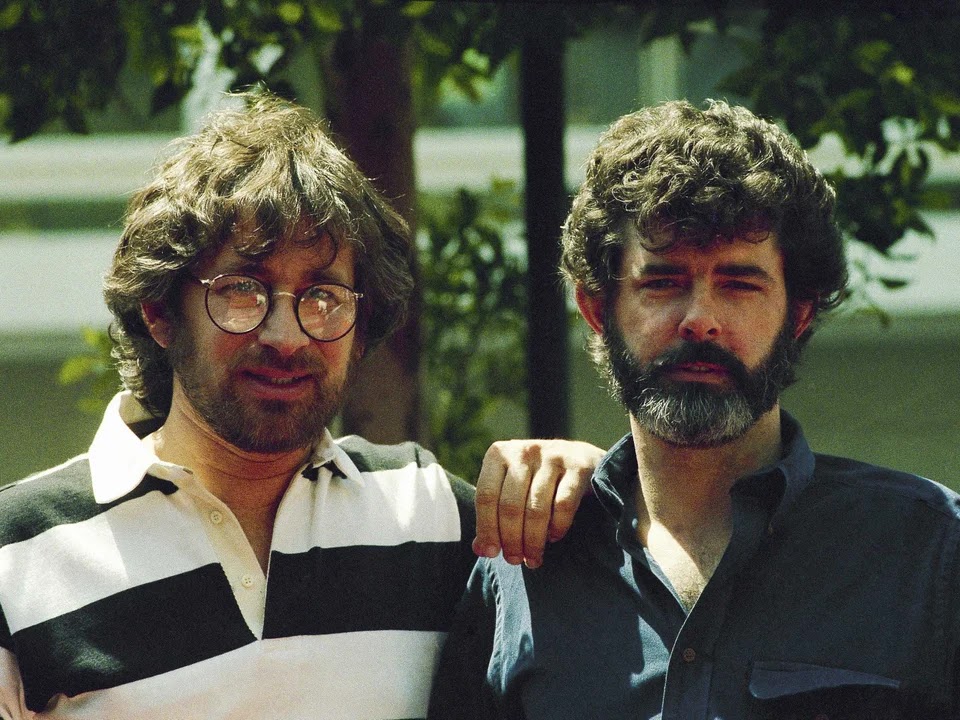
The movies on that shortlist were directed by a cavalcade of what are now household names for many: George Lucas, Steven Spielberg, Robert Wise, and Stanley Kubrick. Between these four people, there’s a total of 46 Academy Award nominations and $23 billion in box office receipts.
George Lucas and Steven Spielberg in the 1970s.
Long before they were beloved by millions of 
moviegoers, science fiction fandom embraced
the works of Steven Spielberg and George Lucas.
The Hugos gave each of them their first award nods
for feature films.
(Image via Reddit)

Each of these directors moved the art of moviemaking forwards and made extraordinary contributions to science fiction cinema … but to be blunt, none of them produced their best work in 1971.

Despite the Hugo ceremony taking place near the Los Angeles airport, none of the finalists made an appearance at the awards. In fact, none of them even bothered to send someone to pick up the award, with local fan Bill Warren acting as the acceptor.

Four movies made the ballot — and a second Firesign Theatre album. Only Bozos On This Bus loosely continues the story started in the previous year’s comedy album, which may make it the first instance in which a work and its sequel were both shortlisted for a Hugo. It probably would have been near the bottom of most of our ballots though. 

More interestingly, an little-remembered television movie L.A. 2017 did make the ballot.

Just 24 years old at the time, Steven Spielberg was taking short-term television gigs while trying to break into feature film work. He’d had a rocky start with poorly-received work on Rod Sterling’s Night Gallery and on Marcus Welby, M.D., when he had the opportunity to direct a one-off science fiction TV movie for an anthology show about journalists in Los Angeles. The result, L.A. 2017, is a surprising inclusion on the Hugo ballot.

Shot for a paltry $375,000, and with a script by Philip Wylie (author of When Worlds Collide and
Poster for City of Stars
The real Los Angeles of 2017 turned out to be far
more dystopian than even Steven Spielberg had
imagined in his first feature-length movie L.A. 2017.
(Image via IndieWire)
Gladiator), L.A. 2017 is an uneven work at best. The parable about a fascist future United States living underground to hide from pollution is heavy handed, most of the acting is hammy, and the ending is an appalling cop out. But having watched a number of other television movies of the time during our voyage through Hugo history, we were struck at how much livelier the directing was. It’s clear that Spielberg was head and shoulders above most of his peers directing television in the early 1970s, conveying more through effective framing and camera movement.

Although not well remembered, L.A. 2017 is of significant historical value as it opened doors for the young Spielberg. It’s also interesting to note that this nomination means that the Hugo Awards can boast of being the first major award to have shortlisted Stephen Spielberg.

Just two years older than Spielberg, George Lucas was somewhat more established in Hollywood. Fresh off filming the disastrous Altamont Music Festival for the Maysles brothers’ documentary Gimme Shelter, Lucas was given his first chance to direct a feature film through a partnership with more-established filmmaker Francis Ford Coppola.

Intended to launch a new studio, THX-1138 was shot on a modest budget of slightly under $1 million — by comparison Marooned, which was released little more than a year earlier, had cost ten times that amount. Lucas does an extraordinary amount on that small budget, creating a world that is evocative, cold, and sterile to tell a story about rebellion and a search for emotional connection.

Although this may be one of George Lucas’ most visually compelling movies, the plot (which is essentially an unacknowledged adaptation of Brave New World) is mostly unengaging. The coldness of the setting leaks into the dialogue, leaving little for an audience to engage with.
Shockingly, the guy who would go on to write 
screenplays for The Radioland Murders and
Strange Magic wrote some clunky dialogue
in the movie THX-1138.
(Image via Lucasfilm)


Interestingly, the Hugo nomination for THX-1138 was also George Lucas’ first major award nomination for a feature film (a short version of the film had received a nod at the Oberhausen Short Film Festival in 1968.)

In 1972, Robert Wise was a Hollywood icon at the height of his career. He’d won Oscars for Best Director and Best Picture twice (1961 West Side Story, 1965 Sound of Music). After Universal had won the bidding war over Michael Crichton’s breakout novel The Andromeda Strain, Wise was brought onboard to bring a sense of respectability to a script that might otherwise have been seen as another cookie-cutter disaster movie. Andromeda Strain covers a four-day period after a pathogen arrives from space, and concerns itself with the scientific team attempting to contain the disease.

While it may not deliver high-octane thrills, or incisive social commentary, it’s one of the best depictions of science or scientists that science fiction cinema had seen up to this point. Notably, it's refreshing to see the inclusion of central protagonist Dr. Ruth Leavitt, a caustic, competent, and down-to-earth scientist. Her character — and the lack of objectification — makes Andromeda Strain one of the least sexist SFF movies up to this point.

That depiction stands in stark contrast to the over-the-top misogyny of A Clockwork Orange, Stanley Kubrick’s stylish, beguiling, and deeply unpleasant Hugo winner. Set in a near-future England that has slid into fascism, the movie follows a young man named Alex, his friend group, and their experiences with the police and prisons.
Alex in Clockwork Orange screaming as he's forced to watch awful movies.
Documentary footage of our cinema club reacting
to 1960 Hugo-finalist Men Into Space.
(Image via FilmLoverss)


Based on a novel by Anthony Burgess, the movie seems to suggest that the sexual revolution will only provide ways for men to aggressively dominate women’s bodies. Debates have raged over the past five decades over whether Clockwork Orange is a commentary on misogyny, or simply misogynistic in and of itself.

Though Kubrik won his third Hugo Award as a director (a feat only equalled by three other directors), it’s difficult to suggest that the voters got this one right. Clockwork Orange is certainly a classic of cinema, and the actual filmmaking, editing, and camera work are all meticulous. But it’s barely science fictional, and many (including about half our cinema club) find it offensive.

It’s not made by as famous a director, but perhaps the more meat-and-potatoes populist option of The Omega Man might have been a more suitable choice to honour with a Hugo in 1972?