Showing posts with label Stanley Kubrick. Show all posts

Saturday, 10 May 2025

All These Films Are Bores ... Except Ghostbusters, Attempt No Panning There (Hugo Cinema 1985)

This blog post is the twenty-eighth  in a series examining past winners of the Best Dramatic Presentation Hugo Award. An introductory blog post is here.

In 1985, for the first time at a Hugo Award ceremony, trailers for each of the five finalists for Best Dramatic Presentation were screened. This technical achievement was slightly undermined, however, by a missed cue and the trailers suddenly being started in the middle of emcee Marc Ortleib’s introduction of the shortlist. But the presentation was greeted with cheers and good humour.
Capitalizing on the success of Stanley Kubrick's
enigmatic and mysterious 2001, Peter Hyram's
sequel offered tepid explanations and answers.
(Image via MGM)


Gone were the years when as few as four nominating ballots were required to get a movie on the shortlist. Even the least-nominated finalist in 1985 had received 40 nominating votes. While Worldcon voters were showing the category some much needed respect, the nominees were less enthused. As per usual — and as is still largely the norm — not a single one of the finalists in the category were on hand to witness the award’s presentation.

It had been a banner year for science fiction and fantasy movies. One of the most successful filmmakers of all time — James Cameron — burst onto the scene with Terminator. Beloved Japanese animator Hayao Miyazaki had his breakout hit with Nausicaä of the Valley of the Wind. The BBC changed the shape of the Cold War with its harrowing and unforgettable depiction of nuclear war in Threads. John Sayles tackled racial alienation in his weird parable Brother From Another Planet. Somehow none of these films made the cut for the Hugo Award. Even beyond this lineup, there were credible works omitted from the ballot. Neverending Story has fantastical charm. Joe Dante’s Gremlins remains iconic. Repo Man and Buckaroo Banzai are cult classics.

Which all makes that year’s Hugo Award shortlist the more befuddling. Most of the movies honoured with a Hugo nod that year are … little more than fine.

The Last Starfighter eked onto the ballot with about half as many nominating votes of anything else on the shortlist. It’s a surprisingly pedestrian outing about Alex Rogan (Lance Guest), a young man from a small trailer park in California, whose prowess with video games leads to his recruitment as a pilot in an intergalactic war. Although portions of the film are charming — especially the comedic storyline involving a replicant android acting as Alex’s stand-in on Earth — the movie is stilted and filled to the brim with leaden performances. The New York Times put it bluntly: it is less inspired than derived.

The Search for Spock is rarely listed as anyone’s all-time-favourite Star Trek movie. It’s an oddly paced script with some clunky concepts. The whole “resurrection” storyline may have been preordained by the ending of the previous movie, but it mostly doesn’t work. That being said, the core cast offer a few endearing performances, and individual character moments are handled well. One notable aspect of the movie is Christopher Lloyd’s performance as Klingon captain Kruge, which would shape how all future iterations of the franchise depict the race.
Brother From Another Planet
is a masterclass in "show, don't
tell." Joe Morton is simply superb.
(Image via IMDB)


David Lynch’s lush, sweeping adaptation of Dune is unfondly remembered by many fans of Frank Herbert’s classic novel, but it has its merits. The cast is first-rate; often providing better performances than the more critically lauded remake. Leading in with an extremely long monologue, and pausing for a lot of exposition, the movie does feel ponderous. However, this set-up was appreciated by those who had watched the recent movies and had found them opaque. Some visual effects scenes were campy, but they were effective. Fundamentally though, the movie has too much story to tell over a relatively short runtime. In a one-star review, Roger Ebert panned the movie as an “incomprehensible, ugly, unstructured, pointless excursion into the murkier realms of one of the most confusing screenplays of all time.”

Of the movies on the shortlist, we’d suggest that Ghostbusters aged the best, despite at least one character’s overt sexism. The continuing series of inferior sequels makes it easy to forget just how much the original was lightning in a bottle. The movie offers viewers three top-tier comedians at the height of their game playing with a high-concept script. The amount of planning required for special effects is often at odds with the improvisational comedy that remains in the final cut, but somehow many of the lines still feel fresh. Conversely, the character of Peter Venckman (played by Bill Murray), who habitually harasses women, was seen as dated when the film was released and fast-forward worthy when rewatching today. Even the filmakers themselves chose to portray this as less than an admirable quality. This begs the question of why it was included at all.
Ghostbusters is a remarkably well-made movie,
one that remains enough appeal today that
a friend of the blog has authored a guest post
grappling with the movie's enduring appeal
.
(Image via IMDB)


The winning movie that year was 2010: The Year We Make Contact, the sequel to Stanley Kubrick’s classic 2001. Languidly paced and cerebral, it’s enriched by several excellent performances including from Helen Mirren and John Lithgow. However, director Peter Hyrams (Timecop, End of Days) is no Stanley Kubrick and the sequel relies too much on exposition and lacks the beauty or the artfulness of the original. Looming nuclear conflict on Earth rarely has the emotional impact it deserves — it’s a strikingly cold movie.

It would be difficult to call the Hugo Best Dramatic Presentation winner the best science fiction movie of the year, but we had little consensus about what should have won. Some in our group thought Ghostbusters deserved the nod, others opted for the grittiness of Terminator, some liked the exuberant weirdness of David Lynch’s Dune, one person even thought the empathy of Brother From Another Planet made it more worthy of the award than any of the nominees.

In 1985, Hugo voters had incredible movies to choose from. They could have done better than 2010.

Friday, 23 September 2022

Clash of the Cinema Titans (1972)

This blog post is the fiftteenth in a series examining past winners of the Best Dramatic Presentation Hugo Award. An introductory blog post is here.

The early 1970s saw a flourishing of SFF cinema. In 1971 alone, Jim McBride’s X-rated Glen and Randa scandalized audiences with post-apocalyptic sex scenes, and garnered critical love along the way. Boris Sagal threw Charleton Heston to the vampires in the blockbuster The Omega Man. And Josef Pinkava offered audiences a whimsical tale of children with a magical computer in The Wishing Machine. But these films were up against long odds to make the Hugo shortlist. 

The shortlist in 1972 may have provided the most star-studded Best Dramatic Presentation ballot the awards have ever seen. 

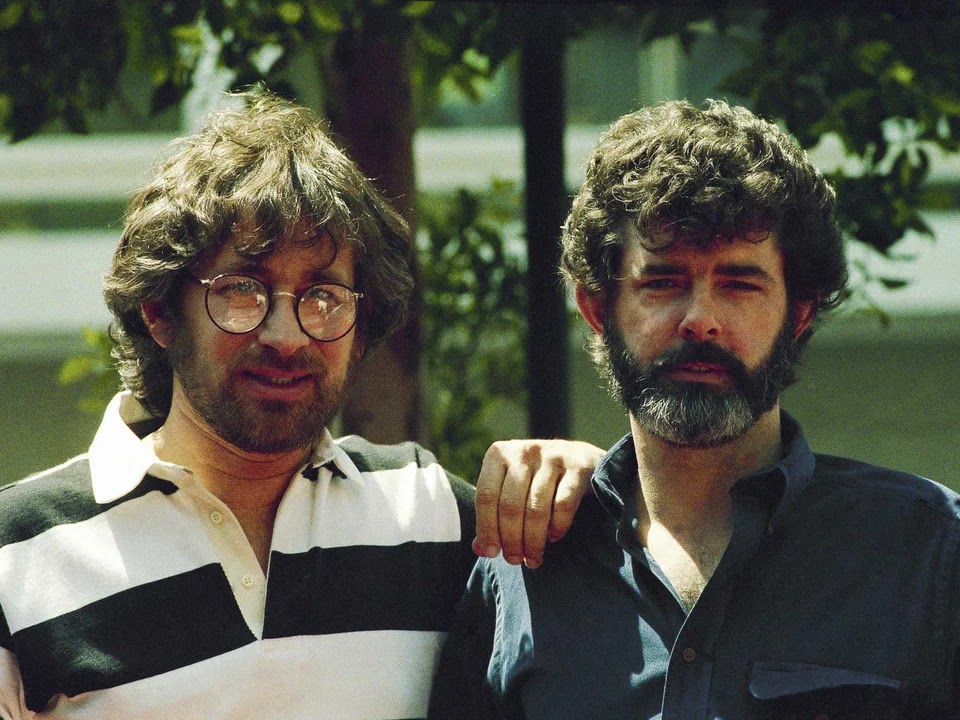
The movies on that shortlist were directed by a cavalcade of what are now household names for many: George Lucas, Steven Spielberg, Robert Wise, and Stanley Kubrick. Between these four people, there’s a total of 46 Academy Award nominations and $23 billion in box office receipts.
George Lucas and Steven Spielberg in the 1970s.
Long before they were beloved by millions of 
moviegoers, science fiction fandom embraced
the works of Steven Spielberg and George Lucas.
The Hugos gave each of them their first award nods
for feature films.
(Image via Reddit)

Each of these directors moved the art of moviemaking forwards and made extraordinary contributions to science fiction cinema … but to be blunt, none of them produced their best work in 1971.

Despite the Hugo ceremony taking place near the Los Angeles airport, none of the finalists made an appearance at the awards. In fact, none of them even bothered to send someone to pick up the award, with local fan Bill Warren acting as the acceptor.

Four movies made the ballot — and a second Firesign Theatre album. Only Bozos On This Bus loosely continues the story started in the previous year’s comedy album, which may make it the first instance in which a work and its sequel were both shortlisted for a Hugo. It probably would have been near the bottom of most of our ballots though. 

More interestingly, an little-remembered television movie L.A. 2017 did make the ballot.

Just 24 years old at the time, Steven Spielberg was taking short-term television gigs while trying to break into feature film work. He’d had a rocky start with poorly-received work on Rod Sterling’s Night Gallery and on Marcus Welby, M.D., when he had the opportunity to direct a one-off science fiction TV movie for an anthology show about journalists in Los Angeles. The result, L.A. 2017, is a surprising inclusion on the Hugo ballot.

Shot for a paltry $375,000, and with a script by Philip Wylie (author of When Worlds Collide and
Poster for City of Stars
The real Los Angeles of 2017 turned out to be far
more dystopian than even Steven Spielberg had
imagined in his first feature-length movie L.A. 2017.
(Image via IndieWire)
Gladiator), L.A. 2017 is an uneven work at best. The parable about a fascist future United States living underground to hide from pollution is heavy handed, most of the acting is hammy, and the ending is an appalling cop out. But having watched a number of other television movies of the time during our voyage through Hugo history, we were struck at how much livelier the directing was. It’s clear that Spielberg was head and shoulders above most of his peers directing television in the early 1970s, conveying more through effective framing and camera movement.

Although not well remembered, L.A. 2017 is of significant historical value as it opened doors for the young Spielberg. It’s also interesting to note that this nomination means that the Hugo Awards can boast of being the first major award to have shortlisted Stephen Spielberg.

Just two years older than Spielberg, George Lucas was somewhat more established in Hollywood. Fresh off filming the disastrous Altamont Music Festival for the Maysles brothers’ documentary Gimme Shelter, Lucas was given his first chance to direct a feature film through a partnership with more-established filmmaker Francis Ford Coppola.

Intended to launch a new studio, THX-1138 was shot on a modest budget of slightly under $1 million — by comparison Marooned, which was released little more than a year earlier, had cost ten times that amount. Lucas does an extraordinary amount on that small budget, creating a world that is evocative, cold, and sterile to tell a story about rebellion and a search for emotional connection.

Although this may be one of George Lucas’ most visually compelling movies, the plot (which is essentially an unacknowledged adaptation of Brave New World) is mostly unengaging. The coldness of the setting leaks into the dialogue, leaving little for an audience to engage with.
Shockingly, the guy who would go on to write 
screenplays for The Radioland Murders and
Strange Magic wrote some clunky dialogue
in the movie THX-1138.
(Image via Lucasfilm)


Interestingly, the Hugo nomination for THX-1138 was also George Lucas’ first major award nomination for a feature film (a short version of the film had received a nod at the Oberhausen Short Film Festival in 1968.)

In 1972, Robert Wise was a Hollywood icon at the height of his career. He’d won Oscars for Best Director and Best Picture twice (1961 West Side Story, 1965 Sound of Music). After Universal had won the bidding war over Michael Crichton’s breakout novel The Andromeda Strain, Wise was brought onboard to bring a sense of respectability to a script that might otherwise have been seen as another cookie-cutter disaster movie. Andromeda Strain covers a four-day period after a pathogen arrives from space, and concerns itself with the scientific team attempting to contain the disease.

While it may not deliver high-octane thrills, or incisive social commentary, it’s one of the best depictions of science or scientists that science fiction cinema had seen up to this point. Notably, it's refreshing to see the inclusion of central protagonist Dr. Ruth Leavitt, a caustic, competent, and down-to-earth scientist. Her character — and the lack of objectification — makes Andromeda Strain one of the least sexist SFF movies up to this point.

That depiction stands in stark contrast to the over-the-top misogyny of A Clockwork Orange, Stanley Kubrick’s stylish, beguiling, and deeply unpleasant Hugo winner. Set in a near-future England that has slid into fascism, the movie follows a young man named Alex, his friend group, and their experiences with the police and prisons.
Alex in Clockwork Orange screaming as he's forced to watch awful movies.
Documentary footage of our cinema club reacting
to 1960 Hugo-finalist Men Into Space.
(Image via FilmLoverss)


Based on a novel by Anthony Burgess, the movie seems to suggest that the sexual revolution will only provide ways for men to aggressively dominate women’s bodies. Debates have raged over the past five decades over whether Clockwork Orange is a commentary on misogyny, or simply misogynistic in and of itself.

Though Kubrik won his third Hugo Award as a director (a feat only equalled by three other directors), it’s difficult to suggest that the voters got this one right. Clockwork Orange is certainly a classic of cinema, and the actual filmmaking, editing, and camera work are all meticulous. But it’s barely science fictional, and many (including about half our cinema club) find it offensive.

It’s not made by as famous a director, but perhaps the more meat-and-potatoes populist option of The Omega Man might have been a more suitable choice to honour with a Hugo in 1972?

Wednesday, 18 May 2022

Monolithic! (The Hugo cinema of 1969)

This blog post is the twelfth in a series examining past winners of the Best Dramatic Presentation Hugo Award. An introductory blog post is here.

Content Warning: This article contains references to sexual violence, both that which is depicted in these movies, and perpetrated by the director of one of those movies.

Spoiler Warning: This article contains plot details of 50-year-old movies.


2001: A Space Odyssey was the first science fiction movie to be shortlisted for the Academy Award for screenwriting. It was a crossover success drawing rave reviews from the mainstream press, with audiences lining up to see it. On its release, it was the first science fiction film in more than a decade to be one of the top-grossing movies of the year. The American Film Institute places it 22nd on their list of the greatest movies ever made.

To non-fans, the fact that 2001 won the Hugo Award
in 1969 might seem like gilding the lily.
(Image via Harvard Crimson)
But still, winning a Hugo Award seemed far from certain.

The movie had been highly anticipated within fandom, but reactions immediately after it was released in April 1968 were extremely harsh. Reviewing an advance screening of the movie for Science Fiction Times, Walter R. Cole opined “2001 probably will be considered for a Hugo nomination in 1969, but unfortunately it is a big disappointment and should not win.” Lester del Rey was filled with invective for the movie. And although he would later change his tune, Isaac Asimov initially panned Space Odyssey.

Despite this initial vitriol, the movie slowly found champions among fandom. One of the most prominent voices in debates over Best Dramatic Presentation Hugos Juanita Coulson, declared that no science fiction movie had ever filled her with such awe. The fanzine Double Bill proclaimed it to be the best science fiction movie ever made. Even reactionary fan Ted White reluctantly went to see 2001: A Space Odyssey having told Samuel R. Delaney that he fully expected and intended to loathe it, but came out of the theatre a convert: “There is little in this movie which will be new to SF fans; in precis it reads like a 1931 SF story: a moralistic travelog that ends upon an almost sermon-like moral” White wrote in Shangri-L’affaires “But it is effective … I was impressed. In spite of myself.”

Certainly, the movie divided our viewing group as few films ever had.

Given the polarity of opinions about A Space Odyssey, it was bound to be a contentious winner, and arguments continued about it for years. Notably a faction of younger fans were all-in for The Prisoner, while another faction was peeved that Star Trek had been left off the ballot altogether.

There are numerous intriguing omissions from the ballot that year. Planet of the Apes, which was a cultural phenomenon and kicked off one of the most successful science fiction film franchises of all time, was nowhere on the ballot

Possibly the most egregious omission in hindsight is Night of the Living Dead, George A. Romero’s seminal and provocative classic. Though it has spawned numerous imitators, sequels, parodies, remakes, and rip-offs, this raw and visceral original has yet to be equaled. It’s tightly edited and enjoys a narrative momentum that distinguishes it from its contemporaries in SFF. The characters are quickly introduced, and they are thrown into a pressure cooker. The multipolar tensions in the group illuminate issues of race and class in ways that continue to resonate more than 50 years later. For at least one member of our cinema club, this movie deserved the Hugo Award most of all.
The movie that has possibly withstood the test of time
best of all is the low-budget Night of the Living Dead.
(Image via FilmComment)

Almost as notable an oversight is that after two years of Star Trek’s dominance, the show was shut out from the Hugo shortlist. Despite a common perception in 1969 that the show had jumped the shark, Star Trek had several worthy episodes that would have been eligible. These include The Enterprise Incident (air date September 27, 1968), The Immunity Syndrome (air date January 19, 1968), The Ultimate Computer (air date March 8, 1968), and The Tholian Web (air date November 15, 1968). Given the dominance of Trek the previous years, we were not too disappointed to see it off the ballot, though it is a shame that the late great Dorothy Fontana had to wait another 20 years to receive a Hugo Award.

The ballot as it stood hewed more to mainstream culture than to the fannish, which was unusual for that era of Hugo Awards. Between the five nominees, two of them were among the top-grossing movies of the year, another featured the most popular pop band in history, and another was an actor-focused drama and mainstream critical darling. Three of the shortlisted movies received trophies at that year’s Academy Awards: Ruth Gordon winning for Best Supporting Actress in Rosemary’s Baby; Charly getting best actor for Cliff Robertson; and 2001: A Space Odyssey being recognized for the best special effects.

Although Yellow Submarine is a visually compelling movie that’s livened by classic and enduring songs, it seemed to us the weakest of the nominated works. Despite the truly spectacular images, a thread-bare nonsensical plot, and the wittering banalities fobbed off as dialogue render long stretches of the movie almost unbearable. In retrospect, we would argue, this did not deserve consideration for a Hugo Award: it’s great as a sequence of music videos, but poor as fantasy or science fiction.

The Prisoner, which comes from the same “cool Britannia” moment of pop culture as Yellow Submarine, fares a lot better in the light of history. The concluding episode “Fall Out”, which made it onto the Hugo ballot, sums up the themes of the series nicely, and provides an emotional resolution to the question of whether or not Number Two can escape. Interestingly, both Yellow Submarine and The Prisoner: Fall Out use the song “All You Need Is Love” in their soundtracks. It’s used with sincerity in the Beatles movie, but with a twist of irony in The Prisoner. We would suggest that it is more effective in the latter.
Was Barbarella a good movie? Definitely not.
But it was visually compelling, and the focus
on female pleasure stands in sharp contrast to 
the violent and deeply troubling scenes in Charly.


Charly
is the first remake to have been shortlisted for the Hugo Award, having been previously on the ballot as the TV movie The Two Worlds of Charlie Gordon in 1961, shortlisted as a novel, and having already won a Hugo as a short story Flowers For Algernon. In light of modern understandings of disabilities, this movie comes across as dated and condescending towards persons with Down’s Syndrome. And the scene in which the protagonist Charly Gordon tries to force himself on his teacher Alice is extremely problematic, especially in light of how this act of violence is framed as forgivable, and an expression of love. If we’d had our druthers, this movie would not have been a Hugo finalist.

It is impossible to talk about Rosemary’s Baby without addressing the later conduct of its director. Roman Polanski has admitted in court to unlawful sexual intercourse with a minor, and as such, his inclusion on this shortlist is a stain on the Hugo Awards. In fact, it is difficult to judge this movie without considering Polanski’s crimes, particularly given that the feminist themes in Rosemary’s Baby stand in stark contrast to the director’s personal life. While there is a scene in which sexual assault is depicted in this movie, it is framed much differently than in Charly. By showing the event from a female perspective, Rosemary’s Baby does not imply the act is anything other than horrific.

The whole movie can be read as a parable about how the patriarchy forces women into specific roles, and punishes those who confront conformity; and the horror of the final scene is that Rosemary ultimately gives in. This presents a significant question about how much a viewer should separate the art from the artist, or how much of a movie belongs to the director, rather than to the original novelist, or actors like Mia Farrow who gave an extraordinary performance, and accentuated the works feminist themes. In some ways, Rosemary's Baby might be more poignant these days than in 1969, and the fact that a predator created it makes it even more unsettling. It is a remarkably excellent movie on many levels and might have topped some of our ballots, though in light of his crimes, most of us would choose not to honour Polanski.

Revisiting 2001: A Space Odyssey in the context of contemporaneous screen science fiction highlights
As had become tradition, nobody
involved in the making of the
Best Dramatic Presentation winner
was on-hand to accept the award.
Well-known fan David Kyle
accepted the award on behalf
of the production.
(Photo by Jay Kay Klein
via Calisphere)

just how remarkable a movie it was. However, it remains just as polarizing. Some of the group could not get past how slow and ponderous it was, but all acknowledged the cinematography and immersive special effects were unlike anything that had been made to date. The special effects would not be equaled for almost a decade. Even such minor elements as the helmets on the spacesuits look light-years more believable than those from Marooned — a movie made a year later on an equivalent budget. The scope of the movie was huge but was made relatable through the slice-of-life-in-space scenes. Some go as far as to call it a masterpiece. Love it or loathe it, we could not deny its impact, both on science fiction and how mainstream audiences perceived the genre.

Screen science fiction and fantasy’s best and worst were on display at the 1969 Hugo Award for Best Dramatic Presentation, and often within the same shortlisted work. Even more than previous years, the Hugo shortlist feels like a time capsule that both reflects a world that no longer exists and reminds us that, when it comes to gender-based violence, we’ve still got a ways to go.