Showing posts with label Climate Change. Show all posts

Friday, 9 October 2026

Polycrisis Pollyanna

E.J. Swift's Clarke Award-winning
novel connects policy decisions with
societal change and progress.
(Image via Goodreads)
Although the word “Pollyanna” is now a pejorative term for someone who is excessively optimistic and passive in the face of calamity, the protagonist of Eleanor Porter’s eponymous 1913 novel displayed an optimism that was neither passive nor uncritical. The Pollyanna for whom the term is named is a character whose optimism spurs her to action in the face of adversity, leading her to improve the lives of those around her.

Released a year ago today, the solarpunk novel When There Are Wolves Again by E.J. Swift could be described as a 21st Century Polyanna — specifically what the original novel offered rather than the negative connotation that “Polyanna” acquired over the past century.

Set in the United Kingdom and chronicling the intertwined lives of two women living through turbulent decades between 2020 and 2070, When There Are Wolves Again is a portrait of optimism in the face of climate and political adversity. In E.J. Swift’s telling, the years ahead are filled with more pandemics, conflicts, and climate-change-driven catastrophes. Despite the polycrisis facing this future United Kingdom, the protagonists of the book find ways to advocate for change and to make a difference — arriving to that place from different places within society; urban and rural, privileged and working class..

There’s a pleasing cadence to the book’s chapters, which alternate between the perspective of young activist Lucy Gillard and documentary filmmaker Hester Moore. Years go by between chapters, giving the book the feel of a future history. Although the two protagonists rarely interact directly, their shared advocacy for conservationism brings them together in interesting ways.

Climate change and its attendant health issues are themes in the book, however the degradation of ecosystems through extinction and extirpation is a more central focus — with Swift making the subject more viscerally affecting by connecting it with the human experience. In particular, the young Lucy’s relationship with her grandmother is strengthened by their shared interest in local bird habitats, which makes for some lovely character development.
The lives and habitats of British birds (like this
common Chaffinch) play a significant role in
When There Are Wolves Again.
(Image by Steve Walker CC BY-ND 2.0 via Flickr)


Interestingly, reactionary forces who cling to older — more ecologically destructive — ways of living and interacting with the natural world are handled with a level of empathy. Even though we never see the story from the perspective of these political foes, the book does not shy away from exploring their narrative arcs. Hester faces tumult because she has family on the opposite side of major protests. Lucy finds an uneasy peace with a violent antagonist. The resolution of these tensions are explored, though we might suggest that Swift has more faith in human nature than some of her readers.

When There Are Wolves Again’s optimism is not based on the assumption that everything will work out. Swift’s future is too messy for that kind of reassurance. The novel finds hope in agency. This is a story about belief that even when individuals cannot fix the world, they can still alter the circumstances immediately around them. Swift’s protagonists do not deny the existence of suffering, but like Pollyanna they refuse to accept suffering as a reason for inaction and sidestep the learned helplessness they see around them.
Pollyanna was a novel whose central
message — and character — resonated
deeply with 1920s audiences who were
faced with a pandemic, global conflicts,
and an exceptionally racist U.S. president.
Obviously, this is not something that
would resonate with modern readers.
(Image via Goodreads)


It is worth noting that the real-world climate catastrophe inexorably barrelling towards us is one that affects global populations differently, with the worst impacts hitting the Global South first and more severely. When There Are Wolves Again offers a slightly parochial, British, and privileged perspective on this crisis. That might be to the book’s detriment, but it is also speaking to those in a position of power to change the future.

There is a longstanding link between science fiction and politics. Every policy decision made in every legislature is based on the same kind of imagining — “what if the world were different in this specific way?” — that underpins speculative fiction. What makes When There Are Wolves Again such an effective work of science fiction is that it connects specific speculative policy decisions with the effects of those policies.The rewilding of the British Midlands is depicted over the course of decades, from proposal to protest, and from concept to consequence. As with real-world policy changes, there are winners and losers in the story.

In this time of polycrisis, perhaps there’s a place for active, engaged, and empathetic Pollyannaishness. Hopefully stories like When There Are Wolves Again can prompt the kind of optimism that fuels change for the better.

Saturday, 31 December 2022

Anthropocene Ruminations

In 1933, Lawrence Manning — the first great Canadian science fiction author — wrote The Man Who Awoke. From the perspective of historians thousands of years in the future, the novel describes our present day as the ‘age of waste’ and paints a picture of a climate irreversibly damaged by human activity.

It could be argued that this is the beginning of climate fiction — of cli-fi — as a recognizable subgenre. Interestingly, the novel predates the scientific discovery of climate change by almost five years.
Guy Stewart Callendar was the first
scientist to show that the planet
was warming due to increasing
atmospheric CO2 levels.
(Image via Wikipedia.) 


It’s a subgenre that has produced lasting classics like Parable of the Sower by Octavia Butler, biting satires like Ben Elton’s This Other Eden, pulpy action thrillers like Trevor Hoyle’s The Last Gasp, cyberpunk adventures like Autonomous by Annalee Newitz. Climate change is all around us, in the air we breathe, the food we eat, and the water we drink … so it shouldn’t surprise anyone that it’s also in almost every book we read.

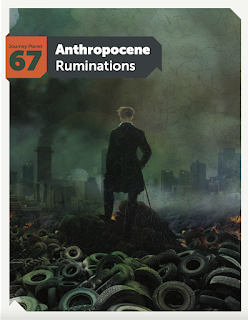
This autumn, we had the opportunity to work with artists and creators who volunteered their time and effort to look at a few different facets of climate change fiction for an issue of Journey Planet we guest edited. We called it Anthropocene Ruminations, and we hope you will check it out. 

This is our small contribution to the broader discussion of cli-fi. 

There’s so much more to say, and so many voices we’d urge you to consider. Phoebe Wagner and Brontë Christopher Wieland’s anthology Sunvault. Arizona State University’s anthology Everything Change.

Although climate change was primarily caused by the people and corporations of the industrialized West, many of its worst impacts are being perpetrated against people in the Global South. This is a global problem, and we must therefore seek a global understanding of it by reading works from non-Western perspectives. Sheree Renée Thomas, Oghenechovwe Donald Ekpeki, and Zelda Knight’s recent anthology Africa Risen includes some excellent cli-fi.

Climate change is the defining crisis of our time, and we’d suggest that cli-fi is the defining subgenre.


Monday, 24 October 2022

Interview with Premee Mohamed, author of the Beneath The Rising trilogy

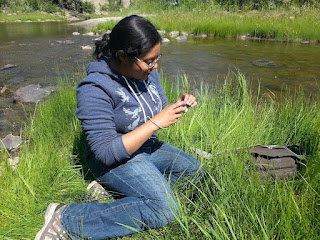
Scientist and author Premee Mohamed photographing
photos of insects in a riparian area of Alberta, Canada.
Her work often reflects environmental impacts and
concerns.
(Image via the author)
Premee Mohamed is an Indo-Caribbean scientist and speculative fiction author based in Edmonton, Alberta. Over the past year, her work has appeared on the ballots for the World Fantasy Award, the British Fantasy Award, and Hugo Awards, as well as earning her a Nebula and an Aurora for best Novella. This spring, she published the capstone to the horror adventure trilogy that started with her debut novel Beneath the Rising. Mohamed spoke with blog contributor Olav Rokne in September.

UHBC Blog: Just earlier today, while prepping for this interview, I read “All That Burns Unseen.” I actually emailed my wife and told her “You have to read this story!”

Every time that we get fire seasons — like the one in the story — I feel like the world is ending. So that story felt very real.

Premee Mohamed: I'm glad … but I'm also horrified, because it feels really really real to me too.

The story came from just this idea of like the year-long fire season with no water left to fight it. And that's barely sci-fi. That's soon. That's going to be happening real, real soon.

UHBC Blog: Do you have any family up north? Because that aspect of the story was particularly true to life.

Premee Mohamed: Not me personally. But for the story, I did uh pick the brains of a friend of mine who works for the air monitoring division [of Alberta Environment and Parks] and he was sent up with very little notice to the Fort Mac fires. And I asked him “Visually what do you remember? What were some things that stood out to you?”

UHBC Blog: So yeah, I was actually planning to bring up the fact that climate change seems like a
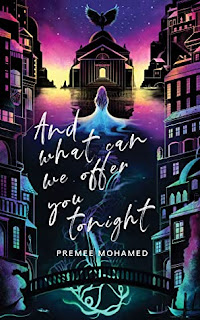
In 2022, Premee Mohamed won
the Nebula for best novella, and
the Aurora for best novella ... 
though oddly with different books
earning the awards.
(Image via Goodreads)

recurring theme for you. It informs What Can We Offer You Tonight, Annual Migration of Clouds, and of course that excellent short story. Do you think it's possible to write near-future fiction and not include some time of climate change elements?

Premee Mohamed: Well, anything's possible in fiction.

But suppose I wanted to write a murder mystery set in London in a fancy house in the middle of the city in 1942. In theory, I could write the entire book just about the murder mystery and these friends would have to solve it.

But in practice, if I didn't mention World War II at any point or the Blitz or the bombs or people that they knew that had died in the war … it would feel very weird and I feel like the book would be kind of missing something enormous about the reality of London in 1942.

So I don't think it's possible to write a future on Earth in fiction where we either aren't facing the catastrophic effects of mass climate change, or we have figured out a way to mitigate it.

I'm looking at my Twitter feed and there's disasters happening all over the world that are directly attributable to climate change. All I can picture is a future where eventually those disasters join up temporally and spatially … and everything is bad for everybody pretty much all of the time.

UHBC Blog: I always read the first two Beneath The Rising books as a bit of a climate change metaphor,

Premee Mohamed: I think what I was thinking of was not specifically um climate change per se, but certainly eschatology — end of the world scenarios.

Nuclear was actually what was informing the first one: this world-ending technology that once it started wouldn't stop.

But I don't think that climate change is actually that different from the idea of this nuclear disaster. 

It's something that most of us can't directly affect ... and the people that can affect it, the people who hold all the power seem unable to respond effectively.
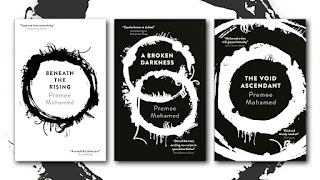
The third book in the Beneath The Rising trilogy
hit shelves in April. 
(Image via SciFiNow)

UHBC Blog: One of the aspects that really drew me into those books was what I perceived as a parasitic friendship between Joanna and Nick. Was any aspect of that drawn from real life?

Premee Mohamed: I was quite young when I started writing that first book; I was Nick's age. So my friends were kind of my entire sphere of influence.

I had just realized that some of my friends' families had a lot more money than mine. I didn't really think about it, it wasn't something that one really noticed. Just, you know, their house was nicer, he always had the latest newest gadgets. I was 18 at this point, and it had been years of me noticing this, but not really noticing. And it kind of sank in like, “Oh man, this explains so much about like the last like seven or eight years of my life.” Things that I did not notice.

So Nick is very cognizant that Johnny is a multi-millionaire, or maybe a billionaire. Aware that she owns companies, she's got influence, she's in the media, she's a celebrity.

And at the start Nick's like “I'm extremely ordinary isn't it a miracle that we're friends.” But then you start to see that the person who has the most Johnny is taking the most and the person who has the least — Nick — is giving the most and it's so uneven. When he realizes that, of course he shatters the friendship.

That being said, it wasn't so much that I drew from myself and my friends when crafting the relationship between Johnny and Nick. Their relationship is more of a microcosm of the overarching story as a whole.

The reason disasters keep happening to them is because the old friendship and trust that they shared has been broken.

When their friendship is close and tight, they're able to work together and they can actually accomplish positive things. But when they don't trust each other, the plot falls apart and disasters start happening.

I wasn't really doing that consciously so much in the first book, but definitely in the second and the third.

UHBC Blog: So … you mentioned that you started writing the book when you were 18 or so. So that would have been around 1999 or 2000. And it seems to me that's right around the time that the resurgence of Lovecraftian fiction was starting, so you were kind of ahead of the curve.

Premee Mohamed: I actually hadn't read any Lovecraft when I started writing the book.

And in the earliest drafts of the book, it was a pretty straightforward good guys against like … the actual devil, and demons. But as I started writing, it seemed like the devil as a villain had kind of been done. I didn't feel like I could put a fresh spin on it.

I was like “why am I putting Satan in this?” “Is this 12 years of Catholic School speaking?”

Around that time, I started reading Robert E. Howard, and in the back of the book someone had written an essay about a bunch of other similar authors

It was like Lovecraft and Arthur Machen and Lord Dunsany and a couple of other names. So I went and looked up Lovecraft collected works in the library and I was like “oh this is some terrible writing and a really good sandbox! Look at all these weird ancient gods and these cults and the possessions and this extremely weird haunted house with tentacles in the basements!”

UHBC Blog: What is it about the current moment that makes these metaphors about secrets that man was not meant to know relevant again?

Premee Mohamed: I suppose part of it must be that with the advent of the internet we don't think there's anything we can't know. There shouldn't be any information that is beyond us because it's somewhere online.

Having just adopted a cat, I think I'm seeing this attitude right now. His attitude is: “Whatever it is you are doing, I have the right — nay, the duty! — to come see what it is.”

I think it's this attitude of entitlement to information is part of it and the idea that there is information out there that someone has that no one else has that we could have.

That's pretty alluring I think and part of it I think must also be the cosmic side of things: This idea that the villain doesn't even notice us unless we somehow attract its attention. The villains are just villainously doing whatever it is they do and humans are so insignificant that all they can think of to do when they encounter us is enslave us or exterminate us or use us as part of their horrible life cycle.

And it all defies understanding and it's supposed to be incomprehensible which in the books that really bugs Johnny. She's a scientist, she wants to understand, and believes she should be able to control magic because to her magic is basically an elementary particle like a photon. If we can understand and measure and control photons why can't she do the same to magical particles?

UHBC Blog: It strikes me that this is somewhat related to a dichotomy in your career. I mean you're a person with two science degrees working in a field that is all about uh metrics and and and facts and and yet a lot of your fiction is entwined with that branch of weird sff in which science cannot save us.

Premee Mohamed: I really enjoy the tension actually.

I like the idea of people encountering things that should be scientifically explicable in some way that just aren't.

For example in And What Can We Offer You Tonight the reason Winfield comes back to life is never given. I don't think there's a point in explaining it, and I don't want somebody to strap her down to a table and vivisect her. I don't know why she did and that's not the point of the story.

If I want to write a story where scientific understanding is the point of the story then I do. For instance my story that's coming out in Life Beyond Us, which is an anthology in association with the European Space Agency. My story is called “The Far Side of the Door,” and it does involve a medical mystery that has to be solved using science.
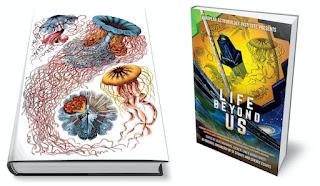
Among her numerous upcoming works is a short
story in the anthology "Life Beyond Us."
(Image via Kickstarter)

But sometimes I don't want to explain it, and it's actually more satisfying to me not to. You know in These Lifeless Things, readers might ask “How do the statues come to life?” “How come that's never explained when the scientists come to the city 50 years later?”

I'm like: “Because I don't want you to know.” “Because I don't want the reader to have some questions answered.” I want them to ask and I want them to not know at the end deliberately, because it's more fun.

UHBC Blog: Well and speaking of These Lifeless Things, you've had a very successful year in terms of novellas. What appeals to you with the novella as a format?

Premee Mohamed: I really love the length. In the next couple of years I'm gonna have three more out.

So one with tor.com and then two are the sequels to The Annual Migration of Clouds.

I've been really trying to put my finger on it, because I just did the Edmonton Expo, and somebody was asking about novellas.

I think what appeals to me about a novella is similar to what appeals to me about a short story is how ruthless you have to be with what part of the character's lives you choose to focus on. What time period you want the story to cover and what events can be allowed to happen in it to kind of illustrate what you want people to go through and how much you have to trust the reader.

In a novel, if I need to explain why this entire city has only subsisted on sardines for the last 50 years, I have room to do that. In a short story I may have a couple of sentences.

The novella is the perfect you know length between I want to explore one idea or one premise with one overarching plot structure and at most one subplot and a limited number of characters.

So when the reader is reading, they are laser focused on this single string of events that is happening and on these few characters' experience of this story. There's no room for tangents, there's no room for digressions.

So it ends up just a really great interesting length to write in terms of both the freedoms and the limitations that it gives you.

Tuesday, 22 June 2021

The Day That No Award Caught Fire (1963)

This blog post is the sixth in a series examining past winners of the Best Dramatic Presentation Hugo Award. An introductory blog post is here.  

The Hugo Awards had already been in existence for a full decade, but until the night of Sunday
A movie about human activity causing the Earth
to slowly grow warmer? Must be science fiction!
(Image via Wikipedia)

September 1, 1963, they had remained an ad-hoc affair. On that evening, in the Congressional Room of the Statler Hilton in Washington, D.C., the World Science Fiction Society constitution was born.

In that first decade of the Hugo Awards, categories varied wildly. Only Best Novel, Best Short Story, Best Fanzine, Best Artist, and Best Prozine had been awarded more often than Best Dramatic Presentation. But still, the category remained the one that attracted the least interest. As far as we can tell from looking over the membership lists of the Worldcon, none of the nominees in this category attended the ceremony.

One major change in the rules that year was to make the Dramatic Presentation category format agnostic. No longer restricted to film or television, it was made explicitly clear that radio, audio recordings, or even stage productions might be eligible. Interestingly, this was an option that Hugo nominators wouldn’t make use of for another eight years.

There were four eligible Dramatic Presentations that received enough nominating votes to be considered for the Hugo in 1963, but due to an error only three of them appeared on the ballot. Night Of The Eagle (aka Burn, Witch, Burn) was omitted from the ballot by mistake.

It seems unlikely to us, though, that its inclusion on the ballot would have made a difference. Although adapted from Fritz Leiber’s novel Conjure Wife, and sharing the broad strokes of the central idea about an academic who struggles with his wife’s witchcraft, screenwriter Richard Matheson took significant liberties, particularly with the ending. In our estimation, the changes were for the worse, as they seem to negate the commentary about gender roles that seem to us to be integral to the story.

The acting and directing is surprisingly good, considering that the movie was helmed by Accapulco
Director Sydney Hayers parlayed
his Hugo shortlist appearance into
a directing gig on Galactica 1980.
(Image via Wikipedia) 

H.E.A.T.
director Sydney Hayers. There’s a clever bit of continuity in which a skeptical professor has the words “I don’t believe” written on a chalkboard early in the movie, only to have the word “don’t” erased when he accidentally rubs his shoulder on the chalkboard near the end.

But there were several other — we would argue better — options on the ballot that year. Twilight Zone showed a significant return to form after an off year. Although the fourth season wouldn’t begin airing until January of 1963, the episodes that aired in 1962 went from strength to strength: To Serve Man, based on Damon Knight’s story of the same name, is deservedly one of the most well-remembered in the series, but there are many other hidden gems here. Little Girl Lost, written by Richard Matheson, is an excellent eerie little episode with a fantastic premise about falling between the cracks of the world. One of Rod Serling’s scripts The Little People is a tightly-paced story that seems almost certain to have helped inspire George R.R. Martin’s Hugo-winning The Sand Kings.

Most of the members of our discussion group would likely not have voted for the beguilingly beautiful but frustratingly befuddling Last Year At Marienbad, the French art movie whose opaque narrative structure and lack of linear storytelling have made it a classic amongst film scholars. It’s a movie that’s clearly worthy of respect and admiration, but it’s not particularly engaging for the casual viewer.

The stand-out of all the Hugo shortlisted dramatic presentations in 1963 was The Day The Earth Caught Fire, a British disaster movie that channeled the atomic fears of the day.

The story follows a journalist who slowly pieces together the fact that due to ill-considered government decisions, the world is getting hotter and soon will become uninhabitable. As he breaks the news about this global warming, various policymakers try to deny the facts even as weather patterns shift and catastrophic storms wreak havoc. Despite the implausibility of this scenario, the movie makes this “climate change” seem like a credible threat.
Director Val Guest earned his
only BATFA award for The
Day The Earth Caught Fire
.
(Image via Pintrest)

This is one of the few movies that accurately captures the energy of a newsroom, and the bleak humour shared by journalists on the job. This is in part because it was partially filmed on-location in the offices of the Daily Express in London, and the actor cast as the newspaper’s editor had previously been the editor of the Express.

Director Val Guest — best known for his work on Quatermass — turned in his career-best directorial effort here, using location and lens choices to move the narrative between almost claustrophobic personal stories, and sweeping global events. The ending (which we won’t spoil) effectively drives home the urgency of the questions raised, and underscores how the movie remains disturbingly relevant to this day, particularly in light of global warming.

Our viewing group unanimously agreed that it is a legitimate shame that the film was denied the Hugo award. The fact that The Day The Earth Caught Fire did not win is more evidence of the lack of interest Dramatic Presentations garnered among Worldcon attendees.

It is a shame that voters chose not to recognize any of these options with a Hugo Award, but it is both a reflection of the attitude that science fiction fans had towards SF cinema at the time, as well as the lack of interest that Hollywood had in the Hugos.

Monday, 2 December 2019

Yearning For Policy-Intentional Science Fiction

There will come a day when novels about climate change will be marketed as historical fiction instead of science fiction.

That day is probably closer than most of us care to realize, which is why all near-future science fiction is naive if climate change is ignored.

This is both a burden to the genre of science fiction, and a set of related opportunities: The opportunity to credibly predict the ramifications of a warming planet; the opportunity to envisage effective climate change mitigation strategies; the opportunity to build a public narrative that
Paolo Bacigalupi's The
Water Knife
is one of the
most underappreciated
novels of the decade.
(Image via Amazon.com)
engenders positive policy changes.

It is this last opportunity that we would like to discuss. There is a need for policy-intentional science fiction that is rooted in the most accurate available forecasts.

The sub-genre of climate fiction (or cli-fi) offers some notable examples that genuinely tackle the human-caused warming of the planet; Paolo Bacigalupi, Saci Lloyd, Barbara Kingsolver and Kim Stanley Robinson have ably attempted to bring the issue into focus within science fiction. Is the general public’s reticence to embrace these works simply a general disinterest with science fiction or a more reactionary resistance to accept climate change science?

It has been argued that one of the most important roles of science fiction is to provide the self-defeating prophecy. That is, to build fictional predictions so compelling — and so well-realized — that they affect the public consciousness and, sometimes, force political responses. Orwell’s 1984 is often held up as the case example of this, having perhaps persuaded generations of voters to reject authoritarian politicians.

Sadly, there does not seem to be a book of comparable impact for climate change. When politicians refer to science fiction about climate change, it is often with derision.

The climate change novel most cited by politicians in Washington seems to be the lamentable State Of Fear by climate change denier Michael Crichton. The book depicts eco-terrorists faking the evidence for climate change. In fact, State of Fear has been cited in congressional records more often than the combined totals of all books by Kim Stanley Robinson, Paolo Bacigalupi and Barbara Kingsolver.

Senator Jim Inhofe suggests that a
conspiracy of scientists are faking
the case for human-caused climate
change and cites SF novel State of Fear
as evidence for this claim.
(Image via Politico)
“Dr. Crichton, as I said, is a medical doctor and scientist.
He very cleverly weaved a very compelling presentation
of the scientific facts of climate change 
— with ample footnotes 
and documentation throughout, I might add — into a gripping plot.”
— Jim Inhofe (R - OK) January 2005

It is clear that — as in most crises — the poor, the disenfranchised, and the ethnically marginalized will bear the worst brunt of the consequences of climate change. Which is why it’s interesting to note that in their lists of novels about climate change, several mainstream sources neglect authors who can speak to those perspectives. We would suggest Moon Of The Crusted Snow by Waubgeshig Rice deserves to be recognized as a vital, vibrant and essential text that should not be omitted from such lists, as is Omar El Akkad’s American War.

It is shocking to us that cli-fi remains a surprisingly small sliver of the overall science fiction field. It’s a niche that warrants an obligatory panel discussion each convention, but which is often overshadowed by subgenres like steampunk and space opera. A review of programming at the latest Worldcon corroborates this (e.g., discussions of Doctor Who and of superheroes far outnumbers discussions of climate), as does a scan of novels published by the major science fiction publishers in 2019.

This dearth of reality-based cli-fi can be seen in public discussions. The climate change narratives that seem to be top-of-mind for members of the mundane public are exceedingly problematic from the perspective of presenting a believable warning about the effects of climate change. The Road; The Day After Tomorrow; Snowpiercer; Oryx and Crake; State of Fear; Waterworld. Many of these are enjoyable works of fiction, but they can inadvertently serve to undermine understanding of climate change and delay urgently needed action.

Stephen Baxter (an author respected by this book club) offered possibly the most egregious example of this trend in his books Flood and Arc — which depict oceans rising unabated until the world has no more dry land at all. The beginning of the first volume is compellingly real, but this warning is
Waterworld is so risible it discredits
the idea of climate change, much to
the detriment of good policy.
(image via IMDB.com)
quickly submerged by scenes of complete fantasy.

Waterworld, as fun as it is, may be the most extreme example of alarmist (and unbelievable) depictions of rising ocean levels, and unfortunately one of the most iconic. The effects of climate change in Waterworld is almost as nonsensical a fantasy as the science-denial fantasy that the Earth isn’t warming at all. The broader public is being fed competing nonsensical narratives — making it more difficult to parse fact from falsehood in the mundane world.

Projections of how climate change will impact society should be influencing policy. This is an important burden that science fiction should be taking up. There needs to be more policy intentional climate change-related science fiction, and the more it is based in real-world science, the more seriously it is likely to be taken.

Wednesday, 10 July 2019

Trail of Lightning: Shockingly Good

Rebbeca Roanhorse’s debut novel Trail of Lightning might appear at first to be a run-of-the-mill
Rebecca Roanhorse at the 2018
Worldcon, where she won her first
Hugo Award.
(Photo by Olav Rokne)
urban fantasy, but it offers the astute reader a culturally-rich narrative.

Set against a multifaceted, frightening future where North America has been ravaged by man-made climate change, Trail of Lightning pits deadly, other-worldly monsters against people with superhuman powers.

Those familiar with Indigenous storytelling practices will be at home with Roanhorse’s writing style, in which metaphor and allegory are used prominently, and more-than-human relations (ie. relationships between humans, nature, animals, and spiritual beings) are common and understood (well, as much as any relationship can be understood).

While mainstream audiences may interpret these stories as myth or as speculative fiction, Indigenous storytelling traditions are more likely to recognize the philosophical and pedagogical nature of these narratives. At times, the stories shift from Aesop-like cautionary tales like that of the windigo, to stories that teach values like the story of Kunuuksaayuka. Roanhorse’s work expands on these traditions and exposes them to a new audience.

Like the Binti trilogy, the culturally-specific narrative anticipates that the audience can adjust, learn,
Trail Of Lightning blends Indigenous
narrative tradition with genre tropes.
(Image via Tor.com) 
and experience what is new to them. At times, etic readers may find this overwhelming, but The Six World series makes the effort worthwhile. Roanhorse doesn’t explain certain terms or phrasing in the first chapters because the protagonist and narrator, Maggie Hoskie, doesn’t need exposition. It’s the reality she lives in and knows. While it may be new to readers, it functions as an immersive experience.

The backdrop of apocalyptic climate change inspired discussion about its possible misuse as a fictive understanding of climate change itself (that is, as an argument against the science behind the evidence-based phenomenon). Others argued that the fantastical nature of the climate change seen in Trail of Lighting was used as a narrative tipping point. That is, the supernatural regains control after humans have mucked up the fifth world. Everyone seemed to agree that the setting made for an interesting element in that it constrained the protagonist from understanding the whole of the world.

With this idea of iterative ‘worlds’ that the planet experiences, it is hard not to compare the work to N.K. Jemisin’s much-lauded Broken Earth trilogy. Both works involve a world broken by Euro-settler hubris, both involve protagonists with superhuman gifts; and both are centred in cultural understandings. Likewise, one can see parallels between Trail of Lightning and American Gods, through its conflicts between the known world and the transcendent.

These comparisons, however, may place Trail of Lightning at a disadvantage, because as an introductory novel, it does not show the same writerly craft as these illustrious predecessors. In particular, some of the character development in the book shows some weakness and inconsistency — Maggie Hoskie’s simmering anger and grimness is a bit lacking in nuance. Given her self-reliance and independence, it’s disappointing to see her make mistakes because of a cliche romantic entanglement.

It is also interesting to compare Trail of Lightning to another 2018 Indigenous post-apocalyptic novel
Anishinaabe journalist Waubgeshig Rice
is another Indigenous writer whose SF
we would heartily recommend.
(Image via CBC.ca) 
Moon of the Crusted Snow by Anishinaabe writer and journalist Waubgeshig Rice, which was on several of our 2019 Hugo nominating ballots. This Canadian bestseller might have been overlooked by the broader science-fiction community, but Rice’s tale deserves more attention for his depiction of the collapse of society from the perspective of those who have marginalized for generations. It is an extraordinary science fiction novel. For those whose appetites for this type of narrative have been whet by Roanhorse’s book, we highly recommend this book.

Overall Trail of Lightning is an engaging read that brings an important and often marginalized viewpoint to a broader science fiction audience. Despite some of our criticisms of characterization, Roanhorse’s deft weaving of cultural knowledge, myth, metaphor and real-world challenges put this at or near the top of many of our ballots.

Tuesday, 24 July 2018

New York 2140 is the book that people need to read, and that is why it deserves to win.

In what may be his crowning achievement as an author of environmental science fiction, Kim Stanley
New York is going to have to deal
with rising sea levels — Robinson
manages to make this future real
and make it hopeful.
(Image via LeftForum.Org) 
Robinson imagines a New York City submerged beneath 50 feet of ocean.

There's a scene in New York 2140 in which Franklin Garr, an investment banker at the fictional firm WaterPrice, explains his system for the valuation of intertidal real estate.

"Intertidal Property Pricing Index. ... The name itself asserted something that before had been questionable. It was still questionable, but all over this world property had already become somewhat liquefied; property now is just a claim on the yield."

This quote is at the heart of what makes New York 2140 not only the most worthy work on this year's Hugo shortlist, but possibly the most important novel published last year: It forces us to ponder questions that humanity will have to — and is starting to — grapple with, in our post-climate-change future.
In New York 2140, Robinson delves
into the social, economic and engineering
challenges that people will face in the
wake of climate change.
(Image via Inhabitat.com) 
These questions range from logistical architectural and engineering quandaries to sociopolitical tensions including the fate of climate migrants and evolving forms of communal governance. Most of all, though, author Kim Stanley Robinson tackles economic questions.

In doing so, Robinson avoids the trap of despair that pervades many other novels about climate change. He offers a vision of the future in which there are catastrophes and significant problems, but a future in which there is also hope.

The central economic question of the novel is how climate change will affect real estate. There is a looming tension between the intertidal zone -- protected from ownership by international convention -- and the places which humans have already claimed as property. If people refuse to move as the intertidal zone encroaches, how will our economic tools resolve this tension?

These questions, and the implications of Robinson’s answers, are explored in the novel through the
The Met Life building in Manhattan
acts as the narrative focus of New
York 2140.
(Image via Wikipedia)
viewpoints of eight different narrators whose lives are tied together by the Met Life building.

Each of these eight viewpoints offer differing perspectives on a New York that is emblematic of how humans might adapt to climate change. In addition to the aforementioned Garr, there’s the building superintendent Vlade, who offers insight into the engineering of post-flood buildings. Social worker Charlotte Armstrong shows how civil society organizations adapt to the changing needs of the population. And orphans Stephan and Roberto’s story explores how the poor and the downtrodden survive. Tying all these narratives together are non-diagetic inserts offering the perspective of an antediluvian New Yorker, through historical notes and assorted philosophical musings.

Informed and leavened by a variety of intellectual traditions, and liberally referencing a variety of sources such as Le Corbusier, Samuel Beckett, and Thomas Piketty, New York 2140 does what the best Hugo winners do: offer a compelling blueprint of the future.

It’s not a novel without flaws. Not all narrators appealed to all of our book club members — for some, it was the comedic moments involving Amelia, while others found Franklin Garr to be a pompous jerk. Some members found the musings about property and economics to be a little on the dry side and found the book overly long — even going so far as to suggest that these inserts are superfluous or self-indulgent.

But these flaws are largely overshadowed by Robinson’s fully-realized vision of coping with climate change. This is a future that is believable, terrifying and hopeful.

At 624 pages, New York 2140 is the longest of this year's shortlist; a weighty novel filled with weighty ideas. The Stone Sky may be the most poetic. The Collapsing Empire may be the most fun. Raven Stratagem may be the most adrenaline-fuelled. Provenance may have been the most upbeat.

But New York 2140 is the book that people need to read, and that is why it deserves to win.

(This blog post is one of two in which different members of our book club make the case for the book they think should win. The second one on The Stone Sky is at this link.) 

Friday, 19 May 2017

The Obelisk Gate – Book Club 2017 – First book discussed

The Obelisk Gate is a worthy nominee for the Hugo Award, but most of us didn’t feel that it was as good as Fifth Season.

True to form, N.K. Jemisin’s writing is strong, her characters are well crafted, and the world building is interesting. And yet the book falls somewhere short of what we had hoped for. 


Although it sounds a bit strange, many of us tried to figure out what had actually happened in the book. As it turns out, not all that much. While interesting context is provided for the events of the preceding book and information is offered about the challenges to come, the characters didn’t actually do very much or move the plot along in any significant ways.

Second-Book Syndrome


Perhaps the book suffers from being the second in a trilogy. As such, it can’t have the originality and vigor of a first book and also can’t have as epic a conclusion as a third book.

Jemisin’s strength as a writer and deft social commentary make this a worthwhile read. Questions of race, class and gender are explored thoughtfully and with nuance. The characters speak with their own voices, and grow.

Alabaster’s slow decline as he tries to pass along knowledge to Essun, and Essun’s growing control of her magic could have been nothing more than a Hero’s Journey ™ like that of Obi-Wan and Luke. But Jemisin’s more nuanced character building elevates this relationship to something more touching and poignant.  Again, she raises the readers’ expectations as they progress through the book.

N.K. Jemisin
Photo from SFWA
The book’s final 50 pages are where the second-book syndrome really comes to the forefront, because nothing is resolved other than knowing that there are significant actions to come. Needing to read the next book to have a dénouement is not a satisfying ending. 

Back-To-Back Hugos?


The Hugo Awards have often honoured multiple books in a well-loved series, but usually not in back-to-back years, and usually only when the author has taken the series in new directions. The Obelisk Gate is unlikely to buck this trend.

None of us would be upset if Obelisk Gate won — and some of us are likely to vote for it. At the same time, we're all hoping that one of the other nominees astonishes us. 

Thursday, 4 May 2017

New York 2140 (Kim Stanley Robinson)

Image via Amazon.com

It's only May 3, and 2017 is already deluged with great SF novels

It's a bit early to start talking about the 2018 Hugo Awards, but we're going to start speculation off already. 

2017 has already been a very good year in SF. Between the new Charles Stross, the highly touted Scalzi space opera, Doctorow's return to form, and a few other high-profile releases, there's already a fairly crowded field of contenders for the top award.

But for at least two members of our book club, Robinson's latest book has to be a clear frontrunner for getting on the Hugo shortlist.

KSR at his best


The short summary of the book is that it's a series of intertwining stories about people surviving in a flooded New York, decades after the oceans rose because of global warming.

Kim Stanley Robinson
photo by Kanaka Rastamon via Flickr
(CC Attribution-NonCommercial licence)

The quick description of the plot doesn't do the book justice. KSR plays with ideas around global capital, investment funds, urbanism, global climate change, ecology and human survival. But he also weaves several narratives about people working together to survive major environmental events, about different classes of people (from the upperclass super-wealthy to homeless orphaned youths), and about different philosophical approaches to global problems.

The book isn't without its flaws: Some point-of-view characters are portrayed with too broad a brush, or with too little understanding of their points of view, and excessive extraneous details about irrelevancies turned off at least one of our book club members. But on the whole, those flaws are eclipsed by a richly textured setting that is almost more important than the characters.

Urban Futurism


The imagined future city of New York 2140 is deeply explored in concept, economy, social relations, technology, and implications. It's one of the most satisfyingly consistent imaginings of a truly plausible future that many of us have read in the past few years.

Sea-level rise is depicted as a world-changing semi-apocalyptic event, and is described convincingly, but also hopefully, because something amazing is built in the aftermath.

The book club's resident KSR superfan lists New York 2140 as possibly the best of the author's works. It's hard for me to disagree with him. Seriously consider this for your Hugo nominations next year.