Wednesday, 31 January 2024

The Maginot Line of Fandom

French Prime Minister Georges Clemenceau famously quipped that “generals are always preparing to fight using the tools of the last war.”

Built by France in the wake of the First World War,
the Maginot Line was an engineering marvel 
completely unsuited to the challenges
of the Second World War.
(Image via History.com) 
At the time of this writing All Fandom Is Plunged Into War, and we are left wondering if some of the tools adopted in the wake of the last battle are suited to today’s conflicts. Is E Pluribus Hugo the Maginot Line of fandom?

This is the seventh year that the E Pluribus Hugo (EPH) methodology of tabulating Hugo Award nominations has been in effect.

Since it was ratified at the business meeting in 2016, EPH has weighted nominating votes in an attempt to ensure that the shortlist is more representative of Worldcon fandom than it was in years past. By our count, the use of EPH has resulted in changes to the Hugo shortlists on 35 occasions. Over the past eight years, this system has removed some works from the shortlist in favour of other works that were nominated by a smaller (but hypothetically more representative) demographic.

Given that there have been almost 900 finalists across all Hugo (plus Lodestar and Astounding) categories since EPH went into effect, that means the new system has made about a four per cent difference to the shortlist.

In essence, EPH created noise around the edges of the data, to little benefit.

EPH was proposed in the wake of the 2015 Hugo Awards controversy, during which a co-ordinated minority of fans were able to overwhelm the nomination process. It was one of a variety of solutions proposed as a remedy to the problem of slate voting.

At the time, those involved with this blog were in support of the EPH proposal. Sure, sometimes it produced weird results like keeping Arkady Martine off the Astounding Award ballot in 2020 … but that seemed like a small price to pay to prevent another year like 2015, in which havoc raged and resulted in five categories resolving as “no award.”
It's worth noting who gets added and who
gets removed from the shortlist due to EPH.
(Image via Hugo Awards 2017 nominations)


In the intervening years, EPH has not been faced with a significant challenge. From 2017 to 2022, nomination patterns among Worldcon members was as expected, with no “slate” that needed to be accounted for. If the data from this year is correct, however, the highly-correlated list of finalists that all received similarly inflated numbers of votes does more than just resemble a ‘slate.’ (This is not to imply malicious action on the part of those casting nominating ballots, but to say that clustered votes that are correlated due to a highly influential recommended reading list will be treated by the EPH system in a way that is similar to a slate of nominators.) And in the face of this trial by fire, EPH has failed.

EPH has also not lived up to the promise that it would ensure that different factions of fandom would be represented in the final ballot. Looking over the list of those who have been excluded from the Hugo Ballot because of EPH, you’ll find some excellent folks who have yet to receive their first nominations. If not for EPH in 2022, Black Nerd Problems would have become the first fanzine made by Black SFF fans to receive a Hugo nomination. If not for EPH in 2020, Priyanka Krishnan would have been the second-youngest editor ever shortlisted for a Hugo Award. Meanwhile, EPH has secured additional nominations for some of the folks who have been recognized the most often in the past. It was a solution that may have reinforced systems of power instead of mitigating their impact.

Another issue with EPH is that it can be gamed. Sufficient people nominating only one item in a category are likely to boost that one finalist through a process that’s been dubbed “bullet voting.” The effects of this can be extreme. In 2023, Oghenechovwe Donald Ekpeki’s short story Destiny Delayed was omitted from the Hugo Award ballot … despite receiving almost twice as many votes as the shortlisted work Resurrection by Ren Qing.

Equally if not more damning, EPH has created a barrier to the public understanding of how the Hugo Award nominees are selected. The integrity of the nominations process, and thus the awards themselves, is being questioned for a variety of reasons, and an arcane system of tabulation only adds to the problem. People are unlikely to trust a system that they don’t understand, and an obfuscatory system they are expected to participate in is anathema to public trust and participation.

EPH doesn’t offer better results, it simply picks different finalists in a way that seems to increase the democratic deficit in our community instead of removing it.

Fundamentally, we’ve seen that “E Pluribus Hugo” has not functioned as intended, produces a shortlist that less accurately reflects the will of the Worldcon community, and adds confusion to the process. It’s time to abandon it altogether. It’s time to craft tools appropriate for tomorrow’s awards.

Friday, 12 January 2024

A New Moon Illuminates The Apocalypse


Rice offers an apocalypse from
a fresh perspective and with 
interesting insights. 
(Image via Goodreads)
Post-apocalyptic fiction is known for its hopeful restarts, but the subgenre can also include ultimately nefarious elements perhaps best described as fantasies of re-establishing paleoconservative social hierarchies. In the aftermath of societal collapses, readers are encouraged to imagine themselves as a heroic survivor, either uniquely prepared, or uniquely suited for the new world that arises from the ashes of the old. Unshackled from the confines and complexities of middle-class suburban civilization, the post-apocalyptic prepper fancies that they’d be able to reach their full potential.

From Robert Kirkman's Walking Dead, to Stephen King’s The Stand, to John Ringo’s The Last Centurion, many authors have used a white cis man empowerment framework to construct a political argument about what sort of idealized rugged individualists would thrive and what kind of world they’d build in the absence of society’s constricting rules.

Almost inevitably, there’s an aspect of libertarianism to these works. The end of centralized government that is inherent to these stories is obviously an appealing prospect to authors who believe government is generally a bad thing.

Over the past few decades the subgenre of post-apocalyptic fiction has sometimes seemed a bit stale. The protagonists are too often fungible, omnicompetent white dudes who live by a rigid moral code. Characters like Joel Miller (Last of Us), Dave Marshall (Slow Apocalypse), Robert Neville (I Am Legend), Miles Matheson (NBC’s Revolution), or Rayford Steele (Left Behind) are basically interchangeable. It should not be lost on anyone that Earl Turner — the protagonist of the white supremacist novel The Turner Diaries — hews closely to this archetype. Race, class and gender are all entwined in the tropes and conventions of apocalyptic fiction, and often with reprehensible subtext.

Given this context for the subgenre, Moon of the Turning Leaves by Waubgeshig Rice is an admirable change of pace. Set a dozen years after a technological collapse, the book follows members of a small Anishinaabe community in Northern Ontario who have used traditional Indigenous knowledge and skills to survive as much of the rest of North America has fallen into ruin.

Although Moon of the Turning Leaves is Rice’s second novel following the Shkidnakiiwin community (after his 2018 novel Moon of the Crusted Snow), it stands on its own fully. Of the two, it offers more depth and insight into what has happened across this post-apocalyptic world.

In Rice’s first novel, the Anishinaabe community located north of Gibson Ontario survived the apocalypse by moving from their government reservation to the banks of a large lake where they’ve been able to subsist on fishing and hunting. By the second book, the resources of that lake and its environs have begun to run out, and the community sends a team of six people south to scout out their ancestral lands near Lake Huron.

Northern Ontario's wilderness provides an
interesting backdrop for an apocalypse.
(Image via Tourism Ontario
Led by Evan Whitesky and his 15-year-old daughter Nangohns (Anishinaabemowin for “Little Star”), the group is forced to confront what has happened to the rest of North America over the post-apocalyptic decade. While Rice’s first novel was about a group of people turning inward and forming community to survive, this second foray is about looking outwards and to the future to thrive.

In this setting, it should come as no surprise just how much time and effort these characters must put into ensuring they have enough food. The depiction of subsistence hunting, for example, brings into focus themes of respect for the land and for traditional practices. There are consequently long stretches of the novel in which not much happens other than surviving without modern conveniences, commercial agriculture, and supply chains. Some of that time might have been better spent on character development, as secondary protagonists can feel indistinguishable.

This is apocalyptic fiction with a rich sense of perspective, a strong authorial voice, and a compelling philosophical argument. In the event of a global societal catastrophe, it seems believable to us that the communities likeliest to thrive might be those who already faced a cataclysm (in this case, one that started in 1492) and thus carry a unique set of survival skills with them.

Is there an aspect of wish fulfillment and empowerment fantasy in Moon of the Turning Leaves? It would be easy to read it that way. But a story about a group of marginalized people seeking to return to their pre-colonization homelands has a completely different resonance than all the tales of privileged yuppies yearning for a might-makes-right world.

Moon of the Turning Leaves breathes new life into post-apocalyptic tropes, and deserves strong consideration for both the Aurora Award and the Hugo.

Sunday, 7 January 2024

The Last Trumpet Shall Sound

In 2023, the Campo Grande Treefrog went extinct.
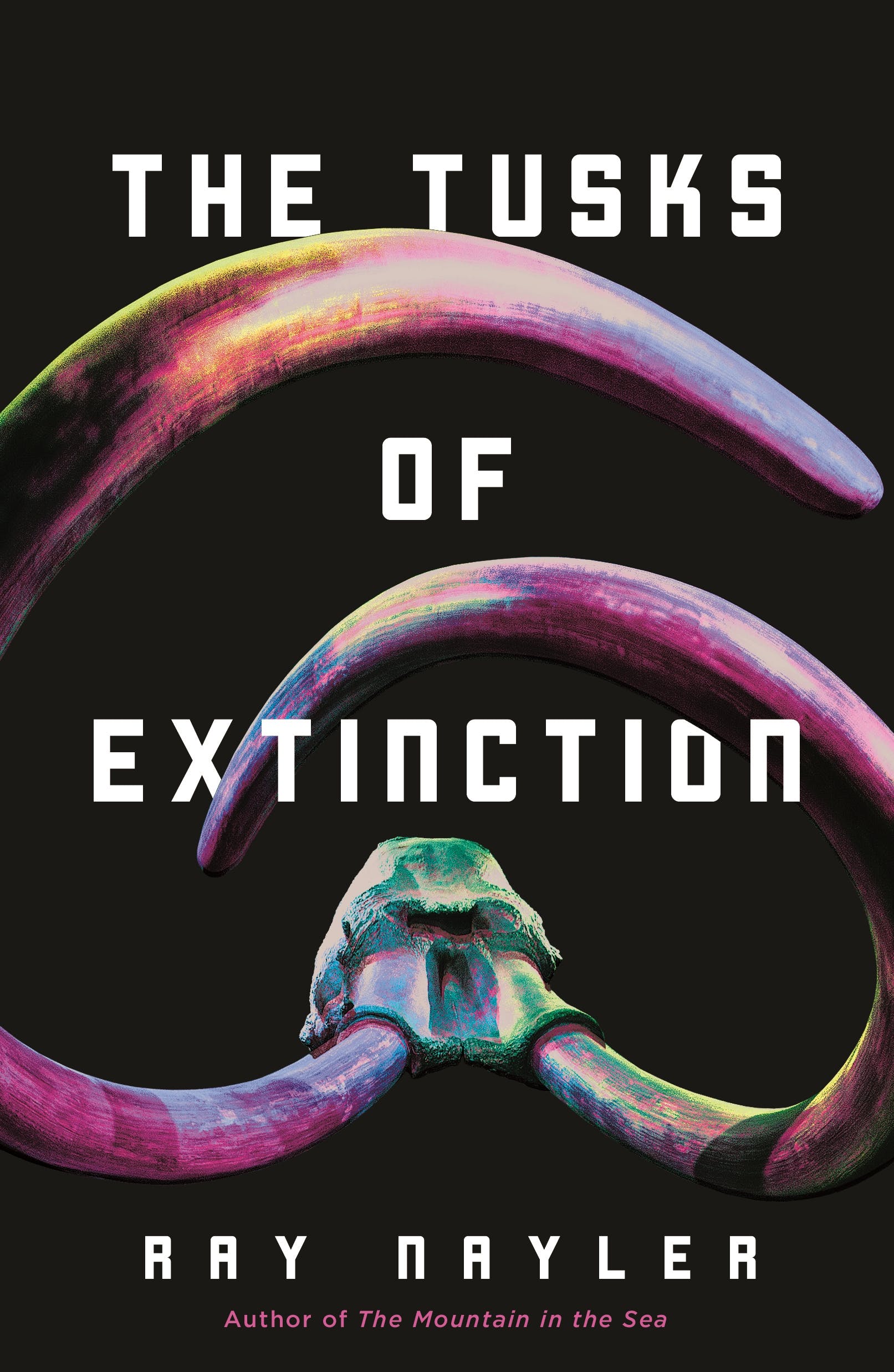
Theres a very real chance that
in the not-too-distant future,
the elephant will trumpet its last.

(Image via Goodreads)


Its loud and distinctive croaking now exists only in recordings. It was one of hundreds of animals that disappeared from the planet last year as human-driven climate change, pollution, and other forms of habitat destruction ravaged ecosystems.

Javan rhinos, orangutans, sea turtles, saolas, pangolins, and elephants are all dying out. Make no mistake: this is a crisis that will have profound downstream consequences for humanity.

Ray Nayler focused his best-selling novel The Mountain In The Sea on this extinction crisis, depicting the extirpation of sea life from the oceans and its impact on humans. But despite the grim subject, the book offers an undercurrent of hope. His new novella The Tusks of Extinction acts as a darker, angrier, possibly necessary counterpoint to the earlier work.

The Mountain in the Sea had its roots in the ecological preservation work I engaged in in Vietnam. That work was preventative and positive, working with youth and with environmental activists to protect the Con Dao Archipelago,” Nayler explained by email in early January. “The Tusks of Extinction has its roots in my experiences in Vietnam dealing with the illegal ivory trade and the trade in rhino horn. That work exposed me to the grimmest realities of human greed, ignorance, and exploitation. The enormity of the slaughter of elephants and rhinos for the sake of useless trinkets and the stupidest pseudo-medicinal ideas.”

The result is an uncomfortable read that will resonate with many and deserves serious consideration in every award category for which it is eligible. It’s science fiction deeply rooted in truth … and the current truth hurts.

As the book begins, scientists are recreating mammoths as a last ditch effort to keep the elephantidae family in existence. Siberia provides isolated stretches of open country, improving the odds for the wild megafauna. Since elephants — and their mammoth cousins — depend on generational knowledge to survive in the wild, the project is forced to recruit the recorded consciousness of a long-dead elephant conservation activist and researcher.

The novella follows three narrators who offer differing perspectives on an attempt to reintroduce the wooly mammoth into the wild: murdered elephant researcher Dr. Damira Khismatullina, uploaded into a mammoth matriarch; young apprentice poacher Syvatoslav; and ultra-rich big-game hunter’s spouse Vladimir.

About 100 African elephants are killed every day
to fuel the illegal trade in ivory. The villain — as is
often the case — is rapacious unchecked capitalism.
(Image via Science.org)
The protagonists are tragic figures; Svyatoslav is the son of a callous and violent hunter who cares for little other than money. Although he feels revulsion at the senseless slaughter, economic hardship and cultural pressure force him to participate. Vladimir is in a relationship with someone who thinks his apex capitalist money can buy love, and Damira has seen her life’s work destroyed by rapacious capitalism.

While humanity’s role in mass extinction is the main theme of the novella, an important sub theme is the relationship between senses, memory, and self identity. After her resurrection in the mammoth, Damira’s experience of the world is radically different, as is her relationship with memory. Assumptions about mind-body dualism are baked into the SF trope of uploading consciousness, and it’s refreshing to see these assumptions challenged.

“In a large part, The Tusks of Extinction is an exploration of the embodiment of mind, and also of the physical reality — the enormity — of our embodiment in the world,” Nayler says. “The mental changes Damira undergoes as a mammoth are a rebuttal of the idea of mind as separate from body and the sensory apparatus. The Tusks of Extinction is an expression of my anti-Cartesian view of the world. We exist in a physical body which exists in an ecosystem. The idea that we are floating intellects which can do as we will is one of the most damaging in human history: our lives are contingent, at all times, on physical reality and our place in it. The realization of that demands a corresponding ethics.”

The rationale behind the fictional project is expertly mapped out; research has shown that wooly mammoths enabled arctic ecosystems to store more CO2 than they otherwise would have. Having the mammoths back in the environment would disperse seeds, and increase resilience to climate change. Nayler gets the details right, and this helps make his larger arguments more believable and compelling.

Grounded in his experiences, Nayler offers insights about the social and economic conditions that lead to poaching. Svyatoslav, for example, is written with compassion and in a way that reflects on the endurance of those who lack the power to change a system that does not value their lives.

Hitting bookstore shelves during a decade when a significant portion of the SFF community seems to be seeking out comfort reads and hopepunk, The Tusks of Extinction may not appeal to all genre readers. But sometimes, sorrow is warranted and sometimes, there’s value in righteous anger.

It’s worth being angry about the potential loss of 44,000 species. As Nayler puts it: “We are intellectual animals with grand capacities, capable of living ethically and morally. It's time we used our brains to act in ways that prove we deserve to be on this planet, and that the human experiment is not doomed to be a destructive failure.”

We hope this novella finds the readership it deserves, and helps motivate some readers to take action.

Friday, 29 December 2023

Death From Above (Hugo cinema 1979)

This blog post is the 22th in a series examining past winners of the Best Dramatic Presentation Hugo Award. An introductory blog post is here.

As the 1970s drew to a close, science fiction cinema was in transition. The Hugo for Best Dramatic Presentation in 1979 reflects this; socially conscious environmental parables of the waning decade were making way for a new era of popcorn cinema.
Star Wars producer Gary Kurtz presents the 1979
Hugo Award for Best Dramatic Presentation to
Superman star Christopher Reeve at Seacon.
(Image via Supermania78)


For the first time, there were two animated movies nominated in the same year (something that would not happen again until 2002): Watership Down and Ralph Bakshi’s Lord of the Rings. Hitchhikers Guide To The Galaxy became the first (and to date only) commercially broadcast radio show to earn a Hugo nod. This left Superman and Invasion of the Body Snatchers as the only live-action movies up for the award. From the start of organized fandom, fanzines had always provided reviews of movies, but in the late 1970s, more column inches were spent on cinema than ever before. Fans debated whether movies like The Wiz, The Cat From Outer Space, or Coma deserved recognition for the Hugo, and wisely decided that they did not.

In the wake of Star Wars, Hollywood had begun to recognize the commercial viability of big-budget science fiction. The floodgates were opening.

There had also been an uptick in televised science fiction. In Britain, Blake’s 7 was drawing in up to 10 million viewers an episode. In the United States, Glen A. Larson’s Battlestar Galactica became the most expensive television series ever made up to that point. Although it received mixed reviews from fandom, the original pilot Saga of a Star World holds up surprisingly well today. One of the show’s few defenders in fandom, Mike Glyer noted that “Battlestar Galactica has been panned in every review I've read — must be something wrong with me, I enjoyed it.”

In the days leading up to the Worldcon in Brighton, UK, the original radio production of The Hitchhikers’ Guide To The Galaxy seemed to have the edge. Indisputably fannish, and replete with genre references, it was an immediate hit in the United Kingdom. Despite the fact that the Douglas Adams’ comedy would not be broadcast in the United States until three years later, SFF fans all over the world were alerted to its existence by their British friends. It was broadcast on the BBC Worldwide shortwave service, and some North American fans were able to receive it via shortwave radio (and bootleg audio cassettes). File 770 took the unusual step of publishing the schedule of shortwave broadcasts for the show.
How many Hugo finalists have
inspired songs by Radiohead
and Perfect Circle?
(Image via Wikipedia)


Though it’s broadly recognized as a classic today, Richard Donner’s Superman did not seem destined to win the Hugo Award in 1979. When the movie first came out, critics were less than charitable in their assessment of the film. The New Yorker’s Pauline Kael excoriated it as smarmy and cynical with “a sour, scared undertone.” The New York Times’ review is even more dismissive, opining that, “It's as if somebody had constructed a building as tall as the World Trade Center in the color and shape of a carrot. Rabbits might admire it. They might even write learned critiques about it and find it both an inspiration and a reward, while the rest of us would see nothing but an alarmingly large, imitation carrot.”

Even within fandom, there was a sense that comic books weren’t ‘real science fiction,’ and consequently a comic book movie wasn’t a ‘real science fiction’ movie. In the fanzine SF Review, editor Richard E. Geis wrote that “We hated Superman cordially (and hated Invasion of the Body Snatchers not so cordially).”

Bakshi’s Lord of the Rings is arguably the weakest work on the shortlist. Some of the viewers in our group would have considered ranking it below no award if we were voting today. Although the first half of the movie hews closely to JRR Tolkein’s original novel, the second half rushes through major plot points without pause before ending abruptly. Praising the faithfulness of the adaptation, but excoriating the jumpy rotoscoping and off-putting visuals, fan Bill Warren dismissed Bakshi’s Lord of the Rings as “Middling Earth.”

More than in previous years, there was debate about the shortlist, and various works had their proponents. Harlan Ellison had endorsed Watership Down, writing that, “It is intelligent, elegant, true to the splendid book from which it was adapted, and as uplifting for adults as it will be for kids.” A reimagining of the Biblical story of Exodus told with rabbits, the movie had its world premiere at the 1978 Worldcon in Arizona. It may have received a boost by being seen by likely Hugo voters, and the enthusiastic lobbying of Ellison. The naturalism of the animal depictions resonate, and the painterly backdrops are striking, but there’s a tonal disconnect between the seriousness of the violence and juvenile elements like the wacky seagull sidekick Kehaar.
#NotMyAragorn
(Image via IMDB)


Though it initially received mixed reviews from mainstream critics, and only a modest success in its initial release, over time the 1978 remake of Invasion of the Bodysnatchers has gained critical acclaim. Some members of SFF fandom were ahead of the curve, with frequent reviewer Bill Warren describing it as the finest movie he’d seen that year, and suggesting that it was “more than just a remake of an old classic, it's a new classic in itself.” More than four decades after its release, the movie has aged well, with multiple possible interpretations. We ended up debating whether it was a warning about the threat of communism, a meditation on societal pressures to conform, or something else. It deserved its nomination, and would have been a worthy winner. It probably lost Hugo votes because author Jack Finney — upon whose book the movie is based — had shown some disdain for the fandom community.

In the final Hugo vote, the top two finalists were surprisingly close … each of which featured a protagonist who is the last survivor of a doomed planet and each of which had an influence on broader, mainstream culture: Superman and The Hitchhiker’s Guide To The Galaxy.

Hitchhiker’s Guide To the Galaxy is rightly regarded as a classic of science fiction comedy. Those in our cinema club who love it, do so unreservedly … but it was not to everyone’s taste. Understated and ironic, some consider it a masterpiece of timing and laconic charm, despite the dialogue feeling loose and unstructured. Following an everyday Englishman who survives the destruction of planet Earth, the series meanders between various science fiction tropes before the protagonist uncovers the galactic conspiracy behind his planet’s demolition. There’s a reason this radio show spawned four sequels, was adapted into a television series, a movie, a video game, and a novelization that sold more than 14 million copies.
The vote came down to two 
stories — each about a last
survivor of a doomed planet
who has to face off against
real estate developers.


The initial popularity of The Hitchhiker’s Guide To The Galaxy cannot be overstated. Within months of its first airing, fans had adapted it to a stage production, and Graham England was publishing a fanzine titled Don’t Panic, which was actively campaigning to get a Hugo Award for its author Douglas Adams. “I’m more astonished and delighted than I can say at the prospect of being put forward for a Hugo nomination — a fairly mind boggling prospect,” Adams wrote on February 14, 1979 about the campaign to have him recognized, and said he was trying to make the show available in the United States.

Despite the disdain critics had shown for it, Superman was the highest-grossing movie of the year and had connected to audiences. At the time, no movie based on a comic book superhero had been among the year’s top-20 grossing films (previous superhero movies such as the 1966 Batman were comparatively small-scale affairs). In many ways, this would be seen as the turning point in cinema history; the most dominant movies of today had their genesis in 1978, with almost every superhero movie in subsequent decades taking cues from Richard Donner’s interpretation of Superman.

When rewatching these movies with 40 years of hindsight, it’s clear that this was not only one of the more interesting Hugo shortlists, it was one of the best. After decades in which the Best Dramatic Presentation Hugo Award had been somewhat of an afterthought, science fiction cinema seemed to be coming into its own.


Saturday, 9 December 2023

Old Man's Boss Baby

(Image via Goodreads)
There’s a saying in the labour movement: make someone a boss and they’re going to act like a boss.

It’s an observation based on a familiar pattern of workers becoming managers and then acting in ways that put them at odds with the needs of the proletariat. The system incentives people to make decisions that serve the few instead of the many.

This is, fundamentally, the problem with John Scalzi’s latest novel. Starter Villain is narrated in the first person by Charlie, an underemployed and financially precarious teacher who inherits a megacorporation after the death of his estranged uncle Jake. Charlie quickly learns that Uncle Jake’s business empire involved global extortion, illicit genetic experiments, and orbital laser platforms; the protagonist inherits the role of corporate supervilain.

It’s an amusing and intriguing premise … one that could have been used to interrogate capitalist systems of power. Instead, Charlie is presented with a series of facile moral quandaries that are resolved when his ‘common-sense’ and ‘hometown values’ lead him to simplistic solutions for complex situations.

He’s a boss … but he avoids acting like a boss because the book skirts around the perverse incentives that (in the real world) drive many in the management class to act like psychopaths. The novel suggests that the evils of capitalism are not based on structural problems, but on the fact that the wrong people are in charge.

Possibly the most egregious example of this is in how Charlie deals with workers’ rights at his secret volcano lair. Early in the novel, he’s introduced to a pod of genetically enhanced intelligent dolphins, and he learns that they have formed a labour union in order to demand better compensation and working conditions. Although the complaints of the dolphins are depicted as being valid, their negotiating tactics are portrayed as obstreperous and confrontational. That is, the reason they have been unable to resolve their contract negotiation is because of worker intransigence. This dispute is resolved when Charlie takes the time to listen to the workers without getting angry at their antics.

The problem with this understanding of labour relations is that it diminishes the agency of the workers and portrays the skills of managers as superior instead of specialized.

Now, it should be noted that this type of labour union depiction is a significant improvement over the anti-worker rhetoric that was common in science fiction of the 1940s-1970s. But it is still based on ideas of management-class paternalism; this is a story in which the liberation of the cetacean proletariat derives not from the emancipation of the worker but from the benevolence of management. However, in reality, anything that can be offered by a good boss can be denied by a bad one.
Maybe it's a bad idea to put people into positions
of authority based on who their uncle was.
(Image via NPR.com)


Ignoring worker perspectives has a long tradition in science fiction stories. Scalzi’s work fits neatly alongside Asimov’s, Dick’s and Pohl’s; evidently well-intentioned towards workers, but ultimately reinforcing management supremacy and failing to platform worker agency.

One highlight of Starter Villain, however, is a denouement which relies on worker-led interspecies solidarity. Not only is this a philosophically coherent plot mechanism, but it showcases percussive action that few authors writing today are capable of.

Scalzi is an author whose work we’ve often admired. His brand of quippy, accessible prose is often entertaining and fun. The Collapsing Empire novels were engaging and well-thought out parables about the dangers of science denial. Old Man’s War is a modern classic for a reason. But Starter Villain hews to some of Scalzi’s more irritating writerly quirks; a protagonist who’s a bit too smug propped up by smart-alec sidekicks. This is admittedly a comedic novel … and nothing is more subjective than comedy. So this farce might be more to some peoples’ tastes than ours.

Not all labour unions are created equal, and nor are depictions of labour unions in science fiction. The past few years have seen some of the best SFF about labour unions ever published (among others, we’d highlight Babel by R.F. Kuang, 
We Built This City by Marie Vibbert, & Hunger Makes The Wolf by Alex Wells). Simply put, Starter Villain falls short.

Thursday, 9 November 2023

Indie Cinema And The Hugo Of Doom

At the 2023 WSFS Business Meeting, a constitutional amendment was passed that would (if ratified at the 2024 Business Meeting) add two new categories to the already long list of Hugo Awards: Best Independent Short Film and Best Independent Feature Film.
Independent Cinema is awesome, but ill-defined.
(Photo by Daniel Penfield via Wikipedia


The beauty and diversity of global cinema and of independent film is something that should be more celebrated at the Hugo Awards. But despite our love of independent SFF cinema, we are firmly opposed to the creation of a secondary award for a specific type of movie.

Here’s the motion that succeeded by a vote of seven to five:

3.3.X: Best Independent Short Film Award. Awarded to science fiction or fantasy productions presented in the short film format (under 45 minutes) for the first time in the previous calendar year. The films should not be funded by a major studio or distribution label/platform/streamer. Films can be funded by national film/arts grants like the BFI or TeleCanada. The award should not include broadcast or streaming television series episodes.

3.3.X+1: Best Independent Feature Film Award. Awarded to science fiction or fantasy productions presented in the long film format (over 61 minutes) for the first time in the previous calendar year. The films should not be funded by a major studio or distribution label/platform/streamer. Films can be funded by national film/arts grants like the BFI or TeleCanada.

“Although we already have a [Hugo] award for films, those films are usually mainstream. They’re already commercially very successful,” Xia Tong, one of the two fans who proposed the new categories, said. “There are a lot of art movies and Indian films that are quite popular among our fandom. They need more encouragement.”

These are sentiments with which we largely agree. What we don’t agree with is the idea that Indie films need a separate award to be recognized for their value by Worldcon members … and the idea that allowing the existing categories to remain the domain of mainstream films will help.
In the independent movie Prospect, Pedro Pascal
plays a grizzled loner hanging out with a kid,
a role completely unlike any other he's taken.
(Image via Wikipedia)  


In recent years, sub-par corporate works such as The Hobbit: An Unexpected Journey and Avengers Endgame have received Hugo nods ahead of significantly better independent and foreign movies such as Robot & Frank and Prospect. That does point to problems with the category. But the solution is advocacy. People who care about independent cinema should be working to encourage Hugo voters to check out a wider variety of films, and then giving them the time to watch those movies by WSFS extension of eligibility under rule 3.4.3.

Over the past four years, we have filed extension of eligibility motions (allowing a longer time for Hugo voters to consider nominating) on lower-budget SFF movies like After Yang, Strawberry Mansion, Neptune Frost, Mad God, Nine Days, Beyond The Infinite Two Minutes, Psycho Goreman, The Color Out Of Space, and Prospect. We are passionate about celebrating and promoting independent SFF movies. However, we do not think that the best way to recognize that is with the creation of new Hugo Award categories, seemingly based on how much money a film makes.

There are a number of problems with the idea of a Hugo Award for independent cinema. The first and most significant to us is that creating these categories positions independent cinema as something other than “real” movies. Hiving off independent cinema into its own special category creates a ghettoized award that is inherently lesser than mainstream studio movies. As an analogy, nobody markets Billie Eilish’s When We Fall Asleep, Where Do We Go? as the winner of the Grammy for Best Pop Vocal Album … because it also won the Grammy for Best Album of the Year. The category with a more restrictive set of eligibility criteria is going to be seen as less prestigious.

The definition of what counts as "independent" is
quite nebulous — and could even include 
music videos such as Skibidi.
(Image via YouTube)
On a practical level, it is difficult to parse out which works might be eligible for these awards. As an example, this year’s Hugo-winning movie Everything Everywhere All At Once has been categorized as an independent film (and was honoured by the Independent Spirit Awards). Although Everything Everywhere All At Once was not funded by one of the Big Five Studios (Universal Pictures, Paramount Pictures, Warner Bros. Pictures, Walt Disney Studios, and Sony Pictures), the production was funded by IAC, a firm with $10 billion in holdings. Likewise, the 2009 Hugo-winning movie Moon can be categorized as an independent film (winning the BIFA award for Best British Independent Film), but the production was funded by Stage 6 Films, which is wholly owned by Sony Pictures. In addition, a reasonable argument could have been made that Iron Man might have been classed as “independent,” since Marvel Studios self-financed the movie and was at that time not part of Disney. Parsing out the differences between “Independent” and “Studio” films would be a significant challenge for Hugo administrators.

This also raises the question of whether a single work should be eligible for two separate Hugo Awards. In the past, the awards have operated on a premise that recognizing a single work with two separate trophies would be akin to gilding a lily. It seems likely that if these awards had existed in 2023, Everything Everywhere All At Once would have been honoured with both the Best Dramatic Presentation Long Form Hugo, as well as the Best Independent Feature Film Award. (Unlike with the Best Series Hugo which was introduced in 2017 and can bend this principle, the creation of the Independent Cinema Hugos would break the principle fully.)

As of 2024, there will be no fewer than 18 permanent categories at the Hugo Awards. The ever-expanding slate of categories is creating an increasing burden on the event, its volunteers, and the voting membership. This is not the main reason to oppose these new categories, but it should be a significant consideration.

The wording for these awards as it stands would exclude any movies that are between 46 and 60 minutes in length; the short movie award caps out at 45 minutes, and the long form is not available for anything shorter than 61 minutes. This is a nitpick rather than a substantive criticism, but it does seem ill-considered.

2023 Hugo Winner Everything
Everywhere All At Once
also
won the Independent Spirit
Award for Independent Cinema.
(Image Via Wikipedia)
Several attendees of the business meeting spoke in favour of these new categories, including Louis Savy who has done excellent work to promote independent SFF movies as the organizer of the Sci-Fi London Film Festival. On Facebook, organizers of other science fiction film festivals have indicated an intention to attend the next Worldcon to vote for this motion. The question, however, is if new Hugo Awards should be created to meet the needs of a small group of professionals, or in the interests of the Worldcon membership.

This blog has a history of championing independent and smaller-budget SFF films. We would suggest that many of the small-budget SFF movies are more ambitious, daring, provocative, and thoughtful than the endless cavalcade of costumed CGI-generated crimefighter movies that are churned out by large studios. As we have previously argued, the role of the Hugos as they were initially envisioned in 1953 was “to make the great works of science fiction better known to the world,” and by this measure the Best Dramatic Presentation category does not serve its purpose by routinely honouring the big-budget blockbusters of which the world is already well aware. The solution is not to create new categories, but to make more use of WSFS rule 3.4.3, which can help platform independent gems. And, to perhaps build awareness and interest in films from regions not regularly represented on the nominating ballot.

Conversely, it’s worth noting that Worldcon has always been more of a literary convention than a media convention. Consequently, the Hugos are voted on by people with a deeper knowledge of literature than of the independent film festival circuit. In that light, it might also be time for us to consider whether or not the Best Dramatic Presentation categories should continue at all, though that’s a conversation for another time.

Awards that recognize works based on a democratic vote depend on an informed electorate. But independent cinema is accessible to a smaller audience than mainstream blockbusters, and it is consequently difficult for nominators to be aware of the field. An award for independent science fiction cinema is warranted, but it is likely that a juried award would be better suited to do justice to this art form.

The WSFS Business Meeting in Glasgow should reject these proposed categories. Not every type of work needs to have a category at the Hugo Awards.


Saturday, 28 October 2023

The Un-American Treatment of a Leftist Science Fiction Fan

Professor Chandler Davis: author, mathematician,
activist, and science fiction fan.
Chan Davis (1929 - 2022) was well known to science fiction fans of the 1940s and 1950s. He was a fanzine editor, an early filker, a Worldcon troublemaker, and a regular contributor to Astounding Science Fiction.

But to the broader public, he’s more likely to be remembered as a mathematician … and as a political prisoner.

Fired from the University of Michigan in 1954, and imprisoned for six months in 1960 on charges of contempt of Congress brought by the House Unamerican Activities Committee (HUAC), Davis has long warranted the sort of examination that biographer Dr. Steve Batterson provides in his new book The Prosecution of Professor Chandler Davis.

“Almost all HUAC witnesses with Communist connections were avoiding the jeopardy of contempt prosecution either by naming the names of others or declining to answer questions under the Fifth Amendment.,” explains biographer Dr. Steve Batterson. “Finding both stay out of jail options to be intolerable, Chandler refused to cooperate asserting the Freedom of Speech protection of the First Amendment. He intended to use the standing gained by an expected conviction to obtain a hearing before the Supreme Court and hopefully end HUAC’s persecution of the left. During the height of McCarthyism, it was a course of enormous risk and courage.” 

Although it starts out as a relatively straight biography of Davis, The Prosecution of Professor Chandler Davis quickly evolves into an in-depth examination of how the American legal system works … or doesn’t work. The book portrays a principled American mathematician at odds with a system that was failing to protect the civil liberties of citizens.

“Even though I’m a mathematician, I’m also sort of a Supreme Court groupie … so the legal aspects of this intrigued me,” Batterson says. “And 10 years earlier, the Hollywood 10 had gone to jail when they based their defense on the First Amendment. So why did Chandler try something that hadn’t worked. It took me a while to understand.”

The book delves deeply into the legal aspects of Davis’ case – particularly the Barenblatt V. United States case in which the Supreme Court ruled that the Communist Party was such a significant threat to American Security that it overrode the country’s commitment to free speech. These are complicated issues, but Batterson explains them clearly and thoroughly.

“It always surprised me that I would talk to mathematicians and they wouldn’t know about Chandler Davis’ story,” Batterson recalls. “It was a long time ago, and the story was just … getting lost.”

An emeritus professor of mathematics at Emory University in Georgia, Batterson had been acquainted with Davis for more than 20 years. He’d read Ellen Schrecker’s history of McCarthyism No Ivory Tower, which included a chapter on Chandler Davis, so he knew the broad strokes of the case.

“Chandler and I happened to be at the same conference in Banff [Canada] in 2010, and were on a hike together in the mountains. When I asked Chandler about the case he was very forthright with me. He wasn’t reluctant to talk about it because he knew he’d done what was right,” Batterson recalls. “The story fascinated me. He was a mathematician who went to jail … I mean that's a pretty unusual thing to happen!”

Science fiction and fandom are relegated to a sideline in the book, though it should be understood that these became less important to Davis as his career progressed. Although Chan Davis appears throughout the fanzines of the 1940s, he fell out of fandom right around the time he was facing the House Unamerican Activities Committee. Although John W. Campbell had been a friend of Davis, they had a falling out in the late 1940s over Campbell’s antisemitism.

“After he had been fired in 1954, he wrote what he later called some of his best science fiction stories,” Batterson notes (The stories in question included The Star System and Adrift on the Policy Level). “He thought that possibly he could make a living as a science fiction writer under an assumed name. But that’s not what he wanted. He was a mathematician, and he didn’t want to be forced into a career change by the government.”
Chan Davis and Natalie Zemon-Davis were
prominent academics based in Toronto.
(Image via University of Toronto)

The book starts off with a fairly straightforward biography of Davis’ early life. His childhood as the son of leftist academics who were members of the Communist Party, his education at Harvard and involvement with science fiction fandom, his military service and his marriage to Natalie Zemon-Davis. All of this is in service of the focus of the book: Davis’ brief stint at the University of Michigan, his firing, and the six-year legal saga that led to his imprisonment.

“It was incredibly courageous what Chandler did,” Batterson explains. “He was 27 or 28 years old when this all started. He had a wife and one child at the time – with another on the way. His wife was a graduate student, and it wasn’t clear at the time that she would go on to become one of the greatest historians of her generation.”

During the period after his firing, the Davis family faced economic hard times. When friends and colleagues took up a donation for them, the FBI ended up with a list of who donated; sadly it appears few in the science fiction community stood by their former compatriot.

“There’s not a lot of mention of science fiction or fandom in the FBI documents,” Batterson notes. “The FBI didn’t consider that to be disreputable.”

After he was released from serving his six-month prison sentence in 1960, the family emigrated to Canada where both Davis and his wife became professors at the University of Toronto. He rejoined fandom there, and published a handful of later stories. In 1989, he was one of the guests at the 47th Worldcon held in Boston. Both he and his wife had distinguished academic careers.

In the seven decades since Davis appeared in front of the House Committee, his position has largely been vindicated.

“These kinds of stories are always relevant. At the time, there was the censorship of left-wing political views under McCarthyism. But you find even now (in Florida for example) an attempt at censorship of left-wing political views,” Batterson notes. “Most people think that they’d take a principled stand, but when push comes to shove ... they bend just a little. Chandler Davis didn’t bend, and I find that interesting.”

Although the three previous biographies that Batterson had written were published by academic presses that specialized in mathematical works, The Prosecution of Professor Chandler Davis was published by the progressive publisher Monthly Review Press, and will consequently be more widely available.

Over the past decade, science fiction fandom has begun to grapple with the histories of its problematic icons. Excellent biographies of Asimov, of Heinlein, of Campbell (among others) have highlighted that they had feet of clay. It is refreshing to be reminded that there were those within the science fiction community who were willing to stand against the prevailing winds of the day, and gratifying to have this excellent volume about Dr. Chandler Davis’ life.