Showing posts with label Worldcon History. Show all posts

Thursday, 16 May 2024

The Un-American wey that a Lee-Science Fan fae the Left wis haunelt (Translated Blog Post)

Chan Davis (1929-2022) wis weel kent tae fans o lee-science in the 1940s an 1950s. He wis a fanzine editor, an early filker, kent for his daffin at Worldcon, an a ongauin screivar wi Astounding Science Fiction.

But the publict in general is mair likely tae mind o him as a mathematician…an as a political presonar.

Gien his jotters fae the Versity o Michigan in 1954, an the jyle for a saxmonth in 1960, on chairges o contemption o the Congress brocht bi the Hoose Comatee anent Unamerican Haunling, Davis haes lang wantit for the kind o vizzie that screivar Dr Steve Batterson plenishes throu his new buik The Prosecution of Professor Chandler Davis.

“Almost all HUAC witnesses with Communist connections were avoiding the jeopardy of contempt prosecution either by naming the names of others or declining to answer questions under the Fifth Amendment.,” explains biographer Dr. Steve Batterson. “Finding both stay out of jail options to be intolerable, Chandler refused to cooperate asserting the Freedom of Speech protection of the First Amendment. He intended to use the standing gained by an expected conviction to obtain a hearing before the Supreme Court and hopefully end HUAC’s persecution of the left. During the height of McCarthyism, it was a course of enormous risk and courage.”

Awtho it sterts aff as a fairly evenforrit life story o Davis, The Prosecution of Professor Chandler Davis soon taks the lang swatch o jist hoo the American law system wirks…or daesna. The buik shaws us a douce American mathematician warslin wi a system that haed failt in hainin the ceevil richts o its ceetizens.

“Even though I’m a mathematician, I’m also sort of a Supreme Court groupie … so the legal aspects of this intrigued me,” Batterson says. “And 10 years earlier, the Hollywood 10 had gone to jail when they based their defense on the First Amendment. So why did Chandler try something that hadn’t worked. It took me a while to understand.”

The buik howks faur intae the law pleas o the Davis case – an in parteeclar the Barenblatt V United States case whaurby the Supreme Coort ruled that the Communist Pairty wis that kenspeckle a threit tae the beild o Americae that it owergaed the kintra’s commitment tae free speech. A raivelt hesp tae be shair, but Batterson expoonds thir maiters clear an pyntitly.

“It always surprised me that I would talk to mathematicians and they wouldn’t know about Chandler Davis’ story,” Batterson recawed. “It was a long time ago, and the story was just … getting lost.”

 An emeritus professor o mathematics at the Emory Versity in Georgia, Batterson haed been aquaint wi Davis for mair nor 20 year. He haed read Schrecker’s history o McCarthyism No Ivory Tower, that comprehendit a chepter on Chandler Davis, sae he kent muckle anent the case.

“Chandler and I happened to be at the same conference in Banff [Canada] in 2010, and were on a hike together in the mountains. When I asked Chandler about the case he was very forthright with me. He wasn’t reluctant to talk about it because he knew he’d done what was right,” Batterson recawed. “The story fascinated me. He was a mathematician who went to jail … I mean that's a pretty unusual thing to happen!” said Batterson.

Lee-science an the warld o fans haes jist a neuk in this buik, tho it shuid be unnerstood that thir cheils becam less important tae Davis the mair he wis in hauns wi his cawing ower the years. Awtho Chan Davis kythes in fanzines aw throu the 1940s, he fell awa fae the warld o fans aboot the time that he wis up agin the Hoose Comatee anent Unamerican Haunling. Awtho John W. Campbell haed been a freen o Davis, thay haed fell oot wi ane anither in the late 1940s over the heid o Campbell’s takkin agin Eebrew culture.

“After he had been fired in 1954, he wrote what he later called some of his best science fiction stories,” Batterson notit (The stories in question comprehendit The Star System an Adrift on the Policy Level). “He thought that possibly he could make a living as a science fiction writer under an assumed name. But that’s not what he wanted. He was a mathematician, and he didn’t want to be forced into a career change by the government.”

The buik sterts oot wi the fairly evenforrit story o Davis’s early life. His bairnheid as the son o academics fae the Left that wis memmers o the Communist Pairty, his education at Harvard an his haun in the warld o lee-science fans, his airmy service, an his mairrage tae Natalie Zemon-Davis. Aw o this serrs tae bring us tae the hert o the wark: Davis’s bittie time spent at the Versity o Michigan, gettin his jotters, an the sax-year lang lawplea that landit him in the jyle.

“It was incredibly courageous what Chandler did,” Batterson said. “He was 27 or 28 years old when this all started. He had a wife and one child at the time – with another on the way. His wife was a graduate student, and it wasn’t clear at the time that she would go on to become one of the greatest historians of her generation.” Batterson expoonds.

In the time efter he tint his job, the Davis faimly gaed haun tae mooth. Whan freens an colleagues got up siller for them, the FBI endit up wi a leet o aw thaim that haed gien; but dowily it seems that no mony in the lee-science community stood by thair sometime billie.

“There’s not a lot of mention of science fiction or fandom in the FBI documents,” Batterson notit. “The FBI didn’t consider that to be disreputable.” Batterson said.

Efter he wis lowsed o his saxmonth sentence in the jyle in 1960, the faimly flittit tae Canadae whaur Davis an his wife becam professors at the Versity o Toronto. Aince mair he wis in aboot the warld o fans, an set furth a puckle stories syne. In 1989, he wis ane o the guests at the 47th Worldcon held in Boston. Baith he an his wife wis weel-quotit in regaird o thair academic cawings.
Chan Davis an Natalie Zemon-Davis
wis kenspeckle academics steidit in Toronto
(Eemage bi gait o University of Toronto )


In the seeven decades fae Davis compeared afore the Hoose Comatee, his poseetion haes been for the maist pairt exonert.

“These kinds of stories are always relevant. At the time, there was the censorship of left-wing political views under McCarthyism. But you find even now (in Florida for example) an attempt at censorship of left-wing political views,” Batterson notit. “Most people think that they’d take a principled stand, but when push comes to shove ... they bend just a little. Chandler Davis didn’t bend, and I find that interesting.” Batterson said.

Awtho the three foregauin life stories that Batterson haed wrutten wis set furth bi academic presses that haed parteeclar intress in warks o mathematics, The Prosecution of Professor Chandler Davis wis set furth bi the forrit-thinking publisher Monthly Review Press, makkin hit faur mair easy tae get a haud o.

Over the bygane decade, the warld o lee-science fans haes stertit tae warsle wi the histories o its kittle icons. Braw life histories o Asimov, o Heinlein, o Campbell (amang ithers) haes shawn hoo muckle thay haed feet o cley. It maks a chenge tae be pit in mind o aw thaim athin the lee-science community that wis willin tae staun agin the blatters o the day, an rare tae hae this braw volume anent Dr Chandler Davis’s life.

Set ower in Scots bi Dr Dauvit Horsbroch, 2024

Saturday, 28 October 2023

The Un-American Treatment of a Leftist Science Fiction Fan

Professor Chandler Davis: author, mathematician,
activist, and science fiction fan.
Chan Davis (1929 - 2022) was well known to science fiction fans of the 1940s and 1950s. He was a fanzine editor, an early filker, a Worldcon troublemaker, and a regular contributor to Astounding Science Fiction.

But to the broader public, he’s more likely to be remembered as a mathematician … and as a political prisoner.

Fired from the University of Michigan in 1954, and imprisoned for six months in 1960 on charges of contempt of Congress brought by the House Unamerican Activities Committee (HUAC), Davis has long warranted the sort of examination that biographer Dr. Steve Batterson provides in his new book The Prosecution of Professor Chandler Davis.

“Almost all HUAC witnesses with Communist connections were avoiding the jeopardy of contempt prosecution either by naming the names of others or declining to answer questions under the Fifth Amendment.,” explains biographer Dr. Steve Batterson. “Finding both stay out of jail options to be intolerable, Chandler refused to cooperate asserting the Freedom of Speech protection of the First Amendment. He intended to use the standing gained by an expected conviction to obtain a hearing before the Supreme Court and hopefully end HUAC’s persecution of the left. During the height of McCarthyism, it was a course of enormous risk and courage.” 

Although it starts out as a relatively straight biography of Davis, The Prosecution of Professor Chandler Davis quickly evolves into an in-depth examination of how the American legal system works … or doesn’t work. The book portrays a principled American mathematician at odds with a system that was failing to protect the civil liberties of citizens.

“Even though I’m a mathematician, I’m also sort of a Supreme Court groupie … so the legal aspects of this intrigued me,” Batterson says. “And 10 years earlier, the Hollywood 10 had gone to jail when they based their defense on the First Amendment. So why did Chandler try something that hadn’t worked. It took me a while to understand.”

The book delves deeply into the legal aspects of Davis’ case – particularly the Barenblatt V. United States case in which the Supreme Court ruled that the Communist Party was such a significant threat to American Security that it overrode the country’s commitment to free speech. These are complicated issues, but Batterson explains them clearly and thoroughly.

“It always surprised me that I would talk to mathematicians and they wouldn’t know about Chandler Davis’ story,” Batterson recalls. “It was a long time ago, and the story was just … getting lost.”

An emeritus professor of mathematics at Emory University in Georgia, Batterson had been acquainted with Davis for more than 20 years. He’d read Ellen Schrecker’s history of McCarthyism No Ivory Tower, which included a chapter on Chandler Davis, so he knew the broad strokes of the case.

“Chandler and I happened to be at the same conference in Banff [Canada] in 2010, and were on a hike together in the mountains. When I asked Chandler about the case he was very forthright with me. He wasn’t reluctant to talk about it because he knew he’d done what was right,” Batterson recalls. “The story fascinated me. He was a mathematician who went to jail … I mean that's a pretty unusual thing to happen!”

Science fiction and fandom are relegated to a sideline in the book, though it should be understood that these became less important to Davis as his career progressed. Although Chan Davis appears throughout the fanzines of the 1940s, he fell out of fandom right around the time he was facing the House Unamerican Activities Committee. Although John W. Campbell had been a friend of Davis, they had a falling out in the late 1940s over Campbell’s antisemitism.

“After he had been fired in 1954, he wrote what he later called some of his best science fiction stories,” Batterson notes (The stories in question included The Star System and Adrift on the Policy Level). “He thought that possibly he could make a living as a science fiction writer under an assumed name. But that’s not what he wanted. He was a mathematician, and he didn’t want to be forced into a career change by the government.”
Chan Davis and Natalie Zemon-Davis were
prominent academics based in Toronto.
(Image via University of Toronto)

The book starts off with a fairly straightforward biography of Davis’ early life. His childhood as the son of leftist academics who were members of the Communist Party, his education at Harvard and involvement with science fiction fandom, his military service and his marriage to Natalie Zemon-Davis. All of this is in service of the focus of the book: Davis’ brief stint at the University of Michigan, his firing, and the six-year legal saga that led to his imprisonment.

“It was incredibly courageous what Chandler did,” Batterson explains. “He was 27 or 28 years old when this all started. He had a wife and one child at the time – with another on the way. His wife was a graduate student, and it wasn’t clear at the time that she would go on to become one of the greatest historians of her generation.”

During the period after his firing, the Davis family faced economic hard times. When friends and colleagues took up a donation for them, the FBI ended up with a list of who donated; sadly it appears few in the science fiction community stood by their former compatriot.

“There’s not a lot of mention of science fiction or fandom in the FBI documents,” Batterson notes. “The FBI didn’t consider that to be disreputable.”

After he was released from serving his six-month prison sentence in 1960, the family emigrated to Canada where both Davis and his wife became professors at the University of Toronto. He rejoined fandom there, and published a handful of later stories. In 1989, he was one of the guests at the 47th Worldcon held in Boston. Both he and his wife had distinguished academic careers.

In the seven decades since Davis appeared in front of the House Committee, his position has largely been vindicated.

“These kinds of stories are always relevant. At the time, there was the censorship of left-wing political views under McCarthyism. But you find even now (in Florida for example) an attempt at censorship of left-wing political views,” Batterson notes. “Most people think that they’d take a principled stand, but when push comes to shove ... they bend just a little. Chandler Davis didn’t bend, and I find that interesting.”

Although the three previous biographies that Batterson had written were published by academic presses that specialized in mathematical works, The Prosecution of Professor Chandler Davis was published by the progressive publisher Monthly Review Press, and will consequently be more widely available.

Over the past decade, science fiction fandom has begun to grapple with the histories of its problematic icons. Excellent biographies of Asimov, of Heinlein, of Campbell (among others) have highlighted that they had feet of clay. It is refreshing to be reminded that there were those within the science fiction community who were willing to stand against the prevailing winds of the day, and gratifying to have this excellent volume about Dr. Chandler Davis’ life.


Wednesday, 26 July 2023

解药:浓度百分之二十五 (The 25 per cent solution - Mandarin Translation)

 过去几年间,雨果奖某些奖项险些因未满章程规定的最低投票数而遭取消。

世界科幻大会已非上世纪六七十年代可比。
(图片来自 fanac.org)

令人感叹的是,这些濒危奖项的受欢迎程度并没有出现明显的滑坡。它们只不过是赶不上其他更具大众化影响力的奖项热度的快速增长。因此,说它们的境遇是最佳长篇小说、最佳戏剧表现等大牌奖项受捧带来的惩罚,似乎不为过。

雨果奖的的评选和颁发是由《世界科幻协会章程》约束的。这份章程的3.12.2款对某奖项空缺的的条件之一做出了规定如下。

3.12.2: 当特定类别的有效选票总数(不包括首先为“空白奖”投的选票)总数少于总数的百分之二十五(25%)时,既属“空白奖”。

2021年最终入围名单的总投票数为2362张。因此,如果某个奖项在终选时获得的总投票数少于591张,该奖项将公布为“空白奖”。最佳粉丝演播奖得到了632张选票,勉强超过了25%的下限。最佳粉丝杂志 (643), 最佳长篇作品编辑 (667), 以及最佳粉丝作者奖 (680) 都面临跌落“空白”深渊的境地。为了感受这些数字的含义,请考虑如下事实:在“25%条款”问世的1963年,任何一个奖项总投票数都没有超过591. 世界科幻大会在成长,它需要在会员群体愈发广大的条件下寻求有效衡量奖项代表性的途径。

我们还观察到一个值得注意的现象。如果仅仅多出来159名参加了最佳长篇小说评选、但同时未能为最佳粉丝杂志投票的会员,那么 Nerds of a Feather 就无法摘获名至实归的雨果奖了。这就体现了当前投票规则的一个漏洞:略微小众一点的奖项可能成为高规格大奖功名之下的牺牲品。

最佳长篇作品编辑奖的不二人选黛安娜·M·傅,
险些因3.12.2条款与奖项失之交臂。
(图片来自 Rokne & Wakaruk)

泛读一下该条款出现当年的一些同人杂志,我们可以看到如此的现状应该不是当时提出这项条款的本意。那时候,大家的牢骚是有的人可能靠着不到10张票获得雨果奖。如果某个奖项有多达500人参与投票,看起来不应该成为这种担心的对象。

章程3.12.2款的历史已经有些年头了,而且其发展历程也很有意思。因为1963年参加雨果奖投票的人数异常得少,随后1964年的章程里出现了这一条款的原始版本。当时的规定里并没有特定的下限,而是授权雨果奖管理会以“明显缺乏投票者的关注”为由取消某个奖项。

我们要明白,这条规则加入章程的年代,参与提名过程者不满200人,最终评选的投票人数不及300. 为20世纪60、70年代特定情况制定的投票规则,在2020年代的现实条件下未必仍适用。

因为文献不足之故,我们未能找到该规定的现行具体条文是什么时候制定的,不过范围就在1978、1979年间。就我们所知,这条规则的明确形式出自本·雅罗 (Ben Yalow) 之手。他提出将门槛定在25%,以增进评选过程的透明度,并确保奖项不会因为任何一届委员会随机的主观意念就遭剔除。

“雨果奖管理委员会有很大的自由量裁权,但他们宁可不动用。因为一旦出手,只能给科幻大会招来批评。”雅罗这样解释道。“所以,将规则制定得更具体,避免粗略的方针指引,可以让委员会从舆论的笔尖下脱身出来。”

在1970年代末,这是一项重要而积极的改进,25%的下限在当时是合理的。不过40年间时过境迁,这一限制也该改改了。

传奇人物本·雅罗是《世界科幻协会章程》
的重要贡献者,他起草了当前版本的3.12.2条款。
(图片来自 Rokne & Wakaruk)

整个1970年代,每年雨果奖终选投票人数平均约800人。这段时期,“空白奖”的下限可以估计为200票左右。如果某个奖项只能引来200票,那么认为它缺乏必要的关注度是可以理解的。

这条规则的另一时代背景是当年各个奖项投票数的分布比现在要均匀很多。1980年是雨果奖完整的投票记录有据可查的第一年。那一年,收到投票数最少的奖项是最佳粉丝作者奖。同样是那一年,在1788名投票者中有884人参与了最佳粉丝作者评选,因此该奖项的参与率有49%.

四十年过去了,参与最佳粉丝作者投票的人数没有显著变化,但参与的比例下降了,因为参加其他虚构作品类别的投票人数大幅增长。这就是说,导致类似奖项面临濒危的境地的原因,并不是关注的人数下滑,而是其他奖项的活跃程度增长。

说白了,最佳长篇作品编辑奖该不该评出,按道理不应该由最佳戏剧表现奖的参与人数来决定。

我们的建议是,与其使用百分数来判定某奖项缺乏关注,世界科幻协会应采用固定票数作为限定标准。当然,就和“25%条款”一样,这一票数下限的设置也会有一定的任意性。但我们认为,这个数字可以调节到能体现显著的粉丝群体持续性关注的水平上。显然,这个限度应高于10人。但同时,我们的观点是,假如在可以想见的将来,某届有3000人参加雨果奖投票的大会上按现有规则需要750票才能保住一个奖项,那么我们的固定票数限额不应该高到如此地步。这一具体数字应定期评估;每5年一次是比较可能的方案。

另一种解决方法是改变参与率低于25%的奖项的处理方式,要求世界科幻协会的雨果奖委员会对其进行重审而非自动取消,以防参与该奖项提名和评选过程的会员之劳动付诸东流。

雨果奖的部分奖项广为大众所知,这是值得欣喜的事情。不过,雨果奖的评选过程亟需与时俱进,既与大众的拥护相适应,同时又不至牺牲更小众的奖项。

当然,这些建议如果采纳,会给世界科幻协会雨果奖评委带来更多工作任务。然而,这样的工作有益于世界科幻大会使命的实现,并将帮助我们保证其程序真正建立在参与的基础上,体现出代表性和民主精神。

复言之:同人类奖项不应成为文学作品类奖项成功背后的牺牲品。

(注:原标题 The 25 per cent solution, 取自福尔摩斯系列作品之 The seven-per-cent solution. 英文中 solution 一词有“溶液”和“解”的双关涵义。)

本杂志编撰团队感谢雨果奖提名,并借此机会挑选了2022年度若干得意之作翻译成中文,以飨参加本年度世界科幻大会的中国友人。译者:Zoë C. Ma [https://zoe-translat.es/]

Wednesday, 8 March 2023

The Cultural Practice of Worldcon

The World Science Fiction Society became an 
organization in 1946 to govern how Worldcon
locations were selected, and how cons were run.
But there's still little documentation of what a 
Worldcon actually is.
(Image via Catherine J. Trujillo)
For more than eight decades, thousands of authors, artists, and fans from across the globe descend on a city each year to discuss science fiction, fantasy, alternate history, gaming, costuming, and other subjects of fandom interest.

Worldcon is many things to many people. Depending on who you ask, it’s “largely magical,” or “a huge, complicated beast” or “hostile and emotionally abusive.” It’s clear that the event has developed cultural practices and expectations. Some might need to change and some are worth continuing. We wanted to start a discussion about how that might happen as key volunteers retire or move on and new venues are selected.

On a strictly technical level, a Worldcon is an event organized by a committee that was approved by a site selection vote held at a previous Worldcon, in accordance with rules that are voted on and approved by the World Science Fiction Society business meeting.

Worldcon could potentially be held at any location on Earth. If site selection voters approved a bid, the event could be held anywhere from Snake Island to Oymyakon.

The document that governs Worldcons — the WSFS Constitution — provides a list of duties that Worldcon committees must fulfill for their event to be a “Worldcon.” But this list is surprisingly short.

Worldcons are by definition volunteer run, and based on the word “convention,” we can infer that it’s “an organized meeting of enthusiasts for a television program, movie, or literary genre,” though the WSFS constitution does not go into even that level of detail.
There's nothing in the rules saying that panel discussions
about science fiction and fantasy is a necessary part
of Worldcon. But the event wouldn't be the same without.
(Photo of panel at Worldcon 2018 by Olav Rokne)

There’s nothing in the document suggesting that a Worldcon needs to have guests of honour, or an indoor venue. Social events are not part of the requirement, nor are dealers’ halls. There is no requirement to hold a masquerade, or even to have panels or programming.

As the 2018 Worldcon’s website notes, “the Worldcon Program is its oldest tradition” — though this is a far different statement than the programming being definitionally a required part of the event.

All that being said, if a Worldcon committee ever organized an event that had no panels, no guests of honour, and no masquerade, we suspect that the broad consensus would be that the event was “not a Worldcon.”

Section 2.6 of the WSFS Constitution deals with “Incapacity of Committees,” for instances in which a committee might fail to put together a Worldcon. But given that a formal definition of a Worldcon is absent, this section could probably never be enacted.

The rules imply the existence of four official staff roles in a Worldcon, though the actual structure of the organization varies from year to year. There’s a Chief Executive Officer or Officers (often using the term “Convention Chair” as per 4.6.1(3)), a Hugo Administrator (implied by Section 3.11, though not essential, and there’s little specificity about duties), a Site Selection Administrator (implied by Section 4.4.1, though there’s little specificity about duties), and there are Committee members (implied by Section 1.2, 1.3, 1.4, etc.).

The rules specify how the governing committees are chosen by the membership of previous Worldcons, but does not indicate what the membership of that committee might be. At the recent 2022 Worldcon in Chicago, there was one Committee Chair, 14 Division Heads, and about 200 further members of the committee.

This system provides some sense of continuity, but little actual guidance about what makes this event a Worldcon, other than the WSFS stamp of approval … and tradition.

We should not let our definition of Worldcon be simply a recreation of an idealized and mythologized past. Allowing ourselves to be governed entirely by tradition risks a “Make Worldcon Great Again” mentality, or a fetishization of a less-diverse, less-accepting, more closed-minded past.
The reason to continue those traditions should
never be “just because that’s the way it’s always
been done.” Just ask the Dutch about their 
tradition of Zwarte Piet.
(Image via State Department

There are however, many cultural practices at Worldcons that are good, and which work for the membership. 

As Hugo-finalist podcaster Marshall Ryan Maresca has noted, the convention has a “rich and deep history, and with that history, a significant amount of resentment and trauma.” This is an important reminder that we must be cognisant of exclusions and marginalizations perpetrated by past conventions, and work towards equity.

Part of the reason that these traditions have been upheld with some degree of consistency is that there are many individual convention organizers who volunteer on numerous Worldcons, and who hold institutional memory — these folks are sometimes called “SMOFs”. As the event has become more international over the years (a positive development in our opinion, though we’d admit that Worldcon is still mostly an Anglosphere event), there is less institutional memory. Therefore there is a need for the progressive community-building conventions (Definition 5) of this convention (Definition 2) to be committed to paper.

So what activities do we think are integral to a Worldcon? What should be maintained, not because of tradition, but because they work for people?

As a starting point for discussions, we brainstormed some of the Worldcon events that seem to us to be serving the membership well:

  • What the letters "S.M.O.F." stand for 
    is a closely guarded secret that is known
    to only a few science fiction fans.
    (Image of a group of Smoves via Calisphere)
    Programming, especially programming that includes panel discussions, solo talks, conversations with authors, and workshops. This programming should platform people of a wide variety of different backgrounds, genders, ethnicities, and ages.
  • A masquerade that involves opportunities for people of every age, skill level, and background to participate. The costuming community is a vital and vibrant part of every Worldcon.
  • Worldcon Guests of Honour. This is a way for the Worldcon to proclaim its values in terms of who the organizers think should be recognized and whose work should be celebrated.
  • A dealers’ hall. Although Worldcon is less commercial than many other science fiction conventions, there’s always been an interest among fandom to delve into the material history of the genre. The retailers who participate in Worldcon dealers (and other fan-run conventions) halls tend to be more niche, more nerdy, and less mainstream than those at commercially-run conventions, and this is a strength of the convention.
  • An art show that provides an opportunity both for fan artists to showcase their works, and to compete in an art competition, as well as for fans to appreciate the works on display.
  • Autographing areas, and a schedule of authors and creators who want to autograph their works.
  • A Code Of Conduct that protects the rights of attendees to be free of discrimination and harassment. The Code of Conduct adopted in Chicago in 2022 should be a model to be emulated going forward. The recently announced Code of Conduct for the Chengdu Worldcon in 2023 looks robust, and grapples with the complexities of a multilingual event with a greater possibility of miscommunication.
But … given that these are just “traditions” of the Worldcon, someone else may have a completely different list of what they believe to be integral to an event being a “Worldcon.” We’d encourage you to comment about which Worldcon events – or practices – you like to see continued or enhanced.

As an annual event with no permanent organizing team, no long-term governing council, and no written-in-stone rules about convention content, Worldcon has the potential to move with the times and improve.

The flexibility to do so should be preserved as much as possible, but we would suggest that there would be a benefit to having some debate on what the minimum expectations of a Worldcon are.

Rather than tying the hands of future conrunners with an amendment to the WSFS Constitution, we would suggest doing so as a Resolution of Continuing Effect. Although non-binding, such a resolution would provide clarity, and could help prevent potential WSFS 2.6 pitfalls down the line.

The debate about what a Worldcon is, and what a Worldcon should be, is a debate worth having.


Tuesday, 22 March 2022

The 25 per cent solution

Over the past few years, several Hugo Award categories have come perilously close to falling off the edge of the ballot.
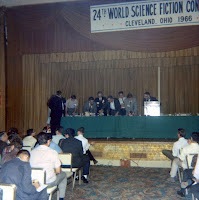
Worldcon has changed since
the 1960s and 1970s.
(Image via Fanac.org)

What’s striking is that these categories aren’t significantly declining in popularity, but rather, they’re just failing to keep pace with the growth of interest in categories with greater mass appeal. This makes them dangerously close to being punished for the popularity of the big-ticket Hugos such as Best Novel and Best Dramatic Presentation.

Section 3.12.2 of the WSFS Constitution – the document that governs Hugo Awards administration – described one of the circumstances under which an awards category should fail to be presented.

3.12.2: “No Award” shall be given whenever the total number of valid ballots cast for a specific category (excluding those cast for “No Award” in first place) is less than twenty-five per cent (25%) of the total number of final Award ballots received.

Since 2,362 final Award ballots were cast in 2021, if any category received fewer than 591 votes in the
Diana M. Pho was nearly denied her
well-deserved first Hugo for Best
Editor Long Form due to Section 3.12.2.
We are glad that she got it.
(Photo by Rokne & Wakaruk)

final count, then a result of “No Award” would have been declared. Fancast received 632 votes, barely scraping past that 25 per cent threshold. Fanzine (643 votes), Editor – Long Form (667 votes), and Fan Writer (680 votes) were all poised near the abyss. For context, consider that 591 is more votes than any category received in 1963 when this rule was first proposed. Worldcon is growing and needs a way to address category relevance that makes sense for a larger membership.

It’s interesting to note that if just 159 more people had cast ballots for Best Novel without voting for Best Fanzine, then Nerds of a Feather would not have taken home the Hugo Award they so richly deserve. This points out a flaw in the current rules: the slightly more niche categories might end up being punished for the success of the higher-profile award categories.

From a read of fanzines contemporaneous to the creation of this rule, it doesn’t appear that this was what was intended by the rule. At the time, people kvetched about the possibility of categories in which the Hugo winner received 10 or fewer votes. It does not appear that they were worried about categories in which more than 500 people were voting.

Section 3.12.2 has a long and interesting history, with the original version of the rule appearing in the 1964 Constitution, having been added in the wake of concerns over the remarkably small number of voters participating in the 1963 Hugo Awards process. At this time, there was no specific threshold, but rather the rules provided Hugo Administrators the ability to nix a category based on “a marked lack of interest in the category on the part of voters.”

It should be noted that this was added at a time when fewer than 200 people participated in the nominating process, and fewer than 300 people voted on the final ballot. Rules crafted for the circumstances of the 1960s and 1970s do not necessarily work in the context of the 2020s.

Because of missing documents, we cannot pin down exactly when the rule in its current form was codified, but it was either in 1978 or 1979. As far as we can tell, this clarification was based on the work of Ben Yalow. By adding a specific threshold of 25 per cent to the rule, his proposal helped bring clarity to the process, and ensured that categories weren’t dismissed on the whim of any given committee.

“Hugo Administrators have a lot of discretion, but really hate to use it since all it does is get the convention criticized,” Yalow explains. “So giving specific rules, rather than broad general guidelines, keeps administrators out of the line of fire.”
The legendary Ben Yalow, whose
contributions to the WSFS constitution
are innumerable, helped craft
Section 3.12.2 in its current form.
(Photo by Rokne & Wakaruk)

In the late 1970s, this was an important and positive change; and the 25 per cent threshold made sense at that time, but things have changed in 40 years, and this threshold needs to be revised.

Over the course of the 1970s, the Hugos had an average of 800 people voting on the final Hugo ballot; at the time the “no Award presentation” threshold could be assumed to be 200 votes or so. And if a category were to only garner 200 votes, one could understand that this might be a sign that there was a lack of interest.

This rule also comes from a time in which there was far more parity between the number of votes in various categories. In 1980 (the first year that we have full voting statistics on the Hugos for), the category which received the fewest votes was Best Fan Writer. In that year, 884 out of 1,788 Hugo voters voted for Fan Writer, giving that category a participation rate of 49 per cent.

Four decades later, the number of people voting in the Fan Writer category has not substantially changed, but the numbers voting in the prose fiction categories has drastically increased. Thus, the percentage of voters engaged with this category has decreased. This means that these Hugo Award categories are being endangered not due to declining interest in those categories when counted by number of voters, but rather by the enthusiasm and growth of other categories.

Fundamentally, the decision about whether or not the Best Editor - Long Form award is worth running should not be contingent on how many people voted in the Best Dramatic Presentation category.

We would suggest that instead of a percentage threshold to indicate a lack of interest in a category, the WSFS should consider a fixed numerical threshold. Of course, just like the 25 per cent threshold, this would be an arbitrary number, but we feel that it should be set at a level that reflects a continued interest by a significant number of fans; clearly that threshold is higher than 10 people, but we’d argue that it’s also fewer than the 750 people that it might take to pass 25 per cent of a 3,000-voter Hugos that is not inconceivable in the near future. This number should be reviewed, likely every five years or so.

An alternate approach would be to change the result of a sub-25-per-cent participation in a category to a mandatory review of the category by the Hugo Awards Committee of the WSFS, rather than invalidating the work of those who did nominate and participate in the process.

Some Hugo Awards categories have become more well-known in the broader public, which is a fact that should be celebrated. But the Hugo Awards process needs to evolve to adjust to this broader acclaim without penalizing more niche award categories.

While these suggestions create more work for the WSFS Hugo Awards Study Committee, it would be an effort spent serving the mission of Worldcon and help ensure a representative, democratic process based on participation.

To repeat: The fan categories should not be doomed by the success of the prose categories.

Thursday, 6 January 2022

Hugos Unlike Any Previous

The 2022 Hugo Awards seem likely to be unlike any previous Hugos, because the Hugo-nominating constituency will be unlike any previous.

As far as we are aware, there has yet to be a Worldcon in which the largest single contingent of the membership came from anywhere other than the United States. Likewise, as far as we can determine, there has yet to be a Hugo Awards at which the plurality of votes came from anywhere other than the United States.

Even when the Worldcon was in Dublin two years ago, members living in the U.S. were the group
Even when the Worldcon was in far-off Helsinki,
there were more Americans than Fins in attendance.
(Photo by Tapio Haaja via Pixabay)

most represented in sales, with 2,750 of the 6,918 memberships (and 1,582 of the 4,190 in-person memberships) being purchased by U.S. residents. In Finland two years before that, 3,368 of the 8,748 memberships (and 1,141 of the 3,316 in-person memberships) were purchased by U.S. residents. At Japan’s 2007 Worldcon, 1,907 of the 4,010 memberships sold were purchased by U.S. residents. The complete and exact tally of how many people from each country bought memberships to Discon III is not available yet due to issues with the registration system, but similar patterns repeat in the demographic breakdown of every Worldcon for which we have found the statistics.

This dominance of American voters is reflected in the results of the Hugo Awards; almost 85 per cent of all Hugo-nominated fiction, and almost 85 per cent of all Hugo-winning fiction was written by U.S.-born authors (a statistic that’s even more revealing when one realizes that the calculation counts Isaac Asimov, Algis Budrys, and Manly Wade Wellman as not being U.S.-born.)

Editor and author Xueting
Christine Ni would be a
worthy inclusion on the Hugo
ballot. (Image via Amazon)

We predict that these statistics (which have remained fairly stable over recent decades) are about to change.

Rumours about a large number of supporting memberships being purchased in the days leading up to the 2023 Worldcon site selection vote were viral at Worldcon 2021. Turns out they were also accurate, with more than 2,400 Chinese residents purchasing supporting memberships for Discon III; approximately 1,600 of those memberships were purchased in the 10 days before the convention. The final vote tally was 2,006 votes for Chengdu to 807 for Winnipeg.
Science Fiction World prints more
than 200,000 copies every month.
(Image via CNBeta.com


We have trepidation about the Chinese government and its human rights record, but we also have respect for the fans and the bid committee behind the Chengdu Worldcon. As much as we would have preferred to see the 2023 Worldcon happen in Winnipeg, we are embarrassed to have seen the (sometimes racist) response we have seen towards the people working on the Chengdu Worldcon bid. Based on our attendance at related Worldcon 2021 sessions and conversations with members of both bids, the groups behind the 2023 bids seemed to be enthusiastic and professional, and backed by dedicated fans.

The Chengdu bid won this site selection vote through organizing, through outreach to convention runners, and through encouraging their local fans to purchase supporting memberships and to vote. As has often been pointed out by proponents of the Chendu bid, China is the country with the world’s largest number of science fiction fans. 

Based out of Chengdu, Science Fiction World (科幻世界) is the science fiction magazine with the largest circulation on Earth; comparable to the total of Analog, Asimov’s and the Magazine of Science Fiction & Fantasy combined. The 2,400 Discon III supporting memberships from China represent a fraction of a percent of the circulation of this one magazine.

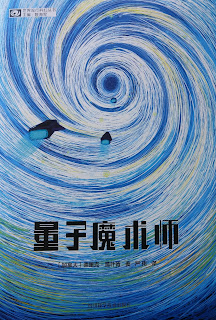
Canadian author Derek Künsken
does well in North America ...
but more than a million people
read his works in China.
(Cover of the Chinese edition
of Quantum Magician via the
publisher)

The vast majority of these memberships were bought by people who have never previously participated in voting on the Hugo Awards, as this will be their first Worldcon memberships. And excitingly, they will be eligible to nominate works for the Hugos in 2022. Given that there are usually little more than 1,000 nominating ballots cast in a given year, these supporting members of Discon III could have an enormous influence on what makes the ballot at the Chicago Worldcon. We encourage them to nominate. 

The third-highest grossing movie worldwide in 2021 was the Chinese-language time-travel movie Hi Mom. Han Song has won the Chinese Galaxy Award six times, but remains little-known among English-speaking readers. Xueting Christine Ni has been tirelessly working to promote Chinese science fiction for years, and could be recognized in one of the editor categories. And some authors underappreciated by Hugo voters (such as Derek Künsken) have found a broader audience with their works translated for Chinese-language magazines such as Non-Exist Magazine. We might also hope that these new Hugo voters will not neglect the fan categories.

There is a real possibility that the 2022 ballot could be the most surprising Hugo Awards shortlist in years — and the least U.S.-centric to date.

Thursday, 21 November 2019

The Politics of Site Selection

In the lead up to this summer’s site-selection vote for the 2021 Worldcon, a small but vocal contingent of fans argued that the convention should not be awarded to any host city in the United States.

In the end, only about twenty or thirty of the 878 site selection ballots indicated a preference to deny the convention to Washington D.C. (including one voter who explicitly cast their ballot for “Anywhere NOT in the United States.”).

This is not a position that most members of this book club endorse, particularly since a large portion
Clearly the existence of Jedward wasn't
enough to disqualify Ireland from hosting.
 (image via Eurovision.TV) 
of the existing fanbase lives in the United States. Even at Worldcons held overseas, Americans often make up the bulk of the attendance. For example, despite the geographic proximity of the United Kingdom, only 1,044 British citizens attended Worldcon 77 in Dublin, compared to 1,582 people who crossed the Atlantic from the United States for the convention. 

This raises the question of the carbon footprint of Worldcon — might the appropriate choice be to choose convention locations that reduce the amount of flying involved? Making environmental choices would prioritize U.S.-based hosts. If Hugo-winning TV series The Good Place has taught us anything, it’s that few choices are clear-cut good or bad. 

So when should government misdeeds become disqualifying for a potential Worldcon site? Since the arguments to avoid the United States centred around political issues, perhaps the question to ask is, “Under what conditions should the Worldcon membership reject a host country?” 

Perhaps the WSFS could convene a committee looking at various measures of political freedom that could be used to craft minimum requirements for a nation to host Worldcon. Some obvious, base, criteria should include safety, accessibility, civil liberties (such as free speech). Even these simple criteria, of course, are subject to interpretation and discussion. 

For the purpose of discussion, then, the United States of 2021 is less likely to meet security requirements than the United States of 2015 was. Hate crimes (particularly those against latinos) have seen a sharp increase in the past few years, so evidently attending a Worldcon in the United States is now less safe for members of marginalized groups. It is even conceivable that there might come a day when we would actively campaign against hosting any events in the U.S.A. (For the record, neither 2021 nor 2022 is likely to be that day.) 

The frequency of Worldcons being held outside of the United States has increased significantly in the past decade; almost half of all non-American Worldcons have occurred in the past 20 years. Next summer’s Worldcon will mark only the second time that there have been back-to-back non-U.S. Worldcons, and the first time that there have been back-to-back non-North-American Worldcons. This is an interesting development, as it indicates the growing internationalism of fandom, but it also means that a Worldcon might end up being hosted by an undemocratic nation. Would any of us want to attend a Worldcon in North Korea, Saudi Arabia, or the Sultanate of Brunei? 

These are obviously ridiculous examples, but it is the marginal cases such as Brazil, Hungary, or Mexico that we should really think about. These are countries that could realistically host a Worldcon and have the sort of fan populations that might consider putting together a bid. But for reasons of personal safety, risk of hate crimes, or government censorship, we would argue they might be less suitable as hosts than the United States. What happens when a work critical of a local government is nominated in a place that has a history of censorship? 

It is interesting that the Freedom Of The World Index, ranks the United States as the least free
Chengdu is known for giant pandas,
ancient irrigation systems and the
persecution of religious minorities.
 (Image via internasia.com)
country that has hosted a Worldcon, although the 2023 Chengdu bid would undercut that dubious distinction. 

If the options are “Hold a Worldcon in China, or don’t hold a Worldcon at all that year,” we do not know which option we would choose. But thankfully, that’s not a question that is being asked of site selection voters, as there are two reasonable competing bids for 2023. 

Recent global declines in democratic governance and the rise of authoritarian leaders, combined with the increasing globalization of science fiction fandom means that the question of what conditions qualify a country to host Worldcons is now one that members should begin debating. 

We believe that although the anti-D.C. crowd were premature in suggesting a boycott of the United States, they are right in arguing that the human rights and civil liberties record of a host nation should be significant factors.

Monday, 26 June 2017

I read it so you don’t have to: Black Genesis

In the 64-year history of the Hugo Awards, about 300 novels have been on the shortlist. Not all of them have been great, and some have been risible. But there is no book other than Black Genesis whose inclusion is as contemptible.
The cover might offer
a clue as to some of the
racial attitudes within.
(Image via ABEBooks.com)

Black Genesis by L. Ron Hubbard made it onto the Hugo Shortlist in 1987 under dubious circumstances. According to those who were involved in Conspiracy '87 (where the awards were handed out), a majority of the book’s nominating ballots were photocopies and were submitted by people who had no prior involvement with Worldcon, and who did not turn up in person for the event. 

But even if the tactics were questionable, and even if it was an unworthy book, the rules are the rules, so its nomination stands. Mr. Hubbard is immortalized as a Hugo-nominated author.

If there had to be a major push to get Hubbard a posthumous nomination, it beggars belief that Black Genesis would be the vehicle through which they chose to do so.

Not His Best Book


Hubbard was once capable of writing an engaging, entertaining fast-paced action novel. To The Stars shows his basic competence as a writer of adventure stories. Final Blackout is actually pretty good, despite fascistic themes. Battlefield Earth is silly, but surprisingly fun.
Hubbard was capable of
writing, even if some of
his books were fascistic.
(Image via Amazon.com)


Few of these works would have necessarily warranted a Hugo nomination, but none of them would have been an insult to the nomination process. The same cannot be said about Black Genesis.  

To fully appreciate the scope of Black Genesis’ failings, one has to experience it as the second part in the 10-part Mission Earth series. The first volume (The Invaders Plan) sets up antihero protagonist Soltan Gris as the sidekick to a noble, incorruptible übermench Jettero Heller, as they are sent to Earth to prevent humanity from wiping itself out so that 50 years from now the Voltarian Empire they serve can conquer the planet.

Unbeknownst to Heller, Gris is part of the Voltarian secret police, and for arcane and labyrinthine reasons he is trying to undermine Heller.

That first (615-page) book consists of nothing but these two characters planning and outfitting their mission. Hugo-nominated novel Black Genesis starts with the pair of them arriving on Earth and beginning to set their respective schemes in motion.

Unpleasant Antihero


Gris is one of the most deeply unpleasant protagonists in all of science fiction. This is clearly intentional, since Hubbard is ham-handed in his efforts to make Gris seem like a jerk. But the intentionality does nothing to mitigate how little fun it is to read Gris’ whinging internal narrative.

L. Ron Hubbard composed a soundtrack
to the 10-volume Mission Earth series.
The official album, performed by
Edgar Winter can be listened to here.
(Image via allmusic.com) 
Given the author’s well-known aversion to psychiatry, it will not astonish anyone that one of the primary antagonists of the book is a psychiatrist, and given his dislike of government, the depiction of the Voltarian Empire’s bureaucracy as hopelessly inept seems inevitable.


What is more surprising is the deep-seated racism, the simmering sexism, and virulent anti-gay attitudes on display. Some of this is framed as ‘satire’ or ‘social commentary.’ But if it is either of these things, it does not work.

Beyond Hubbard’s deeply unpleasant political beliefs are the underlying structural issues that undermine this bloated novel.

Often the middle part of a trilogy fails to advance the overall plot because the dénouement has to wait until the concluding book. In the case of this 10-volume series, it’s clear by the second book that nothing significant will happen until several more tomes are complete.  

Contrived and Meandering


If you like Black Genesis, there are nine
more volumes for you to read. 
So Gris and Heller spend this book (and the next) in a series of contrived happenstances that exist only as mild annoyances and opportunities for Hubbard to proselytize. The plot meanders and wanders from one example of how awful, incompetent and venal Gris is to the next, without actually advancing the character’s supposed long-term goals.


It is deeply unfortunate that this book was on the Hugo shortlist, both on a moral and on an artistic level. That being said, it does put into perspective the relative quality some other lesser nominees, and makes us appreciate their merits.

Black Genesis placed sixth out of five nominees in 1987, losing to Orson Scott Card’s Speaker For The Dead, and finishing behind ‘no award.’ It was a deserved loss.