Showing posts with label Near Future. Show all posts

Friday, 13 February 2026

Midwife Crisis (or Regressive Theocracy For Fun and Prophet)

In a year that has been difficult for many in North America, Naomi Kritzer’s new novella Obstetrix reminds us of the solace and strength that can be found through stories. The book, which bills itself as a rebuke to fundamentalist interpretations of religion, is at its core a celebration of the importance of literature (and fantastical literature in this instance) and how it can keep us grounded in times of adversity and stress.
Although it focuses less on
reproductive rights, Obstetrix
still provides commentary
on modern misogyny.
(Image via MacMillan)


Set in a near-future United States where women’s access to reproductive rights have faced further erosion, Obstetrix follows obstetrician Dr. Elizabeth Gwynn. The book’s setup centres on Gwynn’s criminal charges for performing a medically necessary abortion, forcing her to flee North Dakota. This suggests that Kritzer has set her sights on a work criticizing the broad-scale rising tide of authoritarian right-wing misogynist politics in her home country. However, the story quickly narrows its focus and policy issues take a back seat.

Within the first chapter, Gwynn is kidnapped by an eschatological sect and imprisoned in a compound run by fundamentalists with a narrow interpretation of the Bible. These Christian cultists force their children to get married at the age of 14, and expect every married woman to bear children on a regular basis. Gwynn’s role is to serve as their captive obstetrician, handling the complications of childbirth alongside other medical issues that arise on the compound.

Rather than offer us an over-the-top cult, Kritzer depicts a group based on a fairly mundane, bland, and terrifying version of Christianity that is removed from the American mainstream by degrees, rather than leaps and bounds. Their misogynistic control of women is fairly easy to find textual support for in the King James Bible, and the close-minded censorship and rejection of literature is not much different than many Christian groups that sprung up throughout America’s Second Great Awakening. The cult is scary precisely because its most fervent adherents could well be people we all know.

Kritzer has clearly spent some effort thinking about how a person of Gwynn’s educational and professional background might go about solving problems. For example, her approaches to handling the psychological pressures of dealing with the insanity of a fundamentalist sect are informed by medical practice and experience dealing with newborns and distraught new parents.

Since the cult has prohibited all books (even the Bible can only be read by the cult leader Father John), the captive Gwynn first finds comfort in trying to recount passages from a favourite novel titled, The Onyx Dagger. She then builds a semblance of community with select other women in the camp by sharing stories from the book. These other characters go on to play an important role in the denouement.

If anything is likely to keep Obstetrix from the Hugo ballot it’s that the award has often been likelier to recognize works that are more overt in their fantastical elements. This is instead a near-future dystopia that is sometimes indistinguishable from present-day U.S. What little technological progress may have taken place is largely outside of the purview of the story.

Given the turmoil in Kritzer’s home town of Minneapolis this winter, it is interesting that this book — which had to have been written prior to the chaotic deployment of armed officers from Immigration and Customs Enforcement — seems to speak so directly to the present moment. If anything, events are outpacing the fiction we turn to as a source of comfort in these trying times.

Sunday, 7 January 2024

The Last Trumpet Shall Sound

In 2023, the Campo Grande Treefrog went extinct.
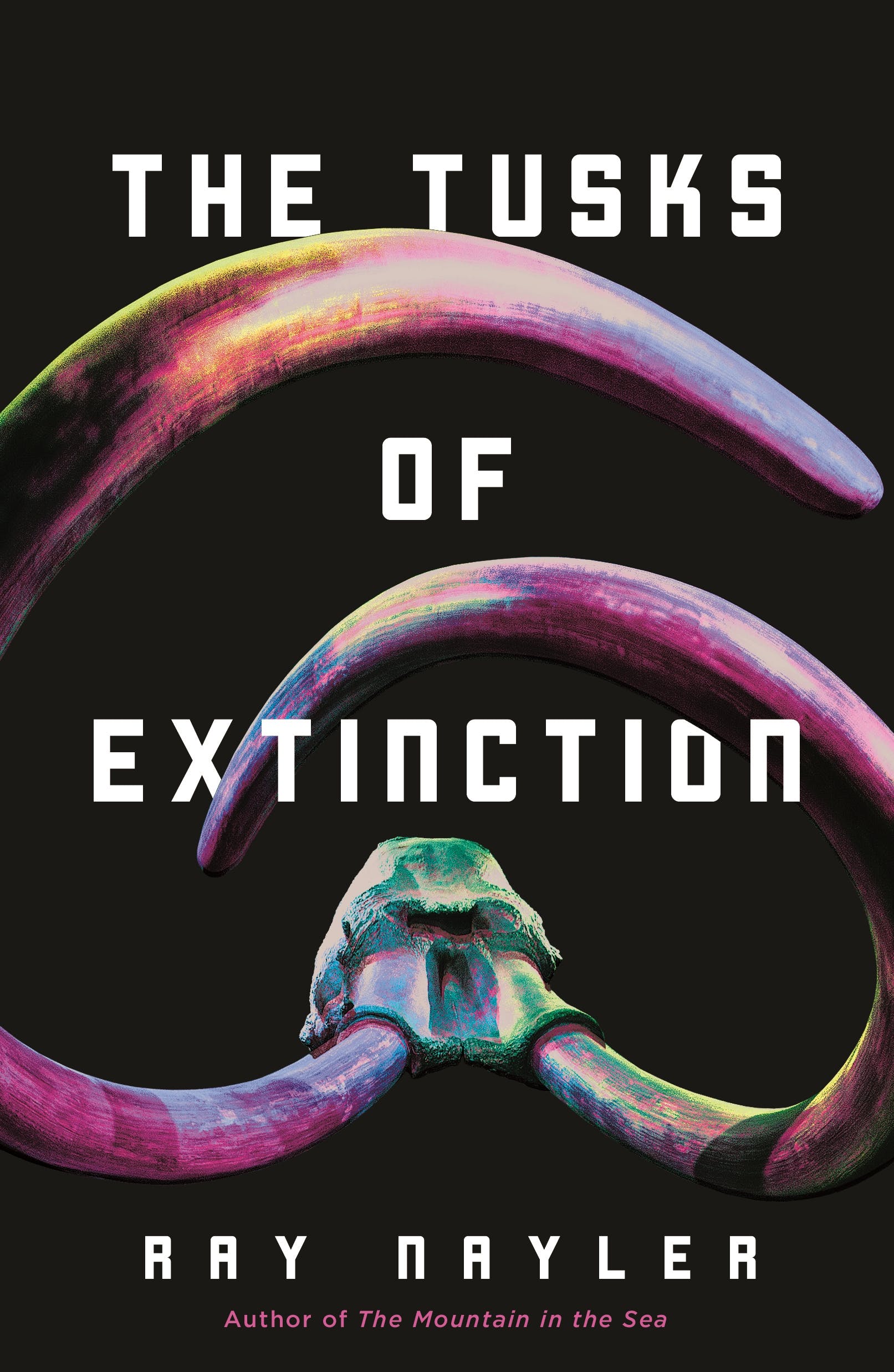
Theres a very real chance that
in the not-too-distant future,
the elephant will trumpet its last.

(Image via Goodreads)


Its loud and distinctive croaking now exists only in recordings. It was one of hundreds of animals that disappeared from the planet last year as human-driven climate change, pollution, and other forms of habitat destruction ravaged ecosystems.

Javan rhinos, orangutans, sea turtles, saolas, pangolins, and elephants are all dying out. Make no mistake: this is a crisis that will have profound downstream consequences for humanity.

Ray Nayler focused his best-selling novel The Mountain In The Sea on this extinction crisis, depicting the extirpation of sea life from the oceans and its impact on humans. But despite the grim subject, the book offers an undercurrent of hope. His new novella The Tusks of Extinction acts as a darker, angrier, possibly necessary counterpoint to the earlier work.

The Mountain in the Sea had its roots in the ecological preservation work I engaged in in Vietnam. That work was preventative and positive, working with youth and with environmental activists to protect the Con Dao Archipelago,” Nayler explained by email in early January. “The Tusks of Extinction has its roots in my experiences in Vietnam dealing with the illegal ivory trade and the trade in rhino horn. That work exposed me to the grimmest realities of human greed, ignorance, and exploitation. The enormity of the slaughter of elephants and rhinos for the sake of useless trinkets and the stupidest pseudo-medicinal ideas.”

The result is an uncomfortable read that will resonate with many and deserves serious consideration in every award category for which it is eligible. It’s science fiction deeply rooted in truth … and the current truth hurts.

As the book begins, scientists are recreating mammoths as a last ditch effort to keep the elephantidae family in existence. Siberia provides isolated stretches of open country, improving the odds for the wild megafauna. Since elephants — and their mammoth cousins — depend on generational knowledge to survive in the wild, the project is forced to recruit the recorded consciousness of a long-dead elephant conservation activist and researcher.

The novella follows three narrators who offer differing perspectives on an attempt to reintroduce the wooly mammoth into the wild: murdered elephant researcher Dr. Damira Khismatullina, uploaded into a mammoth matriarch; young apprentice poacher Syvatoslav; and ultra-rich big-game hunter’s spouse Vladimir.

About 100 African elephants are killed every day
to fuel the illegal trade in ivory. The villain — as is
often the case — is rapacious unchecked capitalism.
(Image via Science.org)
The protagonists are tragic figures; Svyatoslav is the son of a callous and violent hunter who cares for little other than money. Although he feels revulsion at the senseless slaughter, economic hardship and cultural pressure force him to participate. Vladimir is in a relationship with someone who thinks his apex capitalist money can buy love, and Damira has seen her life’s work destroyed by rapacious capitalism.

While humanity’s role in mass extinction is the main theme of the novella, an important sub theme is the relationship between senses, memory, and self identity. After her resurrection in the mammoth, Damira’s experience of the world is radically different, as is her relationship with memory. Assumptions about mind-body dualism are baked into the SF trope of uploading consciousness, and it’s refreshing to see these assumptions challenged.

“In a large part, The Tusks of Extinction is an exploration of the embodiment of mind, and also of the physical reality — the enormity — of our embodiment in the world,” Nayler says. “The mental changes Damira undergoes as a mammoth are a rebuttal of the idea of mind as separate from body and the sensory apparatus. The Tusks of Extinction is an expression of my anti-Cartesian view of the world. We exist in a physical body which exists in an ecosystem. The idea that we are floating intellects which can do as we will is one of the most damaging in human history: our lives are contingent, at all times, on physical reality and our place in it. The realization of that demands a corresponding ethics.”

The rationale behind the fictional project is expertly mapped out; research has shown that wooly mammoths enabled arctic ecosystems to store more CO2 than they otherwise would have. Having the mammoths back in the environment would disperse seeds, and increase resilience to climate change. Nayler gets the details right, and this helps make his larger arguments more believable and compelling.

Grounded in his experiences, Nayler offers insights about the social and economic conditions that lead to poaching. Svyatoslav, for example, is written with compassion and in a way that reflects on the endurance of those who lack the power to change a system that does not value their lives.

Hitting bookstore shelves during a decade when a significant portion of the SFF community seems to be seeking out comfort reads and hopepunk, The Tusks of Extinction may not appeal to all genre readers. But sometimes, sorrow is warranted and sometimes, there’s value in righteous anger.

It’s worth being angry about the potential loss of 44,000 species. As Nayler puts it: “We are intellectual animals with grand capacities, capable of living ethically and morally. It's time we used our brains to act in ways that prove we deserve to be on this planet, and that the human experiment is not doomed to be a destructive failure.”

We hope this novella finds the readership it deserves, and helps motivate some readers to take action.

Friday, 19 February 2021

Logging Back In To CatNet

One of the concerns we have about the creation of the Lodestar Award is that its existence could prevent deserving books from earning a spot on the ballot for the Best Novel Hugo Award. That is, books written for a certain age group might all be sequestered into the Lodestar by default, when they might also be strong candidates for a Hugo award.

Fans of “adult” science fiction should not ignore Chaos On CatNet.
Chaos on CatNet is
the sequel to Naomi
Kritzer's award-winning
Catfishing on CatNet.


Set in the very-near future, the CatNet novels centre on a high-school-age girl Steph, who is befriended by a friendly web-based artificial intelligence that goes by the handle Cheshire Cat. The previous works in the series (the Hugo-winning short story “Cat Pictures Please,” and the Lodestar-winning novel Catfishing on CatNet) focused on the good that a highly intelligent AI with access to big data could do, and on battles over control of data. In Chaos on Catnet, Kritzer starts to look at the other side of the same coin.

Picking up within weeks of where Catfishing on CatNet left off, this latest novel introduces a second artificial intelligence — one whose goals and motivations are murkier than a simple appreciation of domestic felines. This major plot-line explores just how creepy and ugly AI-directed behavioural change algorithms can get; both in terms of beguiling people into destructive fantasy-based worldviews, and in terms of turning people against each other. The fact that Kritzer ties these algorithms both to destructive religion and to tribalist Q-Anon style groups is telling, and insightful.

This book is set in the very, very near future. There are self-driving taxi cabs, the General Dynamics quadruped robots are now consumer-ready, but there are no technological advances that are overly fantastical. In many ways, Kritzer is in conversation with several other authors who have been playing in similar sandboxes: people like Karl Schroeder and Cory Doctorow. It is interesting to compare Kritzer’s approach to the future of policing with that of Doctorow’s approach in his novel Attack Surface. Kritzer’s thoughtful, hopeful blueprint for a better system of policing in Minneapolis is a highlight of the book.

One aspect of the novel that helps elevate Chaos On CatNet above the preceding CatNet works is the
Minneapolis - a city rich with
labour history and for many years
the heart of the flour industry
is a terrific setting for this novel.
(Image via PIXY.org)

use of space and place. Kritzer’s near-future Minneapolis is recognizable to those who have spent time in the city, but also offers a constructive and thoughtful framework for how a city might respond to the riots of last summer. Those riots — which she briefly writes about in a terrific afterword — took place as she was in the process of revising and editing her draft. She decided to “write the Minneapolis you want to see.”

In many ways the present is already catching up to a novel whose first draft was probably written just over a year ago: the chaos caused by the AI antagonist has clear parallels to the ways in which social media algorithms helped fuel the January 6 attack on the U.S. Capitol.

Late in the novel, there are some plot elements that seem to vanish mid-stream (What happened to the big scary robot army? We don’t know!), and the ending is a little too nice and convenient. But despite these quibbles, the novel holds together remarkably well.

Chaos On Catnet should be seriously considered for the Hugo Award for best novel alongside other more “adult” works.

Sunday, 31 May 2020

Attack Surface: A Novel For Today

After the events of a weekend in which waves of violence overtook American streets, I find myself wishing that Cory Doctorow’s upcoming novel Attack Surface were already available.

It’s a novel that is perfectly suited to inform national dialogues about police violence, how
A photograph from today's Detroit
Free Press
could have been pulled
straight out of Cory Doctorow's new book. 
technology can undermine or promote human freedom, and how members of the dominant culture can be allies in combating injustices committed against marginalized groups.

Picking up a decade after the events of Doctorow's Hugo-shortlisted novel Little Brother, this new book follows the career of Masha Maximow, the hacker/programmer who showed up briefly in previous stories.

As an anti-hero protagonist working for private security firms, Maximow's loyalties are split between the well-funded realpolitik employers that let her live in luxury, and the idealistic friends and allies she helps in secret. This makes for interesting internal character tensions, as well as opportunities for Doctorow to delve into the details of computer security and encryption.

One of Doctorow’s strengths as a writer is his ability to tackle complex real-world computer security issues with a depth of knowledge, while making the subject accessible to lay readers. He also makes it evident why the subject — and the nuances he's describing — are of immediate relevance to the plot.

Where the book stumbles is when Maximow reconnects with her former antagonist and ally Marcus Yallow, who was the protagonist of Doctorow’s previous novels Little Brother and Homeland. Yallow’s wide-eyed techno-utopianism feels at-odds with the more pragmatic worldview that has informed Maximow’s life for the majority of the book. Maximow’s subsequent road to Damascus moment is unconvincing at best. This tonal confusion may in part be explained by the unusual placement of Attack Surface as a novel for adults that is a continuation of a story set by two YA novels.

Major portions of Attack Surface are spent in protest scenes that are nearly identical to those plastered
Attack Surface will be
released on October 18,
2020. It could not be
more timely today.
(Image via MacMillan)
across every news station in the U.S.A. right now, and Doctorow captures the hope, the fear, and the confusion of these types of events. Any reader who has participated in a protest that was targeted by the police will recognize that Doctorow is clearly writing from experience.

Some of the police tactics that Doctorow describes — including kettling, deliberate provocations, and cell phone jamming — have been on display over the past few days. The ways in which the protagonists of Attack Surface circumvent those tactics are not always as effective as Doctorow describes, but the novel still provides a good crash course in some forms of effective protest management.

Given the events of this past weekend, I wonder if Doctorow underestimated the willingness of American police officers to act with unmitigated violence, and if he overestimated the judicial system’s ability to hold those police officers accountable.

Despite the ways in which Doctorow depicts omnipresent surveillance, privatized military being turned against citizens, and corporate corrosion of democratic accountability, Attack Surface is at its heart a hopeful novel. This is a story in which protests work and in which individual actors are able to affect change for the better. I am not sure that I found that believable, but at this present moment many readers might need something hopeful.

Attack Surface is a vital and necessary contribution to the public discourse. Doctorow is extremely talented at diagnosing potential problems with new technologies being used to subvert human freedom, even when the resolution to the story he tells might ring hollow.

I wish it were available now, rather than being released in October. 

Wednesday, 11 December 2019

The Ebullient Imagination of Stealing Worlds

Optimistic and replete with ebullient imagination, Stealing Worlds is a compelling techno-thriller
Karl Schroeder's at his best
when proposing new ways to
organize political power.
(Image via Goodreads)
elevated by first-rate near-future world-building.

At one level, the plot is a fairly linear whodunnit; On the run from shadowy figures, protagonist Sura Neelin finds refuge in an augmented-reality game world that allows her to hide in plain sight. As she learns more about her new-found community, she investigates the circumstances around her father’s death.

But at another level, it is the story of revolutionary societal change. It is on this second level that the novel succeeds most fully.

Stealing Worlds is a highly political novel, not in a partisan sense, but because it offers thought experiments about how power structures can be organized. While the book depicts a global capitalist structure that continues to erode human freedom, Schroeder also envisions self-organizing communities that work in the interstices of the modern world. New technology and tools evolve to allow for the exploitation of idle and forgotten resources, to the benefit of those left behind or targeted maliciously by those in power.

The most interesting innovations in the novel, however, don’t come from the technology of augmented reality, but from cleverly imagined legal constructions. Schroeder’s idea of giving legal life to inanimate objects and abstract ideas is the most intriguing part of the story. To accomplish this, Artificial Intelligences (AI) are programmed to operate on behalf of eagles, forests, and other entities and to bargain with people to meet the needs of that legal entity. For example, an AI responsible for the legal personhood of a forest might negotiate the sale of lumber to pay for reclamation or protection. More complex ecosystems might comprise numerous, smaller AI actors that coordinate the survival of, for example, a boreal forest by ensuring the rivers are clean, the animals are not overhunted, and enough habitat remains to support life. Using markets to place value on natural resources isn’t a new idea but this agency provides the natural resources a mind-blowing role in the process.

Schroeder demands more than a passing level of technical knowledge. For example, basic levels of
A futurist by trade and
training, Schroeder brings
intellectual rigor to near-
future science fiction.
(Image via KarlSchroeder.com)
blockchain and cryptocurrency literacy help. While this may turn off some readers, it will make the work more engaging for others. Impressively, Schroeder doesn’t condescend, but builds and explores these concepts for a wide range of readers.

The novel has a clear separation between worldbuilding and adventure. Sura’s path weaves between investigating her father’s death and learning about the hidden world of augmented reality. While reading the thriller portions of the novel, we were left wanting more of the intellectual story and the sharp critique of our world. When delving into the world building, we occasionally forgot entirely about the narrative because we got lost in Schroeder’s irrepressible imagination.

Often, when reviewers focus their praise on a book’s worldbuilding, it is a sign that the book might have significant flaws in other areas. In the case of Stealing Worlds, it is an indication that the novel is possibly the crowning achievement of one of science fiction’s most accomplished — and optimistic — futurists.

The fact that Schroeder proposes a believable and positive vision of the future puts this among our favourite novels of 2019.

Friday, 12 July 2019

The value of Speculative Opinion

This spring, an exciting new series of short science fiction was launched in an improbable publication: The New York Times.
John Karborn has illustrated most
of the articles in the series with
evocative conceptual art.
(Image via New York Times)

Op-Eds From The Future is a feature in America’s paper of record that appears every second week, in which an academic or science fiction author tackles a political issue from the perspective of an editorialist writing in the not-too-distant future.

Given that the series has so far included submissions written by luminaries such as Cory Doctorow, Malka Older, Ted Chiang, and Brooke Bolander, it is unsurprising that the results of this experiment have been compelling.

Masterminded by the paper’s op-ed technology editor Susan Fowler, this project shows the integral connection between science fiction and politics, demonstrating the relevance of the genre to a wider (mundane) audience. Speculative opinion is not standard fare for the New York Times, but it is a very welcome addition.

“Science fiction is so powerful and effective because it takes the problems and issues we face today and puts them into new situations and contexts, allowing us to see them more clearly,” Fowler explained on Twitter. Put another way, the series provides a type of public service.

Every second Monday, the Times publishes a new piece, tackling issues as varied as the intersection of income inequality and genetic engineering, the possible effects of anti-hate speech legislation on internet discourse, and the rights of persons displaced by climate change.

Using the traditional structure of an op-ed to explore a science fictional idea lays bare the political nature of the genre. The futurist nature of these works connects the changing role of technology with the practicalities of policies elected officials might enact as a result.

The format and venue also forces authors to hew closely to constraints of hard science fiction; there is a level of solemnity to the Grey Lady that inspires seriousness in its authors. We suspect that this lean towards hard science is also the product of Fowler’s editorial vision, which we appreciate.

Though several luminaries of science fiction have been featured thus far, those invited to submit articles to the series are not limited to genre professionals  University of Connecticut professor Susan Schneider penned one on the nature of consciousness. 

One of the joys of this series is quickly becoming the Monday-morning anticipation of discovering who has penned the latest installment. Although we have a long list of thinkers we would love to see play in this particular sandbox (i.e. Vernor Vinge, Madeline Ashby, Karl Schroeder …), we suspect that we will be surprised and delighted by the people Fowler has lined up for the coming weeks.

Susan Fowler masterminded the new
series appearing in the New York Times.
(Image via BizJournals)

We would love to see this series included in next year's Hugo shortlist. But there isn’t an obvious category at the Hugo Awards to recognize the importance of this contribution. Susan Fowler is not eligible for Best Editor, nor would it be fair to compare her work to that of editors working on publications dedicated to the genre. The individual Op-Eds might technically fit into the Short Story category, but to us, the value of the overall project is greater than the sum of its parts. We are likely to suggest including the overall Op-Eds From The Future project in the Best Related Work category (though even that is a slightly odd fit that Hugo administrators might find reason to reject).

This is a series that we look forward to reading every week, and hope that the New York Times continues it over the long-term. Even better, we hope to see competitor pieces in other established dailies make this a staple of tomorrow’s newspapers.

Thursday, 27 June 2019

Make Time For Years And Years

Russel T. Davies has usually been the wet firecracker of television writers. Despite this, he has given
Emma Thompson headlines a superb cast
in the BBC/HBO series Years and Years.
(image via iNews
viewers possibly the best science fiction on television in 2019 with his six-part miniseries Years And Years.

Over the course of more than 20 years writing for television, Davies has built a reputation as a capable writer who crafts diverse and emotionally compelling characters, builds suspense and tension effectively, and then pulls the rug out from under viewers through trite and banal endings.

This tendency was the signature aspect of his work on Doctor Who. As we have noted before, deus ex machina is his stock in trade. In the penultimate episode of DW’s Season 2 (The Sound of Drums), The Master is built up into an imposing and compelling adversary, but in the finale he’s defeated by people thinking happy thoughts. In Daleks in Manhattan/Evolution Of The Daleks, the entirety of the plot of the two-part episode is undone in seconds through largely incomprehensible means.

His new six-episode series premiered on HBO on Monday night, shortly after completing its initial run on the BBC. True to his oeuvre, Davies’ sixth and final hour-long episode of Years And Years might not stick the landing, but the previous five episodes are compelling enough to make up for that.

The series chronicles the intertwined stories of a multi-generational family living in and near Manchester over the course of 15 years starting in 2019.

The four middle-aged siblings; Stephen, Daniel, Rosie and Edith Lyons, their grandmother, their spouses and their children provide viewers with different vantage points of a rapidly changing future that is marked with chaos and uncertainty. Woven throughout the series are the rise and ramifications of a far-right political figure Vivienne Rook, which give viewers cause for reflection on current populist political movements.

There’s a soap-opera nature to the series that occasionally feels improbable, but that same aspect
Russel T. Davies can't deliver a good
ending, but for once that doesn't
spoil the overall greatness of a show.
(image via BBC)
makes it easy to suspend disbelief about technological speculation while being pulled into the emotional lives of compellingly flawed characters. When banks fail and brownouts become the norm, you both see and feel the impact on consumers and homeowners. When medical technology advances and health care is privatized, you see and feel what it means for both the person affected and those close to them.

Some of the brilliance of the series is not even what it shows explicitly, but in what is implied in throw-away lines. Bananas are extinct? It’s not safe for U.K. citizens to visit the U.S. anymore? The Tower of Pisa is no longer leaning? There are so many details to appreciate.

The final episode is a disappointment in exceptionally predictable ways. Bad guys are defeated in a particularly trite (and improbable) ending that undermines some of the emotional weight of the series, though at least Davies has the courage to imply that the systemic issues that led to fascism have not been overcome completely.

Years And Years is a series that is more than the sum of its parts. No single episode deserves a Best Dramatic Presentation Short Form Hugo, but the whole should be seriously considered in the Long Form category. The continuous march of technology (and those who control it) – and the creeping rise of fascism – are examined in an engaging way by the birdseye view of years and years of development over the course of all the episodes.

Does Years And Years bear all the hallmarks of Russell T. Davies’ writing? In both the best and worst ways, it does. It may also be his masterwork. Years And Years deserves very serious consideration for a Hugo.