Showing posts with label Semiprozine. Show all posts

Friday, 20 February 2026

The True North Strong And Speculative

In a year that saw concerted attacks on Canadian identity, it is particularly troubling to see that one of the country’s important literary institutions — On Spec Magazine — shut its doors and published its final issue.

The magazine’s impact cannot be overstated, but somehow, neither the magazine nor its editors have ever appeared on a Hugo Award shortlist. Given that its final issue was published in the autumn of 2025, this year will be the last that they will be eligible for most major SFF awards. As far as we can tell, the magazine has only appeared on the long-list once in 2025, placing eleventh.

There are many factors behind this omission; in recent years online-first magazines have dominated the Hugo shortlists while physically printed magazines have lagged. The magazine is less available outside of Canada, and at the last two Worldcons Canadians made up only about three per cent of Hugo voters. Despite these impediments to receiving a well-earned valedictory Hugo nod, we urge all our friends in the Worldcon community this year to consider nominating On Spec for the Best Semiprozine Hugo Award, and to consider nominating Diane Walton for Best Editor - Short Form.

Cory Doctorow, whose first story was published in the magazine put it succinctly: “More than any other publication, anthology or project, On Spec defined and refined Canadian sf. It was always on the leading edge, always editorially daring, and always brilliant. Losing On Spec is a huge blow to our field. It deserves recognition.”
Cory Doctorow's first published story was in 
the winter 1990 issue of On Spec.
(Image via On Spec)


On Spec
was founded in 1989, after a group of writers observed that there was no paying market in Canada for short-form speculative fiction. Some writers even complained that editors outside of the country would ask for their draft stories be made “less Canadian” before they could be accepted or published. It was a team that included Colin Bamsey, Jena Bamsey, Matt Bamsey, Tim Hammell, Ray Lirette, Marianne Nielsen, Paul Rogers, Hazel Sangster, Larry Scott, Phyllis Schuell, Diane Walton, Donna Weis and Lyle Weis, as well as an advisory board consisting of Douglas Barbour, Candas Jane Dorsey, J. Brian Clarke, Pauline Gedge and Monica Hughes.

From the outset, this founding group strived to create a magazine that reflected Canada’s multicultural identity and to include marginalized perspectives within speculative storytelling.

“For a lot of writers, Canadian or otherwise, publication in On Spec was an important signpost and the beginning of many Canadian and international careers,” editor and novelist Hayden Trenholm said about the magazine. “Recognizing it now would be a tribute to three decades of editorial accomplishment and to the hundreds of writers for whom On Spec meant: OMG, I really am a writer!”

For more than three decades, On Spec Magazine was the premier English-language publication for speculative fiction in Canada. Despite being a primarily Canadian publication, its influence on the genre has been felt across borders; it has helped launch the careers of notables such as Julie Czerneda, Cory Doctorow, Peter Watts, and Karl Schroeder; and it fostered a uniquely Canadian science fictional voice. Over the years, it has published works by almost every important science fiction writer in the country; everyone from Candas Jane Dorsey (Winter 1999 issue), Robert J. Sawyer (Summer 1993 issue), Derek Künsken (Autumn 2006 issue), Dave Duncan (Spring 1989 issue), Fiona Moore (Autumn 2016 issue), Michèle Laframboise (Spring 2022 issue), and WP Kinsella (Winter 1994 issue).
On Spec was founded at the convention ConText'89
Authors and editors who attended ConText'89.
Back row L-R: Charles de Lint, Kathryn Sinclair,
Dave Duncan, Lyle Weis, Robert Runté, J Brian Clarke,
Michael Skeet, HA Hargreaves, Doug Barbour,
Yves Meynard, Karl Schroeder, William Gibson, John Park.
Middle Row: Candas Jane Dorsey, Catherine Girczyc,
Marianne Nielsen, Judith Merril, Phyllis Gotlieb,
Nicole Luiken, Lexie Pakulak, Alice Major.
Front Row: Gerry Truscott, Diane Walton, Jena Snyder,
David Kirkpatrick, Sally McBride,
Leslie Gadallah, Eileen Kernaghan, Monica Hughes.


"On Spec was my before-and-after," said Derek Künsken. "Before On Spec sent me my very first acceptance, I felt like an aspiring writer. After that acceptance, I felt like I'd become something new. I didn't understand the impact and reach of On Spec until I saw my story reviewed online and requested for consideration by a year's best editor. On Spec helped me find other Canadian writers who are friends and colleagues and critiquers to this day."

But moreover, they published excellent works that may have not gotten the attention they deserved outside of Canada. We can still remember picking up the 1993 story Kissing Hitler by Erik Jon Spigel, a work whose commentary on the distortion and misremembering of history only seems more prescient today than when it was first published. Or Leah Bobet’s 2006 story Bliss, a brilliant little story about drug addiction that incisively lampoons middle-class fearmongering.

Almost as much as their publication history, the team from On Spec are known for the amount of community outreach that they’ve done. For most of their run, there wasn’t a science fiction convention in Western Canada without a presence from the staff of the magazine. They’d have tables in dealers’ halls, and their editors would conduct story reviews and writing workshops. They didn’t just publish science fiction and fantasy; they nurtured the community and young writers. The convention scene in Canada would have been much poorer without On Spec’s efforts.

For thirty-five years, On Spec has served as a cornerstone of Canadian speculative fiction and an internationally respected semiprozine. It’s high time that they got on the Hugo Award shortlist.

This is a year in which Canadian identity is under attack, and this is the last chance to do so. Please consider On Spec for your Hugo nominating ballot.

Sunday, 13 August 2023

The Numbers Game

Over the past decade, there has been a regularly recurring argument about the maximum number of individual contributors that can be listed for each group finalist on the Hugo ballot. This is more common with fan categories like fanzine, fancast, and semiprozine — in recent years some of the contributors lists for an individual publication have extended to several dozen names.
In 1959, editors of Cry of the Nameless
— F. M. Busby, Elinor Busby,
Burnett Toskey and Wally Weber —
became the first team of more than three
credited for a single Hugo finalist. 
(Cry of the Nameless April 1958 cover
via Fanac.org)


On one side of the argument are those who express logistical concerns about the size of the ballot. On the other side are those who want to ensure that everyone who contributed to the success of a work or publication are given nomination-level credit for their work.

The reason this argument is recurring is because the current WSFS constitution does not offer clear answers about the number of names that can be officially listed. Adding to the confusion, this question has been adjudicated differently from year to year. In 2013, up to nine people were listed per Hugo group finalist … but two years later the number was capped at five. In 2022, there was no upper limit on the number of names credited per group finalist … but this year it was capped at seven.

Since each Worldcon appoints a different Hugo Award Administrator and the decision is within their purview, it has been decided differently each year. There is also no public-facing document that explains the rationale for a limit of exactly seven this year, which makes the number seem arbitrary to observers.

The inconsistent nature of these decisions is concerning, as it calls into question the fairness of the awards process.

We would suggest inserting clarifying language into the WSFS constitution (possibly as Section 3.2.13). This clause could either provide guidance as to a maximum number of contributors per group finalist, could offer clarity about what level of involvement warrants an individual being listed as a contributor, or could state that there is no limit.

Hugo Award administration is a difficult and complex role, and we have a lot of respect for the dedicated volunteers who have taken it on over the years. We would suggest that having clarity in the WSFS constitution on this point would make this aspect of their work easier.

There is a long tradition of recognizing several individuals for a Hugo-shortlisted work; as far back as 1959, the fanzine Cry of the Nameless listed four editors on the ballot. All six members of Monty Python were credited for The Holy Grail in 1976. In 2009, the Hugo ballot credited nine individual contributors for the movie Iron Man.

The conflict over the number of credited contributors seems to have arisen in about 2013, with larger and more complicated fan publications trying to ensure that everyone involved got to call themselves a Hugo Finalist. Given that those participating in these projects are often rewarded with little other than recognition, excluding individual contributors from the “limelight” is often felt keenly.
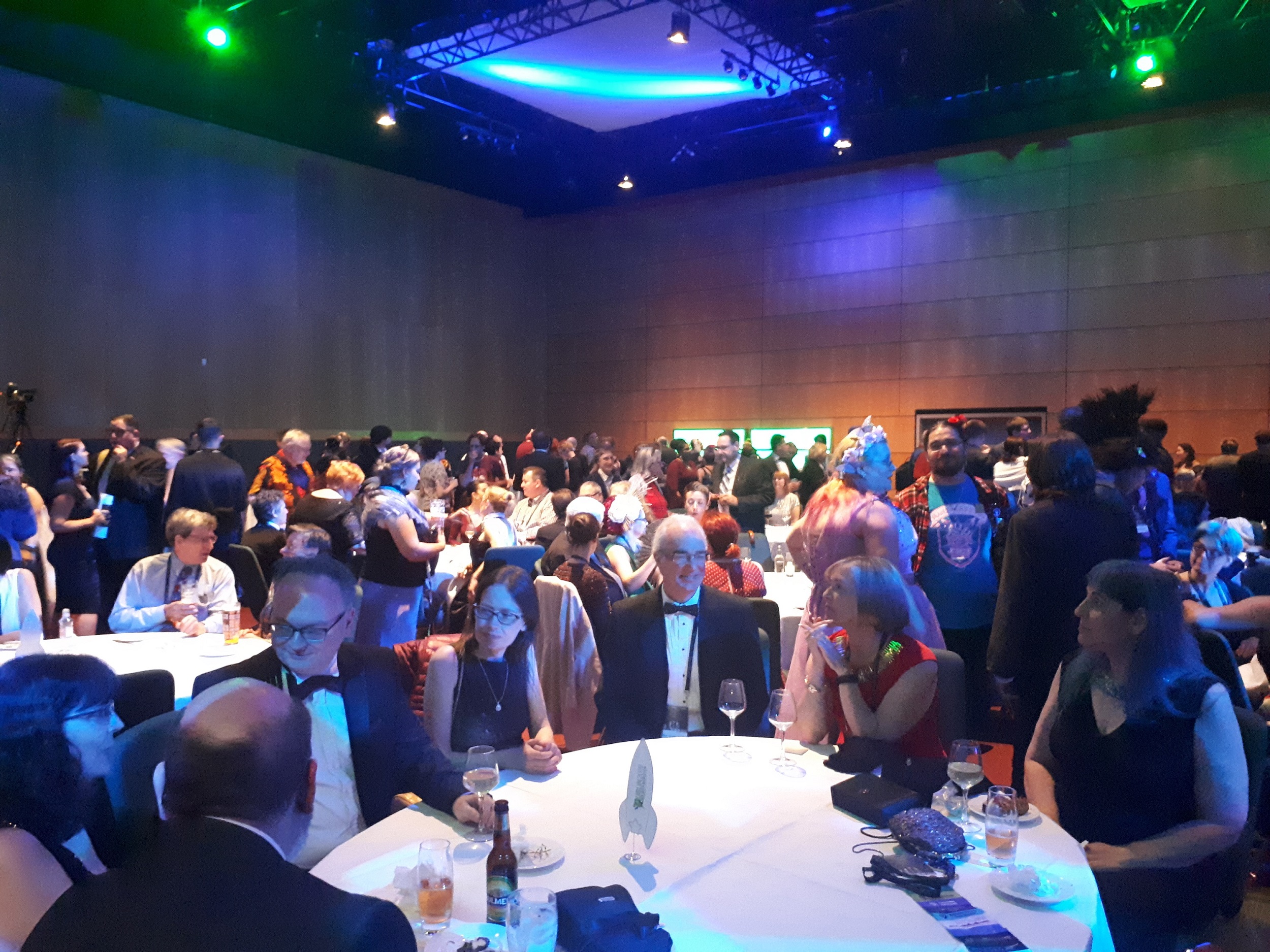
Questions have been raised over the capacity
of the pre-ceremony Hugo Awards reception.
(Photo by Cora Buhlert via File 770)


Those advocating for a more expansive approach to contributors’ lists make a colourable argument that it is often marginalized voices who get omitted from lists of contributors when limits are imposed. Having a maximum number of names per publication will possibly have a detrimental effect on creators who are non-male, who are non-American, and who are racialized.

Those advocating for a more restrictive set of rules point out that the pre-Hugo reception already has capacity issues and logistical constraints. They also suggest that if everyone gets called a “Hugo finalist,” then the status becomes devalued. In addition, the distribution of perks to Hugo finalists, such as the rocketship pins, etc., increase costs on Worldcons.

Both of these positions have merit, and neither should be dismissed out of hand. But the debate should take place in the appropriate forum. The WSFS membership on whose behalf these awards are presented deserve a say in this matter, and the way to do this is to allow both sides to make their case at a business meeting.

The Hugo Awards aren’t the only organization that has had to confront similar issues. As major Hollywood productions became more financially complex in the 1990s, the Oscars had to wrestle with how many producers could be credited for a single Best Picture. After a record-breaking five-producer movie won Best Picture winner in 1999, the Academy imposed a two-producer limit.

What should be noted, however, is that this limit was voted on by the Academy’s Board of Governors, was communicated clearly and well in advance, and was not changed arbitrarily.

Rather than having this argument play out every year over social media and through strongly-worded letters of complaint, there should be an opportunity to discuss and debate a solution at the next Worldcon.

Recognition at the Hugos should follow consistent rules that have buy-in from the community at large.

Thursday, 13 July 2017

Hugo Award 2017 Odds and Ends

There are only two days left to cast ballots on the Hugo Awards for 2017, and a lot of topics we haven’t had an opportunity to delve into on the blog. Given the short window of time, we’re just going to touch on some of the categories and nominees that probably deserve more discussion.

We don’t want to spill too much ink over the dramatic presentation categories, as this blog is mostly focused on the written fiction categories. That being said, Arrival is one of the most thoughtful and compelling big screen science fiction movies in ages. Let the Golden Globes offer their plaudits to Hidden Figures, and let the MTV Movie Awards shower praise onto Deadpool. Arrival is the type of movie that the Hugo Award for Dramatic Presentation – Long Form exists to celebrate.

In the Dramatic Presentation – Short Form category, “Leviathan Wakes” from The Expanse will get
The Expanse is great Science Fiction that
deserves to get some Hugo love.
Image via SyFy.com
our votes. It’s a good episode of a truly science fictional series that needs to get more love. Game of Thrones already has two Hugos, Doctor Who already has five (and “Doctor Mysterio” was kind of an awful episode). The experimental hip-hop album Splendor & Misery (from Hamilton alumnus Daveed Diggs) is interesting, but ultimately not to our tastes.


Give these editors their due

For Best Editor – Long Form, we’re going to put Liz Gorinsky at the top of our list. She’s nurtured some brilliant talent, seems to be nominated every year in this category, but she’s never been handed the trophy. Navah Wolfe’s work at Saga Press also should not go unnoticed.

Neil Clark of Clarksworld deserves
to finally win himself a Hugo
Image via LinkedIn
In the Best Editor – Short Form category, it’s a battle of perennial nominees, with 36 nominations between the six finalists. Our votes are going to Neil Clarke of Clarkesworld Magazine. He’s never won the award, and Clarksworld had a brilliant 2016. Literally everyone in this category deserves the award this year, so it’ll be difficult to rank our ballots.

It’s interesting to note that Sana Takeda’s excellent illustration work has been recognized both in the best Professional Artist category and in the Best Graphic Story category for the comic book series Monstress (which we wrote about earlier). Best Professional Artist is a category that really comes down to a matter of taste, but for our money, Galen Dara should take home the trophy for how varied her art is in tone and palette. Compare her cover of Lightspeed Magazine Issue 80 to the one she did for Uncanny Magazine Issue 10. The former is moody, evocative and shadowy; the latter is fun and
Galen Dara's cover of
Uncanny #10 is awesome.
Image via GalenDara.com
ebullient.
 Dara has range and depth, and needs to be recognized for that.  


Fan Award Is No Joke


We have a sneaking suspicion that Chuck Tingle might win the Best Fan Writer category, which would be a shame. In the past, Hugo voters have had a tendency to throw down-ballot awards to an in-joke (As example: Gollum's Acceptance Speech defeating Firefly in the Dramatic Presentation category in 2004), and Chuck Tingle might benefit from that tendency this year. Our votes will be going to Mike Glyer of File 770. He may have won this award four times previously (including last year), but he deserves it.
What we’ve read from the six Best Semiprozine nominees has been quite good – and the nominees are radically different from each other. Cirsova, which focuses on old-school heroic fantasy and science fiction has published some stories we’ve particularly enjoyed. The BookSmugglers does a brilliant job of talking about all-ages genre fiction, including some kick-ass interviews. These are probably our two top picks in the category.  

We haven’t read all of the Best Novella shortlisted works. That being said, the three we have read have been very strong. China Miéville is always great, and This Census Taker is well-worth voting for. The Dream-Quest of Vellitt Boe is like a masterclass in writing a modern Lovecraft pastiche. But surprisingly, we’re likely to vote for Seanan McGuire’s work. Every Heart A Doorway was likeable, and even won over those in our group who have offered disdain and vitriol for McGuire’s previous stories.   

The Hugo Award for Best Series is a bit of an odd beast. Given the number of Hugo awards that individual novels in the Vorkorsigan series has racked up, it would seem to be the favourite. But are we to judge the series on the overall quality, how well the books work together, the long-term story arcs, or on how good the series was in 2016? Since nothing like this category has been awarded since 1966, there's very little precedent on which to judge this category. We're choosing to interpret this category based on how well the books work together, and if the the series is better than the sum of its parts. By that standard, The Expanse is probably the top pick, although there's a case to be made for the Rivers of London books.