 |
| With multiple award nominations and his first novel hitting shelves, 2023 has been a great year for Wole Talabi. (Image via the author's Facebook page) |
His novelette A Dream Of Electric Mothers was shortlisted for the most prestigious awards in genre fiction, garnering nods from the Hugo Awards, the Nebula Awards, the Locus Awards, and the Sidewise Awards. His first novel Shigidi and the Brass Head of Obufalon hit shelves in August. His story ‘Blowout’ in Analog is receiving excellent reviews. And Daw Books is publishing a collection of his short works Convergence Problems, which should reach readers early in 2024.
“One can never predict such things – or even the timing for certain stories being published,” Talabi says, speaking to us from his office in Malaysia. “Shigidi was initially planned for 2022 but delayed. So it seems that things conspired to make 2023 the year that it has been.”
He adds that this annus mirabilis is part of a larger trend towards a version of science fiction and fantasy fandom that is less focused on works from North America and Europe.
“These stories have always been there,” Talabi reminds us. “African authors have been writing science fiction and fantasy for a long time. We’ve been reading global science fiction and fantasy for a long time. We just weren’t included.”
In part, he credits the success of the movie Black Panther for helping prove to publishers and studios that the public has an appetite for fantastic stories inspired by African cultures.
“But there’s also been grassroots campaigns from people across the continent,” Talabi says. “The African Speculative Fiction Society has been doing a lot to get African authors seen as part of the global science fiction and fantasy writing community.”
Talabi’s novelette A Dream of Electric Mothers was published in Africa Risen (edited by Sheree Renée Thomas, Oghenechovwe Donald Ekpeki, and Zelda Knight), which was one of the first anthologies published by a North American publisher focusing on science fiction and fantasy from African authors. He says the public response to the novelette — which explores identity, memory, and culture through artificial intelligence in an alternate history setting — has been gratifying.
 |
| The brass head of Obulafon is a Nigerian artefact from the1300s that was taken by the British Museum in 1938. (Image via SmartHistory) |
“Some people have messaged me to ask if it’s a far-future science fiction story, and I enjoy telling them that it isn’t. It’s an alternate history story,” Talabi says. “I don’t make that obvious because the story uses the traditional Yoruba calendar, not the Gregorian calendar. It actually takes place in an alternate 2021 in a timeline where essentially European colonization of Africa never happened and they formed an intellectual partnership instead … that’s why it seems like a far-future story. Because we’ve made more progress by not fighting.”
Talabi became interested in science fiction at a young age. His father Kola, who was also a chemical engineer, had a large collection of books that included titles by authors from all over the globe. As a youth, Talabi read voraciously, and discussed the books with his father.
“There were hundreds of books on the bookshelf in our house,” Talabi says. “I would just grab one of them and read it. We had a second-hand book store — it was just a guy who would come around with a bag of books and he would put them on the street — some of the books no longer had their covers attached, so I didn’t always know the name of the book that I had just read.”
Over the past decade, Talabi’s output has ranged from hopeful alternate history to singularitarian speculation to anthropological first contact stories. But he was probably best-known for his thought-provoking consideration of artificial intelligence. From this perspective, a rollicking urban fantasy heist novel might seem like a departure.
In the few weeks since its release, Shigidi and the Brass Head of Obalufon has received a starred review in Publisher’s Weekly that described it as a rollicking thrill ride, and has been praised by Gary K. Wolfe as “terrifically entertaining.” It is a tightly plotted novel written with a deft touch, sitting somewhere between Neil Gaiman’s elegiac deconstruction of myths and Ian Fleming’s hard-edged action.
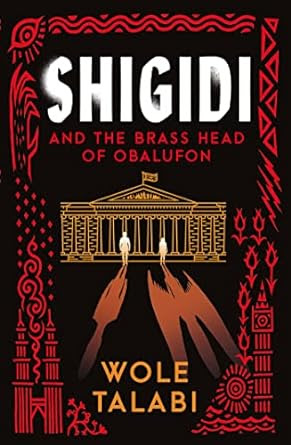 |
| Cinematic and action-packed, Wole Talabi's debut novel packs history and philosophy into a thoughtful and fun novel. Highly recommended. (Image via Amazon) |
According to traditional Yoruba culture, Shigidi is a god of nightmares. He’s a minor god, usually thought of as small and ugly, and represented by small mud figures that are kept in homes to help ward off bad dreams or to send them to enemies.
“When I read about Shigidi, I found this fascinating. This small tiny creature that’s meant to be a god and just sits in peoples’ houses either waiting to catch nightmares, or to send them,” Talabi says. “For a long time I kept thinking ‘That sounds like a terrible job … could he even be happy?”
Talabi reimagines the Yoruba pantheon as a bureaucratic corporation trading in belief and faith, with minor gods serving as minor functionaries or middle managers. After having taken an early semi-retirement, Shigidi gets strong armed into conducting a heist to repatriate an artefact from the British Museum along with his succubus partner Nneoma. It's worth noting that the titular Obalufon is an important 13th-Century historical figure who ruled the Ife Empire in what is now Nigeria. The artefact – an exquisitely crafted brass head depicting the ruler – was found in Ife in 1938, and acquired by the museum under questionable circumstances.
“Obalufon’s story is one of the main drivers for why one of the elder gods in the Yoruba pantheon wants that heist to take place,” Talabi says. “In traditional Yoruba culture, a lot of the gods are believed to have been kings that became deified when they died. Obalufon is actually a god.”
The protagonists of Shigidi and the Brass Head of Obufalon made their first appearance in Talabi’s 2016 novelette I, Shigidi which appeared in Abyss & Apex Magazine. The characters make a few other appearances in Talabi’s short fiction, including Saturday’s Song, which appeared in Lightspeed Magazine.
“There’s definitely room for at least one more novel for these characters,” Talabi notes. “Though I don’t know for sure if that will happen.”
A chemical engineer by profession, Talabi’s day job involves working on software that simulates complex fluid dynamic systems, many of which pertain to the energy sector, which to an increasing degree involves renewables and carbon capture projects.
“In devising the overall structure and plot of many stories, I approach it like I am approaching something I need to figure out as an engineer,” he says. “The title of my upcoming collection Convergence Problems comes from this. [Convergence problems] are the challenges you encounter on your way to resolving something, versus challenges you encounter when you’re trying to run a simulation. You just need to figure out where the problem is coming from so you can resolve it in the story.”
In November, an anthology he edited for Android Press will hit the shelves and ebook platforms. Mothersound: The Sauútiverse Anthology features works from Oghenechovwe Donald Ekpeki, Eugen Bacon, Tobias S. Buckell, Cheryl S. Ntumy, and others, who have worked together to build a shared universe.
“We’ve been working on it since last year. Collaborating to flesh out the magic systems, the technology, culture… we call it an African inspired secondary world,” Talabi explains. “We tried to build in as much African culture and philosophy from all parts of the continent, because we have authors from all parts of the continent who are contributing.”
Talabi has no intentions of slowing down. On top of several short works, Talabi is working on a science fiction novel that he hopes might reach readers’ hands in the next couple of years.


