Showing posts with label Fandom. Show all posts

Friday, 20 February 2026

The True North Strong And Speculative

In a year that saw concerted attacks on Canadian identity, it is particularly troubling to see that one of the country’s important literary institutions — On Spec Magazine — shut its doors and published its final issue.

The magazine’s impact cannot be overstated, but somehow, neither the magazine nor its editors have ever appeared on a Hugo Award shortlist. Given that its final issue was published in the autumn of 2025, this year will be the last that they will be eligible for most major SFF awards. As far as we can tell, the magazine has only appeared on the long-list once in 2025, placing eleventh.

There are many factors behind this omission; in recent years online-first magazines have dominated the Hugo shortlists while physically printed magazines have lagged. The magazine is less available outside of Canada, and at the last two Worldcons Canadians made up only about three per cent of Hugo voters. Despite these impediments to receiving a well-earned valedictory Hugo nod, we urge all our friends in the Worldcon community this year to consider nominating On Spec for the Best Semiprozine Hugo Award, and to consider nominating Diane Walton for Best Editor - Short Form.

Cory Doctorow, whose first story was published in the magazine put it succinctly: “More than any other publication, anthology or project, On Spec defined and refined Canadian sf. It was always on the leading edge, always editorially daring, and always brilliant. Losing On Spec is a huge blow to our field. It deserves recognition.”
Cory Doctorow's first published story was in 
the winter 1990 issue of On Spec.
(Image via On Spec)


On Spec
was founded in 1989, after a group of writers observed that there was no paying market in Canada for short-form speculative fiction. Some writers even complained that editors outside of the country would ask for their draft stories be made “less Canadian” before they could be accepted or published. It was a team that included Colin Bamsey, Jena Bamsey, Matt Bamsey, Tim Hammell, Ray Lirette, Marianne Nielsen, Paul Rogers, Hazel Sangster, Larry Scott, Phyllis Schuell, Diane Walton, Donna Weis and Lyle Weis, as well as an advisory board consisting of Douglas Barbour, Candas Jane Dorsey, J. Brian Clarke, Pauline Gedge and Monica Hughes.

From the outset, this founding group strived to create a magazine that reflected Canada’s multicultural identity and to include marginalized perspectives within speculative storytelling.

“For a lot of writers, Canadian or otherwise, publication in On Spec was an important signpost and the beginning of many Canadian and international careers,” editor and novelist Hayden Trenholm said about the magazine. “Recognizing it now would be a tribute to three decades of editorial accomplishment and to the hundreds of writers for whom On Spec meant: OMG, I really am a writer!”

For more than three decades, On Spec Magazine was the premier English-language publication for speculative fiction in Canada. Despite being a primarily Canadian publication, its influence on the genre has been felt across borders; it has helped launch the careers of notables such as Julie Czerneda, Cory Doctorow, Peter Watts, and Karl Schroeder; and it fostered a uniquely Canadian science fictional voice. Over the years, it has published works by almost every important science fiction writer in the country; everyone from Candas Jane Dorsey (Winter 1999 issue), Robert J. Sawyer (Summer 1993 issue), Derek Künsken (Autumn 2006 issue), Dave Duncan (Spring 1989 issue), Fiona Moore (Autumn 2016 issue), Michèle Laframboise (Spring 2022 issue), and WP Kinsella (Winter 1994 issue).
On Spec was founded at the convention ConText'89
Authors and editors who attended ConText'89.
Back row L-R: Charles de Lint, Kathryn Sinclair,
Dave Duncan, Lyle Weis, Robert Runté, J Brian Clarke,
Michael Skeet, HA Hargreaves, Doug Barbour,
Yves Meynard, Karl Schroeder, William Gibson, John Park.
Middle Row: Candas Jane Dorsey, Catherine Girczyc,
Marianne Nielsen, Judith Merril, Phyllis Gotlieb,
Nicole Luiken, Lexie Pakulak, Alice Major.
Front Row: Gerry Truscott, Diane Walton, Jena Snyder,
David Kirkpatrick, Sally McBride,
Leslie Gadallah, Eileen Kernaghan, Monica Hughes.


"On Spec was my before-and-after," said Derek Künsken. "Before On Spec sent me my very first acceptance, I felt like an aspiring writer. After that acceptance, I felt like I'd become something new. I didn't understand the impact and reach of On Spec until I saw my story reviewed online and requested for consideration by a year's best editor. On Spec helped me find other Canadian writers who are friends and colleagues and critiquers to this day."

But moreover, they published excellent works that may have not gotten the attention they deserved outside of Canada. We can still remember picking up the 1993 story Kissing Hitler by Erik Jon Spigel, a work whose commentary on the distortion and misremembering of history only seems more prescient today than when it was first published. Or Leah Bobet’s 2006 story Bliss, a brilliant little story about drug addiction that incisively lampoons middle-class fearmongering.

Almost as much as their publication history, the team from On Spec are known for the amount of community outreach that they’ve done. For most of their run, there wasn’t a science fiction convention in Western Canada without a presence from the staff of the magazine. They’d have tables in dealers’ halls, and their editors would conduct story reviews and writing workshops. They didn’t just publish science fiction and fantasy; they nurtured the community and young writers. The convention scene in Canada would have been much poorer without On Spec’s efforts.

For thirty-five years, On Spec has served as a cornerstone of Canadian speculative fiction and an internationally respected semiprozine. It’s high time that they got on the Hugo Award shortlist.

This is a year in which Canadian identity is under attack, and this is the last chance to do so. Please consider On Spec for your Hugo nominating ballot.

Saturday, 17 May 2025

A Hugo For The Best Fan Spreadsheet

For more than a decade, one of science fiction and fantasy fandom’s top influencers has been an online crowdsourced spreadsheet. That spreadsheet — and its creators — deserve a Hugo nomination for Best Related Work.

Every year, Renay and the team over at the blog Lady Business create, maintain, curate and edit a Google spreadsheet of eligible works and creators across all Hugo Award categories. As new works are published, the list grows, usually ending up with hundreds of listed works for any given voting year. Because of its massive list of recommendations, the spreadsheet has gained a tongue-in-cheek nickname of The Hugo Spreadsheet of Doom.
It turns out to be difficult to find images to illustrate
a blog post about a spreadsheet. Here's a screenshot
of the Hugo Spreadsheet of Doom.


“The spreadsheet was born out of a shared, friends-only collection of recs from Hugo Award newbies,” spreadsheet creator and editor Renay told us last week. “It wasn't hard to remember novels, but everything else was a huge question mark every time nominations rolled around. The down-ballot categories don't lend themselves to a modern interpretation, either, which makes it hard for new folks to parse their meanings without some hand holding.”

The first iteration of the spreadsheet was launched in time for the 2014 Hugo Awards in London. The subsequent year, when alt-right activists tried to hijack the Hugo process, there was a groundswell of progressive science fiction and fantasy fans getting involved in Worldcon for the first time. The Hugo Spreadsheet of Doom was well-placed to help orient those looking to get involved in Worldcon.

“A good chunk of the motivation for the public project was to make the short lists less male, less white, and try to tempt more diverse voices into contributing to the history of the award,” Renay explains. “I thought helping the winners be more diverse was probably not in my sphere of influence, but we could, as a collective, make the history of the award show a more diverse field in the finalists and long list options.”

The Hugo Spreadsheet of Doom is open for public editing. Suggestions are usually entered by creators promoting their own works or fans who are enthusiastic about a specific story or novella. Through community sourcing, the spreadsheet helps identify overlooked gems, and supports an informed nomination process. As bloggers who write primarily about the Hugo Awards, we browse the list on a regular basis to round out our own list of potential nominees. The Spreadsheet of Doom helps inform our reading across all categories, but especially the fan categories. While many professional publications have publicists trying to influence the public about what might be considered for awards, there is usually no commercial backer aiding the discoverability for fan works and non-professional creators. The Spreadsheet of Doom helps reduce these barriers.

A strength of The Hugo Spreadsheet of Doom is that it’s about as neutral as you can get; the editors assess eligibility but pass no judgement about the Hugo-worthiness of what people contribute. Consequently, the list doesn’t hew to any particular subgenre, style, or set of tastes. Rather, each year provides a broad overview of the state of genre output. Although the editors might deem a work ineligible, this is done in a transparent process with explanations about the WSFS rules.

Around Hugo nominating time, anyone logging into the Google document will see dozens — sometimes hundreds — of anonymous accounts reading over the entries. This snowballing of interest has no doubt brought new Hugo voters into the process. Another important project that has likely benefitted from this exposure is Archive of Our Own (AO3).

“I realized that it had grown beyond my circle in 2017,” Renay says. “I was told that actively campaigning for AO3 was unethical because of my access to the spreadsheet (protip: everyone has access to the spreadsheet because I don't add anything until each sheet is live and promoted). That's when I realized we had made it! “

The spreadsheet encourages community involvement and curation, helps identify overlooked gems, and supports an informed nomination process. Organized by category, it may include notes on format or availability. This shared resource celebrates the genre’s diversity, encourages participation in fandom, and highlights excellence in speculative fiction ahead of the Hugo Awards each year.

The Hugo Spreadsheet of Doom’s simplicity belies the many hours of volunteer labour that goes into assessing the eligibility of works, sorting out which category works belong in, and general quality assurance tasks. This is a project that has enduring value for the community, and should be honoured with a Hugo nomination of its own.

To that end we’ve added “Renay’s Hugo Spreadsheet of Doom” to the Hugo Spreadsheet of Doom.

Friday, 29 September 2023

A Conversation With Wole Talabi

Success as a science fiction author didn’t come out of nowhere for Wole Talabi. The Nigerian-born author’s byline has been appearing regularly in publications such as Asimov’s Science Fiction, Apex Magazine, and the Magazine of Fantasy & Science Fiction for about a decade. But the past year, Talabi’s name seems to be everywhere.
With multiple award nominations and his first
novel hitting shelves, 2023 has been
a great year for Wole Talabi.
(Image via the author's Facebook page)


His novelette A Dream Of Electric Mothers was shortlisted for the most prestigious awards in genre fiction, garnering nods from the Hugo Awards, the Nebula Awards, the Locus Awards, and the Sidewise Awards. His first novel Shigidi and the Brass Head of Obufalon hit shelves in August. His story ‘Blowout’ in Analog is receiving excellent reviews. And Daw Books is publishing a collection of his short works Convergence Problems, which should reach readers early in 2024.

“One can never predict such things – or even the timing for certain stories being published,” Talabi says, speaking to us from his office in Malaysia. “Shigidi was initially planned for 2022 but delayed. So it seems that things conspired to make 2023 the year that it has been.”

He adds that this annus mirabilis is part of a larger trend towards a version of science fiction and fantasy fandom that is less focused on works from North America and Europe.

“These stories have always been there,” Talabi reminds us. “African authors have been writing science fiction and fantasy for a long time. We’ve been reading global science fiction and fantasy for a long time. We just weren’t included.”

In part, he credits the success of the movie Black Panther for helping prove to publishers and studios that the public has an appetite for fantastic stories inspired by African cultures.

“But there’s also been grassroots campaigns from people across the continent,” Talabi says. “The African Speculative Fiction Society has been doing a lot to get African authors seen as part of the global science fiction and fantasy writing community.”

Talabi’s novelette A Dream of Electric Mothers was published in Africa Risen (edited by Sheree Renée Thomas, Oghenechovwe Donald Ekpeki, and Zelda Knight), which was one of the first anthologies published by a North American publisher focusing on science fiction and fantasy from African authors. He says the public response to the novelette — which explores identity, memory, and culture through artificial intelligence in an alternate history setting — has been gratifying.
The brass head of Obulafon is a
Nigerian artefact from the1300s
that was taken by the British
Museum in 1938.
(Image via SmartHistory)


“Some people have messaged me to ask if it’s a far-future science fiction story, and I enjoy telling them that it isn’t. It’s an alternate history story,” Talabi says. “I don’t make that obvious because the story uses the traditional Yoruba calendar, not the Gregorian calendar. It actually takes place in an alternate 2021 in a timeline where essentially European colonization of Africa never happened and they formed an intellectual partnership instead … that’s why it seems like a far-future story. Because we’ve made more progress by not fighting.”

Talabi became interested in science fiction at a young age. His father Kola, who was also a chemical engineer, had a large collection of books that included titles by authors from all over the globe. As a youth, Talabi read voraciously, and discussed the books with his father.

“There were hundreds of books on the bookshelf in our house,” Talabi says. “I would just grab one of them and read it. We had a second-hand book store — it was just a guy who would come around with a bag of books and he would put them on the street — some of the books no longer had their covers attached, so I didn’t always know the name of the book that I had just read.”

Over the past decade, Talabi’s output has ranged from hopeful alternate history to singularitarian speculation to anthropological first contact stories. But he was probably best-known for his thought-provoking consideration of artificial intelligence. From this perspective, a rollicking urban fantasy heist novel might seem like a departure.

In the few weeks since its release, Shigidi and the Brass Head of Obalufon has received a starred review in Publisher’s Weekly that described it as a rollicking thrill ride, and has been praised by Gary K. Wolfe as “terrifically entertaining.” It is a tightly plotted novel written with a deft touch, sitting somewhere between Neil Gaiman’s elegiac deconstruction of myths and Ian Fleming’s hard-edged action.
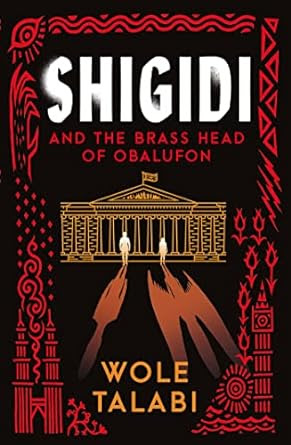
Cinematic and action-packed,
Wole Talabi's debut novel
packs history and philosophy
into a thoughtful and fun novel.
Highly recommended.
(Image via Amazon)

According to traditional Yoruba culture, Shigidi is a god of nightmares. He’s a minor god, usually thought of as small and ugly, and represented by small mud figures that are kept in homes to help ward off bad dreams or to send them to enemies.

“When I read about Shigidi, I found this fascinating. This small tiny creature that’s meant to be a god and just sits in peoples’ houses either waiting to catch nightmares, or to send them,” Talabi says. “For a long time I kept thinking ‘That sounds like a terrible job … could he even be happy?”

Talabi reimagines the Yoruba pantheon as a bureaucratic corporation trading in belief and faith, with minor gods serving as minor functionaries or middle managers. After having taken an early semi-retirement, Shigidi gets strong armed into conducting a heist to repatriate an artefact from the British Museum along with his succubus partner Nneoma. It's worth noting that the titular Obalufon is an important 13th-Century historical figure who ruled the Ife Empire in what is now Nigeria. The artefact – an exquisitely crafted brass head depicting the ruler – was found in Ife in 1938, and acquired by the museum under questionable circumstances.

“Obalufon’s story is one of the main drivers for why one of the elder gods in the Yoruba pantheon wants that heist to take place,” Talabi says. “In traditional Yoruba culture, a lot of the gods are believed to have been kings that became deified when they died. Obalufon is actually a god.”

The protagonists of Shigidi and the Brass Head of Obufalon made their first appearance in Talabi’s 2016 novelette I, Shigidi which appeared in Abyss & Apex Magazine. The characters make a few other appearances in Talabi’s short fiction, including Saturday’s Song, which appeared in Lightspeed Magazine.

“There’s definitely room for at least one more novel for these characters,” Talabi notes. “Though I don’t know for sure if that will happen.”

A chemical engineer by profession, Talabi’s day job involves working on software that simulates complex fluid dynamic systems, many of which pertain to the energy sector, which to an increasing degree involves renewables and carbon capture projects.

“In devising the overall structure and plot of many stories, I approach it like I am approaching something I need to figure out as an engineer,” he says. “The title of my upcoming collection Convergence Problems comes from this. [Convergence problems] are the challenges you encounter on your way to resolving something, versus challenges you encounter when you’re trying to run a simulation. You just need to figure out where the problem is coming from so you can resolve it in the story.”

In November, an anthology he edited for Android Press will hit the shelves and ebook platforms. Mothersound: The Sauútiverse Anthology features works from Oghenechovwe Donald Ekpeki, Eugen Bacon, Tobias S. Buckell, Cheryl S. Ntumy, and others, who have worked together to build a shared universe.

“We’ve been working on it since last year. Collaborating to flesh out the magic systems, the technology, culture… we call it an African inspired secondary world,” Talabi explains. “We tried to build in as much African culture and philosophy from all parts of the continent, because we have authors from all parts of the continent who are contributing.”

Talabi has no intentions of slowing down. On top of several short works, Talabi is working on a science fiction novel that he hopes might reach readers’ hands in the next couple of years.


Sunday, 13 August 2023

The Numbers Game

Over the past decade, there has been a regularly recurring argument about the maximum number of individual contributors that can be listed for each group finalist on the Hugo ballot. This is more common with fan categories like fanzine, fancast, and semiprozine — in recent years some of the contributors lists for an individual publication have extended to several dozen names.
In 1959, editors of Cry of the Nameless
— F. M. Busby, Elinor Busby,
Burnett Toskey and Wally Weber —
became the first team of more than three
credited for a single Hugo finalist. 
(Cry of the Nameless April 1958 cover
via Fanac.org)


On one side of the argument are those who express logistical concerns about the size of the ballot. On the other side are those who want to ensure that everyone who contributed to the success of a work or publication are given nomination-level credit for their work.

The reason this argument is recurring is because the current WSFS constitution does not offer clear answers about the number of names that can be officially listed. Adding to the confusion, this question has been adjudicated differently from year to year. In 2013, up to nine people were listed per Hugo group finalist … but two years later the number was capped at five. In 2022, there was no upper limit on the number of names credited per group finalist … but this year it was capped at seven.

Since each Worldcon appoints a different Hugo Award Administrator and the decision is within their purview, it has been decided differently each year. There is also no public-facing document that explains the rationale for a limit of exactly seven this year, which makes the number seem arbitrary to observers.

The inconsistent nature of these decisions is concerning, as it calls into question the fairness of the awards process.

We would suggest inserting clarifying language into the WSFS constitution (possibly as Section 3.2.13). This clause could either provide guidance as to a maximum number of contributors per group finalist, could offer clarity about what level of involvement warrants an individual being listed as a contributor, or could state that there is no limit.

Hugo Award administration is a difficult and complex role, and we have a lot of respect for the dedicated volunteers who have taken it on over the years. We would suggest that having clarity in the WSFS constitution on this point would make this aspect of their work easier.

There is a long tradition of recognizing several individuals for a Hugo-shortlisted work; as far back as 1959, the fanzine Cry of the Nameless listed four editors on the ballot. All six members of Monty Python were credited for The Holy Grail in 1976. In 2009, the Hugo ballot credited nine individual contributors for the movie Iron Man.

The conflict over the number of credited contributors seems to have arisen in about 2013, with larger and more complicated fan publications trying to ensure that everyone involved got to call themselves a Hugo Finalist. Given that those participating in these projects are often rewarded with little other than recognition, excluding individual contributors from the “limelight” is often felt keenly.
Questions have been raised over the capacity
of the pre-ceremony Hugo Awards reception.
(Photo by Cora Buhlert via File 770)


Those advocating for a more expansive approach to contributors’ lists make a colourable argument that it is often marginalized voices who get omitted from lists of contributors when limits are imposed. Having a maximum number of names per publication will possibly have a detrimental effect on creators who are non-male, who are non-American, and who are racialized.

Those advocating for a more restrictive set of rules point out that the pre-Hugo reception already has capacity issues and logistical constraints. They also suggest that if everyone gets called a “Hugo finalist,” then the status becomes devalued. In addition, the distribution of perks to Hugo finalists, such as the rocketship pins, etc., increase costs on Worldcons.

Both of these positions have merit, and neither should be dismissed out of hand. But the debate should take place in the appropriate forum. The WSFS membership on whose behalf these awards are presented deserve a say in this matter, and the way to do this is to allow both sides to make their case at a business meeting.

The Hugo Awards aren’t the only organization that has had to confront similar issues. As major Hollywood productions became more financially complex in the 1990s, the Oscars had to wrestle with how many producers could be credited for a single Best Picture. After a record-breaking five-producer movie won Best Picture winner in 1999, the Academy imposed a two-producer limit.

What should be noted, however, is that this limit was voted on by the Academy’s Board of Governors, was communicated clearly and well in advance, and was not changed arbitrarily.

Rather than having this argument play out every year over social media and through strongly-worded letters of complaint, there should be an opportunity to discuss and debate a solution at the next Worldcon.

Recognition at the Hugos should follow consistent rules that have buy-in from the community at large.

Monday, 12 April 2021

The Lies That Bind

The story of Stan Lee is a quintessential American tragedy. It is the story of a man whose reach would
Beloved comic book icon Stan Lee
is a figure worthy of serious critical
study. Abraham Riesman's new biography
grapples with his oversized myth. 
(Image via People)

always exceed his grasp, and of someone who would sacrifice the truth, his friends, and eventually himself in a vainglorious pursuit of goals that could never bring happiness.

True Believer: The Rise And Fall Of Stan Lee by Abraham Riesman grapples with Lee’s oversized cultural profile, and with the legacy of one of the most divisive figures in comic book fandom.

Many parts of Stan Lee’s story have been told over the years in interviews, feature articles, and autobiographies. However, these accounts are contradictory and informed by Lee’s incessant and self-serving dishonesty. They were also often written either by journalists who lacked the depth of comic book knowledge to ask the difficult questions, or by comic book fans who lacked the journalistic discipline to parse myth from fact. Mainstream media was — and still mostly is — incurious about how comics are made and who was responsible for what, so often settled for the story told with the most charisma. If anything, Lee was charismatic.

True Believer is therefore a much-needed attempt to provide as complete and accurate a picture as possible of this iconic figure. New Yorker Magazine and Vulture Magazine culture critic Riesman brings both journalistic credibility and a depth of knowledge about comic book history to this biography.

The caveat “as accurate a picture as possible” is key to understanding why this biography is so satisfying. Riesman recognizes that Lee’s incessant lies — and the myth-making empire he built around himself — present significant obstacles when writing about him. When necessary, Riesman relays multiple accounts of the same events, and offers the reader his reasoning as to which might be the most factual. She writes, any account of Lee’s life is “where objective truth goes to die.”

So what is certain? The son of Romanian Jewish immigrants, Stan Lee was born in Manhattan in 1922, as Stanley Martin Lieber. Hired by his uncle at the age of 17, he began working at a comic book company called Timely and rose through the ranks rapidly. It is certain that he receives credit for helping create numerous famous comic book characters such as Spider-Man, the Fantastic Four, Daredevil, the Silver Surfer, Iron Man, the Hulk, the Black Panther, and many more.
Lee loved the limelight, a trait that often led him
to minimize the contributions of others. 
(Image via Times Of Israel) 


It is also clear that Lee was a gregarious and friendly person who managed to recruit and attract significant talent to the comic book industry. He wrote dialogue that was more engaging than most of his 1960s contemporaries, and had some hand in building a pop cultural phenomenon. It is also clear that Lee was capable of significant kindness.

But since the 1990s, there has been escalating controversy about how much of the creative process was Stan Lee’s, and how much belonged to the artists with whom he collaborated. Many of his most famous colleagues — and even his own brother Larry Lieber — suggest that Lee’s contributions were minimal. Riesman doesn’t offer a definitive verdict, but the documentary evidence he provides does not always paint a flattering picture of Lee.

The research put into True Believer cannot be overstated; Riesman interviewed almost every relevant figure, including Lee in his final years. She has combed source documents, old fanzines, lawsuit filings, and correspondence, and shows the ways in which Lee’s claims would change over time, contradicting himself. Lee lied about things even when there was no penalty for telling the truth, and he lied about things which could be fact-checked.

Our most significant quibbles with True Believer have more to do with what is omitted from the story,
Miscommunication over which
character was talking in a panel 
of Spider-Man #36 led Lee to
order artist Sol Brodsky to edit
Steve Ditko's artwork. Ditko
left Marvel comics two months
later, never to work with Lee again.
(Image via Marvel.Fandom.Wikia)

rather than what is included. The haphazard creation of the Avengers #1 (which Lee threw together to fill a publishing window after artist Bill Everett missed his deadlines on Daredevil) reveals aspects of Lee's talents and foibles. Steve Ditko's epic fight with Lee over Spider-Man #36 (where Lee had another artist edit Ditko's illustration of The Looter) illustrates the flaws with Lee's "Marvel Method" of comic book collaboration. The omission of these vignettes seems curious. But in any biographical work, the author must make difficult choices about what to include.  

Because most of Lee’s memorable accomplishments occurred in the 1960s and 1970s, his last three decades of life have mostly been glossed over by biographers. Riesman’s book both fills this gap and provides context to help better understand Lee’s commercial success. If the truth can set you free, then the life of Stan Lee is a parable about how lies can entrap us. Over his last three decades, his tenuous relationship with reality eroded his ability to maintain meaningful friendships. As the book progresses, it becomes clear that Lee ended up surrounded by deceivers like himself, and trapped in a cage of his own making.

Abraham Riesman’s book becomes a cautionary tale about the seductive, destructive power of lies. For those who have been gaslit, or who have lived with a pathological liar, the experience of reading this book might be triggering.

It's often been observed that at the time of his death, Lee was in litigation with most of his friends and family while estranged from the rest.

The negative reviews of True Believer posted to Amazon and GoodReads can be seen as a testament to Lee’s prowess at self-mythologizing. Some of the reviewers seem never to have read the book at all, while others take umbrage at the suggestion that Lee’s involvement in the creation of certain characters was anything other than absolute. Fandom has been overly deferential to Lee in life and death, finding it inconvenient to talk about what artists like Jack Kirby, Steve Ditko, and Wally Wood endured.

There is a long tradition of fandom idolizing a certain variety of PT Barnum-style self-promoter. This tradition has come under much-needed scrutiny in the past decade thanks to works such as Astounding by Alec Nevala-Lee and The Pleasant Profession of Robert A. Heinlein by Farrah Mendelsohn. Abraham Riesman’s True Believer is a welcome addition to this critical reckoning.  

In Riesman’s telling, Lee is not a figure worthy of contempt. He’s a figure worthy of pity. Somehow, that’s worse.