Showing posts with label Pop Music. Show all posts

Thursday, 18 September 2025

The Alien Conquest of Brighton (Hugo Cinema 1987)

This blog post is the thirtieth in a series examining past winners of the Best Dramatic Presentation Hugo Award. An introductory blog post is here.

It had been an unusually cool August in Brighton, the English seaside town that hosted the 45th World Science Fiction Convention. But on the day of the Hugo Award ceremony the weather had turned pleasant.

The Brighton Metropole Hotel, site of the 1987 
Hugo Awards. (Image via Doubletree.com)
The event was held at the Brighton Metropole Hotel. It was possibly one of the most architecturally significant venues ever to host the Hugos, having been designed by Alfred Waterhouse, who was famous for the Natural History Museum in London and Strangeways in Manchester.

The ceremony had to conclude by 10 p.m. sharp, owing to timed fireworks that would conclude the Worldcon. This meant short shrift for categories without acceptors in attendance. Per usual, there was nobody present to accept the Hugo Award for Best Dramatic Presentation, but the win for Aliens was greeted by the audience with a robust cheer. It had won by a considerable margin.

Some weeks after the ceremony, Hugo Administrator Paul Kincaid stopped by the offices of 20th Century Fox and left the Hugo trophy with the receptionist.

It was an eclectic and interesting year for science fiction and fantasy film, with numerous and impressive titles failing to make the shortlist. The Park Plaza Mall was terrorized by security robots in Jim Wynorski’s send-up of Regan-era capitalism Chopping Mall. Autobots and Decepticons battled it out in the first — and best — big-screen outing for the Transformers. A rural British couple faced the aftermath of a nuclear war in Jimmy Murakami’s animated movie When The Wind Blows. And in the Russian movie Dead Man’s Letters, a scientist huddled in the basement of a decimated museum trying to imagine what he’d say to his son.
Clancy Brown is a memorably
great villain in Highlander.
(Image via IMDB)

A surprising omission from the shortlist is Russell Mulcahy’s Highlander, a stylishly directed epic about immortals destined to fight each other to the death. Although it was not particularly successful in the cinemas, the movie had decent buzz within fandom, and has held up better than most movies of the era. Mulcahy, who had a background as a music video auteur, took a rock-and-roll sensibility to the direction and livened up the editing with thoughtful transition wipes. It is impressive how clear and easy the movie is to follow given that the narrative is told in two parallel tracks, following the protagonist Connor McLeod (Christopher Lambert) in the present day in one and in the 1700s in the other. Notably, the soundtrack was by Queen, and featured several top-charting hits. Highlander is one of the most technically accomplished SFF films of the year, despite a leaden and hammy performance by Christopher Lambert.

But to be fair, there’s only really one movie on the 1987 shortlist for Dramatic Presentation that probably doesn’t belong there: Labyrinth, Jim Henson and Brian Froud’s follow-up to The Dark Crystal. Like many other Henson productions, the movie has some charm and is visually appealing, but the story meanders and blunders from event to event with little direction. Featuring David Bowie as the Goblin King, the movie is oddly paced with what little plot there is interrupted by largely irrelevant musical numbers. It does get some points for being the only non-remake, non-sequel movie on the shortlist in 1987.

Labyrinth was one of two musicals on the shortlist, which was the only time multiple musicals were shortlisted for the Hugo in the same year. Little Shop of Horrors (adapted from a Broadway play based on the 1960 Roger Corman movie of the same name) could be considered the first Kaiju movie ever shortlisted for a Hugo Award. It’s filled with top-tier talent (such as Rick Moranis, Steve Martin, John Candy, and Jim Belushi) and has an incredible amount of energy in the first half, leaving the second act in, well, second place. There was a fair amount of disagreement in our viewing club, with some of the viewers complaining that the music was “very Boomer,” and that the lead actress Ellen Greene was cloying in her theatrics.
Evil alien plant Audrey in Little Shop of Horrors
was voiced by Levi Stubbs of the Four Tops.
(Image via Letterboxd)


David Cronenberg’s The Fly is one of the few cinematic remakes that is generally considered to have outshone the original. Set almost entirely in the apartment and laboratory of scientist Seth Brundle (a young Jeff Goldblum), it centres on his relationship with journalist Veronica Quaife (an even younger Geena Davis) as an experiment causes him to slowly transform into a human-fly hybrid. The movie is carried by two truly terrific lead performances, and viscerally disturbing body horror. In another year, it might have competed for the trophy, but 1987 was a very strong year.

Star Trek IV: The Voyage Home came in second in the final vote, and it’s easy to understand why. With the crew time travelling back to 1980s Earth to save humpback whales and humanity, it’s probably the most unserious of all Star Trek movies. It was, however, also one of the most engaging to watch, especially for those in our cinema club who are not hard-core Trekkies. This would have been at, or near the top of most of our ballots despite some dated gender dynamics in the (somewhat forced) romance between captain James T. Kirk and marine biologist Dr. Gillian Taylor (Catherine Hicks).

But the winner for Best Dramatic Presentation in 1987 was never in doubt. It’s easy to see why Aliens — the sequel to 1979’s Hugo-winner Alien — earned more than twice as many votes as its nearest competitor on the shortlist. The sequel sees Ripley return to the alien-infested planet, this time with marines and massive firepower. Much like the Hugo ceremony in 1987, it ends with fireworks. Aliens is a truly exceptional action movie that counterpoints the isolating horror of the original.

YASSSS QUEEN! Hashtag #Slay!
(Image via IMDB)
What is really stunning to see with the benefit of hindsight is just how efficiently written Aliens is, and the technical skill evident in the craftsmanship. Characters are introduced in as few lines of dialogue as possible, and yet seem fleshed out and real; as an example a female marine named Vasquez (Jenette Goldstein) has fewer than a dozen lines in the movie, but connects with the audience. It’s also worth noting that the pace of editing in Aliens is beyond anything contemporaneous audiences were used to, using almost twice as many cuts per minute than anything else on the Hugo shortlist that year. The overall effect is a percussive, and deeply engaging action movie that puts science fiction at the forefront.

The Hugo for Best Dramatic Presentation was just finishing its third decade in existence, and was now clearly one of the most popular categories with voters. More votes were cast with Aliens as a top choice than had been cast in the entire Fan Artist category that year, for example. The award had come into its own, and did it in style by recognizing a movie that is inarguably the best of the year.

Thursday, 27 February 2025

The Ape Star


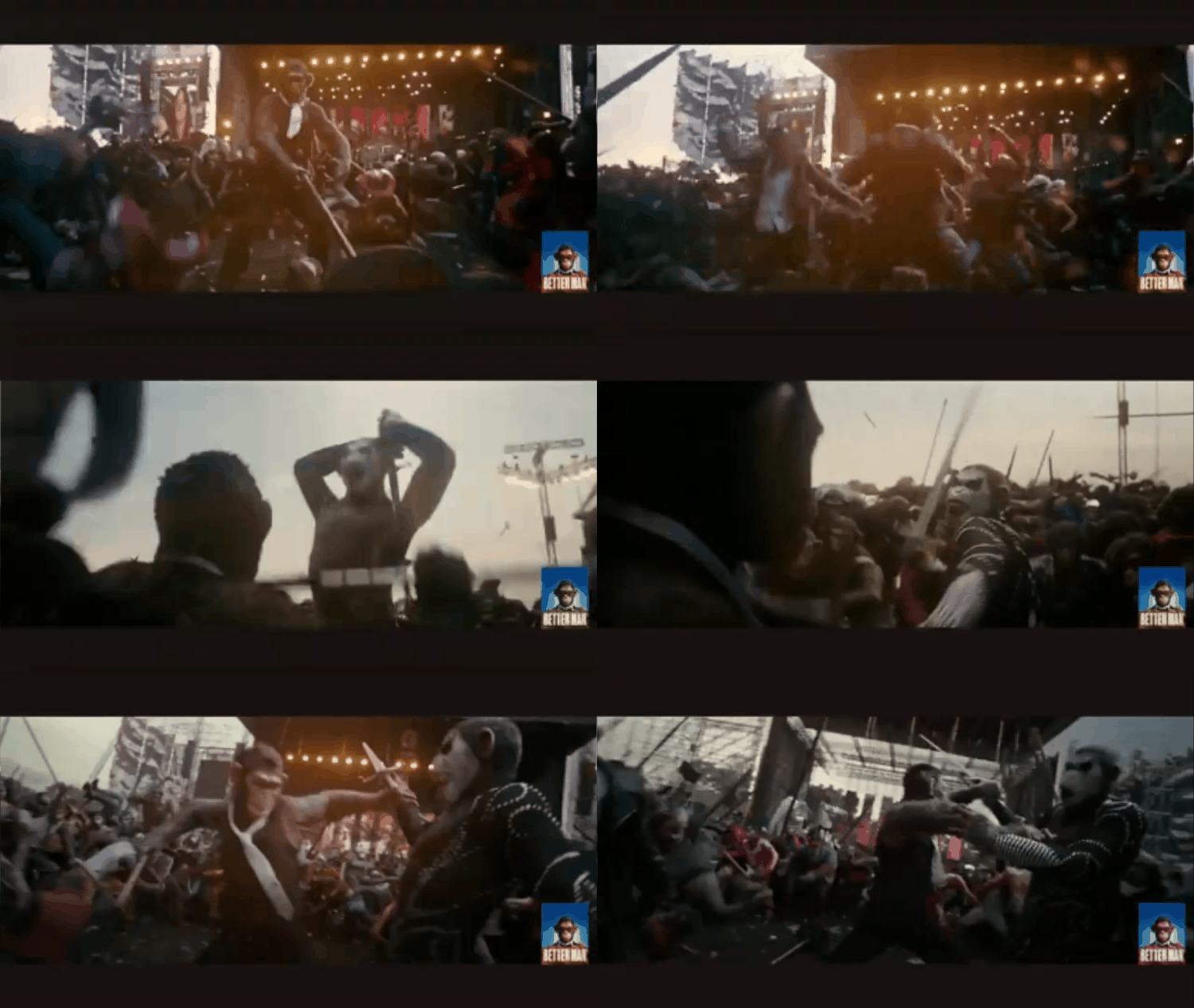
The climactic battle in Better Man is a frenzy
of ape-on-ape violence. This is clearly fantasy.
Image via YouTube.
In the climactic moment of Better Man, an anthropomorphic chimpanzee named Robbie Williams takes the stage at the Knebworth Festival in front of 125,000 fans to sing his pop anthem, “Let Me Entertain You.” Nearing the end of the song, he spots in the audience dozens — then hundreds — of younger and angrier chimpanzee versions of himself. Leaping into the crowd, he begins fighting them one-by-one, with each showdown getting bloodier and more outlandish.

With the leaping chimpanzees, the soaring camera work, and the colourful cinematography, it is as if the Battle of Isengard had been set on the Planet of the Apes and directed by Speed-Racer-era Wachowskis.

So let us be perfectly clear about this point: any movie featuring a battle royale between thousands of anthropomorphic apes is fantastical enough to be considered for a Hugo Award. Whether or not Better Man is a “pure” fantasy movie, it is at the very least a form of magical realism.

It’s also possibly the most audacious — and beautiful — science fiction or fantasy movie released in 2024.

Directed by Greatest Showman auteur Michael Gracey, the movie chronicles the rise of real-world, non-chimpanzee, UK superstar Robbie Williams, his feud with the boy band that launched his career, and his struggles with addiction. These are all the standard narrative beats of a Hollywood music biopic, but Better Man is elevated by the unusual approach to the subject (to whit the motion-capture ape), the panache with which the movie has been directed, and Williams’ sardonic voice.

The real-world non-chimpanzee Robbie Williams
is known for his self-serious dignity.
(Image via RobbieWilliams.com)
Unfortunately, the movie woefully underperformed at the box office — earning only $20 million on a budget that exceeded $110 million. Perhaps it struggled in cinemas because Americans have never really understood Robbie Williams, something explored in the recent Netflix documentary about his life … but not in this film. Americans like their bragaddocio unmitigated; every time Williams offers a bombastic line, he undermines it with a joke. His is a quintessentially British voice that did not appeal to enough people in the USA.

The film’s inability to reach a wider audience is a shame, because by wrapping its narrative in special effects and fantasy, the story becomes more universal. It makes no pretense of being an entirely true and factual depiction of Robbie Williams’ life. To quote Williams himself: “You don’t want the truth. Truth is boring.” This is a fantasy inspired by mostly inaccurate tabloid stories about a pop star. The viewer isn’t being offered the definitive biography of a person, but rather a fable about a dancing primate.

And this makes Better Man better cinema — and more interesting SFF. The movie is full of metaphor and surreal asides in which the chimpanzee Williams is constantly confronted by his personal demons in the guise of past versions of himself.

Williams has spoken about his cinematic simian alter-ego, explaining that he’s often described as “just a performing monkey,” that he’s “less evolved,” and that “fame makes monkeys of us all.” The effect was created by the special effects house Weta, the company that created Gollum in Lord of the Rings and Caesar in Planet of the Apes — they should get a lot of credit for making this central metaphor work, imbuing the animation with pathos while also maintaining its otherness.

One of the central relationships in the movie
is between chimpanzee Robbie and his
grandmother played by Alison Steadman.
(Image via Entertainment Weekly)
The cast is filled with scene-stealing turns by actors who are not yet household names. In the leading motion-capture performance, Jonno Davies manages to imbue the role with pathos and sincerity, while never downplaying the darker places to which the narrative takes him. Alison Steadman is simply superb as Betty Williams, Robbie’s grandmother. The movie’s most dislikeable character, Nigel Martin-Smith, is played with aplomb by Damon Herriman.

But the biggest star of the show is the cinematographer Erik Wilson, who offers infectiously joyful camera work during dance numbers that recall Golden Age movie musicals cranked up to 11 by modern technology. The “Rock DJ” scene in Oxford Circus is a stand-out.

Even describing just the fantastic elements of the movie fails to highlight just how bloody weird the film is. For one thing, Robbie Williams is much younger than you would expect for the subject of a valedictory movie like this; with the exception of movies about stars who died far too young (La Bamba was made when Ritchie Vallens would have been 46, Notorious was made when The Notorious B.I.G. would have been 35, The Doors was made when Jim Morrison would have been 48), the only example of a major Hollywood biopic about a living star as young as Robbie Williams is the Loretta Lynn biopic Coal Miner’s Daughter (Lynne was 48 in 1980 when the movie was released). Williams' most recent studio album is barely five years old, and topped the album charts in the UK, Australia, and Ireland. Moreover, the movie skips some of Robbie Williams’ biggest hits. Millennium, Something Stupid, Strong, and Kids are absent.

Speculative fiction — and the Hugo Awards — can and have embraced off-board picks in the past. Better Man was never marketed as fantasy, but it clearly fits any reasonable definition of genre cinema … and it is among the most bonkers, surreal, and beautiful movies of 2024. Seriously consider giving it a Hugo Award nomination.