Wednesday, 26 July 2023

列王若尘 (The Tsars Like Dust - Mandarin Translation)

虽说科幻拥有其它题材难以企及的辽阔空间可以让艺术家挥毫描画新的世界体系,但我们读到的作品往往落入最陈旧、最粗糙、最愚蠢、乃至最落后的政府形式之窠臼:君主制。
正值伊丽莎白二世女王陛下践祚七十载溥天同庆之祺,
本博客编创团队谨祈愿天下人主
(包括虚君如温莎王室者)
皆喜获废位。(图片来自IMDB.com)


这方面的例子不胜枚举:阿尔达拉公主(出自Buck Rogers 系列),灰色王子 (Jack Vance), 帝查卡国王(出自 Wakanda 瓦干达系列),“星帝”格蕾兰女皇 (John Scalzi), 六方位皇 (Arkady Martine), 火星公主德嘉·索丽丝 (Edgar Burroughs), 拜冷·阿巴萨克斯皇帝(出自《木星上行》),伊茹兰公主(出自《沙丘》系列),金星女王伊拉娜(出自 Queen of Outer Space 电影,见图),阿思查公主 (出自 Doctor Who),大巴札尔帝王(来自 Voltron 大陆译《战神金刚》,美版称Emperor Zarkon),“星火”科莉安公主(DC美漫人物),以及银河大帝革律翁二世(出自阿西莫夫《基地》系列)等等等等……遗憾的是,这里列举的作品大多既做不到批判性地运用君主制度这一概念,也没有努力探究这一政治制度在社会层面造成的后果,更未能拷问它所代言的精英主义哲学这一思想基础。因此,阅读这些作品时,读者应带有怀疑的精神。

考虑到当下除了其残余形态,仍在君主统治下的国度已寥寥无几,或许我们可以理解为什么几乎没有多少作者有意用批判性的态度面对自己笔下帝制造成的影响。毕竟,但凡未满244岁的美国人,以及对彼得卢惨案(1819年)前的社会没有个体记忆的英国人,已经无法通过切身经历来感知“星帝”统治下的生活该有多糟糕。(即使偶有格蕾兰般的明主现世,她们在守旧制度的沉疴之下也无力回天。)

创作者若要更准确地描写太空帝国的面貌,那就该参考当今世界少有的几个绝对君主制政体,例如阿曼苏丹国、斯威士兰(斯瓦帝尼)王国,以及北朝鲜金家王朝。说得直白点,现实世界里“有君权”和“无人权”是直接关联的。但科幻作品中却很少这样描写。

作者之所以对描写帝王趋之若鹜,有一些原因是很清楚的。首先,如果要突出某个人物的重要性和能动性,“称王”是条捷径。比如说,一旦某个人物提到“莉亚公主”,观众很容易领会到这是个“主要角色”。

同样,从故事叙事角度而言,要想解释某个政治决定,将其归为个人意志相对容易,而刻画其它政治体制下必须经历的决策过程就比较麻烦。

我们要看到,很不幸,作为人间现存持续时间最长的制度,有着“万岁”历史的君主制看来还要在未来很长时间内存续下去。

然而科幻题材作品太容易陷入对这种落后压迫制度不假批判的运用。例如,在早期《基地》系列小说中,即便谈起弊政多端、危机四伏的帝国可能的继承者,阿西莫夫也未曾主张任何比帝制更复杂、更富于内涵的治理体系。

《星战》中将奥德朗星描写成桃花源、乌托邦式的君主国。
然而,现
实世界里,人权和君权是水火不容的。
(图片来自 StarWars.com)
在戴维·韦伯的“奥诺尔宇宙” (Honorverse) 系列中,曼堤戈耳(Manticore, 意为西方神话中的刺尾狮人)星际帝国的女王和女皇伊丽莎白三世在任何问题上无一例外必然站在正确的一面,而她果敢的领袖气质则反衬出该系列作品中诸个民主政府的昏聩和低能。至于洛易丝·麦马斯特·比约德虽然承认历史上曾经出现过昏君,她塑造的格里高尔·弗巴拉却基本上“是个好人”。因为这一类作品未能冲击“开明君主”这一不经之谈,它们实质上深化了这一思想的影响。

也许,星际殖民征服只有在暴虐贪婪的帝制下才有更大可能。帝国一旦无力持续扩张,往往也就走向了尽头。因此,民主政体可能更安于(或更可能被要求)将资源集中在创造或者增加公民的福祉上,而非在群星间开疆拓土。就像资本主义下“拟帝制”的公司集权一样,传统的君权也许同样贪得无厌。既然这样,虚构世界中各种奥加纳世家(见《星战》)及其翻版,就应该描写成贪欲无艺的一夫民贼,而非普施仁政的明君。

《星战》系列作品基本上未曾流露出任何涉猎深层次文化批判的企图。即使如此,我们也应注意到其中对各种政体越来越全无章法、有头无尾的描写。我们简直无法读出其中任何一个政府如何运转:既有元老院,又有皇帝,还有选举产生的公主,甚至有掌握着某种政治权力的贸易联盟。不过,有一点表现得很清楚:帝制无过,暴君有辜。进而言之:过在贼人窃据大宝,不在国体自新之亟。

所有的君主制政体都依赖一个假设,即某些特定血统的继承人有着内秉的优越性。在这一点上,它和制度性种族主义所依赖的是同一个哲学。《星战》后传在这一点上变本加厉。蕾伊能够执掌原力,无非是因为她是帕尔帕廷大帝的直系血亲。她的价值和力量来自血统。这样看来,多数来自被歧视、被种族主义压迫群体的科幻创作者,相比于坎贝尔时期以白人为主的科幻作者群体,更倾向在作品中针对帝制表现出健康的质疑精神,这也就不足为奇了。

值得注意的是,坎贝尔时代的两位科幻巨子罗伯特·海因莱因和弗雷德里克·波尔虽然处于政治方向的对立两极,但在同辈中两人可并称为对帝制观念的最强怀疑者。波尔对帝制着墨不多的描写充满了大不敬的调侃,而海因莱因笔下的君主政体要么全然异类,要么面目可憎,但他却塑造了各式各样为民主而英勇斗争的主角。

虽然整体上有细致而高格调的叙事风格,
但 Leprechaun In space 电影还是未能免俗于星际君主的套路。
(图片来自 IMDB)
不过我们还要专门提及另一类作品,它们直接用君主制当作观念上的主要题材,旨在拷问政治制度对其参与者的意义何在。这一类的突出代表是查尔士·斯特罗斯的《商战王朝》(Merchant Princes) 系列,可以说多少直面了承天之命的特权血统造成的后果和对公共社会整体的影响。

君主制是残酷可怖的政治体制,繁荣而进步的国家大多已将其扬弃。屈指一数,当今世界现存只有7个绝对君主政体,此外尚有一小部分有虚君残存的国家。在这样的条件下,科幻这一向往未来的创作题材中,有相当一部分作品仍然将这种弊政制度奉为主要设定。

我们呼吁,在畅想人类社会的未来时,科幻粉丝同人界能够对帝制抱有健康的怀疑。

(注:原标题 The Tsars Like Dust, 得名自阿西莫夫作品 The Stars, Like Dust)

本杂志编撰团队感谢雨果奖提名,并借此机会挑选了2022年度若干得意之作翻译成中文,以飨参加本年度世界科幻大会的中国友人。译者:Zoë C. Ma [https://zoe-translat.es/]

同理心的触手 (The Tentacle of Empathy - Mandarin Translation)

 过去二十多年里,科幻界一种值得思考的动向,是作品中描写“非人类”意识的方式在不断演进。

图片来自 Hachette UK

自从这一作品类型诞生以来,许多创作者以令人钦佩的努力,将人类级别权利的主体不断扩充到越来越广大的生命群体。不过,在起初的几十年里,他们多数很难构想全然异类的存在。诸如克林贡人(《星际迷航》)、伍基人(《星战》)、克孜人(拉里·尼文作品)、咖喱星人(英剧 Doctor Who)及魔马克星人(美剧 ALF)等,其异于人类之处无外乎身形和文化。甚至如《巴比伦五号》中号称混成先天地、希夷不可知的“卧龙族” (Vorlon),又如《星际迷航》里全知全能如 Q 者,亦未能免俗于骄矜、忿怒、寂寥等人之常情。

在我们看来,最近约25年来社会增进了对神经多元性的认识,并且在科幻作品中有所反映。自上世纪90年代起,在孤独症群体的自我主张运动(以及与之相伴的神经多元化运动)促进下,对那些被诊断为孤独症谱系症候群的人及其行为习惯、处理问题方式,社会上的排斥和污名化程度逐渐有所缓解。这一转化的实质,是我们对人的主体体验有了包容面更广的理解;藉此,人格的尊严得到了更广泛的支持。从弗诺·文奇《银河界区》系列小说中对爪族和聚能者反规范的认知方式总体正面的刻画,以及阿德里安·柴科夫斯基《时间之子》系列中塑造的波蒂亚族裔和鸦形族身上,我们都能感受到与孤独症者自我主张运动一脉相承的文化线索。说到底,因为有着一股精干的作者群体不懈地努力从内心深处理解与他们迥异的心智,科幻得以与神经多元化运动齐头并进,为多元的认知方式正名。无论这是有意为之还是无心插柳,其价值是肯定的,因为将形形色色的认知呈现在作品中有益于建立同理心。

10月4日面世的小说《山与海》是雷·奈勒 (Ray Nayler) 崭露头角之作,它将我们的视线会聚到科幻的异认知文化传统。

作品设定于不久的未来,通过多个人物交织的视角,表现他们在踌躇和跌撞中朦胧地摸索同情心在他们人生中的地位。它讲述的,是人们一次次尝试抓住同理心扭动中若隐若现的触手。

小说有两股主要叙事脉络。其中之一跟随海洋生物学家阮夏博士,在偏远的鲲岛探索此前不为人知的章鱼物种及其认知和社会行为。另一线索以立志在商界出人头地的英行为主角,追随他在自动化捕鱼船上被奴役的遭遇。

这些相互穿插的情节构成了作品情感上的阴阳水火。英行的故事被绝望和剥削笼罩着,而对发现的憧憬推动者阮夏的经历。尽管两者判若云泥,但两人相同之处是在不得已的境地下反省人生的不如意。因此,相似的情感主题贯穿着两人的叙事线索。

大学刚毕业,在激烈竞争中斩获首个职位的英行,还没来得及上任就遭人下毒和绑架。他被关押在太平洋某处的渔船里,被迫日复一日做着处理死鱼的沉重劳役,没有喘息也没有报酬。在如此令人绝望的设定下,我们慢慢发现,还有数百条这样的奴隶船正在大洋中破坏性地开采资源,为了追求短期利益而消灭着一切有销售价值的生命。英行的个人历程主要在他自己的思想中展开。他开始思索自己原本的志向在这一剥削体系下的作用,并且在最为残酷的条件下刻意教自己习得同理心。此处,我们最赞赏的,是作者对受奴役的工人依靠团结进行自发组织的描写。奈勒探索的主题,一方面是资本家如何用科技将其剥削的受害者隔绝在自己的世界之外,另一方面是劳工为何往往被非人的制度压制服从。属于英行的环节是小说中最富于力量和感情的部分,不过对很多读者而言可能因情感太浓重而难以消化。幸好,阮夏的情节主线为作品增添了更丰富的内涵。

英行遭绑架和奴役的遭遇并非天马行空的想象
而是现实的反映。我们推荐阅读《纽约时报》
上伊恩·乌尔比纳撰写、时报摄影总编 亚当·迪恩
配图的系列报道《 公海劫波 》
(图片来自《纽约时报》)。

阮夏的环节跟踪的是她通过艰苦的努力,一面试图沟通人类和章鱼之间理解和交流的天堑,一面试图领悟和接纳她自己的孤独。原来,她这份在远海研究海洋生物学的工作,是来自拥有鲲岛并将其置于严密看守下的跨国企业“双灵公司”。这就引发了一系列问题:为什么该公司的利益与章鱼联系如此紧密?它会如何利用章鱼?属于阮夏的大部分情节是通过反衬加以深度刻画的,这依靠的是描写她慢慢与另外两名公司雇员之间信任关系的展开:来自蒙古的安保专家阿勒腾琪琪格,以及“埃芙琳”,世界上唯一真正达到人类水平的人工智能体。

对未来世界勉强运行的地缘政治体系和掠夺式资本主义的极端情形,小说中进行的塑造既有令人唏嘘的真实感,又有引人入胜的细腻表现。奈勒的外交背景所赋予他的视角和知识,让读者能够信服他笔下的故事。

不过,作品感染力的真正核心,是通过不懈的探索揭示了人类解读主体体验的丰富方式,各种不同的感官系统和神经体系如何构建个体对世界的理解,还有人工智能可能的演化路径及其对人造意识的影响。我们无从知晓其他生命体内心的活动,也不能断言对他心的描写是否真的可能实现。不过,我们感觉到奈勒的文字也许已经接近其极致。对章鱼智能可能的演化脉络,以及其形态、能力和脑部生理构造如何造就它们对世界的感受,作者的猜想建立在深入而周密的探究上。因此,从该小说我们可以看到神经多元化运动在科幻作品中非常深刻的体现。

归根结底,奈勒似乎在拷问的是,既然我们作为人,和同类之间都难以建起相互理解的桥梁,又如何能有终一日与异种生命心有灵犀?这部作品不时令人心碎,同时又交织着充满希望的思绪。它确实值得一读。

本杂志编撰团队感谢雨果奖提名,并借此机会挑选了2022年度若干得意之作翻译成中文,以飨参加本年度世界科幻大会的中国友人。译者:Zoë C. Ma [https://zoe-translat.es/]

Saturday, 22 July 2023

The Golden Age Of Wes Anderson Is Twelve

Asteroid City may be Anderson’s first unambiguously genre movie, but for many science fiction fans, it feels like he’s always been one of us.

Wes Anderson's aesthetics have often harkened
back to the post-war era — the waning end of
science fiction's "Golden Age."
(Image via IMDB.com)
Between the heightened reality of his cinematic style and his worldbuilding sets (gormengastian hotels and benthic exploration), his movies have always been on the edge of SFF. In addition, it’s easy to believe that Ender Wiggin, young Anakin, and Wesley Crusher would find a peer group among the socially awkward child prodigies who are mainstays in Anderson’s films.

On the surface, Asteroid City offers what fans have come to expect from Anderson; symmetrical framing, deliberate pastel colour palette, deadpan dialogue delivery, and dysfunctional family dynamics at a time of transition. It will no doubt be loved by many, hated by some, and possibly ignored by most Worldcon nominators.

As with his earlier films — such as The Royal Tenenbaums, The Grand Budapest Hotel, and Moonrise Kingdom — this latest offering provides a complex blend of quirky characters, played by a cult-like cast of actors (plus Tom Hanks and Margot Robbie) delivering whimsical and pretentious dialogue for a fraction of their regular incomes.

The setting for the story is the annual Asteroid Day stargazing event, which includes the Junior Stargazer convention. Here, five privileged, intellectually gifted teens receive awards for their space-related inventions. These relatively benign inventions become crucial to the success of the story’s plot arc, when an alien visit forces a quarantine that raises tensions.

And it’s the film’s child actors that move the narrative and, some might argue, steal the show.

It’s through the teenage characters that we see the strongest ties to science fiction, (although Tilda Swinton as the socially awkward, workaholic astrophysicist Dr. Hickenlooper also gives that thread a serious pull, with her lifelong commitment to “figuring out the math.”)
In a star-studded cast, Ethan Josh Lee,
Grace Edwards,  Zoe Bernard,
and Aristou Meehan still stand out.
(Image via IMDB.com)


Framed on top of and interspersed throughout the main narrative of the film is a meta-analysis that neurotically overlays the existential angst of the playwright, played by a long-time Anderson favourite Edward Norton. This secondary narrative mirrors the motivations of the Junior Stargazers, and provides reflection on the very human need to speculate about the future and always strive to do better. To do your best and, unfortunately but perhaps most importantly, to steadfastly refuse to accept that it’s ok to stop and feel joy if you’ve achieved something that’s merely good enough. In order to drive this point home, an acting class in the secondary layer of narrative literally chants this mantra at the audience: “You can’t wake up if you don’t fall asleep.”

To be clear, this isn’t a film for everyone. But we do see this same indefatigable quest for aspirational advancement everywhere in science fiction. The energy and motivation to seek something better is a prerequisite for most standard science fiction tropes. And, unsurprisingly, this drive is mirrored again, through the alien. The non-speaking character is a duty-bound bureacrat that travels from beyond our star system to steal, inventory, and return an asteroid. The part is played by Jeff Goldbloom, who is later shown smoking a cigarette backstage in the secondary narrative, muttering defensively about his role.

Famed fanzine editor Peter Graham once famously quipped that “the Golden Age of Science Fiction is 12,” and we might suggest that Wes Anderson shows an understanding of what that means at its core. Asteroid City depicts the childlike sense of wonder that is at the heart of science fiction fandom with respect and affection that could be read as a love letter to the genre.

It may be the best genre movie of 2023.

Friday, 14 July 2023

Trivia is Latin for "Three Roads"

One of the ongoing projects of this blog has been to compile fun facts about Hugo Award finalists. To date, we’ve been publishing trivial tidbits mostly on Twitter, but recent developments indicate that it’s worth sharing them here as well.

Isaac Asimov collected trivial facts, and even 
published a book of trivia. 
(Photo by Jay Kay Klein via Calisphere)
As such, we’re going to start posting trivia about Hugo Awards on the blog.

A couple of quick notes:
  • There are eight authors who were Hugo finalists for whom we have no biographical information. These include some who publish under pseudonyms like “Juan Tabo” or “Chuck Tingle,” as well as some recent finalists such as Ren Qing and Simone Heller.
  • We do not compile data about ethnicity because it is often not possible to know how individual authors self-identify, and it would be inappropriate to make assumptions.

International Hugos:
  • The 2023 Hugo Award shortlist in the five prose categories (novel, novella, novelette, short story, and series) includes authors who were born in nine different countries: the USA, Canada, the United Kingdom, China, Japan, Mexico, Nigeria, Taiwan, and New Zealand. By this measure, it is the most international Hugo Award shortlist ever.
  • The previous record for the most international Hugo Award shortlist in the five prose categories was 2022, when authors born in six different countries had works on the ballot: the United States, Canada, Australia, Japan, the United Kingdom, and Nigeria.
  • In the first 40 years of the Hugo Awards combined (1953 to 1992), the Hugo ballot included works from authors born in only eight different countries: the USA, Canada, the United Kingdom, Angola, Germany, Russia, Thailand, and France.

Sibling Rivalry:

  • There are three pairs of siblings in which each has separately been on the Hugo Award shortlist (I.E. they are not credited as collaborating on the same Hugo-finalist work.)
    • 1953 Best Editor finalist H.L. Gold was the brother of 1956 Best Book Reviewer finalist Floyd C. Gale.
      Hugo-finalist editor H.L. Gold
      (image via Wikipedia)
    • Seven-time prose fiction Hugo finalist C.J. Cherryh is the sister of 11-time professional artist Hugo finalist David A. Cherry.
    • 1972 Best Dramatic Presentation Hugo finalist Steven Spielberg is the brother of 1989 Best Dramatic Presentation Hugo finalist Anne Spielberg.

The 10 Hugo Nominations Club:
  • There are only 25 authors who have authored at least 10 works that were finalists for a Hugo Award in one of the prose fiction categories (novel, novella, novelette, short story, and series).
  • The youngest author to do so was George R.R. Martin, who was 14 days shy of his 34th birthday in 1982 when he had “Guardians” on the ballot.
  • Interesting to note that Martin only narrowly beat the record set by John Varley the year previous; Varley was only two days shy of his 34th birthday when he had his 10th appearance on the Hugo ballot in 1981.


The 20 Hugo Nominations Club:
  • Only six authors have each written 20 works that were shortlisted for a Hugo Award in one of the prose categories:
    • Mike Resnick (30 Hugo-shortlisted works),
    • Connie Willis (24 Hugo-shortlisted works),
    • Seanan McGuire (24 Hugo-shortlisted works),
    • Robert Silverberg (22 Hugo-shortlisted works),
    • Michael Swanwick (21 Hugo-shortlisted works), and
    • Ursula K. LeGuin (20 Hugo-shortlisted works)
  • Of these six, the youngest to do so was Seanan McGuire, who was 44 years and eight months old when she reached the 20-Hugo-nominations mark in 2022.
The Hugo Hat Trick:
  • There are only three authors who have won a Hugo Award in each of the four long-established prose fiction categories (novel, novella, novelette, and short story). They are Fritz Leiber, Ursula K. Le Guin, and Connie Willis.
  • Connie Willis was the youngest person to accomplish this when she won her third and fourth Hugo Awards at the age of 47 in 1993. Interestingly, her first four Hugo wins were each in different categories.

Span of time between Hugo Awards:
  • The longest period between first time shortlisted for a Hugo Award in the five prose categories (novel, novella, novelette, short story, or series), and most recent belongs to George R.R. Martin. Thirty-eight years passed between his first Hugo nomination (With Morning Comes Mistfall in 1974) and his most recent (A Dance With Dragons in 2012).
  • Isaac Asimov has the second-longest period between first and last prose Hugo nod, having gone 36 years between his first nomination (The End of Eternity in 1956) and his last (Gold in 1992).
  • James White waited the longest time between two Hugo nominations with none in the intervening years. He was on the shortlist in 1962 and had to wait 15 years to appear on the ballot again in 1977, and had to wait another 20 years for his third and final appearance on the ballot in 1997.
The Longest And Shortest Titles:
  • The Hugo-Award-winning work of prose fiction (novel, novella, novelette, short story or series) with the longest title is “A Witch’s Guide to Escape: A Practical Compendium of Portal Fantasies” by Alix E. Harrow at a length of 69 characters.
  • If one excludes parentheticals or subtitles, the longest is “The Beast That Shouted Love at the Heart of the World” by Harlan Ellison, though that is a comparatively svelte 53 characters long.
  • The Hugo Award-shortlisted work of prose fiction with the longest title is the 84-character behemoth “Ten Excerpts from an Annotated Bibliography on the Cannibal Women of Ratnabar Island” by Nibedita Sen.
  • There have been seven Hugo-shortlisted works with three-letter titles: Kin by Bruce McAllister, Jem by Frederick Pohl, TAP by Greg Egan, Rat by James Patrick, ARM by Larry Niven, Sky by R.A. Lafferty, and Sur by Ursula K. LeGuin.

The Ages Of Editors:
  • The oldest finalist for a best editor Hugo Award was Jerry Pournelle, who was 82 years and eight months old when he was on the ballot in 2016.
  • The youngest finalist for a best editor Hugo Award was Liz Gorinsky, who was just shy of her 29th birthday when she was on the ballot for the first time in 2010.
  • The youngest non-American finalist for a best editor Hugo Award was Oghenechovwe Donald Ekpeki who was 31 when he was a finalist for the first time.
The Power of Nouns
  • Excluding determiners, pronouns and prepositions, the most popular words in Hugo-finalist fiction titles is the word “time.” Thirty-three Hugo finalist works of fiction mention “time” in their title.
  • The word “man” comes in a close second, with 31 titles.
  • By comparison, the word “war” only appears in 11 titles, “dragon” in only 16, “night” in only 17, and “shadow” in only 7.
    (Image via Wikipedia)
  • Most popular planets of the solar system to visit in science fiction? Mercury, Pluto, Jupiter, or Uranus are not named in the titles of any prose-category Hugo finalists. Two Hugo finalists mention Neptune in the title, two more mention Saturn. Only one mentions Venus. Six mention the Moon. Eight works have titles that list the Earth. But Mars is the destination of choice, with 11 Hugo-finalist works referencing the Red Planet in their titles.

If you are interested in us figuring out any other interesting Hugo Awards trivia, please let us know in the comments.

Tuesday, 11 July 2023

Judge, Jury, Executioner ... and Prophet

The black-clad implaccable figure of Judge Joseph Dredd looms large over the history of British comic books.

Ever since March 5, 1977 when he first graced the pages of the comic book 2000 A.D., Dredd has fought alongside Batman and gone toe-to-toe with The Predator, and generally provided a presence that has inspired two Hollywood movies, one animated television show, no fewer than eight video games, four table-top roleplaying games, and a line of Funko Pop! Bobbleheads. Dredd’s cultural impact and enduring appeal are clearly worth examining.

Police conducted a Judge Dredd LARP
in response to a trans-rights demonstration.
(photo by Olav Rokne)


In his new non-fiction book I Am The Law, British journalist Michael Molcher provides the character with an overdue analysis. He makes a compelling argument that Judge Dredd isn’t just the most important British comic book … it might be one of the most important works of science fiction, and maybe even social science fiction, of the past four decades

“What Dredd tackles is the fundamental nature of policing in society. Consequently, it’s a story that has asked deep questions about what kind of society we want,” Molcher says. “Dredd just gives such a prescient warning – such an important warning – about what we’re sliding into.”

Dredd was created by American expatriate writer John Wagner and Spanish artist Carlos Ezquerra in 1977. Each of these creators came to Great Britain having grown up in a country where the relationship between police and the broader public was more fraught than it was in the United Kingdom. Molcher argues that their creation of a militarized science fiction police officer who upheld a rigid and absolutist approach to law enforcement was fundamentally different from other contemporaneous cultural commentaries on policing. While characters like Dirty Harry, The Sweeney, and The Punisher all represented “the strong individual tired of the weak state, Dredd represents the strong state that is tired of the weak individual.”


The book depicts the creation of Judge Dredd as a response to the rising reactionary moral panics that engulfed British media in the late 1970s. Molcher seems to argue that comics provided a fertile ground outside of the “establishment” media for Judge Dredd writers like John Wagner and Alan Grant. It provided a platform from which they could offer pointed critiques that were later seen as prescient. 


“Things that happen in [Judge Dredd] echo, copy, or pressage things that happened in real life maybe a week or two either side. These are comics that were written months before,” Molcher says. “It’s almost Cassandra-like.”

Michael Molcher's deep dive into
philosophy and sociology elevates
I Am The Law to a must-read text.
(Image via the author's Instagram)


By understanding Judge Dredd, Molcher argues, we can understand the multifaceted political crisis we are facing today. Thus, it might also be considered an important work of social science fiction. Throughout the book, history, sociology, and cultural studies are woven together.


“When you look at the book Policing The Crisis by Stuart Hall — it’s about the moral panic around the mugging crisis of the 1970s -- you can’t help but realize that Hall and [Judge Dredd writers] John Wagner and Alan Grant are talking about the same things,” Molcher says.

Dredd was published when an ascendant right-wing press was stoking public fears about crime and safety in Britain. Through the mid to late 1970s, headlines trumpeted the idea of a “mugging crisis,” and chronicled the bloody exploits of the Yorkshire Ripper. Simultaneously, the reputation of the police was being eroded by a series of scandals in which abuse of power had come to light.

Molcher explores how this moment was reflected in contemporaneous pop culture and how Judge Dredd quickly differentiated itself from these other social commentaries. By depicting Dredd’s inhumane response to crime as an explicitly state-sanctioned activity, the comic’s writers suggest that the inhumane actions of real-world police are often implicitly state-sanctioned.

“There's a subtle kind of moral economy to Judge Dredd comics which can be easy to miss if you're there for the shooting,” Molcher says. 


Despite having a cult following in the United States, Dredd has never had as large a following there as in Great Britain. In part this can be chalked up to the stories being published much later in America, in large volumes that only included the most commercially successful issues. 

Early Dredd comics including The Cursed Earth
are put into historical context.
(Image via WhatCulture.com)


“America is always going to struggle with Dredd as a character. It has to do with the nature of the American action film, the nature of America's relationship with its police, and the desire to make Dredd into a hero when he's not.” Molcher says.


The book often makes for grim reading, especially when Molcher explores the global rise of authoritarianism and the decline of democracy. Chapters on how Judge Dredd responds to protestors — and how that’s now reflected in real-world police responses to activism — are chilling. 


“This wasn’t the book that I’d intended to write,” he says, explaining that his original pitch to his publisher was a book more broadly about the history of Dredd. “I knew that the book would be about politics and that there would be an aspect of it that would be about criminology. But the more I read about the history of policing, the more I realized that this version of the book was unavoidable.”


I Am The Law may be the best primer for American audiences wanting to understand the phenomenon of Judge Dredd. It may also be one of the most important books about science fiction published this decade. Molcher has offered readers a dystopian non-fiction that matches the current moment.


Thursday, 8 June 2023

I've Got A Bad Feeling About This (Hugo Cinema 1977)

This blog post is the 20th in a series examining past winners of the Best Dramatic Presentation Hugo Award. An introductory blog post is here.

Imagine the producers of these four movies being
told that ‘no award’ got a standing ovation,”
award presenter Robert Silverberg noted wryly.
(Image from the 1971 Hugos by Jay Kay Klein)
The decision to reject all the nominees in a Hugo Award category should never be taken lightly. And the snubbing of every movie on the 1977 shortlist seems — in retrospect — to be one of the more egregious examples of dismissing members’ suggestions.

It’s a shortlist that’s difficult to argue with: Logan’s Run, Futureworld, The Man Who Fell To Earth, and Carrie are all notable movies that have held up relatively well.

But that shortlist suffered from bad timing, having been announced on April 15, 1977 … just 40 days before the release of possibly the biggest science fiction movie in history. To say that these four movies were overshadowed by Star Wars would be an understatement.

That year’s Hugo Awards presenter Robert Silverberg (appearing on stage with a Wookie) warned the audience that “Best Dramatic Presentation … no, no, it is not Star Wars. Star Wars is not eligible this year.”

And when he announced that there would be no award for Best Dramatic Presentation, the crowd cheered — possibly the loudest cheers of the whole evening.

Star Wars was revolutionary. It transformed the pop cultural landscape, and one can understand how it eclipsed all other science fiction cinema. In retrospect, however, all the finalists are interesting and worth watching — at least from the perspective of the history of genre cinema — and it seems a shame that they were snubbed.

In some ways, the nomination of Futureworld seems like the end of an era in Hugo cinema. Through the 1970s, a certain class of B-grade movies that didn’t require massive special effects budgets and often over-explained their very serious science fiction premises to the audience made frequent appearances on the ballot. The Immortal, Questor Tapes, and The People (among others) share similar pacing, similar lighting, and similar stodginess. Futureworld fits into this mold fairly closely, though some of the big ideas are relatively compelling. The premise is fundamentally sound; and it’s interesting to explore the idea that the androids from the first movie are being used to replace high-profile politicians and subvert democracy. It’s essentially an anticapitalist riff on The Pod People, though most of the ideas in the original Futureworld were explored with more nuance on the recent HBO remake.
Although the movie has some shaky moments,
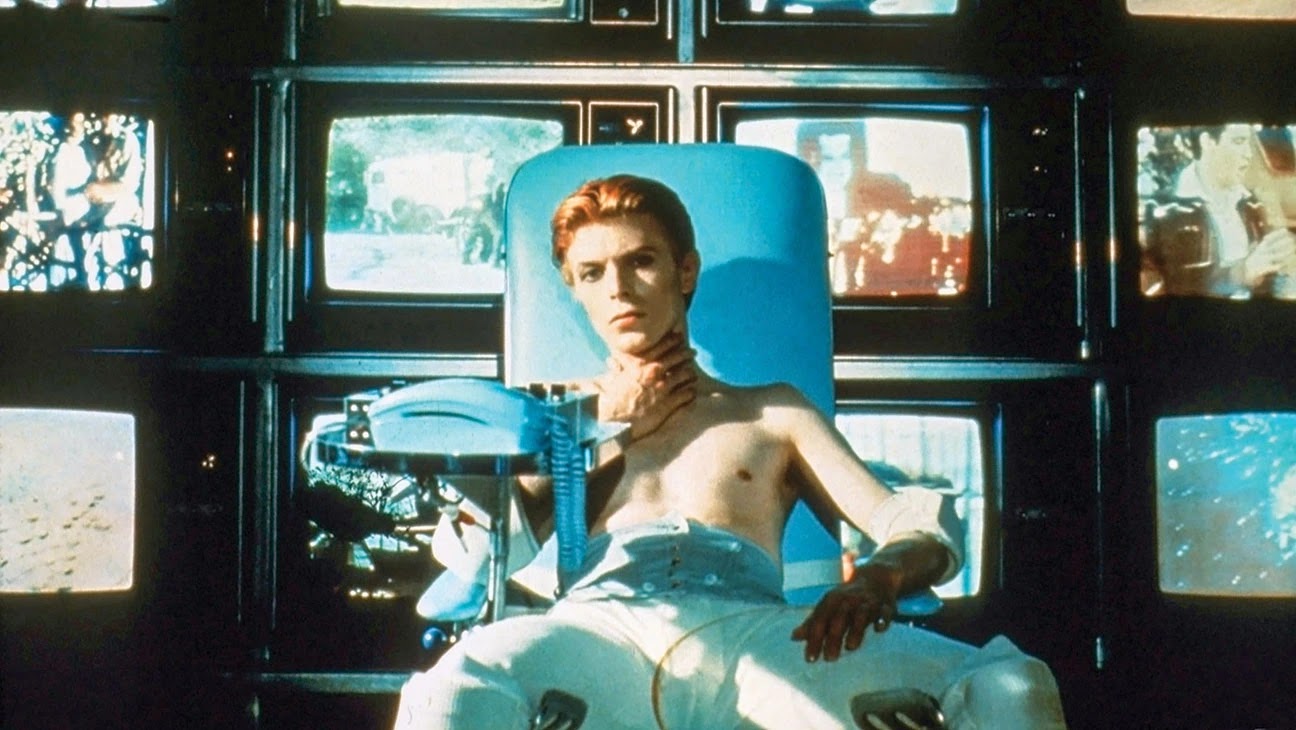
David Bowie is iconic as Thomas Jerome Newton.
(Image via Hollywood Reporter)

At almost the opposite end of the cinematic spectrum is The Man Who Fell To Earth, a ponderous, perplexing, and unsettling piece of arthouse cinema directed by Nicholas Roeg. The movie features David Bowie as the alien Thomas Jerome Newton on a mission to bring water back to his home planet. Armed with a vast archive of scientific knowledge, he starts businesses and investments, building a ship to take himself back to his home planet. Over the course of decades, he becomes seduced by the carnal pleasures available to him on Earth, and loses his way. Based on a novel by Walter Tevis (Queen’s Gambit, Mockingbird, The Hustler), the movie feels incomplete; like more effort was put into visuals than plotting, without much consideration for what the story adds up to.

Though it ended up on the Hugo ballot, there was a significant and vociferous faction of fandom that loathed Logan’s Run. Contemporaneous fanzine reviews described it as “ludicrous,” “hackneyed,” and “insulting.” But with the benefit of four decades of hindsight, we’d suggest it holds up admirably well. Adapted from a novel by William F. Nolan and George Clayton Johnson, the movie explores a society in which citizens are given a maximum lifespan, and are culled the day they turn 30. It’s a broadly ephebiphobic commentary on contemporaneous youth culture; and is reflected in various ways in generations of young-adult dystopias such as The Maze Runner and Divergent. The filmmaking is ambitious, lush, and looks great. One of the striking things about Logan’s Run is just how sex-positive the movie is; this hedonistic society puts consent at the forefront, and accepts homosexuality without judgment. For the era, it’s exceptionally progressive on these fronts.
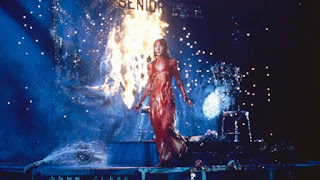
There are portions of Carrie where every frame
of the movie is riveting and spectacular.
(Image via ABC News
Of all the finalists, Brian de Palma’s Carrie probably stands out as the best piece of filmmaking. That said, it’s more uneven a movie than most of us had remembered; de Palma’s attempts to mimic earlier horror directors such as Hitchcock are a little overdone. But when he leans in to his own music-video style the movie soars. There are numerous moments that are etched indelibly into pop culture: Sissy Spacek at the Prom being the most iconic. In some ways, it’s essentially a movie about personal autonomy; Carrie is cowed by an overbearing and extremely religious mother, constrained by bullies, and trapped by her school. In fact, until the last scene, nobody ever asks Carrie what she wants. Even the most well-meaning characters try to act in her best interest behind her back — without consulting her. We'd also note that Sissy Spacek's performance is unbelievable; the movie would not hold up nearly as well without her. 

The Hugo Award should have gone to Carrie or to Logan’s Run. The Worldcon snubbed some great filmmaking that may not have been as momentous and era-defining as Star Wars, but still deserved respect, as did the efforts of those who nominated.

Note: Our series of blog posts about Hugo-shortlisted movies will be on hiatus for the next several months while one of our key contributors recovers from surgery.

Thursday, 25 May 2023

The Word For "World" Isn't America

In China they honour works of science fiction with the Galaxy Award, the Atorox Award is presented annually to the best Finnish work of SFF, Australia’s Ditmar Award recently celebrated 50 years of recognizing Aussie sci-fi, Japan has the Seiun Award, Canada the Aurora, New Zealand the Sir Julius Vogel Award, Netherlands the Paul Harland Prize, in Croatia they present the SFera Award … we could go on.

The Ditmar Award is almost
as old as the Nebula, and
recently recognized 
J.S. Breukelaar's "The Bridge."
(Image via BlackGate)
These national awards support science fiction fandom by platforming works that express the local concerns and national character of their host nations. Although neither Julie E. Czerneda, Candas Jane Dorsey, or Karl Schroeder have been honoured by the Hugo Awards, they’re truly great authors and we’re glad that the Aurora Award has recognized them. Their creative works speak to and for Canadians.

So why is there no national award recognizing the best science fiction published by authors from the United States?

It could be argued that this is a reflection of American exceptionalism or imperialism.

The Hugo Award — when it was established in 1953 — may have billed itself as celebrating the world’s greatest science fiction, but that was for a limited definition of “world.” This was a “world” that extended no further north than Toronto, no further east than London, and no further south or west than Los Angeles. American cultural hegemony was baked into the DNA of the award.

An American national SFF award was not seen as necessary, because the Hugos existed.

To date 84.2 per cent of all winners, and 84.5 per cent of the authors represented in the prose categories (short story, novelette, novella, novel and series) were born in the United States. If anything, these statistics understate the level of American dominance, given that the non-American 15 per cent includes figures like Isaac Asimov (born in Russia), Algis Budrys (born in Germany) and Ursula Vernon (born in Japan). If the goal of the Hugo Awards is to represent the best science fiction in the world, then we cannot limit ourselves to works by American authors.

It can be argued that American dominance might have eased slightly in recent years. But even over the most recent three awards ceremonies, 76 per cent of Hugo finalists in the prose categories were still Americans.

Despite a slightly increasing global reach of Worldcon over the past 20 years, clearly, the award’s early focus on America and on American SFF remains.

And this now feels like a disservice to the genre as a whole. The list of iconic SFF writers who did not primarily write in English, and who consequently never got even a whif of Hugo recognition is long. Among others, we’d mention Japan’s Kobo Abe, France’s Pierre Boule, Brazil’s Jerônymo Monteiro, France’s Bernard Werber.

Elia Barceló is among the best-known Spanish
authors and has published best-selling works of SFF.
But the Hugo Awards have yet to recognize her work.
(Image via Zendalibros.com)
The lack of an award for Best American Science Fiction means that the Hugo is the primary award that American science fiction fans and authors pay attention to, lobby for, and consequently dominate. Thus, the award for the best science fiction on Earth is usually awarded to American authors, and consequently reinforces the perception that American science fiction is the beginning and end of the genre.

Put another way, the lack of an American SFF award ends up disprivileging non-American authors.

But it’s a sword that can cut both ways.

This year, with Worldcon being held in China for the first time, there have been more nominating ballots than ever before received from science fiction fans whose first language is not English. There is consequently a real chance that the Hugo Award ballot may primarily celebrate Chinese-language works.

If this comes to pass, and if deserving works of American science fiction are denied recognition as a consequence, we should not blame the Chinese fans who engaged with the Hugos. The fault belongs with all of us in North American fandom for trying to have our award be global, but still wanting to be the only ones who can win it.

Regardless of what the shortlist looks like in 2023, the Hugos would be improved by the existence of a national science fiction award in the United States.

As much as Worldcon likes to think of itself as a “World” event, it seems pretty clear that for the first seven decades that it existed, the Hugo Award has steadfastly resisted the global reach of fandom.

If the Hugo Award is to be a truly “World” award, American fandom may need to relinquish it … by establishing an American award for American fiction.