Tuesday, 13 December 2022

The Tentacle of Empathy

One of the most interesting evolutions within science fiction over the past two decades has been the ways in which non-human consciousnesses are depicted.

(image via Hachette UK)
From the dawn of the genre, there has been a commendable attempt by many authors to expand the definition of what beings are worthy of human-level rights. However, in earlier decades many have struggled to imagine something truly alien; Klingon, Wookie, Kzinti, Gallifreyan, and Melmacian are all only differentiated from humans by body shape and culture. Even the supposedly ancient and unknowable Vorlons of Babylon 5 and the omniscient and omnipotent Q of Star Trek seem to be governed by human emotions such as arrogance, wrath, and loneliness.

We would suggest that over the past quarter century, an increasing societal understanding of neurodiversity has been reflected in science fiction. Starting in the 1990s, the autistic self-advocacy movement (and the associated neurodiversity movement) have helped destigmatize behaviours and problem-solving practices often associated with those who have been diagnosed as being on the autism spectrum. In essence, this is broadening our understanding of the human experience, and thus promotes human dignity writ large. There is a line that could be drawn between the autistic self-advocacy movement and the broadly positive depiction of non-normative cognition among the Tines and the Focused in Vernor Vinge’s Zones of Thought novels, and the Portids and the Corvids of Adrian Tchiakovsky’s Children of Time books. In essence, science fiction has paralleled the neurodiverse movement in destigmatizing diverse cognition thanks to a small cadre of authors who have been making an effort to get into the heads of intelects that are alien to their own. Whether doing so was intentional or not, it has value, as showing the richness of different forms of cognition helps build empathy.

Ray Nayler’s debut novel The Mountain and the Sea, which hit shelves on October 4, puts this tradition into focus.

Set in the near future, the book weaves between the viewpoints of several characters who are each in their own ways tentatively and clumsily reaching towards a slippery understanding of the role compassion might play in their lives. It’s about trying to grasp a writhing and elusive tentacle of empathy.

The two primary narrative threads follow Dr. Ha Nyugen, a marine biologist making discoveries into the cognition and social behaviours of a newly-discovered species of octopus living near a remote island of Con Dao; and Eiko, an aspiring businessman who is enslaved on an automated fishing vessel.

These interspersed stories act as an emotional yin and yang within the book. Despite Eiko’s tale being one of despair and exploitation and Nyugen’s driven by the hope for discovery, both characters are forced to examine why their lives are lacking and, thus, both narrative threads share fundamentally similar emotional themes.

Eiko’s kidnapping and enslavement is
not fantasy, but rather a reflection
of real-world practices.
We’d recommend Ian Urbina’s
New York Times article series
The Outlaw Ocean, which has
photos from Times
photo editor Adam Dean.
(Image via New York Times.)
Drugged and kidnapped shortly before starting his first, coveted, job out of university, Eiko finds himself trapped on a fishing vessel in the middle of the Pacific ocean, forced to process fish carcasses for mind-numbing hours of back-breaking unpaid labour. This is a bleak setting, in which we slowly learn that there are hundreds of such vessels strip mining the oceans, extirpating all saleable life in the pursuit of short-term profits. Eiko’s personal voyage is mostly in his head, as he begins to analyze the role he had previously intended to play in this exploitative system, and with deliberate effort tries to teach himself empathy in the harshest of conditions. We particularly enjoyed the depiction of solidarity-based organizing among enslaved workers. Nayler explores both the ways in which technology insulates capitalists from the victims of their exploitation, and the ways in which workers are often forced into compliance through inhuman systems. Although Eiko’s chapters are some of the strongest and most affecting content of the novel, they might have been too emotionally exhausting for many readers, if the book hadn’t also been enriched by Nguyen’s story arc.

Her chapters follow a dogged attempt to bridge the gap in understanding and communication between humanity and the octopuses, while she simultaneously grapples with her own quiet isolation. The marine biologist, it turns out, accepted a remote job from the multinational corporation Dianima, which owns and fiercely guards the island of Con Dao. This leads to questions of why the corporation is so interested in the octopuses; and how they might be exploited. Much of Nguyen’s arc is put into sharp relief through the slow development of trust between her and the two people who are also bound to the island by their shared employer: Altantsetseg, a Mongolian security expert and Evrim, the world’s only truly human-level artificial intelligence.

The novel’s depiction of semi-functional future geopolitics and extreme forms of predatory capitalism are sadly believable, but written with interesting nuance. Nayler’s background working in the foreign service has given him a perspective and a knowledge that lends the story credibility.

But at its core, the strength of the novel is in how richly it explores the ways in which humans interpret experiences, how different sensoria and neurological architecture might construct individual understandings of the world, and how artificial intelligences might evolve and what that could mean for their sentience. It’s impossible to know what's going on in another being’s head, nor whether depicting these processes can ever be accomplished, but we suspect that Nayler has done this about as well as possible. The speculation on how octopus intelligence might have evolved, and how their form, abilities, and physical brain shape might perceive the world are meticulously explored. In this way, it could be interpreted as one of the most in-depth examples of the neurodiversity movement reflected in science fiction.

In essence, Nayler seems to be asking how humans might ever be able to build a bridge of understanding with an alien race, when we often can’t even do so amongst our own species. It’s often a heartbreaking novel, but one worth reading and one that’s laced with threads of hope.

Tuesday, 15 November 2022

Battle of the Vonneguts - Hugo Cinema 1973

This blog post is the sixteenth in a series examining past winners of the Best Dramatic Presentation Hugo Award. An introductory blog post is here.

The hotel’s aging air conditioning system wheezed and struggled as the temperatures soared above 100F (30C) outside the Royal York in Toronto in the beginning of September, 1973.

Almost three thousand fans had made their way to Canada’s largest city for the 31st World Science Fiction Convention; a crowd that far eclipsed any previous Worldcon.
The CN tower under construction in 1973
The stump of the CN Tower in August, 1973 as
seen from near the Worldcon convention hotel.
(Image via CBC)


Looming over the proceedings was “the stump” of the CN Tower. The first few hundred meters of what would one day be the tallest building on the planet was slowly reaching to the sky a few blocks from the convention.

In a frescoed ballroom where Queen Elizabeth II had danced only a few short weeks prior to the Worldcon during her tour of Canada, two thousand fans (two thirds of the convention) squeezed in to catch an early glimpse of a highly-anticipated new animated Star Trek series for which associate producer Dorothy Fontana had brought an advance copy.

Dramatic presentations themselves clearly held an appeal to Hugo voters, though the award itself remained somewhat scorned. At that year’s ceremony, Best Dramatic Presentation seemed somewhat of an afterthought. Which is a shame, as it was a fairly good year for science fiction and fantasy cinema. Even the worst entry on the ballot was generally tolerable.

Unusually, two movies shared at least some of the same source material; both the mainstream hit Slaughterhouse Five and the ultra-low-budget Between Time and Timbuktu are based in whole or in part on Kurt Vonnegut’s 1969 bestseller (also Slaughterhouse Five, though to be fair the latter uses very little of the novel). Despite this unique circumstance, it appears that neither Vonnegut nor anyone involved with either production was in attendance for the Hugo Awards ceremony.
Slaughterhouse Five is a beloved adaptation of 
Kurt Vonnegut's most famous work, but in some
ways it has aged poorly, particularly in terms of sexism.
(Image via Guardian.co.uk)


In fact, nobody from any of the finalist Dramatic Presentations were in attendance. Not The People author Zenna Henderson, not Silent Running script writer Steven Bochco, not even Silent Running director Douglas Trumbull who spent that week at the CFTO-TV Studios in Scarborough, barely 15 miles from the Worldcon.

In what may be one of the most eccentric selections in Hugo Award history, voters selected the television movie Between Time and Timbuktu. It is a chaotic and ultimately disappointing PBS television movie that stitches together various scenarios from essentially every major Vonnegut work up to that point including Cat’s Cradle, Harrison Bergeron, Happy Birthday, Wanda June, God Bless You, Mr. Rosewater, The Sirens of Titan, Welcome to the Monkeyhouse, and Slaughterhouse Five.

The overarching plot is that Stoney Stephenson (William Hickey) — a poet in modern-day America — wins a contest to travel into space, and on that trip he gets thrown into a dozen different parallel realities. In each of these realities, the viewer gets a brief glimpse of a better and more coherent movie that might have been.

Between Time and Timbuktu might be an obtuse and often irritating movie, but one has to admire the fannish exuberance that must have led a group of public broadcasting employees to create this. It’s clearly made by people who love every word typed by Kurt Vonnegut Jr., but who have no budget to bring those words to life, and no discipline to bring coherence to the script.

A more successful Vonnegut adaptation is Slaughterhouse Five, based on the author’s semi-autobiographical anti-war novel that was shortlisted for the Hugo in 1970. Told in non-linear order, the movie chronicles Billy Pilgrim as he slips forwards and backwards in time to experiences in the fire bombing of Dresden, to his marriage and suburban post-war life, to his abduction by aliens in the 1960s. It’s a piece of speculative fiction that was important in its day, and it’s difficult to complain too bitterly about the fact that the movie won the Hugo Award; at least two members of our cinema club hold it in some reverence.

Non-linear storytelling is especially difficult in cinema, so the fact that director George Roy Hill manages to make it both comprehensible and engaging is commendable. Michael Sacks brings an abiding humanity to the lead role. Miroslav Ondříček’s cinematography is painterly and draws in the eye. And the soundtrack by Glenn Gould is extraordinary.

But in many ways, the film version of Slaughterhouse Five has aged poorly; the depiction of women is demeaning and unpleasant to watch. Most of all, the fat shaming of Billy Pilgrim’s wife, and Pilgrim getting ‘rewarded’ with a young woman upon his wife’s demise, are beyond objectionable.

Based on the short stories by Zenna Henderson, The People was the ABC TV movie of the week on January 22, 1972. It’s a somewhat ham-handed production about a school teacher (played by Kim Darby) who is sent to what appears to be an anabaptist community that eschews technology. Over the course of the movie, she discovers that the residents are in fact telepathic aliens who fled the destruction of their planet. The conflict in the story — such as it is — involves tension within the alien society about whether or not to continue hiding their true selves. William Shatner’s role as the community doctor is one of his least Shatnery performances, but it’s also among his least memorable. This is probably the weakest finalist of that year.

Silent Running is an innovative and oddball
classic that provides memorable characters
both human and robot. To be blunt, it rules.
(Image via IMDB) 
Of this shortlist, most of our cinema club would have voted for Silent Running. The directorial debut of special effects wizard Douglas Trumbull is a slow, weird little movie about Freeman Lowell (Bruce Dern), an ecologist on a spaceship who is tasked with preserving the planet’s last-remaining forests that have been launched into orbit for safekeeping. It’s a fairly flimsy set up, but it provides compelling drama based around moral dilemmas that occur when politicians order Lowell and his crewmates to scuttle the ship. There’s some grey area in these questions; is it appropriate for Lowell to murder his crewmates to preserve the lives of trees and wild animals? Is Lowell correct to disobey unjust orders in the first place?

The movie’s helper robots Huey, Dewey, and Louie, are among the most memorable robots in all of science fiction cinema; as actors Mark Persons, Steven Brown and Cheryl Sparks manage to imbue them with a subtle empathy and dignity.

Trumbull’s filmmaking is technically excellent, both on the interior shots, and the special effects. Compounded with good performances and an absolutely killer Joan Baez soundtrack, Silent Running is a movie that looks better with each passing year.

But there is one omission from the shortlist that is somewhat galling. One science fiction movie in 1972 towers above all the others: Andrei Tarkovsky’s Solaris. Based on a novel by Polish author Stanisław Lem, the movie follows Kris Kelvin, a psychologist sent to investigate occurrences on a remote research station orbiting a planet that is the movie’s namesake. When he arrives on the station, he discovers that one of the three scientists posted there has died, and the other two are in turmoil. The movie slowly reveals that the planet they’re orbiting is alive, and is sending manifestations to the station, possibly in an attempt to understand humans.
Solaris was well-known to SFF fans
in the 1970s, but somehow it didn't
ever appear on a Hugo award ballot.
(Image via IMDB)

Many have argued that Solaris is one of the finest pieces of science fiction ever brought to the screen, so its complete absence from the Hugo ballot is somewhat baffling. It won awards at Cannes and at the Chicago International Film Festival. It was contemporaneously reviewed in Fanzines such as Norstrilian News and Zimri. Brian Aldis suggests that “it bids fair to stand as the best science fiction film so far.”

The movie is filled with nuance and emotional interiority, as layers of the characters are revealed through their pasts, through the psychological turmoil that the planet’s manifestations cause them, and through the difficult decisions they must make. There’s also an interesting tension between the protagonist’s rationalist worldview, and his desire to believe his deceased wife has been returned to him. It’s a compelling piece of cinema, and should have been a frontrunner for a Hugo Award in any year it was eligible.

The Hugo Award for Best Dramatic Presentation in 1973 had one of the more credible winners, and one of the better shortlists to date. But the omission of Solaris brings the whole enterprise of recognizing the “best” science fiction cinema into question.

Thursday, 10 November 2022

Space Nazis Must Die

Hitler’s goon squad casts a long shadow over science fiction.
 “We will fight them
on the beaches...”
(Image via IMDB.com)


It’s easy to see the outline of Nazi soldiers in the Impirial Military of Star Wars, Doctor Who’s Daleks, The Alliance in Firefly, or the Terran Federation shock troops in Blake’s 7.

Deliberate choices are made in films to offer the connotation of Nazi, often including immaculately tailored Hugo-Boss-style uniforms, Teutonic heel taps of the jackboots when marching, and Riefenstahllian visuals of parade grounds and iconic banners. Sometimes, there’s a suggestion that these fictional soldiers are motivated by some form of racist ideology, though the details of this are usually nebulous.

Let’s be clear here: Nazis are bad.

Nazis should be opposed wherever they exist: on the battlefield, at the ballot box, in the streets, and across the tenebrous depths of interstellar space. As such, depicting villains as Nazis — and therefore Nazism as villainous — has value.

But depiction without engaging with the premises of motivation is lacking. “Nazi” is such an easy signifier for evil, it often allows these narratives to avoid engaging with what evil actually means. Sure, Imperial Soldiers kill a lot of people in the Empire Strikes Back, but so do the zombies in Train to Busan, or the tornado in Twister, or the Xenomorphs in Alien. The faceless hordes provide little more than target practice for laser rays; there’s no interiority behind the mirrorshades and white perspex armour. 

Using the symbolic Nazi provides a type of worldbuilding and character shorthand for the viewer, or reader. It conveys a (false) dichotomy that provides comfort; a comfort in knowing that Nazi = bad and the other side = good. It gives the consumer a break from having to figure out bad from good for themselves.
Nazi-coded villains can be found in all kinds of SFF
from Star Wars to Planet of the Apes to Woody
Allen’s Sleeper. But do these movies invite the
viewer to consider what this iconography means?
(Image via Overture Magazine)


Science fiction’s depiction of fascism and of fascists is occasionally more pointed and valuable. Paul Verhoeven’s Starship Troopers plays a brilliant bit of sleight of hand, first building up the Terran Federation as a heroic force through propaganda techniques, then slowly revealing to the audience that they’ve been duped into cheering for Nazis. Norman Spinrad’s The Iron Dream explores how heroic fantasy narratives are rooted in similar assumptions to the mythologized history that underpin fascist mythmaking. And Vernor Vinge’s Deepness In The Sky explores new ways for human freedom to be subverted by Nazis.

But the predominant conception of Nazis in science fiction is little more than a costume.

Consider: there are overt and unrepentant real-world fascists who are die-hard Star Wars fans. But we wonder – do they see the linkage? The classic trilogy encourages such minimal critical engagement that it would be easy to imagine someone spending a day at a polling station with an assault rifle intimidating BIPOC voters and then go home and watch the Special Edition of A New Hope and cheer for the Rebellion. Likewise, it’s not uncommon to see left-wing pro-democracy activists involved in
The fascist tendency to view human beings as
tools, and the prison system as a source of 
expendable labour is depicted well in Andor.
Some fans didn’t get the message
(Image via Polygon)

the 501st Legion and dressing up as fascist Stormtroopers on a regular basis. This is not to play any false equivalence between these two groups; but rather to point out how vague and tenuous the depiction of fascism has traditionally been in Star Wars and how this leaves the viewer free to engage with its narratives at a superficial level.

And all of this is why the most recent iteration of Star Wars is so refreshing. Andor presents a multi-layered view at the Empire that explores the seductive power that authoritarian systems can have on their participants: the capitalist class that profits from oppression and is lulled by the illusion of security; the mid-level bureaucrats who fetishize order and see the opportunity for advancement; the ground-level workers who sell out their peers just to escape the butcher’s block for another day. At the risk of hyperbole, it sometimes feels as if the series is building a taxonomy of fascists; an Audubon Guide to the Nazis In Our Midst.

Andor suggests that there is no one type of fascist in the Star Wars universe, and in doing so makes the empire more believable, and the imperial system to be far scarier. The genre needs more of this. These may be stories that are often set in a galaxy far, far, away … but fascism is never as distant as it should be.

Monday, 24 October 2022

Interview with Premee Mohamed, author of the Beneath The Rising trilogy

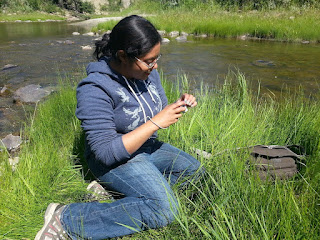
Scientist and author Premee Mohamed photographing
photos of insects in a riparian area of Alberta, Canada.
Her work often reflects environmental impacts and
concerns.
(Image via the author)
Premee Mohamed is an Indo-Caribbean scientist and speculative fiction author based in Edmonton, Alberta. Over the past year, her work has appeared on the ballots for the World Fantasy Award, the British Fantasy Award, and Hugo Awards, as well as earning her a Nebula and an Aurora for best Novella. This spring, she published the capstone to the horror adventure trilogy that started with her debut novel Beneath the Rising. Mohamed spoke with blog contributor Olav Rokne in September.

UHBC Blog: Just earlier today, while prepping for this interview, I read “All That Burns Unseen.” I actually emailed my wife and told her “You have to read this story!”

Every time that we get fire seasons — like the one in the story — I feel like the world is ending. So that story felt very real.

Premee Mohamed: I'm glad … but I'm also horrified, because it feels really really real to me too.

The story came from just this idea of like the year-long fire season with no water left to fight it. And that's barely sci-fi. That's soon. That's going to be happening real, real soon.

UHBC Blog: Do you have any family up north? Because that aspect of the story was particularly true to life.

Premee Mohamed: Not me personally. But for the story, I did uh pick the brains of a friend of mine who works for the air monitoring division [of Alberta Environment and Parks] and he was sent up with very little notice to the Fort Mac fires. And I asked him “Visually what do you remember? What were some things that stood out to you?”

UHBC Blog: So yeah, I was actually planning to bring up the fact that climate change seems like a
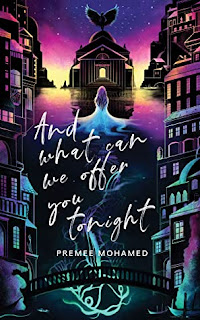
In 2022, Premee Mohamed won
the Nebula for best novella, and
the Aurora for best novella ... 
though oddly with different books
earning the awards.
(Image via Goodreads)

recurring theme for you. It informs What Can We Offer You Tonight, Annual Migration of Clouds, and of course that excellent short story. Do you think it's possible to write near-future fiction and not include some time of climate change elements?

Premee Mohamed: Well, anything's possible in fiction.

But suppose I wanted to write a murder mystery set in London in a fancy house in the middle of the city in 1942. In theory, I could write the entire book just about the murder mystery and these friends would have to solve it.

But in practice, if I didn't mention World War II at any point or the Blitz or the bombs or people that they knew that had died in the war … it would feel very weird and I feel like the book would be kind of missing something enormous about the reality of London in 1942.

So I don't think it's possible to write a future on Earth in fiction where we either aren't facing the catastrophic effects of mass climate change, or we have figured out a way to mitigate it.

I'm looking at my Twitter feed and there's disasters happening all over the world that are directly attributable to climate change. All I can picture is a future where eventually those disasters join up temporally and spatially … and everything is bad for everybody pretty much all of the time.

UHBC Blog: I always read the first two Beneath The Rising books as a bit of a climate change metaphor,

Premee Mohamed: I think what I was thinking of was not specifically um climate change per se, but certainly eschatology — end of the world scenarios.

Nuclear was actually what was informing the first one: this world-ending technology that once it started wouldn't stop.

But I don't think that climate change is actually that different from the idea of this nuclear disaster. 

It's something that most of us can't directly affect ... and the people that can affect it, the people who hold all the power seem unable to respond effectively.
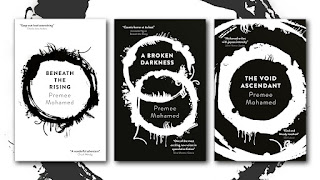
The third book in the Beneath The Rising trilogy
hit shelves in April. 
(Image via SciFiNow)

UHBC Blog: One of the aspects that really drew me into those books was what I perceived as a parasitic friendship between Joanna and Nick. Was any aspect of that drawn from real life?

Premee Mohamed: I was quite young when I started writing that first book; I was Nick's age. So my friends were kind of my entire sphere of influence.

I had just realized that some of my friends' families had a lot more money than mine. I didn't really think about it, it wasn't something that one really noticed. Just, you know, their house was nicer, he always had the latest newest gadgets. I was 18 at this point, and it had been years of me noticing this, but not really noticing. And it kind of sank in like, “Oh man, this explains so much about like the last like seven or eight years of my life.” Things that I did not notice.

So Nick is very cognizant that Johnny is a multi-millionaire, or maybe a billionaire. Aware that she owns companies, she's got influence, she's in the media, she's a celebrity.

And at the start Nick's like “I'm extremely ordinary isn't it a miracle that we're friends.” But then you start to see that the person who has the most Johnny is taking the most and the person who has the least — Nick — is giving the most and it's so uneven. When he realizes that, of course he shatters the friendship.

That being said, it wasn't so much that I drew from myself and my friends when crafting the relationship between Johnny and Nick. Their relationship is more of a microcosm of the overarching story as a whole.

The reason disasters keep happening to them is because the old friendship and trust that they shared has been broken.

When their friendship is close and tight, they're able to work together and they can actually accomplish positive things. But when they don't trust each other, the plot falls apart and disasters start happening.

I wasn't really doing that consciously so much in the first book, but definitely in the second and the third.

UHBC Blog: So … you mentioned that you started writing the book when you were 18 or so. So that would have been around 1999 or 2000. And it seems to me that's right around the time that the resurgence of Lovecraftian fiction was starting, so you were kind of ahead of the curve.

Premee Mohamed: I actually hadn't read any Lovecraft when I started writing the book.

And in the earliest drafts of the book, it was a pretty straightforward good guys against like … the actual devil, and demons. But as I started writing, it seemed like the devil as a villain had kind of been done. I didn't feel like I could put a fresh spin on it.

I was like “why am I putting Satan in this?” “Is this 12 years of Catholic School speaking?”

Around that time, I started reading Robert E. Howard, and in the back of the book someone had written an essay about a bunch of other similar authors

It was like Lovecraft and Arthur Machen and Lord Dunsany and a couple of other names. So I went and looked up Lovecraft collected works in the library and I was like “oh this is some terrible writing and a really good sandbox! Look at all these weird ancient gods and these cults and the possessions and this extremely weird haunted house with tentacles in the basements!”

UHBC Blog: What is it about the current moment that makes these metaphors about secrets that man was not meant to know relevant again?

Premee Mohamed: I suppose part of it must be that with the advent of the internet we don't think there's anything we can't know. There shouldn't be any information that is beyond us because it's somewhere online.

Having just adopted a cat, I think I'm seeing this attitude right now. His attitude is: “Whatever it is you are doing, I have the right — nay, the duty! — to come see what it is.”

I think it's this attitude of entitlement to information is part of it and the idea that there is information out there that someone has that no one else has that we could have.

That's pretty alluring I think and part of it I think must also be the cosmic side of things: This idea that the villain doesn't even notice us unless we somehow attract its attention. The villains are just villainously doing whatever it is they do and humans are so insignificant that all they can think of to do when they encounter us is enslave us or exterminate us or use us as part of their horrible life cycle.

And it all defies understanding and it's supposed to be incomprehensible which in the books that really bugs Johnny. She's a scientist, she wants to understand, and believes she should be able to control magic because to her magic is basically an elementary particle like a photon. If we can understand and measure and control photons why can't she do the same to magical particles?

UHBC Blog: It strikes me that this is somewhat related to a dichotomy in your career. I mean you're a person with two science degrees working in a field that is all about uh metrics and and and facts and and yet a lot of your fiction is entwined with that branch of weird sff in which science cannot save us.

Premee Mohamed: I really enjoy the tension actually.

I like the idea of people encountering things that should be scientifically explicable in some way that just aren't.

For example in And What Can We Offer You Tonight the reason Winfield comes back to life is never given. I don't think there's a point in explaining it, and I don't want somebody to strap her down to a table and vivisect her. I don't know why she did and that's not the point of the story.

If I want to write a story where scientific understanding is the point of the story then I do. For instance my story that's coming out in Life Beyond Us, which is an anthology in association with the European Space Agency. My story is called “The Far Side of the Door,” and it does involve a medical mystery that has to be solved using science.
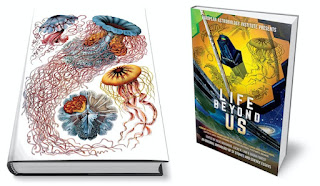
Among her numerous upcoming works is a short
story in the anthology "Life Beyond Us."
(Image via Kickstarter)

But sometimes I don't want to explain it, and it's actually more satisfying to me not to. You know in These Lifeless Things, readers might ask “How do the statues come to life?” “How come that's never explained when the scientists come to the city 50 years later?”

I'm like: “Because I don't want you to know.” “Because I don't want the reader to have some questions answered.” I want them to ask and I want them to not know at the end deliberately, because it's more fun.

UHBC Blog: Well and speaking of These Lifeless Things, you've had a very successful year in terms of novellas. What appeals to you with the novella as a format?

Premee Mohamed: I really love the length. In the next couple of years I'm gonna have three more out.

So one with tor.com and then two are the sequels to The Annual Migration of Clouds.

I've been really trying to put my finger on it, because I just did the Edmonton Expo, and somebody was asking about novellas.

I think what appeals to me about a novella is similar to what appeals to me about a short story is how ruthless you have to be with what part of the character's lives you choose to focus on. What time period you want the story to cover and what events can be allowed to happen in it to kind of illustrate what you want people to go through and how much you have to trust the reader.

In a novel, if I need to explain why this entire city has only subsisted on sardines for the last 50 years, I have room to do that. In a short story I may have a couple of sentences.

The novella is the perfect you know length between I want to explore one idea or one premise with one overarching plot structure and at most one subplot and a limited number of characters.

So when the reader is reading, they are laser focused on this single string of events that is happening and on these few characters' experience of this story. There's no room for tangents, there's no room for digressions.

So it ends up just a really great interesting length to write in terms of both the freedoms and the limitations that it gives you.

Friday, 14 October 2022

A Unanimous Gold Mine Of Subtext

If you’ve ever wondered what it would be like if Sun Ra and Samuel R. Delany had tried to make The Matrix, the answer is something like Neptune Frost.
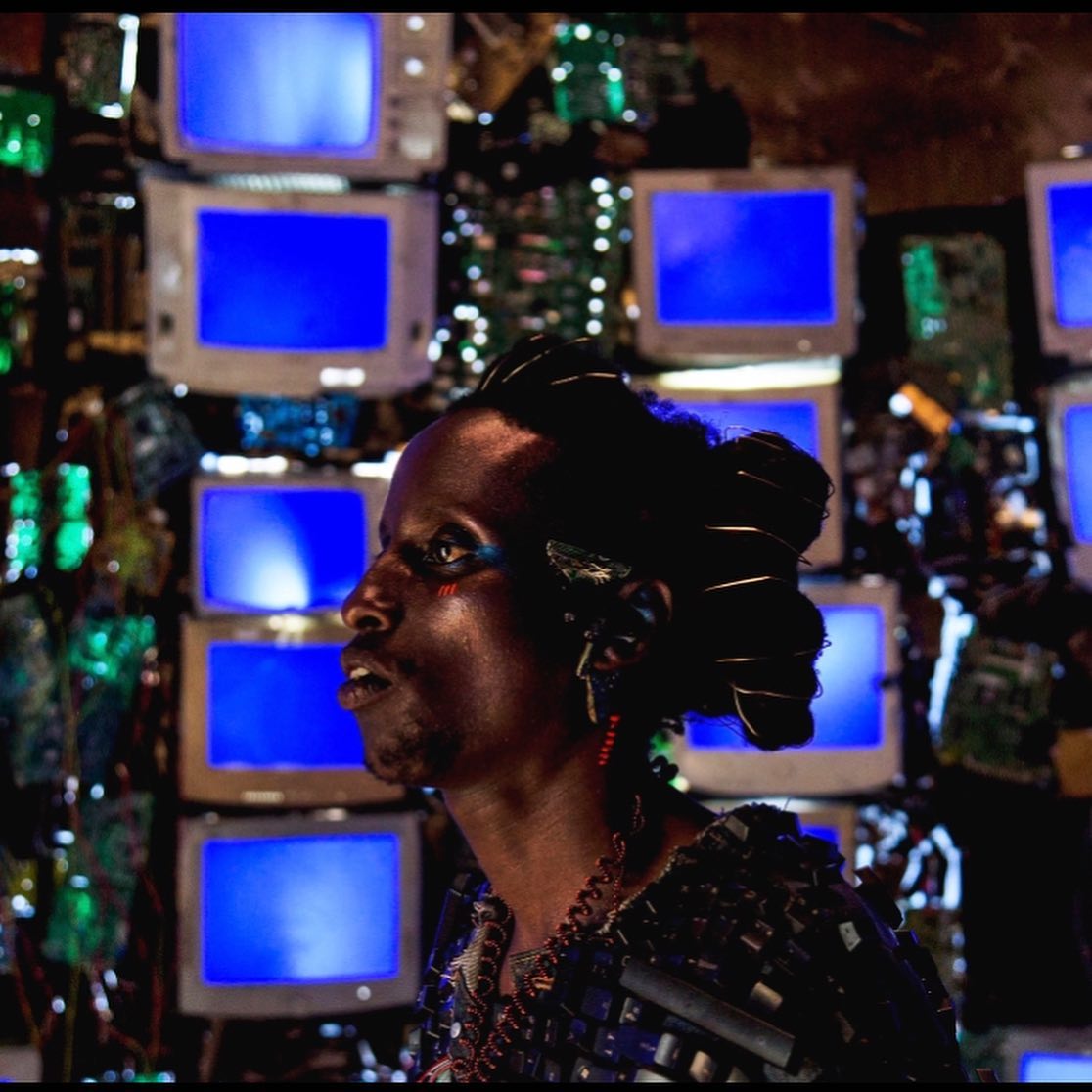
Burudian rapper Kaya Free (AKA Bertrand
Ninteretse
) gives a compelling nuanced performance
as Matalusa in Neptune Frost
(Image via the Facebook Page of Saul Williams


A collaboration between alternative hip-hop artist and provocateur Saul Williams and Rwandan artist and playwright Anisia Uzeyman, Neptune Frost is structured in alternating segments between a story following a coltan miner named Matalusa whose brother is killed while mining coltan in an open pit mine, and an intersex runaway named Neptune who flees from an attempted sexual assault. Neither of them fits into the systems at play in the communities they call home, and through this, the viewer is challenged to find parallels between the oppression of gender conformity and the oppression of standard capitalist employment relationships.

The ability of each of these narrative threads to engender empathy hangs on superb performances in these two roles; Matalusa as played by Kaya Free and Neptune who is played alternatingly by Cherylel Isheja and Elvis Ngabo.

Finding each other when they join a revolutionary anti-capitalist hackers collective, Matalusa and Neptune discover that their relationship warps the fabric of reality and may provide the key to freeing society from the grip of a rapacious mining company and an authoritarian regime.

But a simple plot summary does not begin to convey what makes the movie so unusual and compelling. The central characters’ journeys through this imagined future Rwanda and Burundi shimmers between differing states of existence; musical understandings of the world and cinematic explorations. It’s … a lot to work through.

Additionally, given that it’s a multilingual movie whose dialogue is in parts spoken in Kirundi, Swahili, Kinyarwanda, French, and English, and given that some of the subtext depends on puns in the various languages, it is the sort of cinema that takes some generosity, imagination, and effort to parse.

Although the movie can be opaque and obtuse at times, what is clear is the criticism of capitalism, of colonialism, and of exploitation. This is a movie about an anarchist, anticolonial rejection of heterodox narrative conventions.

This carries through to the exuberant and kaleidoscopic visuals that are elevated by found-item and repurposed set construction. This world is built of broken, discarded, and recycled computers and technology, evoking a punk aesthetic; handmade yet high tech.
Creators Saul Williams and 
Anisia Uzeyman. 
(Image via Facebook)


Although it opened at the Cannes Film Festival in 2021, it’s eligibility for the Hugo Awards was extended at the 2022 WSFS business meeting, so it can be nominated for a Hugo Award for Best Dramatic Presentation in 2023. And it deserves your attention. 

Although the Hugo Award for Best Dramatic Presentation has a long history of celebrating works that are already successful, several nominations in other categories show that Hugo voters are interested in works that represent cultural perspectives other than North American.

In an era when mainstream science fiction movies have embraced safe and comforting fare, experiencing cinema that dares to offer non-traditional narrative structures is refreshing.

Currently available for purchase on various streaming services (YouTube, Apple+, GooglePlay), this challenging, multilayered, perplexing, beautiful beat poem of a movie is probably the most interesting piece of science fiction cinema to have arrived from Africa since the 2009 release of Wanuri Kahiu’s Pumzi.

To quote Neptune Frost itself: this is a Unanimous Gold Mine.

Wednesday, 5 October 2022

Interview with Oghenechovwe Donald Ekpeki, editor of Bridging Worlds

Oghenechovwe Donald Ekpeki is an African speculative fiction writer, editor, and publisher based in
Oghenechovwe Donald Ekpeki at the 
2021 Worldcon in Washington, DC.
(portrait by Richard Man)

Nigeria. Among his numerous honours, he has won the Nebula award and is a multiple Hugo Awards finalist. This spring, he published Bridging Worlds, a non-fiction anthology with 18 essays, interviews, and reflections from Black writers examining the challenges of creating art during a pandemic. Ekpeki, who recently returned from Worldcon, chatted with blog contributor Olav Rokne in September.

How did Bridging Worlds come about? When did you first have the idea to put this together?

While in the middle of a project, the thing that always comes to mind is, what next? And that’s how it was. I was in the middle of editing the Dominion anthology when the idea for Bridging Worlds came to me. The experiences were immense and intense. Working with Zelda Knight, and so many other writers to compile, collate, their works, crowdfund for and produce the book. And while I was at it I thought if people only knew what we went through, how this felt. And I thought why shouldn’t they? And I knew each of the creators had a story to tell, the story of the story, the reality of the fiction they wrote. It was the middle of the pandemic year. They already told me those stories. Why they couldn’t send in their stories on time, or this or that which happened. And I thought, there’s the next project. Why don’t we tell these stories? And that’s how the Bridging Worlds anthology was born. Out of an intense need to not just tell our stories, the stories that we dream up, but the stories of ourselves. Of how we tell our stories. Black, African stories in the middle of a deadly pandemic.

What was your mission in getting this together?

The Black, and African experience is one that’s often minimized and overlooked. It usually takes more effort in a world that marginalizes us. And the world often doesn’t see or understand the effort it takes to create Black excellence or even just Black art, or anything African. The pandemic was no different. It marginalized us just as much as anything else. We died more, suffered more, we lost more. And in the midst of this, we created. Putting this together was so we could document some of that effort and those experiences. So the world could see, have a visible source to go to for those experiences. And the very publication process of this was part of that story.

I note that it’s available for free online; was this an attempt to get the word out more widely? Was there a specific audience you wanted to reach with this?

Ahhh. Every creative loves to be paid. No less marginalized ones during a deadly pandemic, the likes of which its deadly effects hadn’t been seen since the world wars. And with the work that went into collating, gathering and putting out the book, it’s definitely not by choice that it’s free. Black and African creators especially at a time like this, being the demographic hardest hit by the pandemic strongly deserved to get paid. And they were. From the contributing authors of essays, interviews, whatever they contributed, to the copy editors. The book however was made free after the depredations of nearly every force out there that sought to prevent the book from seeing the light of day. 

Both personal and institutional, there were many hindrances. From Amazon to Smashwords to Draft2digital seizing the proceeds from the sale and throwing the book out of their platforms, shutting down our accounts, to review bombing on Amazon and Goodreads, to death threats and online harassment. The only recourse was to make it free altogether. So it wasn’t to get the word out more widely, but to enable it to be born at all into the world, and see the light of day. In the end we had to do a crowdfunding drive to even pay the authors after our funds were illegally detained. As at the time of my writing this, up to 500 dollars of mine is still being held illegally by Smashwords/Draft2digital for no other reason than as they themselves admitted, that I’m Nigerian. You can read about the Amazon and Draft2digital issues there.

Meanwhile the book was made for anyone with an interest in the source and process of Black and African speculative fiction creation, in one of the most gruelling times we have faced in these modern times.

It strikes me that your previous anthology Dominion was extremely successful. It seems to me like it would be tempting to take the easy route and follow that up with something very similar. One of the things that impresses me about Bridging Worlds is that you’ve taken a risk. Could you speak to that risk? To the fact that you’re tackling new ground here?

I consider myself a literary explorer. I want to enjoy and experience things across the entire gamut of the literary, starting with the speculative. That is why I am engaged in a wide range of activities like writing and editing, long and short fiction, non-fiction, slush reading, publishing, conrunning, organizing awards, presses, etc. Even in my fiction, you’ll notice this. O2 Arena my Nebula-winning story is mundane sci-fi as Geoff Ryman coined, where my Nommo-winning “Witching Hour” is fantasyish. “Mother’s Love, Father’s Place” is a historical fantasy and “Destiny Delayed” in Asimov’s and Galaxy’s Edge published this year is a genre blender. My latest story “The Magazine of Horror”, yet unpublished is epistolary, written as a series of letters between magazine editors and a submitter. 
Non-fiction anthology Bridging Worlds
includes 18 essays and reflections
on creativity in a pandemic.
(Image via ODEkpeki.com)

My editing is the same. After Dominion, an original fiction anthology, I undertook to do the first-ever Year’s Best African Speculative Fiction anthology, a Hugo, Locus, WFA & BFA finalist. It was a reprint anthology. And next was Bridging Worlds, an original non-fiction anthology, then I edited several collections with Interstellar Flight Press before returning to editing original fiction with Sheree Renée Thomas and Zelda Knight again in Africa Risen. I believe in exploring, charting and discovering new courses, to challenge myself to growth as you cannot find without risk. Rather than stagnating on the capitalist, hollywoodish attitude of being safe and dying on the altar of ‘never change a winning formula.’ The truest wins, are yet undiscovered and continued progress and the ongoing growth of the genre hinges on going outside our comfort zones to find what’s different, new, needed.

When you set out on this project, did you have a list of authors you wanted to speak to in mind? Was there anyone who you were particularly pleased said “yes” to participating in the anthology?

Well some of the contributors to Dominion who I interacted with already, then players I was aware of their immense work in and contribution to the Black and African speculative fiction space. Mazi Nwonwu of Omenana, Sheree Renée Thomas for her work across the genre editing and community building, esp as the first Black editor of The Magazine of Fantasy & Science Fiction. Zelda herself, my co-editor for Dominion who had been editing several mags and presses for half a decade before we worked together. Chimedum Ohaegbu of Uncanny, Shingai Njeri Kagunda and Lisa Yvette Ndlovu of Voodoonauts, Milton Davis who has done extensive work in the indie sphere, Eugen Bacon, Wole Talabi and Geoff Ryman amongst others. Virtually everybody on the project was truly special in their own way and had contributed immensely to the project.

One of the things I took away from reading this was Wole Talabi’s observation that the rise of hybrid and virtual conventions was breaking down some of the barriers that authors outside of the USA had in terms of promoting their work. To what extent do you think this is true?

I think it’s true to a very large extent. I talk about this myself. It created a bridge to the sff world that had formerly been unavailable. Many people underplay the effects of cons to the development of an sff creative. But it plays a huge role indeed as I talk about on my Twitter thread here. Ironically, with you.

Could you speak a bit to the distinctions between SFF from Africa and that from the Black diaspora? And why is it important to platform both?

Africa means different things to so many of us. And all forms of it and us are valid. So I always try to create that balance of voices and equal representation of Africa in all my projects. From Dominion to the Year’s Best, to Bridging Worlds, to Africa Risen. Africa as we say is not a monolith. The difference is in the flavours of our identity. And it can manifest in so many ways. But ultimately I consider us all part of a whole. And I believe in building bridges that connect and highlight those differences while celebrating them. That’s a major part of what my work is about.

In your interview with Chimedum Ohaegbu, you ask What are your thoughts on the current state of Black and African speculative fiction on the continent and in the diaspora? I’d like to direct the same question to you?

I believe that African speculative fiction is strong. Stronger than it’s ever been and rising faster everyday. There is a lot of work to be done. A lot of gaps to be covered. A lot of firsts are still happening everyday. Recently, Nalo won the Sturgeon award, the first Black person to do so. I and Sheree Renée Thomas who edited Nalo’s Sturgeon winning work in The Magazine of Fantasy & Science Fiction will be the first Black finalists for the Hugo award, best editor short form category. I’ll be the first African-born Black writer to win the Nebula award and be a Hugo finalist. And so on and so forth. A lot more boons and deals could and should happen, to open for African writers in the continent and diaspora. And I am hopeful that as these firsts begin, more will follow until the floodgates are entirely thrown open.

One of the things I particularly liked about Bridging Worlds was how the essays were ordered and how the experience of reading it is structured. Nikhil Singh’s essay starts off the book with an absolutely gut-wrenching look at the stories of people who are among the most marginalized global citizens; a deeply felt piece of writing. Then we get some personal stories about how writers worked to stay creative, and then interviews and thoughts on people helping each other. The whole thing ending with Nicole Givens Kurtz’ metaphor laden piece about surviving and her final parting words I am here. I am alive. Treading water. Could you share some thoughts about how you selected the pieces in the book, and how the experience was structured?

It was more a selection of the people than the pieces. Having worked with a lot of writers in the field, I hand-picked those I identified had stories that the larger industry needed to hear. And so they crafted the stories that later appeared in the anthology after their selection. I also worked closely with them and a copy editor to ensure they were at the right place, that we were all satisfied with. Perhaps there’ll be another volume of the book, with an open call for essays as well this time.

What makes you proudest about Bridging Worlds? What choice that you made brings you the most joy?

For me, it’s the formulation of the idea, firstly. That’s where everything begins; as an idea, as a dream. Without that, nothing can happen. But if you can first dream it, then everything is possible after. A book like this, on this topic and form needed to exist. That and being able to follow through with the idea till it came to fruition, despite all the obstacles we faced with bringing it to conception. I’ve afterall had a number of good ideas. But not all of them were opportuned to see the light of day. Some died in the tunnels to being. I am exceedingly proud of the fact that this one could be carried to term.

The past two years have seen your works reprinted, published in one of the largest-circulation SFF magazines, and recognized by the two most-established SFF awards. What’s next for you? What are your next goals as an author and editor? (Am I out-of-line to be hoping that a novel is on the way?)

A novel isn’t on the way. It’s already here. I am done with the first draft of my novel, and already working on a graphic novel and some other works. I am also putting together a collection and some other special projects still in the works, that I hope will alter for the better, how we see and receive genre and Black/African speculative fiction forms. So collections, anthologies, novels, novellas, short fiction, everything is in the works. And also more non-fiction.

In your most recent few stories, you seem to be increasingly playing with the malaise of capitalism run amok. Why is this such fertile ground for storytelling? How much of Destiny Delayed should we read as poetic realism, and how much should we see as fable?

Well I’d say they are both actually. My stories are both rooted in the imaginary and real. And I believe that one of the biggest problems of the world today is greed. Not lack of but deliberately inefficient allocation or what is hoarding of resources. I believe mastering the malaise that is toxic capitalism will solve so many of the world’s problems and allow us to focus on solving problems that make humanity better instead of just what gives individuals more and takes takes away from all humanity. And I show the harm in toxic capitalism, hoping that the ugliness of what I show the world can make it turn away from its ugly path. You could say I’m hoping to change the world, make a better reality with my fiction.

Over the past three years, there’s been a clear evolution in your writing towards more formal narrative structures. What are your personal goals for your work as a storyteller?

At heart, my goal has been to tell stories, in all forms. Short fiction, long fiction, short non fiction, long fiction, writing, editing, panels, etc. I’m certain phases my work has moved through certain forms. But the goal remains the same, to tell stories that delight and instruct. That contribute to humanity effectively. And for that I’m willing to take my work through all the iterations of the art of the literary that have been discovered and not.

Thanks for taking the time to answer these questions. I’d really like to see this book get on the Hugo ballot next year.

We can hope. And nominate. Thank you as well for doing this.