In 1921 at Max Ernst’s first Dadaist exhibition, the poet André Breton proclaimed that photography had dealt a mortal blow to traditional modes of technology-enabled expression.
 |
| André Breton was often referred to as the Pope of Surrealism. (Image via Wikipedia) |
Over the subsequent decades, Breton’s prognostications have been borne out, as painters have been freed from the need to imitate reality. Painting evolved into a medium for personal expression and conceptual ideas rather than rote documentation.
There was — of course — a backlash against these more abstract and expressive forms of art, including from such conservative critics as Max Nordau and Paul Schultze-Naumburg. Nordeau’s book Degeneration (1892) in which he coined the term “Degenerate Art,” tied Impressionism and other less detail-oriented forms of visual expression to what he perceived as the moral decay of society. The pseudo-intellectual works of such critics were often used by fascist movements to justify their cultural conservatism.
While we are no poets, we would observe that, similarly, the advent of photorealistic special effects in the late 1990s and early 2000s has fundamentally changed speculative fiction literature in many of the same ways — and with many of the same consequences.
The comparison between the effect of photography on painting and the impact of special-effects laden movies on prose speculative fiction is an imprecise one. For example, the advent of photography was far more sudden than the evolution of special effects. Also, literary speculative fiction that is difficult for some readers to comprehend has existed throughout the genre’s history. But in our opinion, the similarities between the two technological shifts are worth discussing.
 |
| It should not be lost on us that among the artists who rejected abstraction in the 1920s was a painter in his 20s named Adolph. (Image via Wikipedia) |
Photorealistic special effects in live action film transformed speculative fiction by visually realizing imaginative worlds once limited to prose. In the 1980s, if you wanted to experience a story about small, hairy-footed country folk befriending talking trees and fighting dragons the primary way to do so was to read a book and imagine much of the associated world-building.
If you’re looking for a cinematic turning point, you could name Jurassic Park’s dinosaurs in 1993 or the seamless use of digital compositing in 1997’s Titanic. But Peter Jackson’s Lord of the Rings should be seen as the watershed moment; the moment at which filmic reality became virtually indistinguishable from documentary footage for the viewer. Film and television are the primary access points for viewing and engaging with The Lord Of The Rings. Although approximately 40 million copies of the first volume of the trilogy have been sold across the globe with a readership of likely triple that number, somewhat in excess of 200 million documented viewers have seen Peter Jackson’s movie. The work has been flattened out in its filmic form, the poetry stripped from the page, and Tom Bombadil relegated to a footnote. While this might offend militaristic bibliophiles, there’s no question that the story found a wider audience through film.
It has often been observed that speculative fiction won the culture war, becoming the ascendant genre and providing most of the popular culture touchpoints in current society, but what’s left unsaid is that it is filmic speculative fiction and fantasy that was the victor, not works of prose. Speculative fiction film and television are the lingua franca of North American culture in the new millennium, but speculative fiction literature is not. As movies took over spectacle and futuristic imagery, written speculative fiction — which is still a relatively niche pursuit — was freed from the need to describe elaborate visuals.
Much of the heft of worldbuilding was suddenly provided to the consumer, in a more passive visual format. We would posit that this shift provided authors with the freedom to delve deeper into complex ideas, philosophical questions, and experimental narratives. Rather than focusing on detailed scene-setting, prose speculative fiction seems now to focus more on literary styling, metaphor, and ambiguity, perhaps redefining itself in response to cinema’s dominance over visual storytelling. It is also possible that there are writers who would have turned to prose in the past, who are now writing for the screen because the medium is in demand, supports the stories they want to tell, and arguably provides more reliable remuneration.
We wonder if speculative fiction authors have had to become more poetic to compete with the hard-edged realism of screen special effects and more demanding readers. The classic work There Will Come Soft Rains — praised in its day for Bradbury’s elegiac style — seems hard-nosed and unambiguous when compared to John Chu’s Hugo-winning magical realist fable The Water That Falls on You from Nowhere.
It should not be lost on anyone that there is an ongoing backlash against abstract (and dare we say more literary) work. Those who preferred the prose style that Heinlein and Asimov had popularized have taken aim at a style of writing that is more metaphorical.
 |
| Anti-Nazi art critic Hermann Broch summed up the fascist tendency of aesthetic conservatism: “The maker of kitsch does not create inferior art, he is not an incompetent or a bungler, he cannot be evaluated by aesthetic standards; rather he is ethically depraved, a criminal willing radical evil.” (Image via Wikipedia) |
It is also worth talking about similarities between the Sad Puppies and the turn-of-the-century fascist artists who saw surrealism and abstraction as overly chaotic and even degenerate. In the 1920s, reactionaries embraced classical forms as symbols of order, purity, and heritage — and became enraged by the conceptual work of artists like Marcel Duchamp. Fascist scholars such as Margherita Sarfatti called for art based on rigid cultural norms that elevated ‘high culture’ of the past as an ideal. Sarafatti excoriated Cubism, Dadaism, and expressionism and called such art disrespectful to the shared aesthetic values she saw as underpinning “Western Civilization” (it is not lost on us that many of Sarafatti’s arguments are today repurposed by TradFash Twitter accounts that use Greco-Roman statues as their profile pictures). In the eyes of those who hew to conservative interpretations of art, the move away from strictly representational forms threatened traditional values by undermining normative conceptions of beauty.
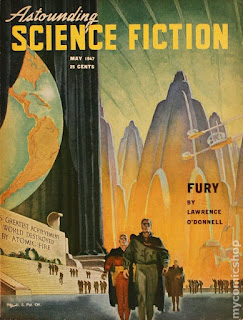
Today, there is also a cottage industry of those who lash out at the Hugo Awards and mainstream publishers, and argue that the genre should return to “old-school science fiction.” Public appeals for a return to traditional “pulp” aesthetics, and “Campbellian” science fiction could be understood as being essentially similar in nature to the calls from the 1930s-era German Reichskulturkammer for visual arts to return to easily understood forms with heroic themes in styles modeled on classical Greek and Roman works.
It is often presumed that the rejection of modernity by some figures in speculative fiction is a rejection of diversity, that what these figures are objecting to is the inclusion of authors who are non-white or non-male. That is, of course, part of the phenomenon. But we would suggest the “pulp revolution,” and “make science fiction fun again” mantras expressed by this conservative wing of fandom suggest that the aesthetics of fascism exert a significant pull on many. Within speculative fiction, the idea of “pulp” hearkens back to the so-called “Golden Age of Science Fiction,” a mythical era in which the genre was supposedly free of “mundane” influences — this is at its heart an aesthetic argument.
The increasing literary flair of speculative fiction has not entirely driven out the prosaic plot-forward storytelling that used to be the staple of the genre. Without casting aspersions, we can think of several progressive and forward thinking mainstream authors who have embraced a traditional “classic” speculative fiction style without being a part of the reactionary movement.
 |
| McLuhan predicted the Global Village, but neglected to mention that the village in question is Salem, Massachusetts in 1692. (Portrait by Yousuf Karsh) |
When discussing the 2015 Hugo Awards, the balkanization of fandom, and the emergence of an overtly right-wing movement within the genre, critics of the speculative fiction genre have often focused their analysis on polarization within broader society. The culture of speculative fiction has changed in the past 25 years, and as McLuhan once wrote, “a theory of cultural change is impossible without knowledge of the changing sense ratio effected by various externalizations of our senses.”
The impact of technological changes on the consumption of speculative fiction should not be understated. We think its impacts have brought a broader public under the wing of fandom, prompting inevitable and uncomfortable splits within the subculture. Much as technological advances in the early 20th Century inspired a reactionary movement among painters and labour writ large, similar technological advances in the past 30 years have been at play in the formation of a reactionary movement amongst some groups of speculative fiction creators.
The impact of technological changes on the consumption of speculative fiction should not be understated. We think its impacts have brought a broader public under the wing of fandom, prompting inevitable and uncomfortable splits within the subculture. Much as technological advances in the early 20th Century inspired a reactionary movement among painters and labour writ large, similar technological advances in the past 30 years have been at play in the formation of a reactionary movement amongst some groups of speculative fiction creators.