Wednesday, 3 July 2019

Best Related Work: Category or Collection of Categories?

Best Related Works category has been a primary focus of controversy at this year's Hugo Awards. Specifically, the inclusion and scope of ownership on a collaborative project has motivated some heated rhetoric. This is a shame, because it has to some degree obscured visibility for a remarkably great group of nominees.

Transformative Works Shine

The phrase, “Hugo Award Shortlisted Author” carries meaning and integrity accrued over decades, due in large part to the tireless efforts of World Science Fiction Society (WSFS) volunteers and members of the fan community.

It should therefore be understandable that members of the WSFS community might get their hackles up at those who spuriously claim this honour, in this case authors who have submitted a story to the Hugo-shortlisted online repository of fanfiction, Archive Of Their Own (AO3) but have not built or maintained the platform itself.

To be clear, those who manage the official Hugo Awards web page have stated that the nomination was for the platform, rather than for any individual story. They have also made it clear that claims of “Hugo-nominated” status by AO3 authors is not appropriate. Yet several authors persist in these claims.

It has been suggested that these claims are made in jest – though this assertion seems disingenuous to
Some of the commentary about AO3's shortlisting
does not imply any respect for the Hugo Awards.
us. If these authors are making such claims in jest, it might imply that the Hugo Award is a joke to them.

Despite the inappropriate self-promotion of a small minority of AO3 contributors, the members of this blog are enthusiastic in our support for the site’s nomination.

Not only have the volunteers behind this site created tools for the sharing and organization of fan works, and not only has the user base of AO3 built a vibrant community, the organization has promoted user rights by advocating for fair use, an important legal provision within our increasingly heavy-handed and overreaching copyright regime.

The work of AO3 benefits the entire science fiction community and society as a whole. We are very glad to see it on the ballot. The fact that we won’t have AO3 at the top of our ballots speaks more to the overall strength of the shortlist and the chaotic nature of the Best Related Work category, than it does any controversy over the nomination.

Bringing Mexico To Worldcon

One of the members of our book club has an interest in Latin American and Indigenous cultures, and the Mexicanx Initiative was an important part of their first Worldcon experience. There is a good reason why this effort to bring wider awareness of Mexicanx science fiction has been successful: it was positive, collaborative, thoughtful, and inclusive.
Marcela Davison Avilés, Adrian Molina,
Ana Ramirez, and Julia Rios
at the Making of Coco panel.
(Photo by Kateryna Barnes) 

The project, which included items such as panel discussions, meetups, social media and an anthology, was based around bringing 42 Mexican and Mexican-American folks to the convention and creating a dedicated discussion of the culture within the convention.

What organizers John Picacio, Julia Rios, Libia Brenda, and Pablo Defendini accomplished through the Mexicanx Initiative had community-building implications for fandom, and could be a model for other equity-seeking efforts and groups. One hopes that the work that began in San Jose last summer will have long-term impact and implications.

Throwing Warner Brothers Into Mount Doom

Of all the shortlisted works, we were most dubious of The Hobbit Duology. At first blush, deconstructing mediocre movies seemed to us too slight a topic to merit three hours of YouTube
Lindsay Ellis' provides welcome insight
into the creation of The Hobbit trilogy.
(Image via YouTube)
analysis. These videos were, however, an incredibly pleasant surprise, and provided exactly the sort of meaty criticism that science fiction fandom needs.

Delving deeply into the production’s circuitous path, film critics Lindsay Ellis and Angelina Meehan trace the commercial forces, directorial decisions, pressures from fandom, and avoidable time constraints that led to the three Hobbit movies being such disappointments. Along the way, they consider Tolkein’s intentions for his most famous works and the questionable morals of the production companies who purchased the rights to tell his stories on the big screen. Using first hand accounts, they unpack the success of multinationals’ anti-actor lobbying efforts and the legacy it has left on New Zealand and its film industry.

Ellis and Meehan approach the subject as dedicated but critical fans, providing a nuanced, tempered analysis that highlights both the good in these films and their significant flaws.

We are very glad that this work received a nomination because we otherwise might not have watched it. At least one member of our book club is considering it for the top of their ballot.

Will LeGuin Three-Peat?

Having earned back-to-back awards in this category, it would be easy to think of Ursula LeGuin as the front-runner for the Best Related Work Hugo Award. That being said, this is an exceptionally strong year for related works, and LeGuin’s Reflections On Writing is fairly low on our ballots.

This year’s LeGuin shortlisted title is a collection of interviews conducted by David Naimon. At a scant 140 pages, this intellectual aperitif is the briefest work on the ballot.

As with everything LeGuin did, this is a thoughtful, nuanced piece. It examines three areas: poetry, fiction and nonfiction. The conversational tone is both a strength (in that it’s approachable) and a weakness (in that it occasionally meanders).

The Story Of The Hugos 

It seems odd to us that this is only the second time that Jo Walton has appeared on a Hugo Award
(Image via Amazon
ballot. It can be argued that several of her novels and non-fiction works warrant the recognition.

Her Informal History Of The Hugo Awards, based around the Tor.com blog posts of the same name that she wrote a couple of years ago, traces the history of the awards through their creation in 1953, through to the year 2000. True to its name, this is a subjective look at both the winners and the shortlists, livened with insight and personal anecdotes.

The book version adds significant material, additional essays and footnotes, as well as a curated set of comments from the blog. Walton has a deep and rich knowledge of science fiction and of fandom, and it shines through in essay after essay tackling controversies of years past, or years where she might disagree with the verdict of Hugo voters.

This is a work that we believe will have enduring value. In most years it would be a lock for the top of our Best Related Work ballots.

John W. Campbell: Good, Bad, and Ugly

Compulsively readable and deeply engaging, Alec Nevala-Lee’s group biography of major figures
Alec Nevala-Lee's book
Astounding explores the
lives of Golden Age SF
authors.
(nevalalee.wordpress.com)
from the Golden Age of science fiction is not just the best work in this category in 2019, but possibly the best work in any category this year.

Astounding delves into the lives of editor John W. Campbell and three of his protegees, Robert A. Heinlein, Isaac Asimov and L. Ron Hubbard. Nevala-Lee recognizes the success of these well-known creators, but also their flaws and failings and the resulting complications for the genre.

Having read the book a few months prior to it’s release, we’ve had time to mull over Nevala-Lee’s work, to ponder the themes of self-delusion, of ego, of wasted potential that his work lays bare. It’s the sort of book that stays with you, that informs your understanding of a genre, and that inspires discussion and analysis. We have been inspired to blog about it on multiple occasions.

Conclusion

This year, even more than most, Best Related Work has created difficult questions to adjudicate.

How do you compare the Mexicanx Initiative – a multimedia project with a time-limited scope – to Jo Walton’s collection of subjective essays about the history of the Hugo Awards? How do you compare Astounding – a richly detailed and engaging history of four of early science fiction’s central figures – to an online repository of fan fiction? These are fundamentally works for which success is measured on completely different axes.

It might be suggested that every single one of the shortlisted works deserve recognition for completely different reasons. It might even be suggested that in a rational world, they’d be recognized in completely separate categories.

Thursday, 27 June 2019

Make Time For Years And Years

Russel T. Davies has usually been the wet firecracker of television writers. Despite this, he has given
Emma Thompson headlines a superb cast
in the BBC/HBO series Years and Years.
(image via iNews
viewers possibly the best science fiction on television in 2019 with his six-part miniseries Years And Years.

Over the course of more than 20 years writing for television, Davies has built a reputation as a capable writer who crafts diverse and emotionally compelling characters, builds suspense and tension effectively, and then pulls the rug out from under viewers through trite and banal endings.

This tendency was the signature aspect of his work on Doctor Who. As we have noted before, deus ex machina is his stock in trade. In the penultimate episode of DW’s Season 2 (The Sound of Drums), The Master is built up into an imposing and compelling adversary, but in the finale he’s defeated by people thinking happy thoughts. In Daleks in Manhattan/Evolution Of The Daleks, the entirety of the plot of the two-part episode is undone in seconds through largely incomprehensible means.

His new six-episode series premiered on HBO on Monday night, shortly after completing its initial run on the BBC. True to his oeuvre, Davies’ sixth and final hour-long episode of Years And Years might not stick the landing, but the previous five episodes are compelling enough to make up for that.

The series chronicles the intertwined stories of a multi-generational family living in and near Manchester over the course of 15 years starting in 2019.

The four middle-aged siblings; Stephen, Daniel, Rosie and Edith Lyons, their grandmother, their spouses and their children provide viewers with different vantage points of a rapidly changing future that is marked with chaos and uncertainty. Woven throughout the series are the rise and ramifications of a far-right political figure Vivienne Rook, which give viewers cause for reflection on current populist political movements.

There’s a soap-opera nature to the series that occasionally feels improbable, but that same aspect
Russel T. Davies can't deliver a good
ending, but for once that doesn't
spoil the overall greatness of a show.
(image via BBC)
makes it easy to suspend disbelief about technological speculation while being pulled into the emotional lives of compellingly flawed characters. When banks fail and brownouts become the norm, you both see and feel the impact on consumers and homeowners. When medical technology advances and health care is privatized, you see and feel what it means for both the person affected and those close to them.

Some of the brilliance of the series is not even what it shows explicitly, but in what is implied in throw-away lines. Bananas are extinct? It’s not safe for U.K. citizens to visit the U.S. anymore? The Tower of Pisa is no longer leaning? There are so many details to appreciate.

The final episode is a disappointment in exceptionally predictable ways. Bad guys are defeated in a particularly trite (and improbable) ending that undermines some of the emotional weight of the series, though at least Davies has the courage to imply that the systemic issues that led to fascism have not been overcome completely.

Years And Years is a series that is more than the sum of its parts. No single episode deserves a Best Dramatic Presentation Short Form Hugo, but the whole should be seriously considered in the Long Form category. The continuous march of technology (and those who control it) – and the creeping rise of fascism – are examined in an engaging way by the birdseye view of years and years of development over the course of all the episodes.

Does Years And Years bear all the hallmarks of Russell T. Davies’ writing? In both the best and worst ways, it does. It may also be his masterwork. Years And Years deserves very serious consideration for a Hugo.

Sunday, 9 June 2019

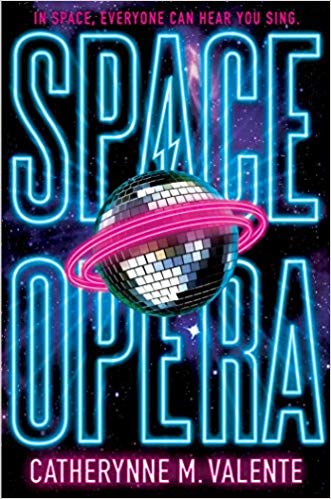
Space Opera — Review

At our book club discussion of the Hugo-shortlisted novel Space Opera, there was a consensus that
Derivative and listless,
Space Opera failed to
meet expectations.
(Image via Amazon.com)
Catherine Valente is an author worthy of a best novel rocket ship on her mantle. We also agreed that Space Opera is not the work that should earn it for her.

Valente’s 2015 novel Radiance is criminally underrated. Thoughtfully tackling issues of patent hoarding and the resulting stifling of innovation, Radiance makes the case for the continued relevance of steampunk as a genre. The structural story-within-a-story techniques shows what Valente is capable of as an artist – this is a non-linear tale that could only really work as a prose novel.

Her 2011 novel Deathless is an engaging – and approachable – historical fantasy that weaves together fairy tales with the Russian revolution. It could be compared to something between Naomi Novik’s Uprooted and Susanna Clarke’s Jonathan Strange and Mr. Norrell.

And by contrast, Valente’s previous Hugo-shortlisted novel Palimpsest is an emotional tour-de-force about desire and possibilities. Deftly imagined – and artfully lyrical – Palimpsest is both a dreamlike and challenging book that readers will continue to get something out of on repeat readings.

Clearly, Valente writes first-rate books, in a wide range of styles and voices. There had not been a single one of her books that anyone in our book club had read and failed to enjoy… until Space Opera.
Catherine Valente is
capable of first-rate
novels, such as the
underrated gem
Radiance.
(Image via Amazon)


There are moments of entertainment in Space Opera’s numerous asides to metagalactic history, but the book is hampered by a surprisingly slow pace, thinly drawn characters, and a weak plot. Most troublesome for fans who wanted to love it, Space Opera is occasionally fun, but rarely funny.

While it’s obvious that not all comedy will appeal to all readers, those who study comedy contend that most successful jokes depend on a subversion of expectations. This is difficult to accomplish in science fiction in part because an author’s imagined strange new worlds are at their core an alienating experience for the reader; thus readers often have fewer expectations that can be successfully subverted.

Throughout Space Opera, every expectation is fulfilled, whether it’s the concluding clause of a sentence that reinforces the overarching point rather than subverting it, or the narrative arc of a character following a predictable cliched path.

In his classic work Hitchhiker’s Guide To The Galaxy, Douglas Adams managed a subversion of expectations repeatedly – often through deft linguistic legerdemain in which an end clause subverts the beginning of a sentence (I.E. “The ships hung in the sky in much the same way that bricks don’t.”), or by taking science fiction tropes to their logical but absurd extremes.

It is difficult not to compare Space Opera to Hitchhiker’s Guide. The latter work is not only the most famous science fiction comedy of all time, it’s set in a chaotic and diverse universe that is a clear antecedent to Valente’s book. This leads to similar joke setups, and similar punchlines.

And this becomes one of the major problems with the comedy in Space Opera; all sentences and actions live up exactly to expectations, especially if you’ve read any Douglas Adams.

As example, when Valente describes various animals that produce economically viable goods (such
If there's ever a movie adaptation
of Space Opera, we hope that the
role of Decibel Jones is played
by comedian Carlos Mencia.
(Image via ComedyZone.com
as a goat that “dispenses ice cream, brie, and buttercream frosting”) due to the random vagaries of evolution, it bears remarkable similarity to Adams’ section of the third Hitchhiker's book Life, The Universe And Everything in which we are introduced to the wild mattress creatures of Sqornshellous Zeta. When Valente treads the same territory as her predecessor, the comedic twist is lost, because you know where the joke is going.

In addition, Valente seems to use polysyndeton as a replacement for wit; “the glitter and the shine and the synth and the knowing”; “You are bizarre and disgusting and interesting and fixated on fetishes”; “Do you have enough empathy and yearning and desperation to connect to others outside yourself…” Sadly, this excessive use of the word ‘and’ just becomes tiresome.

It is uncomfortable for us to describe any book on the ballot as undeserving of the rocket, especially a book from an author for whom we have so much affection and respect. Unfortunately, none of the book club’s members plan to vote for Space Opera, and some couldn’t see placing this book above No Award.

Wednesday, 5 June 2019

Spinning Silver — Review

There is much to admire in Spinning Silver, and we can understand the evident passion that many
Image via Amazon.co.uk
readers have for Naomi Novik’s latest novel.

For one, Novik’s deconstruction, reimagining, and reconstruction of Rumpelstiltskin is both insightful and inventive. The systemic misrepresentation of non-majoritarian religious groups in folk tales – and the antisemitism of Rumpelstiltskin in particular – needs to be challenged. Novik provides an interesting approach, reframing these folk narratives with point-of-view characters who belong to marginalized groups.

Additionally, the animistic universe depicted in Spinning Silver provides an opportunity for an environmental metaphor that Novik weaves into the narrative carefully and subtly. Environmental issues (destruction of habitat) drive one of the major sources of conflict in the novel, and provide motivation for the primary antagonists.

Issues of race, gender, and environmental degradation are weighty subjects for a fairy tale, and could have made the book feel didactic. But Novik creates a narrative that feels natural and timely.

However, the book is not always fun to read. There is a ponderous, at times leaden, nature to the prose, which is often weighed down by excessive dependent clauses.

It will seem overwritten to some readers, like the author was less focused on readability than on crafting rococo sentences.

On the other hand, this excessive (posed) artfulness does have an upside. In some moments Novik hits the nail on the head with sublimely quotable sentence, like “Anger was a fire in a grate, and I'd never had any wood to burn. Until now, it seemed.” Some readers will find these gems worth the slog, while others are likely to grind their teeth at the paragraphs-upon-paragraphs of self indulgence.

Some of us felt that the three main narrators – Miryem, Wanda and Irina – all speak with a very similar, and at times condescending, voice. For example, the reader is often told how to feel, which can prevent the emotional engagement that comes from actually feeling emotional attachment to the characters.
Many of the assumptions in classic
fairy tales need to be challenged,
and there are few who do so as
thoughtfully as Naomi Novik.
(Image via NPR.org) 

The argument could be made that Miryem, the moneylender’s daughter who is involved with the supernatural Staryk, needs to drive a condescending narrative, given her haughty character and the well-earned distrust of her peers. However, when Wanda is narrating, this level of condescension feels weirdly out-of-place.

Other readers feel the three main narrators are distinct and engaging enough, but still agree that some of the tertiary narrators stand out as particularly unnecessary. Chapters told from the point of view of the vain and shallow lord are largely irrelevant and grating.

It should be noted that having a complex and not-always-likable protagonist in Miryem is something we appreciated. Compared with certain other slightly-twee female protagonists in other Hugo-finalist novels this year, Miryem stands out as a compelling and interesting character.

Overall, Novik has done so much so well in Spinning Silver that it will likely be close to the top of many of our Hugo ballots. Despite its flaws, we would not be disappointed to see it win the award, given the thoughtfulness and insight Novik displays in the narrative construction.

Tuesday, 23 April 2019

A People's Future Without Labour

Forty years ago, Boston University history professor Howard Zinn refused to cross a picket line, in a
Howard Zinn speaking to one
of his colleagues during the 1979
Boston University staff strike.
(Image via HowardZinn.org)
show of solidarity with striking clerical workers at his institution. Speaking with the workers on the picket line motivated him to help raise the level of labour history awareness in his country.

He came to believe that the inclusion of labour narratives in popular history books could help. The resulting work, A People’s History Of The United States, has become an influential and controversial classic that examines previously untold stories of workers and marginalized peoples. 

Any author or editor attempting to claim the mantle of Zinn’s work has an unenviable task ahead of them. But when SF luminaries John Joseph Adams and Victor LaValle — both of whom have produced top-quality works — announced a short story collection whose title is an homage to Zinn, we were very excited. 

Given the provocative and timely premise of A People’s Future Of The United States, we approached the collection of stories with enthusiasm. Unfortunately, the collection as a whole failed to live up to the grand ideas described by the editors.

The book’s introduction is one of the strongest parts of the collection. Over the course of eight pages, Adams sets out the premise of the work, and alludes to the fact that many of the same omissions in mainstream historical narratives are reflected in how we imagine possible futures. Like all good
Even the cover of A People's
Future
includes the shadow
of the word "History."
(Image via Goodreads) 
introductions, it encourages the reader to keep reading. 

By definition, collections provide access to a variety of works and it’s rare, perhaps even impossible, to expect that all readers will universally enjoy every contribution. Our book club enjoyed Sam J. Miller’s excellent parable about surveillance, privacy and the policing of heteronormative behaviours. Omar L. Akkad’s harrowing story about internment camps will stay with readers. G. Willow Wilson’s takedown of the privatization agenda is exactly the sort of work we had hoped to read when we picked up this volume. Seanan McGuire’s story includes a ray of hope and helps enrich the anthology.

Questions of race, class and gender are important to explore and have all-too-often been ignored in science fiction. 

We would argue that because science fiction is an inherently political genre, it is of paramount importance to create inclusive futures we can believe in. Some of the stories in this volume do indeed ably tackle topics of race, class and gender. But the topic of labour is almost entirely neglected. 

It is disappointing that an anthology that so explicitly aims to address cultural blindspots has reproduced one itself. 

In comparison, the index to Zinn’s classic history book includes a full page of references to organized labour movements. At a rough estimate, 30 per cent of the book deals with the struggles of traditional union movement organizing, and workers rights are integral to much of the rest of the text. 

Zinn examines at length the general strikes of 1934, 1936, 1938. He tackles women’s roles in the
Howard Zinn's book talks about Joe Hill
and the Industrial Workers Of The World.
(Image via Wikipedia)
labour movement, both prior to the Wagner Act, and afterwards. He talks about how women used the union movement to affect change long before there was an organized feminist movement. He chronicles organized labour’s transition from being mostly indifferent (or antagonistic) to race relations to becoming allies of the civil rights movement. He tackles the philosophical questions that drove a wedge between the Industrial Workers of the World (IWW) and the American Federation of Labour (AFL) in the 1930s. 

It is, in our minds, staggering to think that a book positioned as the spiritual heir to A People’s History Of The United States could completely ignore the role of labour in class and other struggles. It’s not as if issues related to workers’ rights in the United States have been solved. 

Relatedly, some of the stories didn’t seem to exist in a “People’s Future” at all, but rather in a fantastical alternate universe that has little connection to the political environment framing this collection. Celestial beings with snakes growing from their heads and dragons are fun to read about but we found it hard to make a connection to a future United States in at least a few of the stories in this collection. Even when we liked the stories individually, the fantastical elements put them at odds with the idea of a real-world “Future Of The United States.” 

In standard texts about history, labour had been ignored; it didn't fit in with military or great man history. Zinn changed the focus and brought labour to the centre. This collection failed to do that for science fiction.

There are significant current labour struggles that are going to define whatever future people in the United States will share: the fight against precarious employment, the tensions inherent within two-tiered union contracts, evolving questions around scope-of-work issues to name a few. This is an area that is rife with dramatic science fictional potential, but is being neglected in the genre. 

With slightly different editorial choices, A People’s Future Of The United States could have been an essential text for progressive science fiction fans. As it is, we have a short story collection with good stories in it, but which is less than the sum of its parts.

Sunday, 14 April 2019

Recommended "Light" Reading

If Starship Troopers had been written by the love child of Kurt Vonnegut and Philip K. Dick, the
Kameron Hurley's latest
novel is one of her best.
(Image via Simon&Schuster)
result might be something like The Light Brigade.

It may seem grandiose to compare Kameron Hurley to three legends of the field, but her latest novel — her seventh so far — might just be worthy. The Light Brigade solidifies her emergence as one of the most important voices in recent science fiction.

Set against the backdrop of a corporatist dystopia that has completely abandoned any pursuit of the public good, The Light Brigade begins in a manner that is fairly typical of military science fiction. Humanity is attacked without provocation, and an idealistic youth joins the army to become a hero.

This time the prospective hero is a young woman named Dietz, whose family was killed when the city of Sao Paulo was destroyed. However, Hurley slowly turns the standard military science fiction paradigm on its head, peeling away the layers as Dietz discovers truths about the nature of the conflict, about the corporation she’s fighting for (Tene-Silvia), about Earth’s economic reality, and about her own temporal misplacements.

In this war, the six major corporations of the Earth are at war with the free peoples of Mars, who have developed a distinct culture, given their long-term estrangement from the rest of humanity. Hurley uses this setting to explore the dehumanization of adversaries via political rhetoric. For example, Earth leaders describe “Martians” as something other, something lesser, than people.

We are reluctant to reveal too much about the Martians, and about the politics underlying the conflict, because the main character’s shifting understanding is one of the great joys of the book.

Hurley does not shy away from the dark and intertwining complexities of political power, but explores this human condition in a way that will speak to a wide range of readers. Her ability to put forward political arguments without being didactic reminded us of Heinlein at his best.

Over the course of the book, Dietz becomes unstuck in time, leaping to different points in the war like Billy Pilgrim in Slaughterhouse Five. In the hands of a less-skilled novelist, this nonlinear narration could have been aggravatingly confusing. But the clarity of Hurley’s prose, and the way her protagonist slowly begins to understand what’s going on is entertaining and engaging.

Using temporal dislocation as a metaphor for the alienation many soldiers experience when returning
Hurley at Worldcon 2017.
(Photo by Henry Söderlund,
who is an excellent photog.)
home from war has been a recurring theme in military science fiction, notably in Joe Haldeman’s The Forever War. Dietz struggles with relationships, is constantly trying to figure out who knows what about her, and unsure of her role within her organization at any given moment.

This narrative was put together so thoughtfully — it made me want to go back and see how the story might unfold when pieced together in chronological order, rather than in the order experienced by Dietz. Reading the narrative as a straight chronology reveals both attention to detail and internal consistency.

Two years ago, this blog highly recommended Hurley’s previous novel The Stars Are Legion despite occasionally finding the narrative bewildering due to the protagonist’s amnesia. Happily, The Light Brigade includes the strengths of that previous work and exhibits few of its flaws.

While The Light Brigade does invite comparisons to several classic military science fiction novels, it is a wholly original work that pushes the boundaries of the subgenre. It is a page turner that feels fresh and modern, while being knowledgeable in conversation with decades of the genre’s legacy.

In 20 years, when people talk about the classics of military science fiction, we are willing to bet that the conversation will start with Starship Troopers, The Forever War, Old Man’s War, and The Light Brigade. Yes, it is that good.

Friday, 22 March 2019

Labour on screen in science fiction: Fritz to Boots

This is the third of a three-part blog post about the historical invisibility of organized labour in science fiction, as well as recent works that address this absence. In the first two parts, we examined prose works both negative and positive. An additional post includes a list of all labour unions we are aware of in science fiction works

Film is a medium that can help construct a tolerant, diverse, and informed society. It’s no surprise, then, that the first shots of the first movie camera were focused on workers and on work. For 45 seconds, director Louis Lumière documented the comings and goings of factory workers in his 1895 movie “Workers Leaving the Lumière Factory.”
Workers and labour are recurring themes
in early movies, including the 1927
Fritz Lang classic Metropolis.
(Image via IMDB.com)

Employment has been a ubiquitous subject in film — and in science fiction film — but worker organizing has again been neglected.

Some of the earliest science fiction movies feature clashes between workers and automation. From the now-lost 1895 short movie The Mechanical Butcher to Fritz Lang’s 1927 classic Metropolis, filmmakers reflected the concerns of an era that was experiencing rapid industrialization as well as violent actions taken against the working class.

Possibly because of political sensitivities, many of these films made no overt mention of a labour union, but in Metropolis, the workers assert their rights through something similar to anarcho-syndicalist collective action, which may make it the IWW of labour movies.

This treatment of labour and labour unions as a source of strife continues in cinema over the next several decades, though overt union representation is rare. Workers might revolt in a chaotic manner in a science fiction film (as in Stargate, Planet of the Apes or Solo: A Star Wars Story), but they are rarely organized — or effective — in their actions.

The first unmistakable labour union in science fiction cinema that we were able to find is the Textile
The Man In The White Suit may be the
first science fiction movie to have been
nominated for an Academy Award in a
major category, earning a nod for
adapted screenplay.
(Image via Guardian.co.uk)
and Garment Workers Union depicted in the 1951 Ealing Studios comedy The Man In The White Suit. The film revolves around the invention of an indestructible fabric by a mild-mannered chemist played by Sir Alec Guinness, and the subsequent attempts by business and labour unions to suppress the invention. The depiction of unions in this movie is broad and largely inaccurate, depicting them as collaborating with management and encouraging industrial sabotage.

Despite these inaccuracies about how unions operate, we will be endorsing The Man In The White Suit for 1952 Retro Hugos, . It is in most ways a superb and thoughtful piece of science fiction about the introduction of a new technology, and is elevated by witty dialogue and star-worthy performances (Guinness was nominated for an Academy Award that year for a different comedy from the same studio).

Most other labour unions depicted on screen in science fiction up until the 1990s relegate the labour conflict to a tertiary storyline. In Robocop, the government’s decision to deploy the title character is driven by a police union strike. In the real world, in most North American jurisdictions, police officers are unable to strike because they are deemed to be ‘essential services,’ but in the dystopian future depicted in Robocop, police services have been privatized and are now run by the corporation Omni Consumer Products. Because the police are no longer public servants, they are able to (legally) walk off the job.

One aspect of Robocop that is worth noting is that the strike has been engineered by the corporation, the CEO of which deliberately withholds adequate resources (police vehicles and equipment) and acts in bad faith when it comes to pensions and wages. The strike is therefore shown as justified, but when push comes to shove, the most heroic police officers Anne Lewis, Alex Murphy, and Warren Reid all cross the picket line.

During the climactic scenes of the movie, the striking workers come to the rescue of Robocop,
To quote the CEO of OCP, "This strike
can be useful to us." Robocop may
not entirely woke to labour rights,
but it does have thoughtful satire
about privatization of public services.
(Image via Youtube.com)
showing that they are more concerned with doing their jobs than they are their own livelihoods. It is unsatisfying that workers’ rights questions remain unresolved in the movie — the strike is ended but wages, pensions, and funding are all unaddressed.

Robocop
presents us with a prescient warning about the low-wage agenda that is marketed under the term ‘privatization,’ but its depiction of worker organizing and worker solidarity is sadly lacking.

There are at least two prominent portrayals of labour organizing in mid-1990s science fiction television series: Babylon 5 and Star Trek: Deep Space Nine. They offered very different — but equally unsatisfying — portrayals of labour organizing.

Babylon 5’s episode 'By Any Means Necessary' shows a labour movement that is belligerent and badly led into a violent dockworkers’ strike — only the unconventional thinking of the station’s military governor prevents the situation’s violence from escalating. 

Two years later, in Deep Space Nine’s episode 'Bar Association,' we are shown an example of solidarity organizing to address the plight of underpaid waiters and waitresses in Quark’s Bar. Once the employer has compromised on wages, however, it is suggested that a union is ‘no longer needed.’ In both of these examples, the labour movement is shown as being an unruly rabble whose actions need to be kept in check.

The low point in televised science fiction’s portrayal of labour may have been 'Dirty Hands,' a third season episode of Battlestar Galactica. The ‘villains’ of the episode are workers who conduct a work
There's a term for workers whose right
to stop working has been taken away
through state-sanctioned violence.
(Image via IMDB.com) 
slowdown in an attempt to negotiate safer working conditions. The episode’s resolution features the ‘protagonist’ Admiral Adama arresting the union leader and threatening execution of non-compliant workers. This protagonist specifically promises that the union leader's wife will be the first one to be 'put against the bulkhead and shot.'

In the labour movement, this behaviour might be described as unfair bargaining practices.

As the product of a collaborative and corporatized structure, television might be a compromised medium when it comes to offering nuanced depictions of class struggle. Published text narratives — though subject to some editorial controls — are usually credited to a single author with a greater level of intellectual freedom and interest in a personal brand. Because a single author is better able to take personal responsibility for their ideas and their words, they are less likely to be constrained in what they say.

Last year, two very different examples of labour union depictions in science fiction hit the screens, and were surprisingly positive portrayals. The last two episodes of South Park’s most recent season 'Unfulfilled / Bike Parade' features a storyline about employees at an Amazon warehouse who decide to assert their right to a safe workplace in the wake of an accident. Although South Park is as irreverent in this episode as you’d expect it to be, the plight of the workers — and the tensions between picketers and picket-line crossers — are handled surprisingly well.

A very different example — but even more satisfying — was Boots Riley’s directorial debut Sorry
Boots Riley's Sorry To Bother You
shows the tensions and conundrums
faced by union members and organizers
while trying to assert their workplace rights.
 (Image via WorkingClassPerspectives)
To Bother You
. A surreal workplace comedy with science fictional elements, Sorry To Bother You uses a story about the unionization of a call centre to explore larger themes about worker solidarity, the erosion of middle-class incomes, and the hyper-competitiveness encouraged by corporate culture and capitalism more broadly, pitting one worker against another. This may be one of the finest examples of labour union depiction in science fiction to date.

Overall, society’s (and science fiction’s) failure to imagine new forms of economic organization reinforces the neoliberal paradigm. Given science fiction’s speculative mandate, this is even more pronounced in the genre and especially its cinema and television (which reach a wider audience than literary forms). The marginalization of unions in science fiction is significant — and symptomatic. As Mark McCutcheon and Bob Barnetson argue in their paper Resistance Is Futile, themes that are omitted from popular culture are often consigned to not merely to impossibility, but to unthinkability.