Monday, 20 March 2023

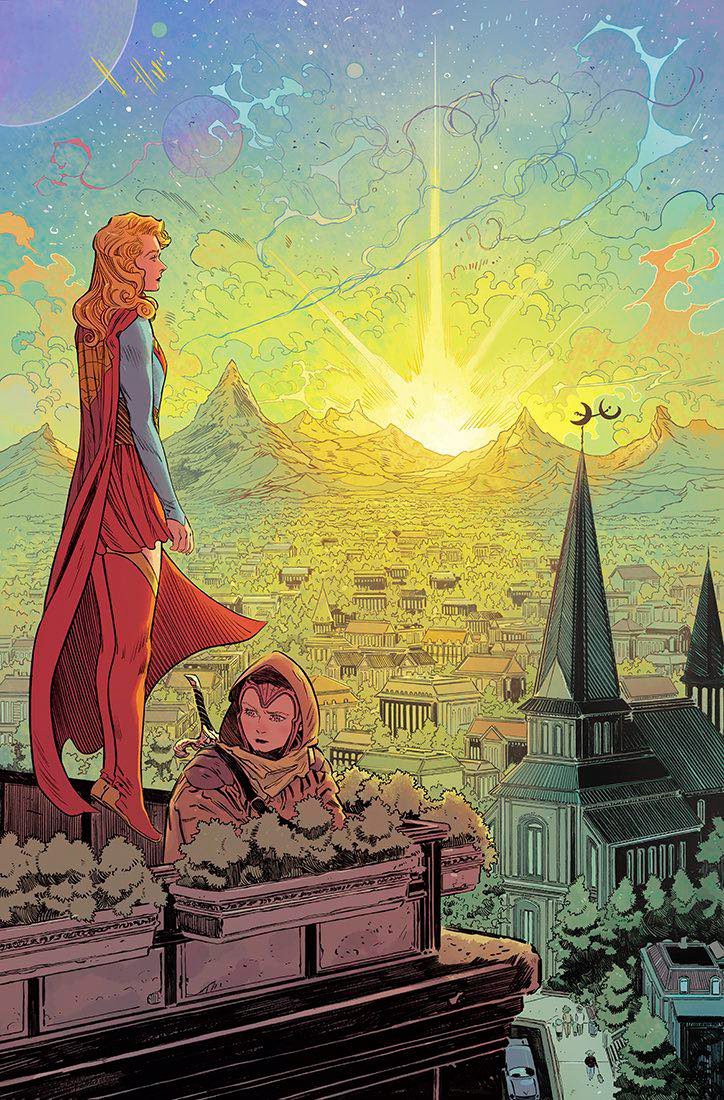
Kara Zor-El Unbound

The second-most famous
Kryptonian, Kara Zor-El
finally gets the attention
she deserves in
Woman of Tomorrow.
(Image via DC.com)

Created in 1959 as a female version of the most popular character in comic books, the paradox of Supergirl as a character is that although she is instantly recognizable to broad swaths of the public, there is often little understanding of what differentiates the character from her more famous cousin, Superman.

Sadly, too many writers treat Supergirl as if she were just a gender-flipped Superman.

Like Superman, she was born on the doomed planet of Krypton. And like him, she is mostly invulnerable, has super strength, has various enhanced senses, can shoot lasers from her eyes, and flies around the planet saving people in distress.

Kara Zor-El grew up in the domed city of Argo. This city escaped the destruction of Krypton, and after several years Kara was sent to Earth to find her cousin Kal El (Superman), who had been sent there as a baby. There, she took up the mantle of Supergirl, and fought alongside Superman on various adventures.

Over the decades, writers have grappled with the conundrum of how to make the character interesting; varying her origin story, altering what her superpowers are, and occasionally removing the character from the shared comic book universe altogether.

With the 2022 publication Supergirl: Woman of Tomorrow, writer Tom King (Mr. Miracle, Human Target, Sheriff of Babylon) and artist Bilquis Evely (The Dreaming, Doc Savage, Wonder Woman) provide one of the more successful attempts to define the character not in relation to her cousin, but on her own terms. This story looks at what it means for someone to lose their family, their homeland and their culture as a teenager, and focuses on how she constructs meaning for herself.

It is probably the most compelling Supergirl story yet published.

Over the past 30 years, almost every major superhero has been deconstructed. Grim-and-gritty reboots, meta-commentary on comic books, and reframing of existing story arcs have been done often enough in superhero stories that postmodern comic book work has begun to look tired. What elevates Tom King’s work is that he tends to focus on the ‘hero’ more so than the ‘super.’ This is recontextualization, but not deconstruction. It’s examining the characters through a constructive lens. This can be seen in how he’s evolved Kite Man as a character, how he’s explored Batman’s marriage, and peered into Scott Free’s psychology. And now, how he’s focused on what motivates Supergirl.

Tom King's work has previously inspired the hit
TV show Wandavision on Disney+.
(Image via Entertainment Weekly)

King’s work is probably familiar to many of those who follow the Hugo Awards, as he’s a two-time finalist, with The Vision: Little Worse Than A Man earning a nod in 2017, and Strange Adventures appearing on the ballot last year. He’s won the Best Writer Eisner Award twice.

Woman of Tomorrow is told from the perspective of Ruthye — a young orphan on an alien world — who is seeking revenge for the murder of her father by a bounty hunter named Krem. In her quest for vengeance, Ruthye gets in trouble and must be rescued by Supergirl. Because she has never heard of Supergirl (or Superman) before, Ruthye provides readers a fresh perspective of the Kryptonian, essentially seeing her through new eyes.

Over the subsequent eight issues of the comic series, the duo track Krem across planets and star systems, deal with space pirates, and have adventures on interstellar public transit.

Supergirl takes time to help one of Krem’s victims dig graves for everyone he’s known, provides a therapy session to a grieving mother, and uncovers a genocide. Each of these adventures is a delay from her mission but is necessitated by a code of honour that compelled her to start the mission with Ruthye in the first place.

Krem proves to be an adept adversary. He figures out Supergirl’s vulnerabilities and strips her of her powers. This gives us a chance to see Ruthye’s own strength as she defends the titular heroine and faces her own trials, largely unaided.

These aren’t stories about saving the universe, defeating galactic tyrants, or challenges with world-shattering consequences. But the fact that the stakes are more personal shows what matters to Supergirl, and the human scale of the story makes it highly engaging.
Taverns, swords, heroic
fantasy-style adventures.
(Image via DC.com)

On a technical level, this is a superhero comic book, but the writing takes much of its inspiration from heroic fantasy. This is a story about a sword-wielding hero and sidekick traveling across distant landscapes on a quest and getting pulled into side adventures. Given that it takes cues from the heroic fantasy work of Fritz Leiber, Woman of Tomorrow seems like something that would appeal to many Worldcon attendees.

This heroic fantasy influence is accentuated by the expressive artwork of Bilquis Evely and the talented colouring by Matheus Lopes, which bring the series to life. Evoking the best of Barry Windsor Smith’s sword and sorcery work for Epic Comics, Evely’s style is both detailed and energetic. The colouring provides a perfect counterpoint to the linework, transitioning from muted tones for more sombre scenes, to vivid and engaging palettes for the wild space adventures. The work is lush, inviting, and perfectly suits the tone of the writing.

In 2023, Warner Brothers announced their upcoming slate of movies based on DC comic books, and named Woman of Tomorrow as the direct inspiration for their next Supergirl movie. Although we cannot figure out how they might translate the visual poetry of Evely’s work, they couldn’t have chosen a better comic to adapt. Supergirl deserves to be more than a gender-flipped Superman, including on the big screen.

We’d love to see this earn a Hugo nomination.

Wednesday, 8 March 2023

The Cultural Practice of Worldcon

The World Science Fiction Society became an 
organization in 1946 to govern how Worldcon
locations were selected, and how cons were run.
But there's still little documentation of what a 
Worldcon actually is.
(Image via Catherine J. Trujillo)
For more than eight decades, thousands of authors, artists, and fans from across the globe descend on a city each year to discuss science fiction, fantasy, alternate history, gaming, costuming, and other subjects of fandom interest.

Worldcon is many things to many people. Depending on who you ask, it’s “largely magical,” or “a huge, complicated beast” or “hostile and emotionally abusive.” It’s clear that the event has developed cultural practices and expectations. Some might need to change and some are worth continuing. We wanted to start a discussion about how that might happen as key volunteers retire or move on and new venues are selected.

On a strictly technical level, a Worldcon is an event organized by a committee that was approved by a site selection vote held at a previous Worldcon, in accordance with rules that are voted on and approved by the World Science Fiction Society business meeting.

Worldcon could potentially be held at any location on Earth. If site selection voters approved a bid, the event could be held anywhere from Snake Island to Oymyakon.

The document that governs Worldcons — the WSFS Constitution — provides a list of duties that Worldcon committees must fulfill for their event to be a “Worldcon.” But this list is surprisingly short.

Worldcons are by definition volunteer run, and based on the word “convention,” we can infer that it’s “an organized meeting of enthusiasts for a television program, movie, or literary genre,” though the WSFS constitution does not go into even that level of detail.
There's nothing in the rules saying that panel discussions
about science fiction and fantasy is a necessary part
of Worldcon. But the event wouldn't be the same without.
(Photo of panel at Worldcon 2018 by Olav Rokne)

There’s nothing in the document suggesting that a Worldcon needs to have guests of honour, or an indoor venue. Social events are not part of the requirement, nor are dealers’ halls. There is no requirement to hold a masquerade, or even to have panels or programming.

As the 2018 Worldcon’s website notes, “the Worldcon Program is its oldest tradition” — though this is a far different statement than the programming being definitionally a required part of the event.

All that being said, if a Worldcon committee ever organized an event that had no panels, no guests of honour, and no masquerade, we suspect that the broad consensus would be that the event was “not a Worldcon.”

Section 2.6 of the WSFS Constitution deals with “Incapacity of Committees,” for instances in which a committee might fail to put together a Worldcon. But given that a formal definition of a Worldcon is absent, this section could probably never be enacted.

The rules imply the existence of four official staff roles in a Worldcon, though the actual structure of the organization varies from year to year. There’s a Chief Executive Officer or Officers (often using the term “Convention Chair” as per 4.6.1(3)), a Hugo Administrator (implied by Section 3.11, though not essential, and there’s little specificity about duties), a Site Selection Administrator (implied by Section 4.4.1, though there’s little specificity about duties), and there are Committee members (implied by Section 1.2, 1.3, 1.4, etc.).

The rules specify how the governing committees are chosen by the membership of previous Worldcons, but does not indicate what the membership of that committee might be. At the recent 2022 Worldcon in Chicago, there was one Committee Chair, 14 Division Heads, and about 200 further members of the committee.

This system provides some sense of continuity, but little actual guidance about what makes this event a Worldcon, other than the WSFS stamp of approval … and tradition.

We should not let our definition of Worldcon be simply a recreation of an idealized and mythologized past. Allowing ourselves to be governed entirely by tradition risks a “Make Worldcon Great Again” mentality, or a fetishization of a less-diverse, less-accepting, more closed-minded past.
The reason to continue those traditions should
never be “just because that’s the way it’s always
been done.” Just ask the Dutch about their 
tradition of Zwarte Piet.
(Image via State Department

There are however, many cultural practices at Worldcons that are good, and which work for the membership. 

As Hugo-finalist podcaster Marshall Ryan Maresca has noted, the convention has a “rich and deep history, and with that history, a significant amount of resentment and trauma.” This is an important reminder that we must be cognisant of exclusions and marginalizations perpetrated by past conventions, and work towards equity.

Part of the reason that these traditions have been upheld with some degree of consistency is that there are many individual convention organizers who volunteer on numerous Worldcons, and who hold institutional memory — these folks are sometimes called “SMOFs”. As the event has become more international over the years (a positive development in our opinion, though we’d admit that Worldcon is still mostly an Anglosphere event), there is less institutional memory. Therefore there is a need for the progressive community-building conventions (Definition 5) of this convention (Definition 2) to be committed to paper.

So what activities do we think are integral to a Worldcon? What should be maintained, not because of tradition, but because they work for people?

As a starting point for discussions, we brainstormed some of the Worldcon events that seem to us to be serving the membership well:

  • What the letters "S.M.O.F." stand for 
    is a closely guarded secret that is known
    to only a few science fiction fans.
    (Image of a group of Smoves via Calisphere)
    Programming, especially programming that includes panel discussions, solo talks, conversations with authors, and workshops. This programming should platform people of a wide variety of different backgrounds, genders, ethnicities, and ages.
  • A masquerade that involves opportunities for people of every age, skill level, and background to participate. The costuming community is a vital and vibrant part of every Worldcon.
  • Worldcon Guests of Honour. This is a way for the Worldcon to proclaim its values in terms of who the organizers think should be recognized and whose work should be celebrated.
  • A dealers’ hall. Although Worldcon is less commercial than many other science fiction conventions, there’s always been an interest among fandom to delve into the material history of the genre. The retailers who participate in Worldcon dealers (and other fan-run conventions) halls tend to be more niche, more nerdy, and less mainstream than those at commercially-run conventions, and this is a strength of the convention.
  • An art show that provides an opportunity both for fan artists to showcase their works, and to compete in an art competition, as well as for fans to appreciate the works on display.
  • Autographing areas, and a schedule of authors and creators who want to autograph their works.
  • A Code Of Conduct that protects the rights of attendees to be free of discrimination and harassment. The Code of Conduct adopted in Chicago in 2022 should be a model to be emulated going forward. The recently announced Code of Conduct for the Chengdu Worldcon in 2023 looks robust, and grapples with the complexities of a multilingual event with a greater possibility of miscommunication.
But … given that these are just “traditions” of the Worldcon, someone else may have a completely different list of what they believe to be integral to an event being a “Worldcon.” We’d encourage you to comment about which Worldcon events – or practices – you like to see continued or enhanced.

As an annual event with no permanent organizing team, no long-term governing council, and no written-in-stone rules about convention content, Worldcon has the potential to move with the times and improve.

The flexibility to do so should be preserved as much as possible, but we would suggest that there would be a benefit to having some debate on what the minimum expectations of a Worldcon are.

Rather than tying the hands of future conrunners with an amendment to the WSFS Constitution, we would suggest doing so as a Resolution of Continuing Effect. Although non-binding, such a resolution would provide clarity, and could help prevent potential WSFS 2.6 pitfalls down the line.

The debate about what a Worldcon is, and what a Worldcon should be, is a debate worth having.


Friday, 10 February 2023

IT'S ALIVE — Hugo Cinema 1975

This blog post is the eighteenth in a series examining past winners of the Best Dramatic Presentation Hugo Award. An introductory blog post is here.  

One of the more amusing anecdotes from the 1975 Hugo Awards comes from the nominating ballots for Best Dramatic Presentation. More than 40 different movies and television shows were recognized by those planning to attend that year’s Worldcon, which was being held in Australia for the first time.

Given the location of the convention, it should be no surprise that the low-budget Australian exploitation film The Cars That Ate Paris received qualifying votes.

More surprising is that former American president Richard Nixon appeared on the longlist for the Dramatic Presentation “Resignation Speech,” which Hugo administrators decided was eligible for the award, as it was a ‘work of high fantasy.’ Nixon also received awards in several other categories, with Hugo administrator David Grigg later noting “He would have achieved a nomination in one category or another if his supporters had not spread their aim.”
Since 2005, the WSFS Constitution
(the document that governs the Hugo Awards)
has under clause 3.8.7 empowered
Hugo administrators to assign
nominating votes to the valid category,
even if they were made in the wrong category.
So under today’s rules, Nixon would
probably have made the final ballot.
(Image via Futurama.wiki)


By 1975, Forrest J. Ackerman had accepted Dramatic Presentation Hugos on at least two occasions for filmmakers who could not — or possibly just didn’t care to — attend the Hugo Awards ceremony.

In Australia, he was yet again called upon to accept the award. This time he accepted on behalf of Young Frankenstein director Mel Brooks, who had at least sent a brief note to be read out, thanking Mary Shelly for her timeless story.

Mel Brooks is the one of the only directors in history to have a year in which he directed two of the top-five box office hits of the year, with Blazing Saddles being the biggest movie of 1974. earning a whopping $120 million and Young Frankenstein in fourth-place with $85 million. To put that in perspective, that places Mel Brooks’ inflation-adjusted domestic 1974 box office numbers ahead of last year’s Marvel Cinematic Universe movies.

He was at the top of his game, and 1974 had been the year of Mel Brooks. It’s difficult to find fault in Hugo voters selecting Young Frankenstein as the Hugo recipient — even if it’s not the movie we would have voted for.

Young Frankenstein is lovingly made with obvious affection for the Universal Monster movies of the 1930s and 1940s, even including the original props from James Whale’s 1931 original. The framing, the lighting, and even the camera movements are all perfectly mimicked from the five classic Frankenstein movies. This is a well-crafted movie. In terms of acting, while Marty Feldman, Madeline Kahn and Cloris Leachman are all first-rate, it seems difficult for them to keep up Gene Wilder’s slow build from reserved professor to full-on maniac, which may be his finest career performance.

But more than in any other of his films, Brooks telegraphs the punchlines — it isn’t enough for a joke to happen, the characters constantly point out that a gag has been made and the audience should laugh. While comedy is obviously subjective, for most of us, this forced approach severely undermined the movie. In fact, Mel Brooks himself may have described it best, calling Young Frankenstein the “best movie I ever made, though not necessarily the funniest.”

One work that’s often the subject of jokes, however, turns out to be possibly the finest work of science fiction cinema to be released that year.

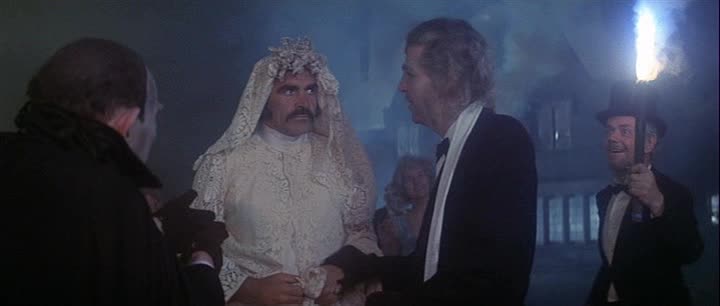
Zardoz, the infamously weird epic from John Boorman, is often mocked for the red thong costume worn by Sean Connery. Set on a far-future Earth where humanity has been divided into warlike tribes and an isolated colony of androgynous immortals, the film follows a barbarian named Zed as he stows away on a giant stone head and embarks on a journey to discover the truth underlying his worldview.
Everyone knows that Sean Connery donned
a red speedo in Zardoz, but few people remember
that he also wore a wedding dress.
(Image via Alternateending.com)

It’s filled with big ideas and occasionally silly execution, though the gauzy pretentiousness ensures that everything has deep meaning. The sheer strangeness and cool imagery make up for the occasionally pompous nature of the material. For at least three people in our viewing group, this would have been at the top of their ballot.

Bombastic, audacious, and over-the-top, Brian de Palma’s Phantom of the Paradise has aged better than many movies from the Hugo shortlist. A mash-up of Faust and Phantom of the Opera, this musical satirizes the excesses of the prog rock era through the story of a composer named Winslow Leach (William Finney) whose work is stolen by record producer Swan (Paul Williams).

There’s still some of the pervasive sexism of the 1970s, but in Phantom of the Paradise, it seems a bit more muted as the record industry’s exploitation of women is clearly depicted as villainous. One also has to wonder how much Swan is based on then-iconic record producer Phil Spector, whose eccentricity, violent mood swings, and pathological need to control were then becoming known to Hollywood insiders. It’s a flawed movie, but one with enough going for it that it would have been a worthy winner.

Though there are flaws with each of these, they are still far better than the last two works on the ballot. Unequivocally, these should not have been nominated.

Gene Rodenberry returned to the Hugo ballot for another unsuccessful pilot episode of a TV show that never went to full series with The Questor Tapes. The premise is that a scientist named Emil Vaslovik has created an android, and then disappeared mysteriously, leaving nobody who understands his research. That android — Questor — then has to flee from government researchers, accompanied by Vaslovik’s research assistant.

There’s some good ideas here; and you can see Roddenberry recycle those ideas later and more successfully with the character of Data in Star Trek: The Next Generation. The tension between logic and emotion, the questions about what it means to be human, are all ones that Roddenberry would return to time and again. But slotting these ideas into the standard protagonist-on-the-run model of television (emulating The Fugitive, Kung Fu, The Immortal, The Incredible Hulk, etc.) doesn’t quite work. The result is stilted, formulaic, and boring. It’s a bit of a grind to watch it.

And unfortunately, one of the movies that had the most potential to be progressively transgressive, did not fulfill that promise. Flesh Gordon is a mostly-unfunny porn spoof of classic 1930s science fiction movies. It’s clearly made with a lot of attention to detail; there’s effective split-diopter shots, and rear projection, and superb miniatures work. Though the special effects are actually quite well-done, and the science fictional elements tell a mostly-coherent story, the acting is dreadful and the dialogue is leaden.

Most upsetting, the combination of racism and sexism would place this movie firmly below “no award” on our ballots. Given the fact that they were already working with a motion picture rating that would have given them leeway to tackle LGBTQ issues, and given that they were telling a science fictional story about a society with different social mores, it’s particularly galling that the filmmakers were still in thrall to 1970s homophobia and gender essentialism.
For Sun Ra, space was a place in which racism
had no power. There’s an emancipatory power to this
narrative convention, and a philosophical underpinning
that helps get past the movie’s hokier moments.
(image via Filmfestival.gr)

Flesh Gordon seems to be an attempt to make outsider art, but instead reinforces pre-existing biases.

If we’d had our druthers, we probably would have included both Sun Ra’s afrofuturist jazz musical Space Is The Place and graphic designer Saul Bass’ visually compelling ant-pocalyptic disaster movie Phase IV.

Overall, 1975 was a more promising year for the Best Dramatic Presentation Hugo, with several credible choices on the ballot, and a winner that continues to find fans almost 50 years later. Although we’d argue Zardoz is a more meaningful work of art that probably deserved the award, this is more a quibble about populism versus high culture.

Tuesday, 7 February 2023

Open Discussion — What's worth considering for the ballot in 2024?

The following list will be updated over the next few months as we read, watch, and listen to Hugo-eligible works for 2024. These are not necessarily what we plan to nominate, but rather works that at least one member of the Edmonton Hugo Book Club has enjoyed and believes to be worth consideration. We appreciate any additional suggestions in the comments.

Updated on March 8, 2024 

Items marked with a “*” are ones for which there was significant disagreement within the book club. 

Novel
The Surviving Sky — Kritika H. Rao
The Blue, Beautiful World — Karen Lord
Julia — Sandra Newman
House of Open Wounds — Adrian Tchaikovsky
Moon of the Turning Leaves — Waubgeshig Rice

Novella
Emergent Properties — Aimee Ogden
To Sail Beyond The Botnet — Suzanne Palmer
And Put Away Childish Things — Adrian Tchaikovsky
The Keeper's Six — Kate Elliott
The Tinker In The Timestream —Carolyn Ives Gillman

Novelette
The Year Without Sunshine — Naomi Kritzer
I Am AI — Ai Jiang
What I Remember of Oresha Moon Dragon — P. Djèlí Clark 

Short Story
Jamais Vue — Tochi Onyebuchi
The Spoil Heap — Fiona Moore
Bad Doors — John Wiswell
Zero Percent — Andrew Dana Hudson
To Carry You Inside You — Tia Tashiro

Best Series
The Final Architecture — Adrian Tchaikovsky
Time Police — Jodi Taylor
Quantum Evolution / Venus Ascendant Novels — Derek Künsken
Universe of Xuya — Aliette de Bodard

Graphic Story
Black Cloak — Written by Kelly Thompson, art by Meredith McLaren
Bea Wolf — Written by Zach Weinersmith, art by Boulet
What’s The Furthest Place From Here — Matthew Rosenberg and Tyler Boss

The Prosecution of Professor Chandler Davis — Steve Batterson
The Spice Must Flow — Ryan Britt

Dramatic Presentation (Short Form) 
The Last of Us S01E03 "Long Long Time"
Silo S01E03 "Machines"
Ms. Davis S01E05 "A Great Place to Drink to Gain Control of Your Drink"
Star Trek: Strange New Worlds S02E07 "Those Old Scientists."
My Adventures with Superman S01E01 "Adventures of a Normal Man"

Dramatic Presentation (Long Form) 
Barbie — Directed by Greta Gerwig, written by Greta Gerwig and Noah Baumbach
Dungeons & Dragons: Honour Among Thieves — Jonathan Goldstein & John Francis Daley
Guardians of the Galaxy Volume 3 — Written and directed by James Gunn
Asteroid City — Written and directed by Wes Anderson
The Creator —  Written and directed by Gareth Edwards
Godzilla Minus One — Written and directed by Takashi Yamazaki

Lodestar
Speculation — Nisi Shawl
Liberty's Daughter — Naomi Kritzer

Astounding Award

Best Editor

Fan Artist

Fan Writer
Phoebe Wagner
Paul Weimer
Alasdair Stuart
RiverFlow 河流
Bonnie McDaniel

Unofficial Hugo Book Club Blog
Journey Planet
Galactic Journey


Sunday, 29 January 2023

All Words In All Languages Are Metaphors


(image via Goodreads)
Canadian media theorist and pop cultural icon Marshall McLuhan once described art as “a distant early warning system that can always be relied upon to tell the old culture what is beginning to happen to it.”

Babel — the latest novel from Astounding Award-winner R.F. Kuang — seems to fit this definition. It may also be the most McLuhanesque fantasy novel ever written.

Set in 1830s England, Babel follows a Cantonese orphan Robin Swift who is recruited to work for Oxford’s translation department in a world in which the translation of words from one language to another can have mystical consequences. The enchantment of translation has become crucial to England’s ability to colonize and exploit much of the globe, as silver bars inscribed with words in multiple languages can manifest the meaning that is ‘lost’ in translation. The United Kingdom has a near monopoly on this magical technology, and Oxford is at the heart of the Empire’s power.

There’s a long tradition in genre literature of the British historical fantasy as a particularly escapist work. Stories during the Napoleonic War, or the Victorian Era, can provide a cozy and comfortable setting that’s often insulated from vital questions of equity between those of differing racial groups, social classes, and genders. This is not to dismiss these works — as escapism has its place — but this peculiar form of nostalgia can conveniently edit or omit important issues of social justice. Babel, however, does not shy away from any of the injustices of the timeframe it is set in, but rather confronts them head-on. It would take more than magic, the book seems to suggest, to make a fairer, more just world.

This is a novel that uses the form of Regency-era historical fantasy to tackle themes of social justice that are at the forefront of today’s cultural vanguard in science fiction and fantasy. In short, it uses the cultural precepts of England at the peak of its colonial power to disclose and critique the social impacts of those systems.

It’s worth noting that although many American authors have attempted to mimic the style of period British prose, the vast majority have failed, often sounding affected, or pompous, or leaden. But instead of clumsy pastiche, Babel feels like a fantasy that William Makepeace Thackeray might have written. Kuang evokes era-appropriate ambiance and regionally-believable prose and dialogue so skillfully that we double-checked to see if she was born and raised in Hertfordshire or Dorset. (We strongly encourage everyone to read the “Author’s Note on Her Representations of Historical England, and of the University of Oxford in Particular,” which precedes the text of the novel.) It is especially gratifying that a book that is deeply concerned with language as a concept uses it so skillfully.
“All words, in all languages are metaphors,” wrote
Marshall McLuhan — a sentiment that might 
resonate with the protagonists of Babel.
(Image via University of Toronto)


Central to the themes in the book are the three close friends that Swift makes at Oxford. Victoire Desgraves, Letitia (Letty) Price, and Ramiz (Ramy) Mirza are — like Swift — translation students who are alienated from their peers for reasons related to race, class, gender, or a combination of these. Calcutta-born Ramy and Haitian-born Victoire keenly feel the animosity directed towards them by racist and classist rich white students, though Letty, who is white herself, never seems to understand or to see what her friends are going through.

About a decade ago, psychological researchers in Texas examined how the grammatical patterns that individuals use are a strong predictor of romantic attraction and relationship stability. The possible explanation they offered was that similar patterns and order of functional words (prepositions, articles, quantifiers, high-frequency adverbs, etc.) probably reflect similar patterns of thought … and can therefore be a signifier of the potential for meaningful relationships. Interestingly, this seems to be true across languages. Rami and Robin — whose life stories parallel each other in myriad ways — speak the same language of love and of friendship, and reminded some of us of this research. Their attraction, though never explicitly spelled out, is an emotional backbone of the novel. As much as many readers (us included) would love for their romance to play out more happily, there is a certain degree of integrity to depicting the characters as being prisoners of the heteronormative homophobia of the 19ᵗʰ century.

Language can also act as a barrier, even among those who speak the same one. For much of the novel, working-class characters are given short shrift. Striking labourers are depicted as speaking incoherently, and their concerns are dismissed by Robin, Rami, Victoire and Letty. But then the novel pulls a nice piece of narrative revelation; showing that even the protagonists can be unaware of matters of social justice, and that allyship can be found in less-expected places. Labour unions — including the Oxford Translators Union — become vehicles for solidarity and for bridging cultural divides.

After three excellent novels, R.F. Kuang had already established herself as one of the best young writers in genre fiction. With Babel, she has taken her work to a new level.

Tuesday, 10 January 2023

The Evil of Choosing Among Lessers

This blog post is a part of the Hugo Book Club Blog’s cinema club, which has been working its way year by year through all the Hugo-finalist movies and television episodes

In the early 1970s, NBC executive Paul L. Klein explained how the major networks created television programming. The then-dominant Big Three American networks (ABC, CBS, and NBC) believed that people didn’t watch specific programs, they watched television, and therefore the successful strategy was not to make high-quality shows, but rather to make the shows that would cause the fewest viewers to change the channel.
The L.O.P. model of entertainment incentivizes
corporations to produce banal and derivative
television series that provide little intellectual heft.
(Image via TV Tropes)

Viewers aren’t choosing the show they like, Klein said. They’re choosing to watch television, and selecting the least-objectionable option. It was a strategy that introduced television viewers to the evil of choosing among lessers, if you will.

He called this the “least-objectionable programming” (L.O.P.) theory, and it’s a view of mass media that dominated the television landscape for several decades (from roughly 1958 to 1992), and continues to inform the choices made by media executives.

As our cinema club has been working its way through Hugo-finalist television shows from the heyday of L.O.P., there’s often been uncomfortable parallels between the trends that led to Holmes & Yo Yo, and the direction that our present-day streaming services are going.

In fact, the legacy of L.O.P. can be seen today and is essential to understanding why certain shows get canceled, why others continue to be produced, and what to expect in the coming decades.

Many in the media have expressed confusion in the past week over Netflix’ decision to cancel German science fiction series 1899 after only eight episodes, despite generally positive critical reviews and reportedly high viewership numbers. The decision has been pointed to as emblematic of the streamer’s habit of canceling shows after only one season, and described as part of their growing graveyard of unfinished stories and a slash-and-burn approach to TV making.
The show 1899 inspired passion in fans,
but confused others. Under the completion
rate-driven paradigm Netflix is pursuing,
mediocre but unchallenging is preferable
to that which might be great. 
(Image via Netflix.)

Because it got out of the gate first, and therefore is the biggest player in the streaming landscape in terms of subscriber numbers, Netflix has an incentive first and foremost to keep people just engaged enough not to stop watching — which is a very different task than convincing people to sign up in the first place.

This incentive manifests itself as a focus on completion rates. What Netflix doesn’t want is a front-page show that people turn on, then decide they don’t want to watch anymore. The Midnight Club was one of the top shows on this streamer, racking up more than 90 million hours viewed when it debuted in October. The Mike Flanagan YA horror was praised by critics, but reportedly had a completion rate of just above 34 per cent, meaning that 65 per cent of viewers decided they had better things to do than watch the ending. The aim is to persuade people not to change the channel, which makes unobjectionable programming a top priority for Netflix.

L.O.P. is still alive and well at Netflix. This can be seen in their approach to colour grading and to cinematography. The streamer maintains a house style of editing that appears to be designed not to challenge viewers; there’s a flat and depthless feel based on their rigid rules for camera specifications. If you fall asleep watching the Netflix movie Adam Project, and wake up watching Red Notice, you might not notice that it’s a different movie. The cinematic language is always easy to parse: establishing shot followed by over-the-shoulder back and forths for dialogue. It’s all very comfortable, and makes it easy to go from one fungible Netflix Movie to the next without stopping between. This is a remarkably similar phenomenon to NBC’s TV shows of the 1970s, which recycled the same action beats, the same framing, and even the same typefaces. The L.O.P. model relies on fungibility. This makes a vast swath of Netflix content ideal for a demographic that doesn't care what they're watching.

This wasn’t always the case for Netflix; back when it was the scrappy upstart competing against legacy television, the streamer swung for the fences, took risks, and created some content of enduring value. But sometime around 2018 Netflix reinvented L.O.P. from first principles. And it makes sense for them in the short term; the financially comfortable court complacency when there’s a reward in stasis.

In the 1980s, the death grip that L.O.P. had on television networks started to be eroded by emerging technologies like pay-per-view and narrow-cast cable networks. Ironically, Paul L. Klein was instrumental in launching both. The Cambrian Explosion of television that followed produced new forms as well; the appointment viewing prestige channel; the direct marketing machine; the niche interest network. Each of these upended the assumptions of L.O.P., and the resulting market habitats can still be seen today.
From his cynical view of TV
viewers, it should be no surprise
that Paul L. Klein was also
a racist purveyor of fascist porn.
(Image via Twitter)

Now, before we talk about how each streamer is different, we should note the obvious: Neither Netflix,nor Paramount+, nor Apple+, nor Amazon Prime, nor HBO Max is your friend. They are each appendages of multinational corporations whose agendas are only to make profit for shareholders. If any of these corporations could boost their margins by a fraction of a per cent by paying Hunter Moore and Andrew Tate to direct pornographic snuff films, they would do so without thinking twice.

The most obvious counterexample to the L.O.P. model of television is HBO, the pay network whose service model from 1992 onwards was to focus on a few anchor shows that drew in viewers. The content didn’t need to appeal to every viewer, and could be objectionable to many, as long as it was something that drew in a sufficient number of paid subscribers. We would wager that if they had launched on HBO Max in 2020, 1899 would have received a second season, while Emily In Paris would have been quickly forgotten. Until recently, the appointment viewing service model governed HBO’s approach to streaming, though with the chaos that has engulfed Warner Media over the past six months the approach they take now remains to be seen.

But the product differentiation that governed narrow-interest cable networks like SYFY, Legend, and Nick, is fundamentally different from both the L.O.P. or Appointment Viewing approach. Narrow-interest networks create products that are designed to check boxes; not necessarily to avoid offending, nor to cause water cooler conversations, but rather to fulfill a mandate. Obviously, Shudder and Crunchyroll are among the most prominent examples of this corporate entertainment paradigm in the streaming landscape of 2023.

There are two final models of streaming service to talk about, both of which are deeply problematic.

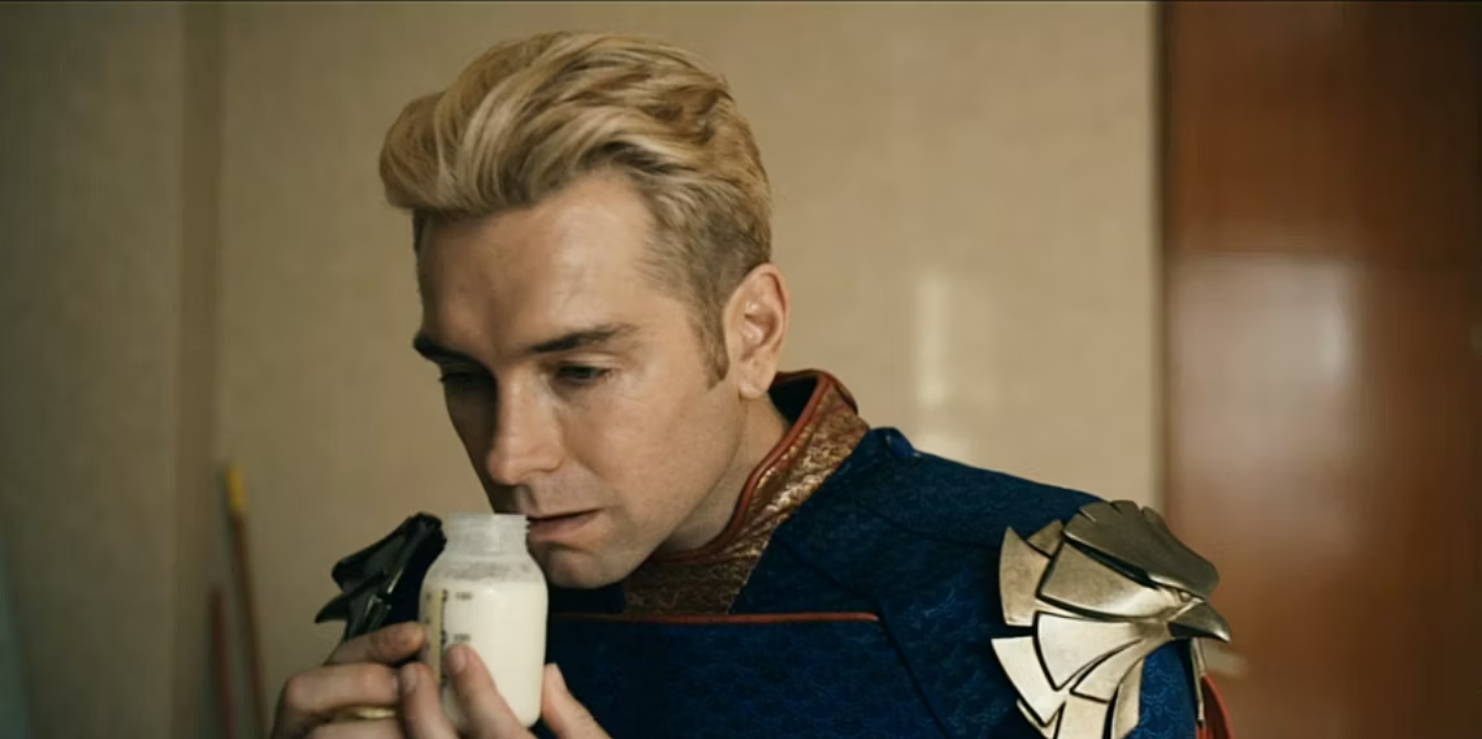
Jeff Bezos knows which scenes from The Boys
that viewers pause on for long periods of time,
so don’t be surprised if you get targeted ads
selling you farm-fresh milk.
(Image screen captured from Amazon Prime)
The first is video entertainment as a tool for data mining; the notable example of this is Amazon Prime, which in some ways operates as a loss-leader. The television service doesn’t actually turn a profit, but rather incentivizes consumers to sign up to Amazon’s free shipping program and consequently (hopefully) order more from the online retailer. But more insidiously, the retail giant is able to create more and more accurate profiles of its streaming service users by recording the details of what they watch, how much they watch, and when they stop. We would suggest that one of the key reasons that Prime has shows geared to as wildly different political constituencies as The Boys and The Handmaid’s Tale is as part of a subtle psychological testing experiment. The Venn Diagram of people who watch Reacher and Ms. Maisel has little overlap; and now their algorithms know which data bucket you fall into.

The final model of streaming service may seem the most innocuous, but it’s the one that causes us the most concern: Identity as a subscription service. This model is typified by Disney+ and by Paramount+, and is fairly obvious in the ways in which they’ve built their content libraries around specific, organized media-franchise fandoms. There’s no ‘anchor show’ for either of these streamers, but rather an identity as a fan that one is subscribing to. It is difficult to be a “true Star Wars fan,” without paying an $11.99 monthly fee to Disney+ to be a part of that fandom. Likewise, it is difficult to be a “true Star Trek fan” without paying $9.99 to Paramount+ each month.

While individual shows on these services might come and go, these services are among the most likely to appear rational in their choices to an outside observer, and they are unlikely ever to abandon any of their cash-cow multimedia properties. Expect intellectually low-risk offerings that don’t rock the boat, and don’t threaten the long-term value of the IP owners or shareholders.
Noted anti-union activist
Walt Disney has a
problematic legacy of
promoting patriarchy. 
(Image via USA Today)

Self-identity as a key selling point of a subscription service may not seem like a problem, but it’s relatively easy to imagine a scenario in which a major streaming service leans into culture war divisions in an attempt to build a walled-garden identity streamer that appeals to the increasingly extreme right wing political identity. Given the company’s long history of encouraging heteronormativity and white supremacy, one would suspect that Disney+ is the likeliest streamer to follow the Fox News organizational radicalization highway. The consequences of this to the broader culture could be disastrous.

When discussing the purveyors of video entertainment, viewers and critics should always ask what each company is selling, how they are selling it, and to whom they are selling. The answers to these questions are vital for understanding the current media landscape, the future of streaming, and consequently the future of culture.


Sunday, 8 January 2023

God Never Talks. But the Devil Keeps Advertising. — Hugo Cinema 1974

This blog post is the seventeenth in a series examining past winners of the Best Dramatic Presentation Hugo Award. An introductory blog post is here.

If you looked only at the Hugo shortlist for 1974, you might be excused for assuming that it was just a bad year for screen science fiction and fantasy. But there were, in fact, excellent movies and even television shows to be found. The Hugo for Best Dramatic Presentation had missed the mark before, but never this substantially.

Rather than dwell on the uninspiring shortlist, the frankly abysmal winner, or the at-best controversial celebrity who created it, let’s start by talking about the works that deserved to be celebrated instead.
The Exorcist is an iconic and enduring movie, but
somehow was not honoured by the Hugo Awards.
(Image via Bloody Disgusting.)

For starters, the absence of The Exorcist on the 1974 Hugo ballot for best dramatic presentation is one of the most glaring omissions in the history of the award.

Reportedly, viewers fainted in the cinema and experienced nightmares for weeks after. To this day, it routinely tops lists of the greatest horror movies ever made. Nominated for 10 Academy Awards including Best Picture, The Exorcist won two Oscars including Best Screenplay. It was the highest-grossing movie of the year.

And considering that Rosemary’s Baby had earned a Hugo nomination just five years previously, it was obviously clear to WSFS members that supernatural horror movies were eligible for the award.

But … it appears not to have been well liked by fandom at the time. Writing in the WSFA Journal, Richard Delap describes it as a “shallow, poorly-written jumble of religious assertions and flaky characters.” Writing his own review a few months later in Son of the WSFA Journal, Don Miller was dismissive of the movie, suggesting that despite the hype, it would be quickly forgotten.

But for those of us watching The Exorcist with 50 years of hindsight, the movie holds up remarkably well — and better than most of its contemporaries. We can see why this movie was instantly hailed by most in the mainstream press as a classic. It straddles the line between high-art and pulp entertainment, combining superb filmmaking with well-paced dialogue and narrative momentum. The Exorcist stands out among supernatural horror by playing with the boundary between what is known and what is unknowable. From the perspective of science fiction and fantasy fandom, a surprising amount of the movie involves characters attempting to solve the problem scientifically before they turn to a supernatural solution.

We would suggest that the early dismissiveness that many in fandom had towards The Exorcist shows some of the difficulties of providing quick assessments of the enduring value of art. Or maybe the film just made them uncomfortable.

Don't Look Now, directed by Nicholas Roeg,
is an unsettling movie that remains a classic of
supernatural horror. 
(Image via The New Yorker)
Another horror-fantasy that would have been a creditable Hugo finalist is Don’t Look Now, a subtle and carefully constructed British ghost story based on a novelette by The Birds author Daphne du Maurier. The movie follows a couple after the accidental death of their daughter, as they start to explore supernatural options to regain contact with her. Director Nicolas Roeg approaches the subject with a Kubrickian attention to detail, alluding to themes and portents with carefully constructed visual elements. Interestingly, writing in the fanzine Starling in early 1974, Jim Turner highlighted the quality of Don’t Look Now, and noted that the movie was Hugo-eligible.

George Romero’s The Crazies received some attention from contemporaneous fanzines, with Christopher Fowler writing in Vector that it might make a credible Hugo finalist. Using the premise of a biological weapon being accidentally unleashed in an American small town, The Crazies paints a picture of organizational dysfunction and of government incompetence. It is worth noting that this is one of the few movies of the era to cast a BIPOC actor in a role of authority, with Lloyd Hollar playing Colonel Peckham, one of the few competent government officials trying to keep the disease contained. In the decades since its release, it has become a cult classic, and has been interpreted by libertarians as a condemnation of big government, and interpreted by leftists as a takedown of right-wing military thinking. It’s a rich text that continues to inspire conversations, but was overlooked.

Imagine if The Matrix had
been made in Germany during
the 1970s by an art-house genius,
that's World On A Wire.
(Image via Criterion)
Though any foreign-language movie is always unlikely to make the Hugo ballot, World On A Wire (AKA Welt am Draht) needs to be highlighted as an option, as it is possibly the first depiction of virtual reality in screen science fiction. A German-television adaptation of Daniel F. Galoye’s book Simulacron-3, the show follows a scientist who takes over a computing project after the mysterious death of his boss. As it turns out, the project is a simulation of the real world used for market research, and within the simulation, there are thousands of artificial intelligences who think they are in the real world. Directed by Rainer Werner Fassbinder, this might be the best-looking television production of the decade, stylish, moody, and thoughtful. Although slow at points, this philosophical masterpiece would have topped the Hugo ballot for at least one member of our viewing group.

French animated sci-fi fantasy Fantastic Planet (AKA La Planète sauvage) received some discussion in that year’s fanzines, and would have been a worthy contender for the Hugo. An epic parable about colonization and the rights of sentient beings, the movie depicts humanity being enslaved by giant aliens who keep us as pets. It’s an odd and beautiful movie at times, because of the animation, with the visuals serving to hammer home the horrific nature of being treated as less than human. Similarly, The Belladonna of Sadness, a Japanese animated movie about a woman who makes a pact with the devil to enact revenge against men who assaulted her, uses innovative artwork to underscore the inhumanity of the villains. These have both stood the test of time far better than anything that actually made the ballot.

We might also highlight Alejandro Jodorowski’s sophomore effort The Holy Mountain, which was released in 1973, and would have been eligible for the Hugo. The surreal and poetically weird movie presents a parable about searching for meaning, and about the sins of humanity. The protagonist — who is either a thief or Jesus — must team up with human avatars of the planets of the solar system to journey to the top of a mountain in order to replace the magicians who live at the summit. It’s at turns self-indulgent and thoughtful, philosophical and crass, entertaining and ponderous, and is one of the high points of 1970s cinema overall.

Playful, beautiful, kaleidoscopic, The Holy
Mountain
 plays with the sacred and the profane.
One of the high points of 1970s cinema.
(Image via IMDB.com)
So given all these excellent options in terms of science fiction and fantasy on screen, what did make the ballot? Soylent Green, Sleeper, Westworld, Genesis II, and The Six Million Dollar Man.

Of these, only Soylent Green would have ranked slightly above ‘No Award’ for us. Though it has lines that are often quoted today, this adaptation of Harry Harrison’s novel Make Room, Make Room did not age as well as many other movies. There are some scenes that work; in particular the suicide machine, and the depiction of fresh fruit as something extraordinary. But more often than not, this movie fails. The sexism is pervasive, and stands out even among the contemporaneous movies we have watched. Live-in prostitutes are referred to as ‘furniture,’ and almost every female character is treated as little more than a sex object. Although the premise of a society that treats women as ‘furniture’ could have been a satire of real-world sexism, director Richard Fleischer seems unable to bring a critical lens to the behaviour. Even contemporaneous (and cis-male) critics found the sexism of Soylent Green objectionable — In the WSFA Journal, Richard Delap noted the uncritical and misogynist depiction of prostitution in a scathing review and concluded “It’s easy to complain about a film that aborts the fine material on which it was based; but Soylent Green is much worse than that.” 

Given that the movie Westworld — written and directed by Michael Chrichton — would go on to spawn a sequel and two television series, it clearly connected with audiences. With a great premise — an amusement park filled with robots that descends into chaos — this could have been a first-rate film. But it quickly devolves into a monster movie as robot Yul Brenner tries to kill the two protagonists. It’s light on dialogue, light on character, and mostly pretty wooden in direction. Some contemporaneous fans agreed; “The good moments are much too infrequent, and the remainder much too trite. Any SF fan is bound to be saddened to see such workable potential by bad editing to throw-away trivia.” Richard Delap wrote in the WSFS Journal. The narrative premise would be better implemented forty years later in an HBO adaptation, which deserved a Hugo nod far more than the original.
The Belladonna of Sadness is a weird, problematic
movie with some incredible artwork and themes.
Those planning to watch it should probably read
this essay from The Anime Feminist, which 
highlights both the movie's strengths and 
flaws. (Image via Anime Feminist).

Genesis II, one in a long line of Gene Roddenberry failed pilot episodes, is a jumbled mess of a show about Dylan Hunt, a scientist from the present who is frozen in time and wakes up in 2133. Finding himself in a post-apocalyptic world, Hunt joins up with pacifist scientists and fights against evil mutants. Laden with excessive narration, weak characters, and ethnic stereotypes, there’s little to recommend Genesis II. One can only suspect that leftover goodwill from Star Trek earned Roddenberry this Hugo nomination.

Conversely, The Six Million Dollar Man pilot episode did get picked up to series, going on to last five seasons, a spin-off series, and several TV movies. The character of Steve Austin, introduced in this Hugo-finalist TV movie, would grace screens for more than two decades and produce several excellent outings (The Seven Million Dollar Man and Death Probe come to mind.) But the pilot episode is clunky at best; there’s little narrative arc for the first two thirds of the episode, and the terrorism plot seems tacked on. The nominated episode is simply not Hugo worthy.

Woody Allen’s listless, puerile, Hugo-winning comedy Sleeper is self-indulgent to the point of onanism. Allen stars as Miles Monroe, a jazz clarinetist who is cryogenically frozen and wakes up 200 years later in a Brave New World-style dystopia. (To be clear, this is not an Orwellian dictatorship, but rather one that controls people through hedonism.) After various pratfalls and masturbation jokes, Miller is then caught up in a revolution to overthrow the oppressive society. It’s a fairly banal science fiction story whose plot is often twisted out of shape just to force one more joke about self-pleasure into the script. The movie still has fans today, but to us, most of the slapstick jokes fell relatively flat — though your mileage may vary. In retrospect, and in light of Allen’s later conduct, we feel deeply uncomfortable with him being honoured with a Hugo.

It is a shame — but not surprising — that in a year that offered cinema with such strong themes of rejection of authority, female empowerment and social activism, the Hugos went with some of the whitest, most regressive picks available. All-too-often, nerd culture has reproduced the exclusionary aspects of mainstream culture, and such was the case with the 1974 Hugos.

Having now watched almost two decades worth of Hugo-eligible movies and television, it’s clear that the Best Dramatic Presentation category has a poor track record of selecting works that would enjoy enduring value. But even by those standards, the 1974 shortlist is a low point. It is particularly galling considering the quality of cinematic and televised SFF that was available to viewers in the preceding year. The Exorcist should have won, and for it to be denied even a nomination must have been a bad look for the award itself, even in 1974.