Monday, 21 April 2025

It's The End Of The World As We Know It (And Dorian Lynskey Feels Fine)

Humans seem to be obsessed with the cause of their own finality. Perhaps because, subconsciously, we want everything to fit into a nice narrative structure that has a beginning, a middle … and an end.
And I hope that you can forgive
us, for Everything Must Go.
(Image via Amazon)


From the dawn of recorded history, there have been stories of the end of days, from John’s Revelations to the Fimbulwinter of Norse myths. And since the enlightenment, the task of providing an original, satisfactory narrative conclusion has fallen to science fiction authors, providing a secular eschatology. Over the past 200 years, apocalyptic fiction has been — under various guises — one of the most robust and popular subgenres of SFF. 

Documenting this prolific output feels like an impossible task, but British journalist Dorian Lynskey has made a valiant attempt in his recent book Everything Must Go. The book — published in the United States in February 2025 — should be strongly considered for a Best Related Work Hugo Award next year.

Beginning with a prologue on various gods and their respective end-times predictions, the book then divides narrative apocalypses into subcategories; meteors, plagues, rogue computers, climate change and the like. The categorization helps break down the subject into slightly more manageable sections, though each of these categories probably warrants a tome of its own. Lynskey’s overarching thesis that catastrophic fiction reflects the preoccupations of its time may not be revolutionary, but his painstaking research and herculean collation is impressive and even, at times, entertainingly presented.

A culture and entertainment beat reporter by trade, Lynskey approaches the subject with wit. It’s a charming book, though sometimes his pop-culture journalism style verges on flippant. Many of his pithiest quips can be found in the books’ introduction and epilogue. As with the best reference works, these sections are essential to understanding where and when to consult the remaining chapters. As stated in the introduction, “Writers of fictional doomsdays all reveal what they love or hate about the world as it is, and what they fear. Such stories are the ice-core data for dating the life cycle of existential concerns.”

Everything Must Go is clearly a labour of love. The relentless criticism of the many works that descend into fascistic reveries about the world made anew required unusual stamina. The subtext apparent in survivalist fiction, in particular, is put under the microscope. “The post-apocalyptic trope of rebirth from the ashes overlaps, often unintentionally, with fascist notions of regeneration achieved through virility and violence,” he writes.

In the face of apocalypse, The Bed Sitting Room
encourages us all to put on our best and go out 
in style
. 
(Image via IMDB)
Some chapters, particularly the chapters on “impact fiction” (i.e., meteors, comets, etc.) and “zombies” become a bit scattershot as Lynskey lists countless works and goes off on tangents about the relationships between them and real-world events. The eight-year gap between Terminator 2 and The Matrix is related to Gary Kasparov’s chess match against a machine and then to the UFO cult Chen Tao in Texas. The cavalcade of references is overwhelming. At times it feels like Lynskey wants to include every single apocalypse in this book — which results in just under 500 pages, including copious endnotes and a 30-page index. (We would add that even in this, there is a certain joy for those who are deeply invested in the genre to see references to old and obscure books that they've read.)

As Lynskey explains, the genre is rarely about the end of all things, but rather about what happens next for those lucky few who withstand the cataclysm. While the cause of the end of the world might be uncertain, one thing we can rely on is that humans will be writing about it until it happens. Everything Must Go provides a foundation from which future documentarians of the apocalypse can build from. To paraphrase Billy Corgan, The Beginning Is the End Is the Beginning. 

Saturday, 12 April 2025

Worldcon In An Age Of American Truculence

The World Science Fiction Convention — as it has existed for the past seven decades — is a reflection of the “consensus” that has been post-war international relations.

That consensus is over. Fandom needs to be asking: “What’s next?”
The Peace Arch in British Columbia represents
how easy it has been for citizens of the USA
and Canada to cross the border.
(Image via Chilliwack Progress)


Although the first ‘World’-cons were held in the 1930s and early 1940s, the handful of pre-war events were set in the United States and the number of attendees from elsewhere minimal. When Worldcons resumed in 1946, they did so in an era governed by an uneasy consensus of US-centric international relations that fostered cooperation, stability, and collective security. This enabled international organizations built by the new world order to thrive. Increasing international mobility for travellers, greater trust between nations, and a relative sense of communal good made international conventions more common.

The scope and reach of the event grew massively from the first post-war Worldcon which reportedly had a “handful of Canadians” as the international contingent, to the last pre-pandemic Worldcon (2019 in Dublin) that boasted attendees from more than 60 countries. Worldcon thrived as it became increasingly globalized, but never lost its abiding connection to the country in which it was born. The World Science Fiction Convention remains a predominantly US event. With the sole exception of the 2023 Worldcon in China, US citizens have made up the largest single contingent at every single Worldcon.

The ties Worldcon has to the United States are deep; as a volunteer-run and volunteer-organized event, it takes an enormous amount of goodwill and institutional knowledge for a Worldcon to happen. There are pools of volunteers in the United Kingdom, Canada, and in China who would be able to put together a Worldcon every few years if called upon, but it seems unlikely that they could do so every single year. In the United States, there are communities of con-runners scattered across the nation; West Coast, Chicago, Midwest, New England, and more. Even with the greying of a core of US fandom, these communities account for the majority of Worldcon expertise and volunteer hours.

In light of recent political events, and the destabilization of the post-war consensus, it seems likely that the era of growth in its country of origin is over for Worldcon. Travel to and from the United States is declining rapidly. Countries such as France, Germany, and Ireland have updated their government websites advising a degree of caution in planning trips to the country. There are concerns about the low number of international fans registering for the upcoming two Worldcons (Seattle in 2025 and Los Angeles in 2026). Some non-US finalists for this year’s Hugo Awards have indicated they do not feel safe attending the ceremony in person.

Many of the disruptions that Worldcon currently faces are tied to decisions made by the current US administration. But even if there is a change in power in the next four years, international trust will remain precarious. Travel plans remain contingent on the whims of a mercurial electorate. Holding a Worldcon within the United States will consequently be challenging.

Worldcons in challenging locations are not a new phenomenon. The 1951 Worldcon in segregated New Orleans shouldn’t have happened. The Worldcon in Chengdu in 2023 received a significant amount of criticism. Bids to host Worldcons in Saudi Arabia, in Israel, and in Uganda have all been floated — and greeted with skepticism by many.

Of course, it will never be possible to host a Worldcon in a location where every science fiction fan can attend. Every Worldcon that is in a physical location will be exclusionary to some degree. As such, there is a great value in having Worldcon hosted in as many different and disparate locations as possible in order to ensure that as many different people as possible can attend. Travelling to China in 2023 may have been off the table for a lot of US fans, but those fans had US-based Worldcons for the two previous years. If Rwanda’s Worldcon bid succeeds, it would provide African fans — who often have troubles getting travel visas for North America — the chance to attend a Worldcon. There is an enormous value in giving a variety of local communities of fans their turns.

Not every passport will get you into every country
in fact, so every Worldcon location is a choice
about which fans are welcome to attend.
(Image via Boundless.com)
And this presents the dilemma at hand: On one hand Worldcon cannot be a ‘World’ event if it is limited to the United States, and on the other the majority of the volunteer base that makes Worldcons possible is in the United States. There is no Worldcon without the world, and Worldcon doesn’t work in the long term without the US and its fans.

In the past, the World Science Fiction Society (which governs Worldcon organizing) employed a rotation system. The convention was supposed to be held in three different zones on a rota. One year would be the West Coast of the US, the next would be the East Coast, and finally a Worldcon would happen in the central US. (Non-US bids could fit anywhere in that rotation.) Given the sparsity of Worldcon bids some years, the intention was difficult to realize. But it’s a premise that has merit.

Because of the voter base, institutional knowledge, and enormous fan base, US Worldcons will and should always occur. But perhaps there should be an increased willingness among fandom to support overseas conventions in locations that present logistical hurdles for North American travellers. If we may be so bold, perhaps we as fans should encourage the practice of having a Worldcon outside of North America every second year.

In an age of US truculence, Worldcon needs to embrace friends and allies around the globe without turning its back on the generations of fans and volunteers who have built it as an institution.

Thursday, 27 March 2025

Interview with Rebellion Editor David Thomas Moore

The Hugos for Best Professional Editor are arguably two of the more difficult categories for Worldcon members to vote on, given that editorial contributions are completed behind the scenes and, when done well, will be invisible to the reader.

David Thomas Moore has been an editor at Rebellion Publishing in the UK since 2010, where he has worked on books by authors such as Adrian Tchaikovsky and Premee Mohamed. Currently the publisher’s editorial director, he’s provided leadership to the organization through a period of growth. In 2024, he was a finalist for the Hugo Award for Best Editor Long Form.
Hugo-finalist editor
David Thomas Moore.


Earlier this year, Moore took the time to chat with Unofficial Hugo Book Club Blog about the evolving role of editors in the long-form publishing world.


UHBCB:
What is your process when working with an author?

Moore:
Oof, start with an easy question, why don’t you?

It depends a lot on the author and the book. If I’ve acquired a book from an agent, I already have a manuscript (which has probably already had a couple of editing passes), and the process is a lot to do with midwifing that manuscript into the world. But if I’ve commissioned the work, then a big part of the process is getting the manuscript to delivery in the first place. Different jobs, different demands, different expectations. And of course different authors have different preferences: some like to be very involved, and some are already working on the next book.

So the biggest challenge is communication. I try not to deluge the author, but I’m also aware that they’re stuck out on the periphery of the machine and often don’t have much of a sense of what’s going on — and I’ll be the first to admit I sometimes get the balance wrong! Much of this is dictated by the stages of the process: there’s an email exchange around the first edit, then again when the copy-edit is done, when the proofread is done, around cover and design choices, hooking them up with the marketing team and so on.

My structural/developmental edits tend to be light. It’s not my story — if it were told in a very different way it wouldn’t be the same thing. Conversely, my line edits are brutal; I’m determined to make that story — the story the author wants to tell — the best version of itself it can be, so I pay close attention to the language and the execution (although I also try to make sure I’m conscious of the author’s voice and style).

I guess if there’s any particular philosophy, it’s that I try and make sure the author is aware at every stage that it’s their book. My edits are suggestions, the cover approach is a preference. I’ll always listen and engage, and in the end if the author doesn’t like an idea I’ll make sure it doesn’t happen.


UHBCB:
Do you have any thoughts on the state of modern SFF?

Moore:
It’s great, to be honest! There’s such a richness and plurality of identities and voices now; when I started fifteen years ago stories by marginalised authors were marketed on that, because they were exceptional, but now it’s scarcely worth mentioning. And that’s reflected in the stories themselves — when most writers looked like me, most of the stories were the types of stories I’d tell, but now I get to read and work with stories, characters, language and structures that are completely out of my safety zone and I love it.

We’re challenging genre conventions (and mashing them up). We’re pushing the boundary between “literary” and “genre.” We’re trying new things out, questioning assumptions and experimenting. And we’re having fun — the younger crop of writers approach their work with such joy and love, it’s wonderful.


UHBCB:

Are the preoccupations of the genre different now than when you began publishing?

Moore:
Yeah, definitely. I came in at the end of that fin-de-siecle period, with all the brooding heroes, morally grey worlds and bleakness. We’ve come back around to the idea that heroes can just sometimes be good people who try to do the right thing, or people who love each other and support each other — or who find people to love and support them. I sometimes see these kinds of stories dismissed as “cosy” (or do you remember “squeecore” a few years ago?), but these stories absolutely still include threats and challenges, suffering and adversity; it’s just that the goodies get to be goodies without making them low-key horrible, or forcing them through some narrative meatgrinder for the sake of it.
One of the books Moore
is currently editing is 
An Unbreakable World
by Ren Hutchings.
(Image via Amazon.ca)


In a perverse way, I think it’s about hope and defiance. In the ’90s, for most of us in the white Western world, the future felt reassuringly stable and dull. There were still problems, but surely we would gradually resolve them. So in our stories we created problems to make the world more interesting. Now everything feels, frankly, a bit shit, between impending climate doom, political turmoil and a determined attempt to roll back the social progress of the last century; we want nice things in our stories.

I was asked, for a recent article, why we’re telling so many “retrofuturist” sci-fi stories and aesthetics — or more to the point, so few stories set in our direct future. I said I thought it was because we struggle to see what our direct future looks like. I think that’s right — we’re imagining around the future to give ourselves something to hope for.


UHBCB:
What are you excited about in science fiction and fantasy in 2025?

Moore:
Ooh. More defiance. Stories about people working together to circumvent and overthrow the systems of control built around them. More joy and love. More voices — give me stories set in places I haven’t heard from! I’m excited to see what the “BookTok” crowd that turned up for the new wave of romantasy turn to next, and the stories that this new generation of D&D players come up with.


UHBCB:
How has the editing world changed since you started?

Moore:
There’s a lot less paper, for starters! I juuust about started when editing on paper was still the norm — you’d print out the manuscript, mark it up in red pen, then turn that into electronic notes. It only became the norm to edit straight onto screen in the mid 2010s or so. And that goes for everything — I sent my first digital contract (7000 miles!) in 2012, we stopped getting physical proofs from the printer in about 2015 or so, and so on.

The pandemic, of course, made us all remote. We work in solitude, much of the time; aside from a handful of meetings a week, we do most of what we do alone at a computer. So we all switched to remote work without missing a step, and although our bosses are starting to drag us back to the office (some more willingly than others), I think we’ve all seen how working from home is a viable option for us, at least some of the time. That’s probably going to stay with us. And it means we can hire more widely as well; people who can’t move to the big cities, for whatever reason, could do these jobs, which means there’s a ton of talent there to draw upon that we didn’t have access to before.

There’s more of us, at least in SFF. You used to be able to get all the UK SFF editors around a large table (we literally did, at an occasional Christmas dinner in London) – now we pack out a good sized pub. And it’s a more diverse bunch, which is awesome; it’s all very well to say we want to hear more voices in fiction, but that means getting more voices in the publishing houses to help find and hone those stories.

But everyone is busier. It’s always been the norm for editors to do submissions reading on their own time, but now increasingly we do the same for the actual editing. And everyone has an inbox full of unanswered emails and a guilt-inducing pile of unread subs. (This isn’t any one publisher, or an indie vs corporate thing — it’s all of us.) It feels like something’s got to change there.


UHBCB:

Since the editing process is opaque to those outside of the industry, do you have any advice to Hugo voters on how to assess the work of editors?

Moore:
Ooh, tricky one! It’s an odd category (although please don’t take it away — it’s the only award we got!), because without access to an unedited copy of the MS to compare side by side with the final published version, you really can’t tell what an editor’s done to the text itself.

But nil desperandum! Keep in mind that an editor isn’t just there to work on the text. They most likely acquired the manuscript, which meant they read through a pile of subs, picked that one as the one to champion, and fought it through an acquisitions process. They conceived of the cover approach (again, via a process) and commissioned the art, they liaised with the freelancers working on the project.

So I would say look at the books each editor brought into the world last year and decide which ones you love the most. Because what you’re looking at there isn’t just the product of the editor’s grasp of structure, grammar and punctuation; it’s reflective of their tastes, they made it their passion, the whole package is (partly) their vision. They wanted you to be holding just exactly that book. If that book makes you happy, then vote for the person who edited it.


UHBCB:
What are some of your proudest accomplishments as an editor?

Moore:

I mean, being nominated for a Hugo’s got to rank up there!

When my books do well, obviously. When one of them sells well, when it gets picked for a fancy special edition, when it gets nominated for an award; I always get a huge kick going to an award ceremony (either with my author or on their behalf) because a bunch of other people loved that book as much as I did. I’ve been to the Hugos, the Nebulas and the Clarkes on behalf of my authors and it’s a huge honour every time.

But more than anything, it’s the people I gave a chance to: like commissioning Cass Khaw for the Rupert Wong novellas, getting Suyi Okungbowa for David Mogo, Godhunter, acquiring Premee Mohamed’s Beneath the Rising. Just incredible talents I was lucky enough to accompany through their first books. Seeing them succeed — and especially seeing them succeed with other publishers — is an incredible feeling, because maybe I made that possible (I mean, maybe they’d have done it without me, but I can tell myself I helped!), and it feels like I made the world a slightly better place each time.
Moore acquired the rights to
publish Premee Mohamed's
excellent first novel 
Beneath The Rising.
(Image via Amazon)


UHBCB:

Worldcon sessions about editing and working as an editor tend to be very popular. Do you have any advice for aspiring editors?

Moore:

For editing, per se: read and read and read. Discard the idea of having a “taste” in fiction. By which I don’t mean you should have no taste(!), but that you should aspire not to have a preference. Teach yourself to romp your way through a high-action adventure, then pick up a dense, wordy examination of human nature before jumping into a cosy romance followed by a gory slasher story, and enjoy them all (and, more importantly, learn to judge all of them by the standards of their own genres and styles). You’ll not only be a more versatile editor, you’ll be better even at editing the genres you already liked, because you’ll broaden your perspective.

For working as an editor (which I’ll interpret as meaning, getting a job like mine), it’s so much to do with luck I’m not sure what to say! I’ve never applied for, nor advertised, a job like mine that had fewer than 100 applicants. I guess, having had to sift through the applications pile, my biggest tip would be, show me how much you know and love genre stories. I’m more likely to give an interview to someone whose formal credentials are maybe less than stellar but whose covering letter mentions three or four SFF books they loved and which came out in the last five years, than I am to someone whose experience and qualifications are spotless but who clearly regards SFF as the fiction world’s redheaded stepchild (if they think of it at all).


UHBCB:

What projects are you working on right now?

Moore:

Hee. I kind of love answering this question even though I always end up going into a slight trance, because inevitably I’m working on three or more projects at various stages of production at once:

Currently shepherding Ren Hutchings’ An Unbreakable World through production, an absolutely charming action/heist story with a queer love story running through it, set in the same world as Under Fortunate Stars. Ren’s voice is delightful, and her books are enormous fun; she captures some of the mood of classic Trek, with fun time loops, twists and reveals.

In the final stages for Adrian Tchaikovsky’s The Hungry Gods, a smart, angry (all his novellas are angry in the best way) post-apocalyptic story in which four sociopathic techbros return to the Earth they destroyed to wipe out the survivors and create new worlds in their own images, and immediately go to war with each other.

Editing Anna Smith Spark’s Anderson vs. Death, a 2000 AD tie-in novel telling the story of what happened in the eighteen months when Judge Anderson first successfully trapped the evil Judge Death in her head and got sealed in Boing!™. It’s set in Anderson’s mind, in an imagined Mega-City One, as Cass duels Death for control of herself. Anna turns out to be an old-school 2000 AD fan, and has married the gonzo weirdness of early-eighties Dredd with her signature dark poetic style. It’s gorgeous and I can’t wait for people to see it.

Tuesday, 4 March 2025

Open Discussion — What's worth considering for the ballot in 2026?

The following list will be updated over the next few months as we read, watch, and listen to Hugo-eligible works for 2026. These are not necessarily what we plan to nominate, but rather works that at least one member of the Edmonton Hugo Book Club has enjoyed and believes to be worth consideration. We appreciate any additional suggestions in the comments.

Updated on December 14, 2025

Items marked with a “*” are ones for which there was disagreement within the book club. 

Novel
Always on my Mind — Carys Green
Future's Edge — Gareth Powell
Death of the Author — Nnedi Okorafor
Bee Speaker — Adrian Tchaikovsky
Katabasis — R.F. Kuang * 
The Incandescent — Emily Tesh

Novella
The Artistry of Magic — Helen De Cruz
Automatic Noodle — Annalee Newitz
Hungry Gods — Adrian Tchaikovsky
But Not Too Bold — Hache Pueyo

Novelette
Mindtrips — Tlotlo Tsammaase
The Temporary Murder of Thomas Monroe — Tia Tashiro
The Tin Man's Ghost — Ray Nayler
Liberation — Tade Thompson

Short Story
The Demon of Metrazol — Ray Nayler
The Flaming Embusen — Tade Thompson
Forsaking All Others — Premee Mohamed
Yarn Theory — Marie Vibbert

Series
Dogs of War — Adrian Tchaikovsky
The Convergence Saga — Cadwell Turnbull 
Pandominion Saga — M.R. Carey

Best Poetry
Dead Channel Sky — Clipping
Hex Supply Customer Support Log —Elis Montgomery
Xenotext Book 2 — Christian Book

Best Related Work
Everything Must Go — Dorian Lynskey 
Colourfields — Paul Kincaid

Semiprozine

Best Game Or Interactive Work 
Split Fiction — Hazelight Studios
Clair Obscur: Expedition 33 — Sandfall Interactive
Death Standing 2 — Kojima Productions
Hollow Knight: Silksong — Team Cherry

Astounding Award For Best New Writer
Sophie Burnham 

Dramatic Presentation (Short Form) 
Pluribus S01E01 - "We Is Us" - Apple+ (Written and directed by Vince Gillian)
Murderbot S01E01 "FreeCommerce" - Apple+ (Directed by Paul Weitz based on the works of Martha Wells)
Paradise S01E07 "The Day." (Directed by Glenn Ficarra & John Requa)
Peacemaker S02E07 "Like a Keith in the Night" (Directed by Alethea Jones)
Alien: Earth S01E05 "In Space, No One..." (Written and directed by Noah Hawley) 

Dramatic Presentation (Long Form) 
Superman — Written and directed by James Gunn
Mickey 17 — Directed by Bong Joon Ho based on a novel by Ashton Edward
Sinners — Written and directed by Ryan Coogler 
Andor — Creator and show runner Tony Gilroy
28 Years Later — Directed by Danny Boyle, written by Alex Garland
Predator: Badlands — Written and directed by Dan Trachtenberg

Best Editor - Long Form

Best Editor - Short Form
Scott H. Andrews
Diane Walton
Neil Clarke
Michael Damien Thomas

Fan Artist

Graphic Story
Arkadi and the Lost Titan - Caza
Plastic Man No More! - Christopher Cantwell and Alex Lins
Krypto: Last Dog Of Krypton - Ryan North and Mike Norton
The Power Fantasy - Written by Kieron Gillen, art by Caspar Wijngaard

Fan Writer

Thursday, 27 February 2025

The Ape Star


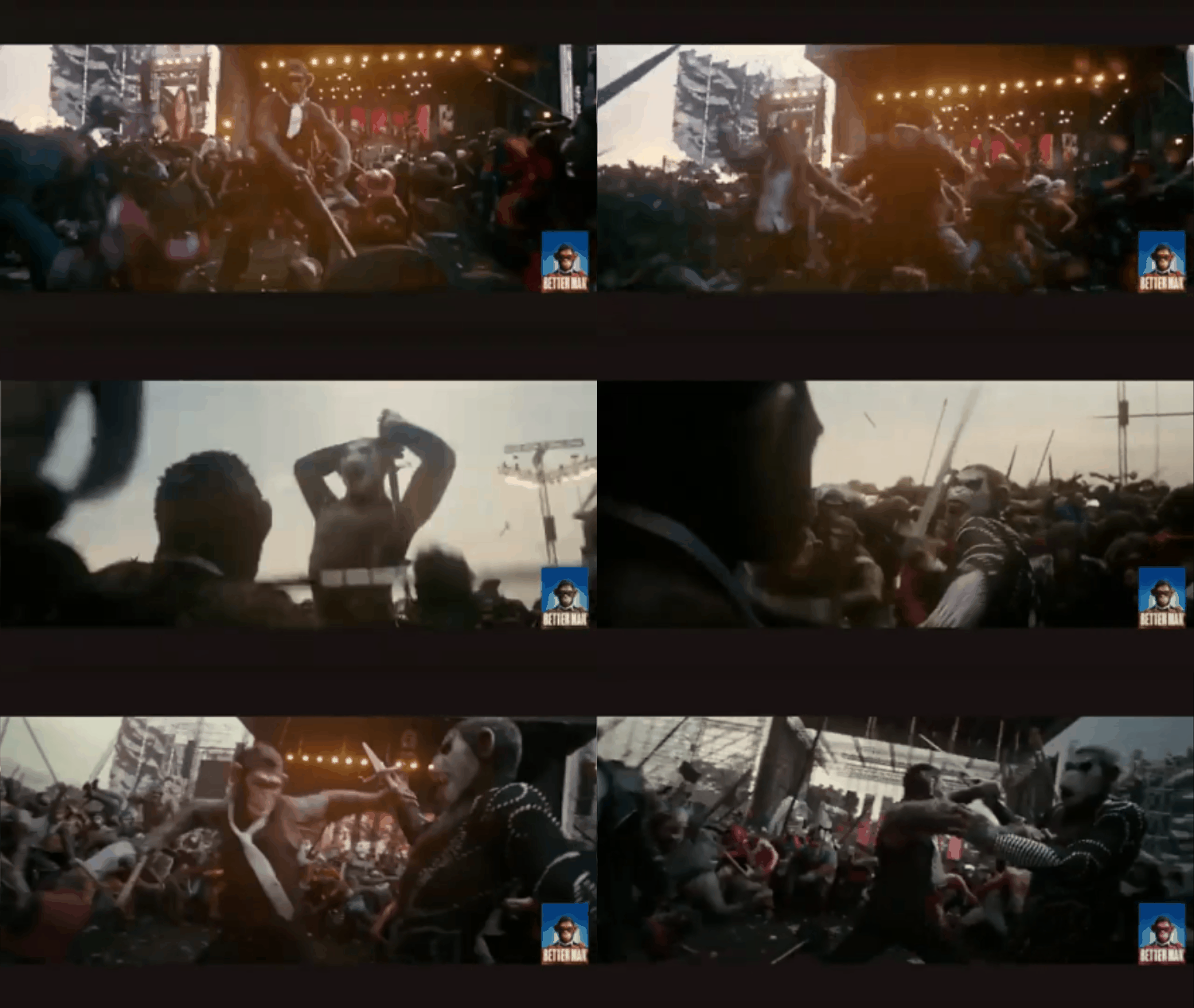
The climactic battle in Better Man is a frenzy
of ape-on-ape violence. This is clearly fantasy.
Image via YouTube.
In the climactic moment of Better Man, an anthropomorphic chimpanzee named Robbie Williams takes the stage at the Knebworth Festival in front of 125,000 fans to sing his pop anthem, “Let Me Entertain You.” Nearing the end of the song, he spots in the audience dozens — then hundreds — of younger and angrier chimpanzee versions of himself. Leaping into the crowd, he begins fighting them one-by-one, with each showdown getting bloodier and more outlandish.

With the leaping chimpanzees, the soaring camera work, and the colourful cinematography, it is as if the Battle of Isengard had been set on the Planet of the Apes and directed by Speed-Racer-era Wachowskis.

So let us be perfectly clear about this point: any movie featuring a battle royale between thousands of anthropomorphic apes is fantastical enough to be considered for a Hugo Award. Whether or not Better Man is a “pure” fantasy movie, it is at the very least a form of magical realism.

It’s also possibly the most audacious — and beautiful — science fiction or fantasy movie released in 2024.

Directed by Greatest Showman auteur Michael Gracey, the movie chronicles the rise of real-world, non-chimpanzee, UK superstar Robbie Williams, his feud with the boy band that launched his career, and his struggles with addiction. These are all the standard narrative beats of a Hollywood music biopic, but Better Man is elevated by the unusual approach to the subject (to whit the motion-capture ape), the panache with which the movie has been directed, and Williams’ sardonic voice.

The real-world non-chimpanzee Robbie Williams
is known for his self-serious dignity.
(Image via RobbieWilliams.com)
Unfortunately, the movie woefully underperformed at the box office — earning only $20 million on a budget that exceeded $110 million. Perhaps it struggled in cinemas because Americans have never really understood Robbie Williams, something explored in the recent Netflix documentary about his life … but not in this film. Americans like their bragaddocio unmitigated; every time Williams offers a bombastic line, he undermines it with a joke. His is a quintessentially British voice that did not appeal to enough people in the USA.

The film’s inability to reach a wider audience is a shame, because by wrapping its narrative in special effects and fantasy, the story becomes more universal. It makes no pretense of being an entirely true and factual depiction of Robbie Williams’ life. To quote Williams himself: “You don’t want the truth. Truth is boring.” This is a fantasy inspired by mostly inaccurate tabloid stories about a pop star. The viewer isn’t being offered the definitive biography of a person, but rather a fable about a dancing primate.

And this makes Better Man better cinema — and more interesting SFF. The movie is full of metaphor and surreal asides in which the chimpanzee Williams is constantly confronted by his personal demons in the guise of past versions of himself.

Williams has spoken about his cinematic simian alter-ego, explaining that he’s often described as “just a performing monkey,” that he’s “less evolved,” and that “fame makes monkeys of us all.” The effect was created by the special effects house Weta, the company that created Gollum in Lord of the Rings and Caesar in Planet of the Apes — they should get a lot of credit for making this central metaphor work, imbuing the animation with pathos while also maintaining its otherness.

One of the central relationships in the movie
is between chimpanzee Robbie and his
grandmother played by Alison Steadman.
(Image via Entertainment Weekly)
The cast is filled with scene-stealing turns by actors who are not yet household names. In the leading motion-capture performance, Jonno Davies manages to imbue the role with pathos and sincerity, while never downplaying the darker places to which the narrative takes him. Alison Steadman is simply superb as Betty Williams, Robbie’s grandmother. The movie’s most dislikeable character, Nigel Martin-Smith, is played with aplomb by Damon Herriman.

But the biggest star of the show is the cinematographer Erik Wilson, who offers infectiously joyful camera work during dance numbers that recall Golden Age movie musicals cranked up to 11 by modern technology. The “Rock DJ” scene in Oxford Circus is a stand-out.

Even describing just the fantastic elements of the movie fails to highlight just how bloody weird the film is. For one thing, Robbie Williams is much younger than you would expect for the subject of a valedictory movie like this; with the exception of movies about stars who died far too young (La Bamba was made when Ritchie Vallens would have been 46, Notorious was made when The Notorious B.I.G. would have been 35, The Doors was made when Jim Morrison would have been 48), the only example of a major Hollywood biopic about a living star as young as Robbie Williams is the Loretta Lynn biopic Coal Miner’s Daughter (Lynne was 48 in 1980 when the movie was released). Williams' most recent studio album is barely five years old, and topped the album charts in the UK, Australia, and Ireland. Moreover, the movie skips some of Robbie Williams’ biggest hits. Millennium, Something Stupid, Strong, and Kids are absent.

Speculative fiction — and the Hugo Awards — can and have embraced off-board picks in the past. Better Man was never marketed as fantasy, but it clearly fits any reasonable definition of genre cinema … and it is among the most bonkers, surreal, and beautiful movies of 2024. Seriously consider giving it a Hugo Award nomination.

Saturday, 22 February 2025

Interview with Worldcon Poet Laureate Brandon O'Brien

Worldcon poet laureate Brandon 
O'Brien chatted with us at UHBCB
about the value of speculative poetry.
(Image via Facebook)
Speculative poetry is as old as the genre itself, and perhaps even started it. From the epic poems of antiquity like Gilgamesh, to the poetry of utopian fantasists of the 1800s such as William Morris, to Robert Heinlein’s Green Hills Of Earth, there is a long tradition of using the form of poetry to express emotions and convey ideas about how the world might be different. This year, for the first time, the Hugo Awards will feature a category for poetry.

Many Hugo awards recommendations lists — including our own — have been slow to include poetry. Poetry is not typically central to SFF consumption, and it can take some effort to disclose and discover speculative poetry. The form can also feel mystifying to readers who sidestepped learning about poetry in middle school and never stumbled across a welcoming introduction to it later in life.

Earlier this year, we had a conversation with 2025 Worldcon poet laureate Brandon O’Brien. He suggested that all readers have an ear for poetry. There are few people more qualified to speak to the question of speculative poetry than O'Brien, whose work has garnered multiple awards and has been published in almost every relevant genre publication.

Our conversation, below, has been edited for brevity.


UHBCB: What is the value of speculative poetry?

Brandon O’Brien: What I particularly find valuable about speculative poetry is the balance between what speculative fiction does well and what poetry does well — it's a form where you get to explore the unexpected and the unreal, to imagine the myriad pasts and futures of our world, but you also get to use its brevity and its strong formal quality as a place to play with sound and language and rhythm.

UHBCB: Does everyone have an ear for poetry? Should everyone vote in this year's Hugo for best poem?

Brandon O’Brien: Here's the thing — I think everyone undeniably has an ear for poetry, and everybody knows in their heart that they do. I just think that lots of little biases get in the way of how we see poetry.

It's the same way that I think everyone has a feel for dance even if they can't dance well, and then we grow up and we see expert dance as too technical or too high-art to judge, and it limits our appreciation — but when we see good dance, we know it, and good dance is not just ballet, but folk dancing and breakdancing and swing and salsa, and we can feel all of those, too.
O’Brien’s collection Can You Sign My Tentacle
is a first-rate little book, and one of the only tomes
of poetry that's on our shelves. 

And in that same way, everyone is feeling poetry all the time: if you're listening to music you're listening to poetry, and depending on your favourite genre or favourite artist, whether you’re listening to Kendrick Lamar or Metallica or Fiona Apple, you're probably listening to very challenging poetry, too. And if you're already a fan of speculative fiction you also know enough about the genre and its trappings to make an assessment of whether its tropes are being played with in interesting or revealing or emotional ways.

So if everyone who can nominate and vote in the Hugo Awards just used those senses that they already have, they're just as capable of deciding what should win in the Best Poem category.

UHBCB: What does speculative poetry do that prose fiction just can't?

Brandon O’Brien: I shudder to say ‘can’t’, because not only are there some very talented prose writers, but if I may give some love to my contemporaries, some of my favourite SFF prose writers are also poets.

Two things I think poetry gives you, as a reader and a writer, is both a sense of sound and a sense of weight. Sound because obviously you're playing with rhythm and meter in ways that should make the reader inherently imagine how the words flow on the page, how they create their own flow and their own timing. And in terms of weight, it's knowing that every word has a duty to perform, because you only have so many lines.

Even if you're writing a longer poem, you can only work with so much space before you're kind of stretching beyond your poem's range. So it’s about finding ways for your poem to do more than one thing, or for them to do one thing so terribly well that your other words can do other things.

UHBCB: How did you become interested in speculative poetry?

Brandon O’Brien: I've been writing both poetry and prose since I was very young. In high school, writing poetry consumed so much of my life that even before I started performing, before I was interested in being published or anything, my classmates and my teachers noticed how invested I was in reading and writing poetry. But at that point, I wasn't aware that speculative poetry was a thing — I was writing the same sappy, emotional poetry I thought other teenagers elsewhere were writing.

It wasn't until I started widening my range that I found my way to speculative poetry. First it was discovering spoken word, and getting deep into performance; then it was performing in other spaces with other writers and discovering how many writers from the Caribbean were writing science fiction and fantasy, and wanting to be a part of that as well.

Discovering beyond those things that there was room for poetry in genre as well, that there was this whole other form that I didn't know had a name — and feeling like some of my younger poetry was actually scratching at the edges of this, trying to find a way to say unreal things — was actually really inspiring, and I've latched on ever since.

UHBCB: Is there a tension between the literalism and positivism of classic ("hard") science fiction and the genre of poetry?

Brandon O’Brien: I don't think there has to be. There is lots of room for poetry to be 'hard'. I think this is bias coming into play before the work does, again — the twin biases of real science, and therefore hard science fiction, being too pointed and strict with its language, and poetry being somehow universally defined by a freedom of language that some people interpret as looseness, as 'softness'.

But funnily enough, I'd argue that one thing I consider a strength of poetry is also undeniably present in hard scientific text such that it can be present in science fiction — a deliberateness with language, a series of strong choices about what words have weight in terms of defining the state of the world of that work.

So much of what we consider hard scientific language is inherently poetic in its application — the way scientists name things like plants or the suffixes of chemical compounds or the names of the quarks — that in a lot of ways they just blend together seamlessly with proper effort.

UHBCB: Who are some poets you think are doing interesting things in the genre right now?

Brandon O’Brien: There is a wealth of outstanding poets doing really neat work in the form. Off the top of my head: Terese Mason Pierre, Shivanee Ramlochan, Woody Dismukes, Sara Norja, Maria Schrater, Tiffany Morris, Uche Ogbuji, Sara Omer, Holly Lyn Walrath, Tamara Jerée... I could keep going for ages, but I probably mustn't.

UHBCB: Why is the Hugo Award for Best Poem important? How is it different from the Rhysling Award?

Brandon O’Brien: The Hugo Awards are one of the most prestigious awards in the genre, so having that accolade is important especially as a reminder that poetry is an equal element of the genre to prose.

The Rhyslings are just as valuable, to be sure, but it matters that there is a Hugo that values poetry just as much as it does the short story and the novella and the essay and the work of artists and podcasters.

We are in a new age as a genre community where more award spaces are opening up to rewarding the effort of poets, and I'm excited that the Hugos are a part of that mission especially because it's an award open to the public. Anyone can get a membership to the Hugos and nominate work right now as we speak, and become a part of shaping what earns an award. Especially right now, that reminder that your voice matters just as much as anyone else's is important.

Wednesday, 19 February 2025

On Our First Decade

This is a particularly special year for the Unofficial Hugo Book Club Blog, as it marks our tenth anniversary of sharing irreverent, iconoclastic, incendiary and often incorrect opinions about science fiction, fandom, and nerd culture.
The bloggers in question.


So much has changed over the course of 10 years. Back when we started this blog, everyone was wearing skinny jeans and button-front skirts, Taylor Swift was Shaking It Off, and some people still believed that climate change was real. Younger readers may not remember this, but way back then science fiction fandom often named important literary awards after famous racists.

When we started this project in 2015, the Hugo Awards were facing multiple crises: WSFS membership numbers were down, a politically motivated cadre tried to hijack the awards, and worst of all the movie Zardoz was not yet available on Netflix.

There were debates about how to handle the crisis, but prior to the launch of the UHBC Blog, nobody had considered writing reviews of science fiction novels and then posting those reviews to what was then still called the “world wide web.”

And how technology has changed as well! Although today, we’re all reading fanzines in the Mark Zuckerberg-memorial fanzine archive in the metaverse, when this blog was launched, most of us were visiting rough-hewn text-only web sites that could be accessed only via dial-up modems. We can still remember the buzzing noise of our Pravetz IMKO-1 personal computer as it slowly downloaded editions of Journey Planet, the villainous fanzine that quickly became our nemesis.

Early editions of this fanzine were typeset entirely in the font Jokerman, mimeographed onto Zip Discs, and then physically mailed to the server farms from which they’d be accessed. It is unfortunate that so many of these early issues of the UHBC Blog are inaccessible now because we no longer have a Zip Drive.

The past decade has had many ups and downs for the UHBC Blog, from highs such as getting nominated for a Hugo Award and interviewing such iconic figures as Billy Zane, to lows such as repeatedly losing the Hugo Award and getting sued by such iconic figures as Billy Zane for claiming to have interviewed him.

Thank you to all those who have contributed to the blog, read the blog, commented on the blog, or hurled invective at the blog. Without your help and disdain, we could never have become the definitive source for reliable factually accurate barely news and almost information about science fiction.

Here’s to 10 more great years together.

Sincerely,
Olav and Amanda (the latter under duress)