Showing posts with label Superheros. Show all posts

Monday, 20 March 2023

Kara Zor-El Unbound

The second-most famous
Kryptonian, Kara Zor-El
finally gets the attention
she deserves in
Woman of Tomorrow.
(Image via DC.com)

Created in 1959 as a female version of the most popular character in comic books, the paradox of Supergirl as a character is that although she is instantly recognizable to broad swaths of the public, there is often little understanding of what differentiates the character from her more famous cousin, Superman.

Sadly, too many writers treat Supergirl as if she were just a gender-flipped Superman.

Like Superman, she was born on the doomed planet of Krypton. And like him, she is mostly invulnerable, has super strength, has various enhanced senses, can shoot lasers from her eyes, and flies around the planet saving people in distress.

Kara Zor-El grew up in the domed city of Argo. This city escaped the destruction of Krypton, and after several years Kara was sent to Earth to find her cousin Kal El (Superman), who had been sent there as a baby. There, she took up the mantle of Supergirl, and fought alongside Superman on various adventures.

Over the decades, writers have grappled with the conundrum of how to make the character interesting; varying her origin story, altering what her superpowers are, and occasionally removing the character from the shared comic book universe altogether.

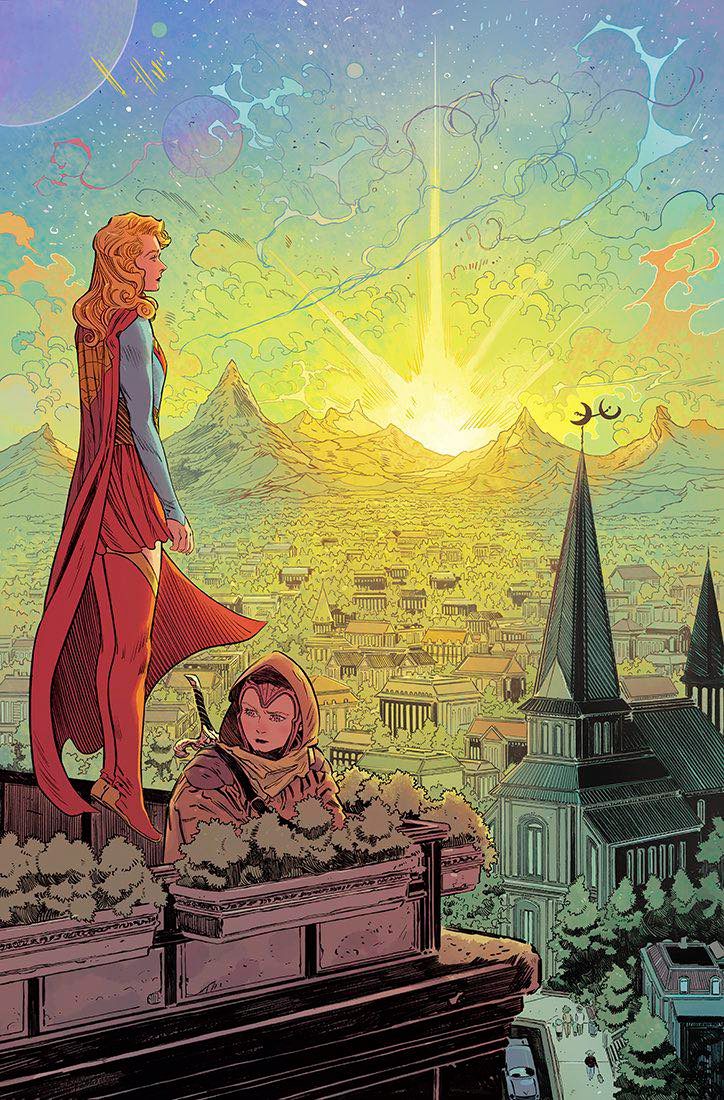
With the 2022 publication Supergirl: Woman of Tomorrow, writer Tom King (Mr. Miracle, Human Target, Sheriff of Babylon) and artist Bilquis Evely (The Dreaming, Doc Savage, Wonder Woman) provide one of the more successful attempts to define the character not in relation to her cousin, but on her own terms. This story looks at what it means for someone to lose their family, their homeland and their culture as a teenager, and focuses on how she constructs meaning for herself.

It is probably the most compelling Supergirl story yet published.

Over the past 30 years, almost every major superhero has been deconstructed. Grim-and-gritty reboots, meta-commentary on comic books, and reframing of existing story arcs have been done often enough in superhero stories that postmodern comic book work has begun to look tired. What elevates Tom King’s work is that he tends to focus on the ‘hero’ more so than the ‘super.’ This is recontextualization, but not deconstruction. It’s examining the characters through a constructive lens. This can be seen in how he’s evolved Kite Man as a character, how he’s explored Batman’s marriage, and peered into Scott Free’s psychology. And now, how he’s focused on what motivates Supergirl.

Tom King's work has previously inspired the hit
TV show Wandavision on Disney+.
(Image via Entertainment Weekly)

King’s work is probably familiar to many of those who follow the Hugo Awards, as he’s a two-time finalist, with The Vision: Little Worse Than A Man earning a nod in 2017, and Strange Adventures appearing on the ballot last year. He’s won the Best Writer Eisner Award twice.

Woman of Tomorrow is told from the perspective of Ruthye — a young orphan on an alien world — who is seeking revenge for the murder of her father by a bounty hunter named Krem. In her quest for vengeance, Ruthye gets in trouble and must be rescued by Supergirl. Because she has never heard of Supergirl (or Superman) before, Ruthye provides readers a fresh perspective of the Kryptonian, essentially seeing her through new eyes.

Over the subsequent eight issues of the comic series, the duo track Krem across planets and star systems, deal with space pirates, and have adventures on interstellar public transit.

Supergirl takes time to help one of Krem’s victims dig graves for everyone he’s known, provides a therapy session to a grieving mother, and uncovers a genocide. Each of these adventures is a delay from her mission but is necessitated by a code of honour that compelled her to start the mission with Ruthye in the first place.

Krem proves to be an adept adversary. He figures out Supergirl’s vulnerabilities and strips her of her powers. This gives us a chance to see Ruthye’s own strength as she defends the titular heroine and faces her own trials, largely unaided.

These aren’t stories about saving the universe, defeating galactic tyrants, or challenges with world-shattering consequences. But the fact that the stakes are more personal shows what matters to Supergirl, and the human scale of the story makes it highly engaging.
Taverns, swords, heroic
fantasy-style adventures.
(Image via DC.com)

On a technical level, this is a superhero comic book, but the writing takes much of its inspiration from heroic fantasy. This is a story about a sword-wielding hero and sidekick traveling across distant landscapes on a quest and getting pulled into side adventures. Given that it takes cues from the heroic fantasy work of Fritz Leiber, Woman of Tomorrow seems like something that would appeal to many Worldcon attendees.

This heroic fantasy influence is accentuated by the expressive artwork of Bilquis Evely and the talented colouring by Matheus Lopes, which bring the series to life. Evoking the best of Barry Windsor Smith’s sword and sorcery work for Epic Comics, Evely’s style is both detailed and energetic. The colouring provides a perfect counterpoint to the linework, transitioning from muted tones for more sombre scenes, to vivid and engaging palettes for the wild space adventures. The work is lush, inviting, and perfectly suits the tone of the writing.

In 2023, Warner Brothers announced their upcoming slate of movies based on DC comic books, and named Woman of Tomorrow as the direct inspiration for their next Supergirl movie. Although we cannot figure out how they might translate the visual poetry of Evely’s work, they couldn’t have chosen a better comic to adapt. Supergirl deserves to be more than a gender-flipped Superman, including on the big screen.

We’d love to see this earn a Hugo nomination.

Sunday, 12 April 2020

The Phoenix Farce

Jean Luc Picard didn’t have the decency to wait the traditional three days before rising up out of the grave.

The quick-and-easy revival of the Enterprise captain is emblematic of a trend in pop culture — particularly in science fiction and fantasy — in which all-too-many significant characters are “killed off” one moment and then resurrected the next.

It’s a lazy writing technique that undermines dramatic tension, cheapens character moments, and
Fun fact, if you start playing the song
“Back to Life” by Soul 2 Soul
when Picard dies, he will be resurrected
before the song ends. We timed it.
(Image via StarTrek.com)  
impoverishes the emotional experience of narratives. For us, it was one of the biggest disappointments in an otherwise pretty decent season of Star Trek.

Picard is dead for fewer than three and a half minutes of screen time. He literally spends more time saying that he will lay down his life for a cause than he spends being dead. Why should viewers get emotionally invested in Picard putting his life on the line when his life costs him nothing?

Although the finale of Star Trek: Picard’s first season provides a case example of this trend, we’d like to be clear that his pointless death and meaningless resurrection is by far not the most underwhelming. Even within the past few years of Star Trek, we’d note Dr. Hugh Culber’s resurrection in Star Trek: Discovery, and Kirk’s resurrection in Star Trek: Into Darkness.

This latter example offers an interesting comparison between resurrections of fictional characters, and what makes some more egregious than others. Into Darkness is a soft remake of The Wrath of Khan, and follows many of the same character moments: a reactor overloading, and a beloved protagonist sacrificing themselves for the greater good. In the case of The Wrath of Khan, it’s Spock who gives his life for the greater good, while in Into Darkness, it’s James Kirk. In both cases, the character who dies gets a prolonged death scene, and an emotional farewell. The narrative asks audiences to grieve for the character’s demise.

But post-mortem, these stories diverge. Within the same movie, after just a few minutes of grieving,
Somehow, while The Wrath of Khan
is considered one of the great Star Trek
movies, Into Darkness is often regarded
as one of the lesser ones.
(Screen capture via Youtube)
Kirk is injected with ‘super blood,’ and is healed almost instantaneously. He’s back on his feet and able to go toe to toe with Khan. End of story.

Compare this with what happened in the earlier movie — Spock stays dead. And when (years later) he’s brought back to life, it’s only through adversity and sacrifice that his friends manage to revive him. When Spock is resurrected, he continues to suffer adverse effects of the trauma. In essence, Spock’s sacrifice is a sacrifice because he actually gave something up.

This is not to suggest that Spock’s resurrection in The Search For Spock is good, but rather that it is a less anemic use of a resurrection plot device than Kirk’s. The ‘Genesis Planet’ may be no less risible a contrivance than ‘Super Blood,’ but the amount of effort and turmoil caused by Spock’s death means that his sacrifice has narrative weight.

In essence, the differences between the two stories highlight the fact that that death without consequence is empty.

This phenomenon is not limited to Star Trek. In movies and television, Spider-Man, Superman, Buffy the Vampire Slayer, Babylon 5 captain John Sherridan, Ellen Ripley, Agent Phil Coulson, and Harry Potter have all died and come back to life with essentially little consequence.

It gets absurd when you consider that X-Men comic book mainstay Jean Grey has been killed and resurrected numerous occasions; two "official" deaths, three more fake-out deaths …

Why bother with killing off a character if their rebirth is expected by audiences? In part we suspect that characters are killed off in order to imbue a story with meaning — and we naturally associate death as a serious and consequential event in the narratives of our lives. But the significance of death is not in the event itself, but rather in the consequences.

The Death of Superman is a good case study of how resurrection stories often fall flat. Retailers assumed Superman's resurrection would be as big or bigger than his death and over-ordered copies of Adventures of Superman #500, the much-hyped issue in which he returned. To this day the issue in which he dies sells for about $20, but the issue with his resurrection is in the quarter bin of most comic stores.

Death sells, but resurrection doesn't. There is drama in death, after all, everyone without exception has to experience it eventually. But (Easter Sunday and generations of its normative cultural expectations aside) resurrection is not something we empathize with. The experience is alien to us.

Abhay Khosla once observed that in recent years the big superhero crossover had become a pagan ritual where a super hero’s life is given up as a blood sacrifice in the hopes their death will bring prosperity to the comics. It’s like Shirley Jackon’s ‘The Lottery’, except you can often predict who will have the ticket by analyzing sales data trends.

Viewers rarely want to say farewell to a beloved character, and rights holders never want to release a
Did any of us really expect Spider-Man:
Far From Home
to be set in Hades?
(Image via Twitter)  
profitable intellectual asset. Excessively long copyright terms on pop culture icons and the hegemony of franchise culture leads to strong incentives for the corporations that control the rights to these characters to ensure that stories about those characters are in perpetual production.

Spider-Man was never going to stay dead — in fact, even when he “dies” on-screen in Avengers: Infinity War, studios had already announced the movie Spider-Man: Far From Home. For moviemakers to expect his demise to resonate is manipulative, cynical, and insulting to audiences. They expect us to grieve for a character we know isn’t actually gone.

The superficial treatment of death means that our heroes live in a consequence-free environment.

This trend is so pervasive that when fan-favourite protagonist Ned Stark dies in the first season of Game of Thrones (and the book on which the show is based), his death is shocking in its finality. While later seasons may have undermined this consequence-rich storytelling, the show stands out for having the guts to let the dead stay dead.

Stories resonate most when they reflect and engage with human emotional states, including grief. When death is meaningless, and resurrection is easy, these stories become little more than shallow wish-fulfillment fantasies.

Thursday, 25 May 2017

The Hugo For Best Graphic Story (Part 1)

This is part one of a two-part blog post. The second part, discussing this year's nominees, is found here. 

This trophy is fine, but a
rocket ship is just classier.
(Image via willeisner.com)
Best Graphic Story is one of the newest categories for the Hugo Awards, and unfortunately, it’s the one that has always felt like it doesn’t fit in with the rest of the awards.

Because two well-established comic book awards (the Eisners and Harveys) exist —and because they often celebrate the quasi-SciFi of superhero stories — the Hugo for Best Graphic Story doesn’t seem to carry as much weight as the other Hugo awards. 

The award can seem redundant, especially when the Hugos recognize a superhero comic book. 

Some worthwhile works have been honoured in the first decade of the award, but a look over the shortlists from 2009-2016 reveals a lot of fandom’s in-jokes, media tie-ins, and works created by people we know within the Worldcon community. 

In short, the Best Graphic Story category has been treated in part like a fan writer category and in part like a professional category. That hasn’t been fair to either group. 

Missed opportunities


Ironically, the inferior movie
adaptation "Edge of Tomorrow"
did get a Hugo nomination. 
Because of this profusion of questionable nominees, some significant works of fantasy and science fiction went unrecognized in the first several years of the Best Graphic Story Hugo. Walt Simonson’s Ragnarok (2014), All You Need Is Kill by Hoski Sakurazaka (2015) and Beasts Of Burden by Evan Dorkin (2009) all spring to mind. 
  
One solution to this conundrum would be to split the award into a fan-created category and a professional category. But this might not solve the more fundamental problems caused by the comic book industry’s overreliance on superhero tropes.

We have to recognize that the superhero genre is a weird niche in science fiction, whose traditions and themes do not hew to many of the same ideas that inform the rest of the genre. Superheros can be classified as science fiction, but that does a disservice to both creative traditions — Kal-El and Bruce Wayne have little in common with Paul Atreides, Hari Seldon, Frodo Baggins, or Valentine Michael Smith.

XKCD is awesome. It richly
 deserves the Hugo it received.
(Image via XKCD.com) 

Be conscious of our mandate


As such, when nominating works in the Best Graphic Story category of the Hugos, Worldcon members should consider whether something is a great comic book with fantastical elements, or whether it is a great work of science fiction or fantasy that happens to be a comic book. The former type of work is probably best left to the Eisner and Harvey awards.


If there is to be a Hugo for Best Graphic Story, we as Hugo voters must continue to be deliberately conscious of what our mandate is, what the purpose of the award is, and why this award is relevant.