Showing posts with label Fantasy. Show all posts

Thursday, 11 July 2024

The Path Of Peace

Image via Goodreads
Given the timelines involved in publishing a novel, there was no way to predict that The Siege of Burning Grass would hit bookshelves at a time when the tensions it explores are playing out on North American campuses.

But Premee Mohamed’s philosophical and nuanced new book, which explores ideas of pacifism and to what degree citizens are responsible for the actions of their governments, is a novel that fits the zeitgeist. It is the right novel to read while contemplating the courage it takes for those with no political authority to speak out against state-sanctioned violence.

“I've said in more than one of my books that if you claim you’re not picking a side, you’ve just picked one: the side of the oppressor,” Mohamed says. “Those students are acting more nobly than anyone I can think of right now.”

The novel follows conscientious objector Aelfret, who has been imprisoned for refusing to take part in a war between his country of Varkal and the Empire of Med’ariz. After years of brutal treatment at the hands of his captors, he’s dragooned into an underhanded scheme to bring an end to the conflict. Having lost a leg during his capture, he’s confined to crutches and accompanied by wasps that tend to his wounds.

Along with a captor-soldier named Qhudur, Aelfret embarks on a journey across battlefields and conquered provinces to reach enemy territory on a secret mission. Throughout, Aelfret’s avowed pacifism is challenged and Qhudur is forced to confront the limits of his war-mongering ideology.

“I think it’s inevitable that no philosophy of any kind has ever had a completely ‘pure’ implementation of its ideals,” Mohamed says. “People are complicated, history is complicated, the physical world complicates things.”

This is Mohamed’s best book on almost every level. Her prose is elevated by subtle rhetorical twists, the world is engaging and distinctive, and Aelfret is likely her most memorable protagonist. While the crippled pacifist’s doubts, epistemological angst, and constant questioning of his own motivations can be occasionally frustrating, it also makes him relatable, believable, and an interesting foil to Qhudur, whose narrow worldview and military training have produced in him an implacable certitude.

“I didn't start off wanting to write a story about pacifism per se,” Mohamed explains. “I wanted to show Alefret (the main character) as someone still learning, still at the start of his educational arc, about pacifism, nonviolence, militarism, and his own relationship to those things based on his personality and history. If he had not been who he was, he would have been a very different pacifist.”

A government policy specialist with degrees in molecular biology and environmental sciences, Mohamed has become well-known as the author of science fiction and fantasy able to weave themes based on ecological challenges into her stories. The Siege of Burning Grass has some of these themes, but the book also revels in weirdness. This is a world in which war is fought with assault Pteranodons, talking birds are used as spies, and in which nurse wasps rend flesh in service of medical experiments.

In some ways, the book could be read as the exact mirror image of Starship Troopers. While many authors have written thinly veiled rebuttals of the controversial classic, they’ve usually been playing in the sandbox that Heinlein built; The Forever War, Old Man’s War, Ender’s Game may all critique Starship Troopers … but they’re still playing with the same toys. Mohamed has rejected the entire paradigm, and consequently is able to tackle the same subjects without being bound by the assumptions that underlie most military SFF. It’s worth remembering that Starship Troopers arrived at a time when Americans were just beginning to grapple with their country’s increasing military involvement in Vietnam, and many of the novels engaging with Heinlein’s classic were informed by campus protests.

The Siege of Burning Grass is a novel that matches its moment, and should inspire discussion, debate, and reflection about the moral responsibilities of citizens. Very few novels this ambitious succeed as fully. This book deserves your consideration for every award for which it is eligible.

Monday, 20 March 2023

Kara Zor-El Unbound

The second-most famous
Kryptonian, Kara Zor-El
finally gets the attention
she deserves in
Woman of Tomorrow.
(Image via DC.com)

Created in 1959 as a female version of the most popular character in comic books, the paradox of Supergirl as a character is that although she is instantly recognizable to broad swaths of the public, there is often little understanding of what differentiates the character from her more famous cousin, Superman.

Sadly, too many writers treat Supergirl as if she were just a gender-flipped Superman.

Like Superman, she was born on the doomed planet of Krypton. And like him, she is mostly invulnerable, has super strength, has various enhanced senses, can shoot lasers from her eyes, and flies around the planet saving people in distress.

Kara Zor-El grew up in the domed city of Argo. This city escaped the destruction of Krypton, and after several years Kara was sent to Earth to find her cousin Kal El (Superman), who had been sent there as a baby. There, she took up the mantle of Supergirl, and fought alongside Superman on various adventures.

Over the decades, writers have grappled with the conundrum of how to make the character interesting; varying her origin story, altering what her superpowers are, and occasionally removing the character from the shared comic book universe altogether.

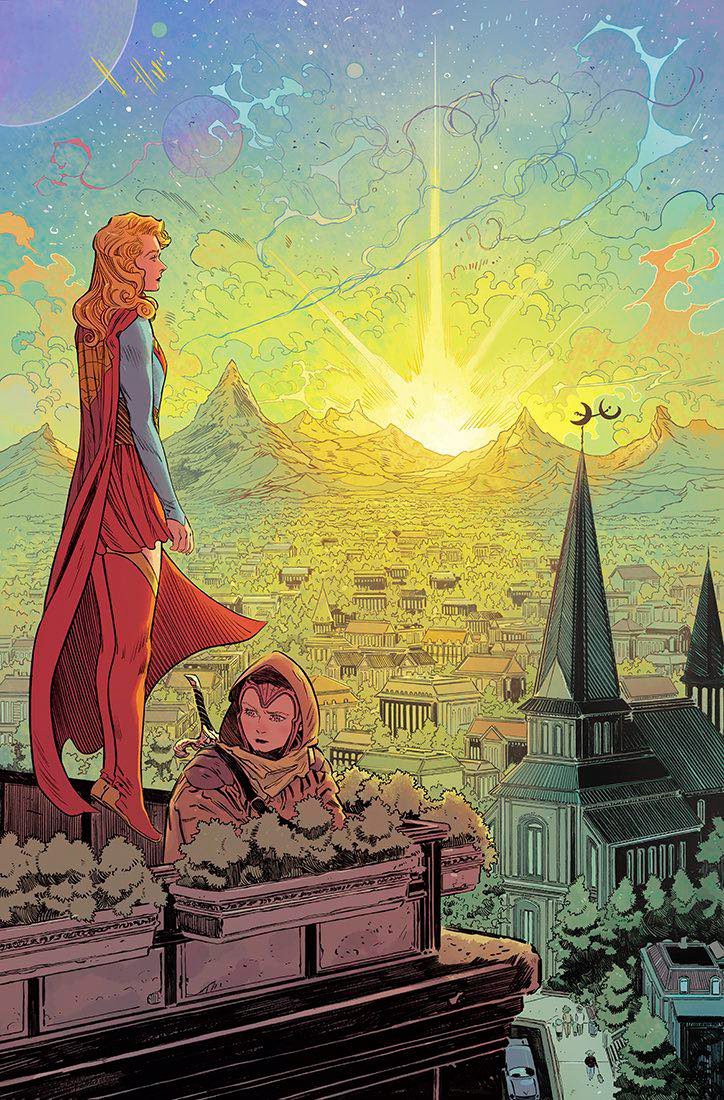
With the 2022 publication Supergirl: Woman of Tomorrow, writer Tom King (Mr. Miracle, Human Target, Sheriff of Babylon) and artist Bilquis Evely (The Dreaming, Doc Savage, Wonder Woman) provide one of the more successful attempts to define the character not in relation to her cousin, but on her own terms. This story looks at what it means for someone to lose their family, their homeland and their culture as a teenager, and focuses on how she constructs meaning for herself.

It is probably the most compelling Supergirl story yet published.

Over the past 30 years, almost every major superhero has been deconstructed. Grim-and-gritty reboots, meta-commentary on comic books, and reframing of existing story arcs have been done often enough in superhero stories that postmodern comic book work has begun to look tired. What elevates Tom King’s work is that he tends to focus on the ‘hero’ more so than the ‘super.’ This is recontextualization, but not deconstruction. It’s examining the characters through a constructive lens. This can be seen in how he’s evolved Kite Man as a character, how he’s explored Batman’s marriage, and peered into Scott Free’s psychology. And now, how he’s focused on what motivates Supergirl.

Tom King's work has previously inspired the hit
TV show Wandavision on Disney+.
(Image via Entertainment Weekly)

King’s work is probably familiar to many of those who follow the Hugo Awards, as he’s a two-time finalist, with The Vision: Little Worse Than A Man earning a nod in 2017, and Strange Adventures appearing on the ballot last year. He’s won the Best Writer Eisner Award twice.

Woman of Tomorrow is told from the perspective of Ruthye — a young orphan on an alien world — who is seeking revenge for the murder of her father by a bounty hunter named Krem. In her quest for vengeance, Ruthye gets in trouble and must be rescued by Supergirl. Because she has never heard of Supergirl (or Superman) before, Ruthye provides readers a fresh perspective of the Kryptonian, essentially seeing her through new eyes.

Over the subsequent eight issues of the comic series, the duo track Krem across planets and star systems, deal with space pirates, and have adventures on interstellar public transit.

Supergirl takes time to help one of Krem’s victims dig graves for everyone he’s known, provides a therapy session to a grieving mother, and uncovers a genocide. Each of these adventures is a delay from her mission but is necessitated by a code of honour that compelled her to start the mission with Ruthye in the first place.

Krem proves to be an adept adversary. He figures out Supergirl’s vulnerabilities and strips her of her powers. This gives us a chance to see Ruthye’s own strength as she defends the titular heroine and faces her own trials, largely unaided.

These aren’t stories about saving the universe, defeating galactic tyrants, or challenges with world-shattering consequences. But the fact that the stakes are more personal shows what matters to Supergirl, and the human scale of the story makes it highly engaging.
Taverns, swords, heroic
fantasy-style adventures.
(Image via DC.com)

On a technical level, this is a superhero comic book, but the writing takes much of its inspiration from heroic fantasy. This is a story about a sword-wielding hero and sidekick traveling across distant landscapes on a quest and getting pulled into side adventures. Given that it takes cues from the heroic fantasy work of Fritz Leiber, Woman of Tomorrow seems like something that would appeal to many Worldcon attendees.

This heroic fantasy influence is accentuated by the expressive artwork of Bilquis Evely and the talented colouring by Matheus Lopes, which bring the series to life. Evoking the best of Barry Windsor Smith’s sword and sorcery work for Epic Comics, Evely’s style is both detailed and energetic. The colouring provides a perfect counterpoint to the linework, transitioning from muted tones for more sombre scenes, to vivid and engaging palettes for the wild space adventures. The work is lush, inviting, and perfectly suits the tone of the writing.

In 2023, Warner Brothers announced their upcoming slate of movies based on DC comic books, and named Woman of Tomorrow as the direct inspiration for their next Supergirl movie. Although we cannot figure out how they might translate the visual poetry of Evely’s work, they couldn’t have chosen a better comic to adapt. Supergirl deserves to be more than a gender-flipped Superman, including on the big screen.

We’d love to see this earn a Hugo nomination.

Monday, 8 August 2022

Hat on a Hat

One of the first things that an aspiring improv comedian will learn is this: Never put a hat on a hat.

Basically, what this means is that when you have a strong premise, it’s usually inadvisable to distract it by layering a different premise overtop of it. To put it another way, cognitive dissonance caused by disharmonious conceptual work will distract from strong material. Point is, if you have one hat … why do you need another hat on top of it?
This is an extremely well written
book filled with great ideas.
It’s unsurprising that Ryka’s other
works have been recognized
by the Lambda Literary Awards.
(Image via Goodreads)


Despite being an exceptionally well written novel filled with likable characters, and some very interesting ideas, Light From Uncommon Stars suffers from hat-on-a-hattedness. And this may prevent it from being at the top of our Hugo ballots. It’s a novel composed of at least two fundamentally separate narratives, and those stories might have been better served by being split into separate works.

The main story arc follows Katrina, a gifted but untrained violinist, whose talent blossoms after being spotted by Shizuka Satomi, a superstar violin teacher. Saddled with a surprisingly apt nickname ‘the Queen of Hell,’ Satomi needs to claim a human soul to free herself from a deal with the devil. Taking the young violinist as a student, Satomi offers a safe harbour from an adolescence marked by horrible abuse and neglect. Twinning musical and personal growth, Katrina eventually finds her feet at an open air concert, bringing the audience to tears with a classical piece (despite her passion for videogame music). The consummate entertainer, she adapts to meet her audience with a confidence that comes from self-actualization.

The anticipation builds as the reader is left wondering when, and how, Shizuka will be remunerated for her tutelage. Will she turn Katrina over to the demon Tremon, as traditional narrative would demand, or can a different future be negotiated? As a purely fantastical tale, Light From Uncommon Stars is well written and engaging, and gives us a main character that is easy to care about and root for. It’s strengthened further by deeply researched backstories about the emotional weight of violin production and ancestral gender roles that have disadvantaged women around the globe.

Recent documentary
Donut King provided
context that helped us
enjoy the book more.
(Image via IMDB)
On its own — with no aliens or spaceships — this would have been enough. But woven into this tale is another story about entrepreneurial aliens who have to learn the hard way that their food replicators are no match for an earthling palette. On its own, this is a satisfying science fiction story filled with alien tech toys: projectors that levitate their subjects, phones that scramble English into Vietnamese, AI that can substitute offspring, and weaponry that disintegrates humans and/or their memories. And this is all packed into a completely delightful narrative concept that could easily have sustained a whole novel. Instead, it left us wanting more. 

The novel could have stood on the rock solid foundation of a beautiful girl finding her place in the world, through the mastery of musical expression and the support of a found family.

While this profusion of distractions from the main story are in most cases entertaining, on their own, our group felt they could sometimes feel like clouds that blocked the light from the star.

We wanted more Katrina.


Monday, 27 June 2022

Clark's inDjinnious worldbuilding

With his first novel, Master of Djinn, P. Djèlí Clark returns to the alternate magical Egypt that he previously explored in works such as his Hugo-finalist novella The Haunting of Tram Car 015.
The UK edition of Master of Djinn sports
a cover that is as epic as the contents. 
The designer Matthew Burne deserves kudos.
(Image via Little Brown Book Group)


Set decades after magic was returned to the world by 19th-Century wizard al-Jahiz, these stories follow detectives who are tasked with solving supernatural mysteries.

This time, protagonist Fatma el-Sha’arawi is tasked with solving the murder of an important foreign dignitary, Lord Worthington, and the possible return of al-Jahiz himself.

What elevates the work is Clark’s use of the premise for confident explorations of colonialism, racism, and sexism. One member of our book club flippantly described Master of Djinn as being “from an alternate history where The Dresden Files bothers to say something interesting.”

Alternate history often doesn’t have a deep enough toolbox with which to examine and challenge historical power structures. Colonialism, patriarchy, and structural racism are so ingrained in the cause-and-effect patterns of real-world history that it’s difficult to find plausible allohistorical points of divergence in which these forces are subverted. In short, it would take magic of the sort that enriches Master of Djinn to tackle these entrenched forces and their myriad complexities.

The fantastical elements of Clark’s Egypt are imbued with a deep sense of history. While this book isn’t precisely an alternate history (as many purists of that genre will argue that any story that involves magic cannot be alternate history), Master of Djinn’s worldbuilding is complex enough for the reader to feel that there is a real past and a real future to this society.

In fact, this living, breathing history might be the most engaging character in the book. It’s a world full of sky trams, clockwork angels, and jazz clubs. Clark has skillfully woven worldbuilding details into the narrative that made it seem effortless and natural. It helped, of course, to have a character smitten with history and dedicated to sharing that knowledge.

An interesting parallel could be drawn between Master of Djinn and Rockne S. O’Bannon’s Hugo-shortlisted dramatic presentation Alien Nation. These are stories that deal with police investigating mysteries in a society that is adapting to the arrival of alien beings. In both cases, there are strong elements of social criticism and the use of non-humans as a metaphor for cultural barriers.
P. Djèlí Clark — also known as Dr. Dexter Gabriel
— holds a PhD in history and teaches at the University
of Connecticut. This education is evident in the 
richly layered history that he crafts in Master of Djinn.
(Photo by Peter Morenus via UConn Magazine)


While the central mystery of the book, and most of the characters, are mostly enjoyable they are also largely unremarkable. For some readers, the relentless description of the flawlessness, stylishness, and incredible competence of the protagonist became tiresome. Likewise, Fatma’s much-trumpeted skill as a detective is undermined by how selectively observant she was, and how much of the plot depended on her missing obvious clues. Those who are seeking an engaging mystery may be disappointed, for the reasons above and also because this is not a page-turner typical of that genre.

It did seem odd that the novel was peppered with so many references to the previous stories set in the same world. Those who had not read the preceding works were left feeling that there was something missing.

But for many in the book club, these quibbles are overshadowed by the engaging motivations of those who committed the crime, the well-thought out tensions in the world’s international politics, and the skillful interrogation of power dynamics. Digressions into a possible alliance between the Kaiser and Ottoman Empire, and speculation about what Lord Worthington may have been up to before his demise are all quite interesting.

A Master of Djinn is a strong Hugo finalist that may be near the top of some of our ballots.

Tuesday, 5 April 2022

Monstrously Wealthy

It is impossible to be monstrously wealthy without being truly monstrous.
For tyrants they are both,
even flat against their oath
To grant us they are loathe
 free meat and drink and cloth
Stand up now diggers all.

(Image via Goodreads.) 


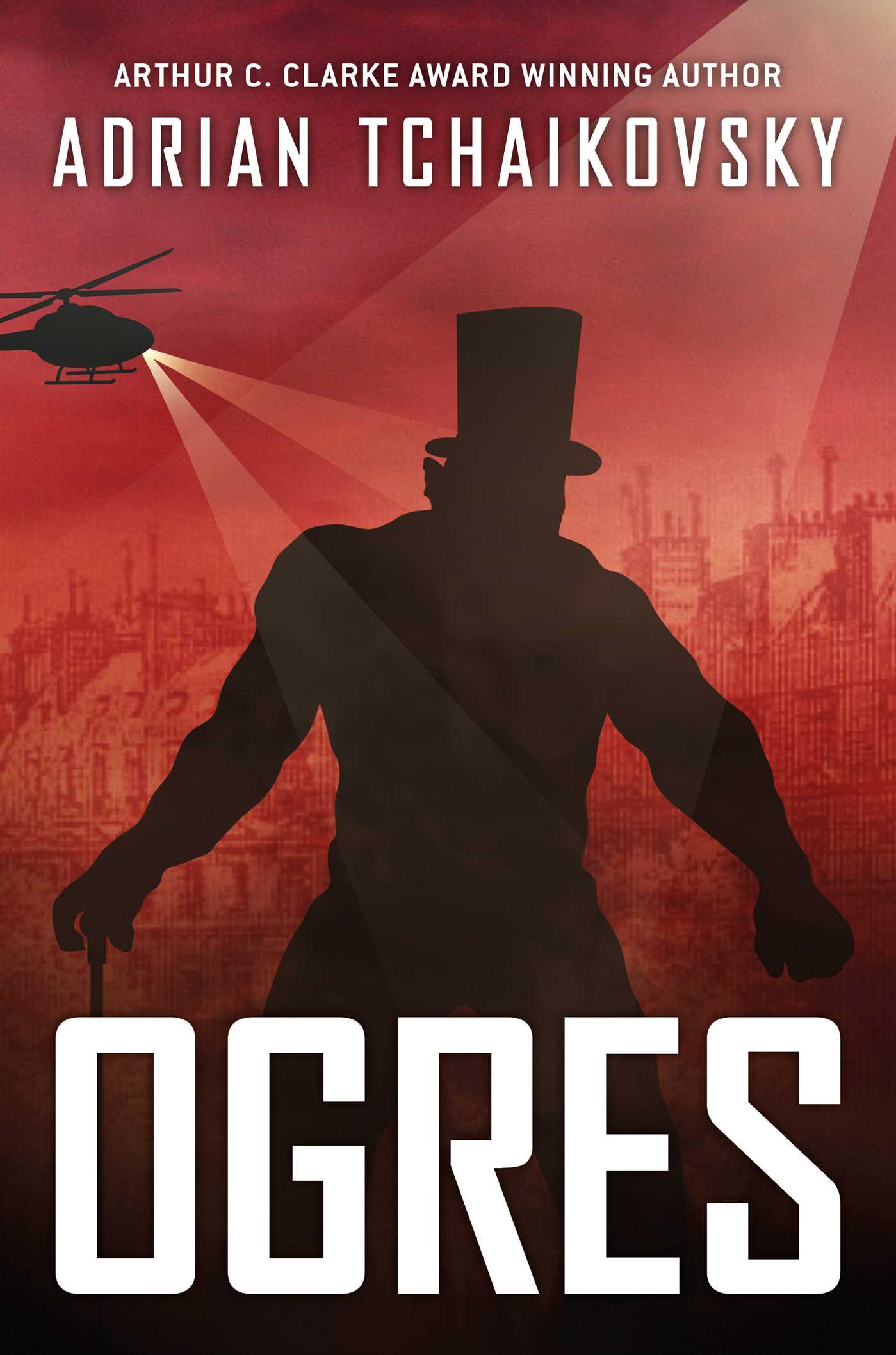
This is the core theme of Adrian Tchaikovsky’s latest novella Ogres, a fast-paced and clever little book about a world where the titular 10-foot-tall monsters extract rent from proletarian humans.

Told in the second-person, the story follows Torquell, the son of a rural village headsman, whose life gets turned upside down after he makes the mistake of having an altercation with the son of the Ogre noble who oversees his village, and is forced to flee into the wider world. Through Torquell’s eyes, readers are taken on a tour of this society, seeing factory towns, exploited military regiments, and Ogre high society.

Nuanced, iterative worldbuilding reveals a complex set of social relations, despite an initially obvious – and blunt – metaphor about inequality.

Ogres may be one of the most overtly leftist pieces of mainstream SFF published in the past 50 years; it is clearly informed by Enclosure Acts-era British rent seeking, by Dickensian living conditions, by The Sound Of His Horn, and by Marxist theory. This is not Marxist in the pop-culture understanding of the word, but informed by the academic intellectual framework.

This theoretical underpinning is evident in the ways societal structures reinforce the Ogres’ control, and maintain economic disparity. The use of religion as a tool for maintaining the compliance of economically disadvantaged people is particularly striking. Likewise, the way that “economic” is used as a pejorative by the Ogres highlights the philosophical stance of the book, as well as how the Ogres think about humans.

By the end, it is clear that what makes the Ogres monstrous isn’t their enormous size or their strength, but rather their wealth. Those who attain such heights of power and privilege are monstrous, no matter what their shape or size.

At times, the second-person point-of-view narration can come across as a bit precious. It is certainly not the standard perspective for most fiction, and this may present an impediment for some readers. But once the story gets going, this quirk of prose style becomes less and less obtrusive, and by the book’s conclusion it is evident why the second-person voice was necessary.
Tchaikovsky's Ogres
may be his most 
political work yet, and
is among his best.
(Image via Pan MacMillan)

While this isn’t the easily accessible prose that Tchaikovsky’s fans have come to expect, it is just as rich as his other works. For example, the book is filled with some excellent turns of phrase such as a line in which someone is described as “used to weighing others by the amount of world they displace.”

At the risk of offering a relatively mild spoiler, the second-person perspective pays off in the last 10 pages in a note-perfect and unexpected recontextualization of the entire narrative. Portions of the denouement that seemed improbable or overly convenient were put in sharp focus — and improved — by this conclusion. It was the sort of ending that may prompt re-reads of the work for those who want to find all the little clues throughout. If we had our way, it would be included in a creative writing curriculum.

Over the course of several of his most recent novellas (Elder Race, Expert Champion, Ogres), Tchaikovsky has explored various iterations of Clark’s Law. In Ogres, he goes one further and shows that while sufficiently advanced technology may be indistinguishable from magic, sufficiently advanced inequality is indistinguishable from grimdark fiction.

Science fiction and fantasy are at their best when something real is reflected through unreal worlds. The monstrous nature of Ogres is effective because it is so real.

Tuesday, 16 March 2021

Witches Of The World Unite!

Themes of women’s liberty, worker solidarity and resistance to capitalism are all addressed in The
(Image via Goodreads)

Factory Witches of Lowell, a lovely novella by C.S. Malerich about a 19th-Century cotton workers union.

The story follows union organizer Judith and her witch coworker Hannah as they organize the women factory workers into a labour union to oppose Mr. Boott, the agent of the capitalists back in Boston.

Hannah casts a spell with the cooperation of the other factory girls that will enforce solidarity among the workers. None of them can break the strike without the cooperation of all the workers. Solidarity being perhaps the most useful tool among the working class, this is very powerful magic indeed.

Of particular note is how magic in The Factory Witches is inherently tied to a capitalist worldview, as it is impossible to cast a spell without ownership of the spell components. This draws into question the very nature of ownership over intellectual property and its theft.

Mr. Boott, as an agent of wealthier men back in the city, is doing all he can to ensure the highest profits for his principals. He raises the cost of rent, threatens lower wages and longer hours. He squeezes the workers to ensure profit stays where it belongs, with the wealthy owners. He is the clear villain as he attempts to break the strike by the factory girls. He plays this role well and is a thoroughly unlikeable character.

Overall, the story is one with a good message and a strong narrative. At a scant 80 pages, it moves along quickly and provides a hurried resolution. While many SFF stories can feel long, this novella’s weakness is that it might be too short. This results in underemphasizing the factory workers’ struggle, and failing to depict the efforts that capitalists were, and still are, willing to make to break a strike and the power of unions.

It’s easy to enthusiastically recommend this story when wanting more is our biggest quibble. We look forward to reading more work by C.S. Malerich.

Thursday, 28 January 2021

The Architecture of Identity

It is difficult to overstate the yearning many fans have felt for Susanna Clarke’s follow-up to Jonathan
The long-awaited second novel
from Susana Clarke: Piranesi.
(Image via Bloomsbury UK)

Strange and Mr. Norrell
.

Younger fans may not grok the fanfare that greeted Clarke’s 2004 debut, but it was a cultural phenomenon; on top of its Hugo Award, the novel earned a Locus Award, a Mythopoeic Award and a World Fantasy Award. Like few other fantasy novels, it was celebrated both by fandom, and by the non-genre community. The New York Times hailed it as a masterwork, Time Magazine named it the best novel of the year, it appeared on the Whitbread Award shortlist. 

Piranesi, therefore labours under a weight of expectations that would be impossible to meet.

This is a very different book than Clarke’s debut, and those simply looking for another Jonathan Strange and Mr. Norrell should consider themselves warned. Instead, this is a slender volume — 250 pages as opposed to Strange and Norrell’s 800 — that provides less action. What it provides instead is a nuanced meditation on the construction of identity and the role of memory, especially as it intersects with social conditioning, the formation of personality, and happiness.

Readers are guided through the story by a journal written by the title character as he navigates an endless series of labyrinthine halls in which there is evidence of only fifteen people having ever lived (only two of whom are living). Piranesi is content with his life, and exalts the House, describing its halls, staircases, waters and particularly its statues in reverential tones. The tale becomes a puzzle as it is revealed that the mysteries of the House and Piranesi’s identity are intertwined.

The House (the word House is always capitalized) is described as an enormous and strange structure that evokes images similar to Jorge Luis Borges’ Library of Babel
The novel's prose effectively evokes
the etchings of its namesake, the
18th century Italian artist Piranesi
.
, or Giovanni Battista Piranesi’s Imaginary Prisons. It is a dangerous place, filled with perils both physical and spiritual, but in the narrator’s eyes the House is not malevolent. The novel is structured as a series of journals that Piranesi keeps to detail his daily life in the House.

Piranesi tells a small-scale story that belies its literary and philosophical depths. Although a short novel, the story takes time to reflect on the nature of knowledge and beauty. The story’s end is tidy — feeling like the beginning of a grand adventure we are unlikely to ever see explored — and doesn’t provide much closure to the more meditative aspects of the novel.

Our book club found itself divided, there were members who unreservedly adored Piranesi, others who enjoyed it (with reservations), and some who found themselves regrettably disappointed.

Most of our members were thoroughly charmed by the titular character’s curiosity and optimism. However, at least two members of the book club found Piranesi’s narrative voice grating, and argued that Susanna Clarke’s most impressive literary achievement with Piranesi was to make a novel that’s one third the length of Jonathan Strange and Mr. Norrell three times as interminable. More than one member found the narrative voice and reflective writing to be the novel’s greatest strength, which demonstrates Clarke’s flexibility as a writer.

Some of our discussion group struggled with the novel’s strangeness (and fondness for Grandiose Capitalization) in the early pages, and a few never connected with the story. This isn’t a book for everyone, but one that provoked strong opinions — mostly positive — and prompted spirited discussion and deep-dive analysis.

Those looking for a puzzle, for poetry, and for philosophy, may find themselves pleasantly ensorcelled by the cyclopean halls of The House.

Friday, 24 April 2020

The Edges Of A Genre

When Arthur C. Clarke observed that “any sufficiently advanced technology is indistinguishable from magic,” he highlighted a fundamental malaise of science fiction as a genre. This is a discomfort with which the fandom community continues to grapple.

There is a continuum between utterly mimetic and purely fantastical fiction; the difference between
(Image via Wikipedia)
Truman Capote’s In Cold Blood, and J.R.R. Tolkein’s Lord of the Rings is only a matter of degrees. The angst of science fiction is that it lies in a liminal area between that which reflects the real world and that which eschews reality.

There is clearly no “hard line” between what is science fiction and what is fantasy, a fact that Norman Spinrad inartfully grappled with in a now-notorious column in Asimov’s magazine last November.

Genre-based awards are, by definition, bound by an accepted understanding of the genre itself. For the science fiction community, and the Hugo Awards in particular, the existential anxiety of defining these boundaries continues to be both a strength and a weakness.

These days, the Hugo Award is an award for any form of speculative fiction, be it fantasy, science fiction, alternate history or other sub-genre work. In many ways, this inclusive, adaptive approach is a strength. But it does mean that none of the top-five most prestigious literary awards focus squarely on science fiction as a genre.

Fantasy has the World Fantasy Award (WFA), and horror has the Bram Stoker Award — neither of which recognize works of science fiction (beyond the occasional genre-blurring piece). The Arthur C. Clarke Award is more strict about genre delineations, but it is UK-based, and doesn’t have as high a profile as the WFA or the Locus Award. Both Hugos and Nebulas are about as likely to go to a work
Norman Spinrad may
have expressed himself
inelegantly recently.
(Image via Wordbasket)
of science fiction as they are a work of fantasy.

Those who criticize the Hugo Awards for recognizing fantasy works may in part be reacting to the absence of a “pure” science fiction award. However, it is possible for those who yearn for a more narrowly-defined award for science fiction to do so positively.

It’s worth digging into why the World Science Fiction Society (WSFS) at the World Science Fiction Convention gives an award formerly known as the “Science Fiction Achievement Awards,” but does not restrict the award to science fiction in the same way the World Fantasy Convention’s World Fantasy Award is restricted to works of fantasy (try saying that sentence ten times fast). Part of the explanation of this oddity may be found in the history of the Hugo Award.

In the 1953 Worldcon Progress Report #3, Will Jenkins writes:
  • “At the 11th World Science Fiction in Philadelphia on Labour Day weekend, a new tradition will be established, with the formal awarding of the First Annual Science Fiction Achievement Awards to those writers, editors, artists, and fans whom the members of the convention feel have distinguished themselves during the past year. This is the first time in the history of Science Fiction that such awards have been made to include all fields of Science Fiction endeavor.”
By the repetition of the phrase “science fiction” in describing the award and not once mentioning the word “fantasy,” it might be reasonable to assume that the original intent of the organizers was to focus on science fiction. Certainly in what we’ve read of the discussions of award voting that year, there’s no mention of now-classic works of fantasy that would have been eligible, such as C.S. Lewis’ The Voyage of the Dawn Treader. This seems to be an assumption that WSFS rules historian Ben Yalow disagrees with, as he writes on the official Hugo Awards website “The Hugo Award ... has always included works of fantasy.” Our disagreement with Yalow's assertion is more of a nitpick than a substantive argument against it.

We find it amusing to think that there might be proponents of Hugo Award Rules
Antonin Scalia was wrong
about the U.S. constitution …
much like the WSFS constitution,
it's a living document.
(Image via Wikipedia)
originalism; a WSFS equivalent of Antonin Scalia if you would. An examination of the evidence will tell you that the Hugos have accepted works of fantasy for more than six decades.

By the time they awarded the second Science Fiction Achievement Awards, the rules written by Nicholas L. Falasca include a note “While the award carries the connotation that only science fictional material will be considered, we hasten to add that fantasy and weird material can be included.” There’s explicit acknowledgment of fantasy, but the list of winners continues to show a strong bias towards what would generally be classed as science fiction (although the fanzine award that year was given to Fantasy Times).

By 1959, when the term “Hugo” began to be used in official documents to describe the awards, and the phrase “science fiction or fantasy” was used throughout the rules, clarifying that these awards include both.

The first 40 years of the Hugo Award winners show a strong bias towards works that would be classed by most readers as falling on the science fiction side of the SF-F spectrum. By our estimate, the first work of pure fantasy to win — or even be shortlisted for — a Hugo Award for fiction was in 1959 with the short story “That Hell-Bound Train” by Robert Bloch.

However in recent years, works that would likely be described as fantasy have become more common. This is particularly evident in the short story category where in 2019, the only finalist that falls on the science fiction end of the spectrum was Sarah Gailey’s interactive “STET.”

The World Fantasy Award — which was founded in 1975 as part of the World Fantasy Convention — doesn’t seem to have ever had any controversy about whether or not science fiction should be considered for the award. Looking over the list of shortlisted works, it would be difficult to argue that the World Fantasy Award recognizes science fiction. Although we have been unable to find an online version of the WFA rules, the nominees and winners appear to fit squarely within what most would describe as fantasy. The closest that we could find was the WFA judging panel announcements which mention that: “All forms of fantasy are eligible, e.g. high, epic, dark, contemporary, literary.

The struggle to define the exact boundary between science fiction and fantasy does not mean that
Last year, the only short story on the
Hugo ballot that could be called
science fiction was Sarah Gailey's
"STET." If you haven't read it yet,
you should do so right now. It's great.
(Image via Goodreads)
there is no difference. Instead, it points to the fact that the edges of a genre aren’t necessarily hard edges, but rather points on a continuum. A work might be more science fictional or less science fictional, more fantastical or less fantastical. Those who suggest that one needs to “take a side” are woefully misguided... but those who suggest that there is no difference between science fiction and fantasy aren’t entirely correct either.

In his column, Spinrad took umbrage with the “evaporating” boundary between science fiction and fantasy. Some of his many critics have claimed that there is no difference between science fiction and fantasy, that any attempt to distinguish between them is futile.

In a well-reasoned response to Spinrad’s column, Alexandra Erin blogged at Uncanny magazine about the impossibility of creating a hard distinction between fantasy and science fiction. She highlighted numerous ways in which works that are generally considered to be science fiction are in fact fantastical, and several instances in which works generally regarded as fantasy are science fictional.

Within our book club, there are widely varying opinions and preferences about fantasy versus science fiction. Some of our book club members believe that a broad, more inclusive set of rules for the Hugos means that the cream rises to the top without putting it through a filter first. Others feel that the increasing prevalence of fantasy on the Hugo ballot makes the award more likely to be redundant, as there are other awards to recognize works of fantasy.

It can be said without privileging one over the other that there is a difference between science fiction and fantasy. Likewise, it’s completely fair for an individual reader to prefer science fiction or fantasy without casting aspersions on the other.

The Hugos have changed with time and with different contingents of Worldcon attendees. In the late 1960s, the definition of science fiction was radically changed as the demographic juggernaut of Baby Boomers began nominating and voting for works that addressed their concerns and tastes. We’re currently undergoing a similar demographic shift with the Hugos, as Millenials come into their Hugo-voting years and redefine the genre again.

Because Hugo nominees are not determined by a judging panel in the style of the WFA and Stoker,
"Oh no, millennials killed
science fiction!" is clearly
a ridiculous claim.
(Image via SassySpoon.com)
they are more affected by demographic shifts, and more prone to mutability of purpose. While this mutability is not necessarily a bad thing, it has left a gap in the ecosystem of genre awards, one that is keenly felt by fans who prefer a more technologically centred version of science fiction.

There is no easy way to address this gap. None of us want to impose more restrictive rules on the Hugo awards, since trying to parse the exact boundaries of the genre would be a fool’s errand. Creating a separate category within the Hugo architecture would likewise be unsatisfying, as there are frankly too many categories already, and more would dilute the importance of the awards.

For now, those who yearn for “pure” science fiction can make do with alternatives like the geographically restricted (not-universal) Arthur C. Clarke Award, sub-genre specific (but less prestigious) awards like the Prometheus Award, or recently created and troubled awards like the Dragon Awards. They can also lobby for the best examples of writing they love to win the Hugo. More people talking about great stories can only be a good thing.

These options may seem like cold comfort to some, but they are all better than — through churlish nostalgia — undermining an existing awards system that works well for a broader spectrum of genre fiction.

----

This is a blog post in part inspired by:
https://camestrosfelapton.wordpress.com/2019/11/07/fantasy-versus-science-fiction/
https://www.tor.com/2019/11/06/science-fiction-vs-fantasy-the-choice-is-clear/
https://classicsofsciencefiction.com/2019/11/06/does-science-fiction-have-a-purpose/
https://www.asimovs.com/current-issue/on-books/

Amy Goldschalger and Avon Eos did a creditable job of trying to define the differences between SF and fantasy: https://www.sfsite.com/columns/amy26.htm

Saturday, 21 September 2019

The Privilege Of Magic

The most frightening villain ever to stalk the halls of a school for magic isn’t Voldemort, it’s
Designed by Will Staehle,
the cover of Magic For
Liars is memorably great.
(Image via Amazon)
privilege: the subtle, corrosive force at the heart of Magic For Liars.

At its core, Sarah Gailey’s debut novel is about how the powerful impose their will without consent, and without a second thought. These power dynamics might be portrayed within Magic For Liars as the relationship between the magical and non-magical, but they are grounded in well-observed real-world dynamics between those who have privilege and those who don’t. 

Setting the story at the Osthorne Academy for Young Mages, Gailey uses the standard tropes of the magical academy to explore notions of privilege by telling the story from the perspective of someone who lacks magical ability. The protagonist, private investigator Ivy Gamble, is the non-magical twin sister of a teacher at the school. Ivy is lead by circumstance to investigate a murder within the magical community. 

Through this set-up, Gailey interrogates themes of power, consent, toxic relationships, sibling resentment, and identity. Memorable scenes, such as when a magical healer subjects Ivy to an invasive procedure without asking, or a flashback to a practical joke her sister played on her, effectively reinforce these themes. This is a lot of heavy subtext for a novel with a sprightly cadence and breezy prose, but for the most part it works. 

Some of the things we enjoyed the most about Magic For Liars were what Gailey chose to omit. Rather than deluging the reader with endless explanations of magic or magical society, Gailey focuses on characters and motivations. Rather than treating the sexuality of characters as big revelations, the inclusion of LGBTQ characters is refreshingly natural and casual. 

The magic of privilege enables many
people to become their worst selves.
(Image via Twitter.) 
Because of the massive cultural hegemony of Harry Potter, it’s difficult not to compare any novel about a school for magicians to the one in J.K. Rowling’s best-sellers. But we’d argue that the school in Magic For Liars might more aptly be compared to Eton College, the famous privilege factory that has churned out generations of upper class twits such as David Cameron and Boris Johnson. 

Some have suggested that the book is more comparable to Lev Grossman’s The Magicians than to the Harry Potter series. This is in part due to the age of the students and the mature tone of the books. Most notably, the ability — the privilege —of doing magic enables characters to be their own worst possible selves. Interestingly, Ivy Gamble is a far more likeable protagonist than Quentin Coldwater.

When dealing with characters and their relationships, when dealing with magic as a metaphor for social stratification and when dealing with implied politics, Magic For Liars succeeds, but as a mystery novel, it is somewhat unsatisfying. The investigative threads are occasionally obvious, and the lack of observational acuity among the school faculty beggars belief. Most troubling is the convenient trail of notes left for the protagonist — most of our book club found it too simple to be considered a puzzle.

Gailey’s prose oscillated at times between light and engaging fantasy and noir detective pastiche. Some readers found this tone switching distracting, especially in early chapters where the overuse of similes was especially annoying. One reader almost didn’t finish the book because of lines like “The drought-impossible velvety green lawn that surrounded the school looked like frosting that was waiting to have a finger through it.” It was suggested that this tone might have been intentionally over-the-top to evoke hard-boiled detective prose. 

But despite these quibbles and qualms, it is a book that we recommend. We suspect that it will appeal to many Hugo voters, especially given how the protagonist reminded at least a few of us of Elma York, the hero of Mary Robinette Kowal’s Hugo-winning The Calculating Stars. Much like York, Ivy Gamble is a flawed narrator who deals with anxiety and impostor syndrome, and much like York, she challenges systems of privilege and power.

We look forward to reading Gailey’s subsequent works.

Wednesday, 5 June 2019

Spinning Silver — Review

There is much to admire in Spinning Silver, and we can understand the evident passion that many
Image via Amazon.co.uk
readers have for Naomi Novik’s latest novel.

For one, Novik’s deconstruction, reimagining, and reconstruction of Rumpelstiltskin is both insightful and inventive. The systemic misrepresentation of non-majoritarian religious groups in folk tales – and the antisemitism of Rumpelstiltskin in particular – needs to be challenged. Novik provides an interesting approach, reframing these folk narratives with point-of-view characters who belong to marginalized groups.

Additionally, the animistic universe depicted in Spinning Silver provides an opportunity for an environmental metaphor that Novik weaves into the narrative carefully and subtly. Environmental issues (destruction of habitat) drive one of the major sources of conflict in the novel, and provide motivation for the primary antagonists.

Issues of race, gender, and environmental degradation are weighty subjects for a fairy tale, and could have made the book feel didactic. But Novik creates a narrative that feels natural and timely.

However, the book is not always fun to read. There is a ponderous, at times leaden, nature to the prose, which is often weighed down by excessive dependent clauses.

It will seem overwritten to some readers, like the author was less focused on readability than on crafting rococo sentences.

On the other hand, this excessive (posed) artfulness does have an upside. In some moments Novik hits the nail on the head with sublimely quotable sentence, like “Anger was a fire in a grate, and I'd never had any wood to burn. Until now, it seemed.” Some readers will find these gems worth the slog, while others are likely to grind their teeth at the paragraphs-upon-paragraphs of self indulgence.

Some of us felt that the three main narrators – Miryem, Wanda and Irina – all speak with a very similar, and at times condescending, voice. For example, the reader is often told how to feel, which can prevent the emotional engagement that comes from actually feeling emotional attachment to the characters.
Many of the assumptions in classic
fairy tales need to be challenged,
and there are few who do so as
thoughtfully as Naomi Novik.
(Image via NPR.org) 

The argument could be made that Miryem, the moneylender’s daughter who is involved with the supernatural Staryk, needs to drive a condescending narrative, given her haughty character and the well-earned distrust of her peers. However, when Wanda is narrating, this level of condescension feels weirdly out-of-place.

Other readers feel the three main narrators are distinct and engaging enough, but still agree that some of the tertiary narrators stand out as particularly unnecessary. Chapters told from the point of view of the vain and shallow lord are largely irrelevant and grating.

It should be noted that having a complex and not-always-likable protagonist in Miryem is something we appreciated. Compared with certain other slightly-twee female protagonists in other Hugo-finalist novels this year, Miryem stands out as a compelling and interesting character.

Overall, Novik has done so much so well in Spinning Silver that it will likely be close to the top of many of our Hugo ballots. Despite its flaws, we would not be disappointed to see it win the award, given the thoughtfulness and insight Novik displays in the narrative construction.

Thursday, 3 August 2017

All The Birds In The Sky — Book Club Review

All The Birds In The Sky comes with a gold-star pedigree. Universally, our book club looked forward to reading it because of our longstanding respect for Charlie Jane Anders’ work as a science fiction
Image via Amazon.ca
journalist.

While this book — Anders’ first novel — shows promise, it ultimately did not live up to our expectations.

As with many journalists who turn their quills to novel writing, Anders’ fist attempt at long-form writing seems to be an aggregation of vignettes. The prose is more than competent in places, but the structure is uneven, the pace is off-putting and the dialogue left us wondering about the intended audience.

Written with knowledge of the genre


That being said, Anders’ long-time involvement in fandom and knowledge of the genre shine through. Members of our book club praised the magic system she created and the odd applications of scientific technology — particularly the university-based A.I. that is trying to help people find romantic partners.

Many of these ideas may be worthy of development into standalone short stories — a format that Anders has shown skill with in the past (We would particularly highlight her first-rate story The Fermi Paradox Is My Business Model).

Charlie Jane Anders
(Image via Wikipedia)
As noted in a previous blog post, our group has a preference for books that have a beginning, middle and end and are self-contained. This book’s large-scale structure — childhood, divergence, conflict, apocalypse — works, and it’s good to see at least one nominated book that fulfills a single large narrative arc.

Uneven pacing


But the pacing of this arc is choppy and characters disappear and reappear suddenly and without explanation. The assassin — one of the more interesting characters in the book — disappears for long stretches without cause and, when he is written in, seems to act without clear motives.

The book’s exploration of societal dichotomy between nature-based neo-pagan beliefs and technophilia spurred some lively debate in our group.


Given our appreciation for much of Anders’ previous work as a journalist and short stories, many of us are looking forward to her subsequent works. However, this book was not at the top of any of our Hugo ballots.

Friday, 19 May 2017

The Obelisk Gate – Book Club 2017 – First book discussed

The Obelisk Gate is a worthy nominee for the Hugo Award, but most of us didn’t feel that it was as good as Fifth Season.

True to form, N.K. Jemisin’s writing is strong, her characters are well crafted, and the world building is interesting. And yet the book falls somewhere short of what we had hoped for. 


Although it sounds a bit strange, many of us tried to figure out what had actually happened in the book. As it turns out, not all that much. While interesting context is provided for the events of the preceding book and information is offered about the challenges to come, the characters didn’t actually do very much or move the plot along in any significant ways.

Second-Book Syndrome


Perhaps the book suffers from being the second in a trilogy. As such, it can’t have the originality and vigor of a first book and also can’t have as epic a conclusion as a third book.

Jemisin’s strength as a writer and deft social commentary make this a worthwhile read. Questions of race, class and gender are explored thoughtfully and with nuance. The characters speak with their own voices, and grow.

Alabaster’s slow decline as he tries to pass along knowledge to Essun, and Essun’s growing control of her magic could have been nothing more than a Hero’s Journey ™ like that of Obi-Wan and Luke. But Jemisin’s more nuanced character building elevates this relationship to something more touching and poignant.  Again, she raises the readers’ expectations as they progress through the book.

N.K. Jemisin
Photo from SFWA
The book’s final 50 pages are where the second-book syndrome really comes to the forefront, because nothing is resolved other than knowing that there are significant actions to come. Needing to read the next book to have a dénouement is not a satisfying ending. 

Back-To-Back Hugos?


The Hugo Awards have often honoured multiple books in a well-loved series, but usually not in back-to-back years, and usually only when the author has taken the series in new directions. The Obelisk Gate is unlikely to buck this trend.

None of us would be upset if Obelisk Gate won — and some of us are likely to vote for it. At the same time, we're all hoping that one of the other nominees astonishes us.