This blog post is the eighteenth in a series examining past winners of the Best Dramatic Presentation Hugo Award. An introductory blog post is here.
Given the location of the convention, it should be no surprise that the low-budget Australian exploitation film The Cars That Ate Paris received qualifying votes.
More surprising is that former American president Richard Nixon appeared on the longlist for the Dramatic Presentation “Resignation Speech,” which Hugo administrators decided was eligible for the award, as it was a ‘work of high fantasy.’ Nixon also received awards in several other categories, with Hugo administrator David Grigg later noting “He would have achieved a nomination in one category or another if his supporters had not spread their aim.”
 |
| Since 2005, the WSFS Constitution (the document that governs the Hugo Awards) has under clause 3.8.7 empowered Hugo administrators to assign nominating votes to the valid category, even if they were made in the wrong category. So under today’s rules, Nixon would probably have made the final ballot. (Image via Futurama.wiki) |
By 1975, Forrest J. Ackerman had accepted Dramatic Presentation Hugos on at least two occasions for filmmakers who could not — or possibly just didn’t care to — attend the Hugo Awards ceremony.
In Australia, he was yet again called upon to accept the award. This time he accepted on behalf of Young Frankenstein director Mel Brooks, who had at least sent a brief note to be read out, thanking Mary Shelly for her timeless story.
Mel Brooks is the one of the only directors in history to have a year in which he directed two of the top-five box office hits of the year, with Blazing Saddles being the biggest movie of 1974. earning a whopping $120 million and Young Frankenstein in fourth-place with $85 million. To put that in perspective, that places Mel Brooks’ inflation-adjusted domestic 1974 box office numbers ahead of last year’s Marvel Cinematic Universe movies.
He was at the top of his game, and 1974 had been the year of Mel Brooks. It’s difficult to find fault in Hugo voters selecting Young Frankenstein as the Hugo recipient — even if it’s not the movie we would have voted for.
Young Frankenstein is lovingly made with obvious affection for the Universal Monster movies of the 1930s and 1940s, even including the original props from James Whale’s 1931 original. The framing, the lighting, and even the camera movements are all perfectly mimicked from the five classic Frankenstein movies. This is a well-crafted movie. In terms of acting, while Marty Feldman, Madeline Kahn and Cloris Leachman are all first-rate, it seems difficult for them to keep up Gene Wilder’s slow build from reserved professor to full-on maniac, which may be his finest career performance.
But more than in any other of his films, Brooks telegraphs the punchlines — it isn’t enough for a joke to happen, the characters constantly point out that a gag has been made and the audience should laugh. While comedy is obviously subjective, for most of us, this forced approach severely undermined the movie. In fact, Mel Brooks himself may have described it best, calling Young Frankenstein the “best movie I ever made, though not necessarily the funniest.”
One work that’s often the subject of jokes, however, turns out to be possibly the finest work of science fiction cinema to be released that year.
Zardoz, the infamously weird epic from John Boorman, is often mocked for the red thong costume worn by Sean Connery. Set on a far-future Earth where humanity has been divided into warlike tribes and an isolated colony of androgynous immortals, the film follows a barbarian named Zed as he stows away on a giant stone head and embarks on a journey to discover the truth underlying his worldview.
It’s filled with big ideas and occasionally silly execution, though the gauzy pretentiousness ensures that everything has deep meaning. The sheer strangeness and cool imagery make up for the occasionally pompous nature of the material. For at least three people in our viewing group, this would have been at the top of their ballot.
Bombastic, audacious, and over-the-top, Brian de Palma’s Phantom of the Paradise has aged better than many movies from the Hugo shortlist. A mash-up of Faust and Phantom of the Opera, this musical satirizes the excesses of the prog rock era through the story of a composer named Winslow Leach (William Finney) whose work is stolen by record producer Swan (Paul Williams).
There’s still some of the pervasive sexism of the 1970s, but in Phantom of the Paradise, it seems a bit more muted as the record industry’s exploitation of women is clearly depicted as villainous. One also has to wonder how much Swan is based on then-iconic record producer Phil Spector, whose eccentricity, violent mood swings, and pathological need to control were then becoming known to Hollywood insiders. It’s a flawed movie, but one with enough going for it that it would have been a worthy winner.
Though there are flaws with each of these, they are still far better than the last two works on the ballot. Unequivocally, these should not have been nominated.
Gene Rodenberry returned to the Hugo ballot for another unsuccessful pilot episode of a TV show that never went to full series with The Questor Tapes. The premise is that a scientist named Emil Vaslovik has created an android, and then disappeared mysteriously, leaving nobody who understands his research. That android — Questor — then has to flee from government researchers, accompanied by Vaslovik’s research assistant.
There’s some good ideas here; and you can see Roddenberry recycle those ideas later and more successfully with the character of Data in Star Trek: The Next Generation. The tension between logic and emotion, the questions about what it means to be human, are all ones that Roddenberry would return to time and again. But slotting these ideas into the standard protagonist-on-the-run model of television (emulating The Fugitive, Kung Fu, The Immortal, The Incredible Hulk, etc.) doesn’t quite work. The result is stilted, formulaic, and boring. It’s a bit of a grind to watch it.
And unfortunately, one of the movies that had the most potential to be progressively transgressive, did not fulfill that promise. Flesh Gordon is a mostly-unfunny porn spoof of classic 1930s science fiction movies. It’s clearly made with a lot of attention to detail; there’s effective split-diopter shots, and rear projection, and superb miniatures work. Though the special effects are actually quite well-done, and the science fictional elements tell a mostly-coherent story, the acting is dreadful and the dialogue is leaden.
Most upsetting, the combination of racism and sexism would place this movie firmly below “no award” on our ballots. Given the fact that they were already working with a motion picture rating that would have given them leeway to tackle LGBTQ issues, and given that they were telling a science fictional story about a society with different social mores, it’s particularly galling that the filmmakers were still in thrall to 1970s homophobia and gender essentialism.
Flesh Gordon seems to be an attempt to make outsider art, but instead reinforces pre-existing biases.
If we’d had our druthers, we probably would have included both Sun Ra’s afrofuturist jazz musical Space Is The Place and graphic designer Saul Bass’ visually compelling ant-pocalyptic disaster movie Phase IV.
Overall, 1975 was a more promising year for the Best Dramatic Presentation Hugo, with several credible choices on the ballot, and a winner that continues to find fans almost 50 years later. Although we’d argue Zardoz is a more meaningful work of art that probably deserved the award, this is more a quibble about populism versus high culture.
In Australia, he was yet again called upon to accept the award. This time he accepted on behalf of Young Frankenstein director Mel Brooks, who had at least sent a brief note to be read out, thanking Mary Shelly for her timeless story.
Mel Brooks is the one of the only directors in history to have a year in which he directed two of the top-five box office hits of the year, with Blazing Saddles being the biggest movie of 1974. earning a whopping $120 million and Young Frankenstein in fourth-place with $85 million. To put that in perspective, that places Mel Brooks’ inflation-adjusted domestic 1974 box office numbers ahead of last year’s Marvel Cinematic Universe movies.
He was at the top of his game, and 1974 had been the year of Mel Brooks. It’s difficult to find fault in Hugo voters selecting Young Frankenstein as the Hugo recipient — even if it’s not the movie we would have voted for.
Young Frankenstein is lovingly made with obvious affection for the Universal Monster movies of the 1930s and 1940s, even including the original props from James Whale’s 1931 original. The framing, the lighting, and even the camera movements are all perfectly mimicked from the five classic Frankenstein movies. This is a well-crafted movie. In terms of acting, while Marty Feldman, Madeline Kahn and Cloris Leachman are all first-rate, it seems difficult for them to keep up Gene Wilder’s slow build from reserved professor to full-on maniac, which may be his finest career performance.
But more than in any other of his films, Brooks telegraphs the punchlines — it isn’t enough for a joke to happen, the characters constantly point out that a gag has been made and the audience should laugh. While comedy is obviously subjective, for most of us, this forced approach severely undermined the movie. In fact, Mel Brooks himself may have described it best, calling Young Frankenstein the “best movie I ever made, though not necessarily the funniest.”
One work that’s often the subject of jokes, however, turns out to be possibly the finest work of science fiction cinema to be released that year.
Zardoz, the infamously weird epic from John Boorman, is often mocked for the red thong costume worn by Sean Connery. Set on a far-future Earth where humanity has been divided into warlike tribes and an isolated colony of androgynous immortals, the film follows a barbarian named Zed as he stows away on a giant stone head and embarks on a journey to discover the truth underlying his worldview.
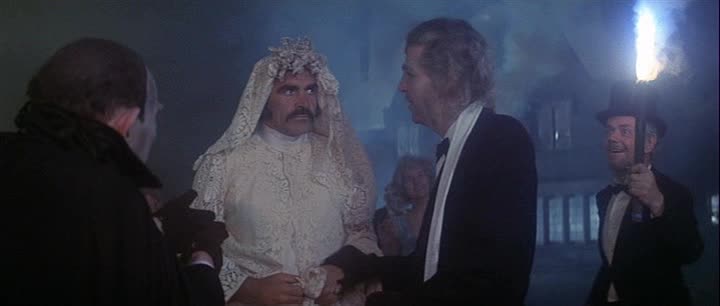 |
| Everyone knows that Sean Connery donned a red speedo in Zardoz, but few people remember that he also wore a wedding dress. (Image via Alternateending.com) |
It’s filled with big ideas and occasionally silly execution, though the gauzy pretentiousness ensures that everything has deep meaning. The sheer strangeness and cool imagery make up for the occasionally pompous nature of the material. For at least three people in our viewing group, this would have been at the top of their ballot.
Bombastic, audacious, and over-the-top, Brian de Palma’s Phantom of the Paradise has aged better than many movies from the Hugo shortlist. A mash-up of Faust and Phantom of the Opera, this musical satirizes the excesses of the prog rock era through the story of a composer named Winslow Leach (William Finney) whose work is stolen by record producer Swan (Paul Williams).
There’s still some of the pervasive sexism of the 1970s, but in Phantom of the Paradise, it seems a bit more muted as the record industry’s exploitation of women is clearly depicted as villainous. One also has to wonder how much Swan is based on then-iconic record producer Phil Spector, whose eccentricity, violent mood swings, and pathological need to control were then becoming known to Hollywood insiders. It’s a flawed movie, but one with enough going for it that it would have been a worthy winner.
Though there are flaws with each of these, they are still far better than the last two works on the ballot. Unequivocally, these should not have been nominated.
Gene Rodenberry returned to the Hugo ballot for another unsuccessful pilot episode of a TV show that never went to full series with The Questor Tapes. The premise is that a scientist named Emil Vaslovik has created an android, and then disappeared mysteriously, leaving nobody who understands his research. That android — Questor — then has to flee from government researchers, accompanied by Vaslovik’s research assistant.
There’s some good ideas here; and you can see Roddenberry recycle those ideas later and more successfully with the character of Data in Star Trek: The Next Generation. The tension between logic and emotion, the questions about what it means to be human, are all ones that Roddenberry would return to time and again. But slotting these ideas into the standard protagonist-on-the-run model of television (emulating The Fugitive, Kung Fu, The Immortal, The Incredible Hulk, etc.) doesn’t quite work. The result is stilted, formulaic, and boring. It’s a bit of a grind to watch it.
And unfortunately, one of the movies that had the most potential to be progressively transgressive, did not fulfill that promise. Flesh Gordon is a mostly-unfunny porn spoof of classic 1930s science fiction movies. It’s clearly made with a lot of attention to detail; there’s effective split-diopter shots, and rear projection, and superb miniatures work. Though the special effects are actually quite well-done, and the science fictional elements tell a mostly-coherent story, the acting is dreadful and the dialogue is leaden.
Most upsetting, the combination of racism and sexism would place this movie firmly below “no award” on our ballots. Given the fact that they were already working with a motion picture rating that would have given them leeway to tackle LGBTQ issues, and given that they were telling a science fictional story about a society with different social mores, it’s particularly galling that the filmmakers were still in thrall to 1970s homophobia and gender essentialism.
 |
| For Sun Ra, space was a place in which racism had no power. There’s an emancipatory power to this narrative convention, and a philosophical underpinning that helps get past the movie’s hokier moments. (image via Filmfestival.gr) |
Flesh Gordon seems to be an attempt to make outsider art, but instead reinforces pre-existing biases.
If we’d had our druthers, we probably would have included both Sun Ra’s afrofuturist jazz musical Space Is The Place and graphic designer Saul Bass’ visually compelling ant-pocalyptic disaster movie Phase IV.
Overall, 1975 was a more promising year for the Best Dramatic Presentation Hugo, with several credible choices on the ballot, and a winner that continues to find fans almost 50 years later. Although we’d argue Zardoz is a more meaningful work of art that probably deserved the award, this is more a quibble about populism versus high culture.


