Over the past few years, several Hugo Award categories have come perilously close to falling off the edge of the ballot.
 |
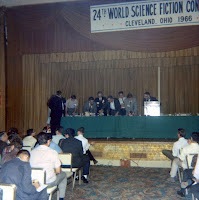
Worldcon has changed since
the 1960s and 1970s.
(Image via Fanac.org) |
What’s striking is that these categories aren’t significantly declining in popularity, but rather, they’re just failing to keep pace with the growth of interest in categories with greater mass appeal. This makes them dangerously close to being punished for the popularity of the big-ticket Hugos such as Best Novel and Best Dramatic Presentation.
Section 3.12.2 of the WSFS Constitution – the document that governs Hugo Awards administration – described one of the circumstances under which an awards category should fail to be presented.
3.12.2: “No Award” shall be given whenever the total number of valid ballots cast for a specific category (excluding those cast for “No Award” in first place) is less than twenty-five per cent (25%) of the total number of final Award ballots received.
Since 2,362 final Award ballots were cast in 2021, if any category received fewer than 591 votes in the
 |
Diana M. Pho was nearly denied her
well-deserved first Hugo for Best
Editor Long Form due to Section 3.12.2.
We are glad that she got it.
(Photo by Rokne & Wakaruk) |
final count, then a result of “No Award” would have been declared. Fancast received 632 votes, barely scraping past that 25 per cent threshold. Fanzine (643 votes), Editor – Long Form (667 votes), and Fan Writer (680 votes) were all poised near the abyss. For context, consider that 591 is more votes than any category received in 1963 when this rule was first proposed. Worldcon is growing and needs a way to address category relevance that makes sense for a larger membership.
It’s interesting to note that if just 159 more people had cast ballots for Best Novel without voting for Best Fanzine, then
Nerds of a Feather would not have taken home the Hugo Award they so richly deserve. This points out a flaw in the current rules: the slightly more niche categories might end up being punished for the success of the higher-profile award categories.
From a read of fanzines contemporaneous to the creation of this rule, it doesn’t appear that this was what was intended by the rule. At the time, people kvetched about the possibility of categories in which the Hugo winner received 10 or fewer votes. It does not appear that they were worried about categories in which more than 500 people were voting.
Section 3.12.2 has a long and interesting history, with the original version of the rule appearing in the 1964 Constitution, having been added in the wake of concerns over the remarkably small number of voters participating in the 1963 Hugo Awards process. At this time, there was no specific threshold, but rather the rules provided Hugo Administrators the ability to nix a category based on “a marked lack of interest in the category on the part of voters.”
It should be noted that this was added at a time when
fewer than 200 people participated in the nominating process, and
fewer than 300 people voted on the final ballot. Rules crafted for the circumstances of the 1960s and 1970s do not necessarily work in the context of the 2020s.
Because of missing documents, we cannot pin down exactly when the rule in its current form was codified, but it was either in 1978 or 1979. As far as we can tell, this clarification was based on the work of Ben Yalow. By adding a specific threshold of 25 per cent to the rule, his proposal helped bring clarity to the process, and ensured that categories weren’t dismissed on the whim of any given committee.
“Hugo Administrators have a lot of discretion, but really hate to use it since all it does is get the convention criticized,” Yalow explains. “So giving specific rules, rather than broad general guidelines, keeps administrators out of the line of fire.”
 |
The legendary Ben Yalow, whose
contributions to the WSFS constitution
are innumerable, helped craft
Section 3.12.2 in its current form.
(Photo by Rokne & Wakaruk) |
In the late 1970s, this was an important and positive change; and the 25 per cent threshold made sense at that time, but things have changed in 40 years, and this threshold needs to be revised.
Over the course of the 1970s, the Hugos had an average of 800 people voting on the final Hugo ballot; at the time the “no Award presentation” threshold could be assumed to be 200 votes or so. And if a category were to only garner 200 votes, one could understand that this might be a sign that there was a lack of interest.
This rule also comes from a time in which there was far more parity between the number of votes in various categories. In 1980 (the first year that we have full voting statistics on the Hugos for), the category which received the fewest votes was Best Fan Writer. In that year,
884 out of 1,788 Hugo voters voted for Fan Writer, giving that category a participation rate of 49 per cent.
Four decades later, the number of people voting in the Fan Writer category has not substantially changed, but the numbers voting in the prose fiction categories has drastically increased. Thus, the percentage of voters engaged with this category has decreased. This means that these Hugo Award categories are being endangered not due to declining interest in those categories when counted by number of voters, but rather by the enthusiasm and growth of other categories.
Fundamentally, the decision about whether or not the Best Editor - Long Form award is worth running should not be contingent on how many people voted in the Best Dramatic Presentation category.
We would suggest that instead of a percentage threshold to indicate a lack of interest in a category, the WSFS should consider a fixed numerical threshold. Of course, just like the 25 per cent threshold, this would be an arbitrary number, but we feel that it should be set at a level that reflects a continued interest by a significant number of fans; clearly that threshold is higher than 10 people, but we’d argue that it’s also fewer than the 750 people that it might take to pass 25 per cent of a 3,000-voter Hugos that is not inconceivable in the near future. This number should be reviewed, likely every five years or so.
An alternate approach would be to change the result of a sub-25-per-cent participation in a category to a mandatory review of the category by the Hugo Awards Committee of the WSFS, rather than invalidating the work of those who did nominate and participate in the process.
Some Hugo Awards categories have become more well-known in the broader public, which is a fact that should be celebrated. But the Hugo Awards process needs to evolve to adjust to this broader acclaim without penalizing more niche award categories.
While these suggestions create more work for the WSFS Hugo Awards Study Committee, it would be an effort spent serving the mission of Worldcon and help ensure a representative, democratic process based on participation.
To repeat: The fan categories should not be doomed by the success of the prose categories.